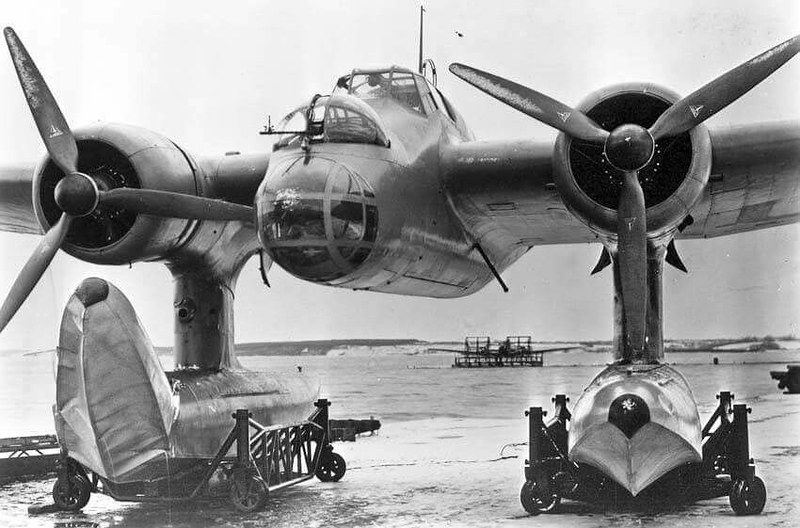
Blohm and Voss Ha 139 – The Largest Float Plane of its Time
The Blohm & Voss Ha 139 was built at a time when German aerospace engineering was entering a stage of revival under the Nazi regime. This revival allowed German engineers to experiment with new designs and research different ideas for commercial and military aircraft. Blohm & Voss used this new period of engineering design to create the largest float plane designed at the time and one with capabilities to transport people and goods around the world.
However, the start of the Second World War cut the Ha 139’s commercial life short and it was transferred to Luftwaffe use.
It was extensively modified but ultimately deemed unsuitable as a combat aircraft and disappeared from service.
Origins
In the aftermath of the First World War, the Treaty of Versailles placed limits on the number of aircraft Germany could produce and strictly mandated that the speed, range and power of any new plane designs built in Germany could not exceed that of older designs that had been built during the war. This particularly effected both civilian and military aircraft production as Germany had once been considered at the forefront of aircraft design and technology during the First World War.
Following the rise of Hitler and the Nazi Party to power, the new regime began to reverse the Treaty’s mandates and reinvested heavily in military and commercial production of aircraft.

Blohm & Voss ship-building facilities in 1877.
The shipbuilding company Blohm & Voss had wanted to branch into aircraft manufacturing and experiment with metal-skinned type planes which they believed represented the future of aircraft design. However, they also faced the same problem limiting other German industrial manufacturers of the Treaty stymying any significant research and development into new projects.
The coincidental timing of Nazi government effectively tearing up the Treaty helped Blohm & Voss from a business standpoint by allowing for development freedom and the opportunity to take design specifications from elsewhere.
Drawing from their shipbuilding background, the company began exploring float plane and seaplane designs in 1933, believing them to be a viable and efficient method of transporting goods and people by combining air and sea.

Blohm & Voss are known for their rather odd aircraft designs, such as this, the BV 141.
In 1935, the German national airline Deutsch Lufthansa put out a specification for a new four engine seaplane that could be used on long distance transatlantic mail routes to the United States.
The proposed aircraft design would need a cruising speed of around 155 miles per hour and be able to carry cargo over long distances. To maximize efficiency and versatility, Lufthansa also asked that the new plane be capable of performing both water and catapult launch takeoffs.
Development
Blohm & Voss took the contract to build the new plane and began working on potential prototype designs at their Hamburg plant which they initially codenamed “Project 15.”
The company proposed a “floatplane,” different to a flying boat which uses its hull for buoyancy and landing, but instead uses separate floats mounted under the fuselage. The new plane also featured an inverted gull wing design with the floats attached to a V shape strut under the fuselage. The fuel tank would be stored in a reinforced metal cylinder which also function as the main wing spar. The end result of the Project 15 process was a distinct and unique looking design that stood out from other seaplanes and flying boats.
The intended crew number was between four and five: with a pilot and co-pilot, and other crew members performing radio operation and navigational duties.

Note the floats on the Ha 139. It did not use its fuselage for bouyancy.
Blohm & Voss decided that the engines would be four piston powered diesel units powering four-bladed propellers that could produce an average cruising speed of 148 miles per hour.
The wingspan totalled out at 29 meters, the overall length of the aircraft was 20 meters and the height just over four meters.
The first working prototype named the Ha 139 V1 “Nordwind” completed its maiden flight in 1936 and was followed by the V2 “Nordmeer” variant which also took to the skies in the same year. Both the V1 and V2 began their trial flights on the Atlantic with Lufthansa in 1937, operating a service between New York City and the Azores islands.
The initial trials lasted until November 1937. Test pilots and crews concluded in their reports that the aircraft was a durable and innovative design, but after takeoff problems were found with stability in the air and the engine cooling system. Blohm & Voss responded to the feedback by updating and enlarging the flaps and rudder from the first design with improved versions.
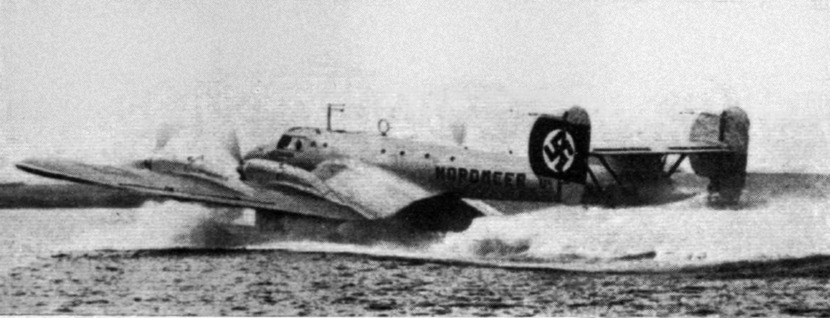
Ha 139 landing.
Using research information gleaned from the first two prototypes, Blohm & Voss manufactured a third prototype in 1938 which they named the V3 “Nordstern.” This version was larger and heavier than the V1 and V2 but featured updated, more powerful engines mounted lower on the wings.
Test flights resumed from July to November 1938 until commercial production of all Ha 139 variants were given the green light, although only three models (one of each prototype) had rolled off the production line by the outbreak of World War Two.
Commercial service
Lufthansa agreed to order all three versions of the Ha 139 from Blohm and Voss. Commercial passenger, cargo and mail ferrying services began in 1937.
The Ha 139 was used on transatlantic routes from German coastal ports to Natal, Brazil and as far afield to locations in Africa such as Bathurst in the Gambia. As Blohm & Voss intended, the Ha 139 could be launched by a conventional water takeoff or from a catapult.
The Ha 139 was also one of the largest active seaplanes in commercial service during the late 1930s, and was recorded as being the largest ever float plane constructed. During its commercial life, it was able to transport up to 500kg of mail at a distance of 5,000km.
Military service
The outbreak of the Second World War in 1939 interrupted the Ha 139’s Lufthansa service when passenger and cargo flights between Germany and Allied nations were halted.
Like many other aircraft intended for civilian use, the Ha 139 was withdrawn from the Lufthansa fleet and taken over by the Luftwaffe for military purposes. However, the Ha 139 had not been developed by its designers for potential military service, unlike other commercial planes which had the ability to perform both roles.
Nonetheless, Luftwaffe and Blohm & Voss engineers in Hamburg set to work converting the Ha 139 for war use with the Luftwaffe deciding that the Ha 139 could be used for aerial reconnaissance, military transport and mine sweeping roles over the Baltic Sea.

The Ha 139, in its intended role with Lufthansa.
The conversion process produced the Ha 139 Umbau variant which featured a modified, all glass nose to allow the flight crew better visibility. Defense was provided by 7.9 mm machine gun installations along the fuselage, with one gun placed in the dorsal fuselage line and two guns placed at either side in the mid-section.
The mine sweeping variant had the machine guns removed and a magnetic ring placed around the fuselage. The ring was designed to detonate naval mines from the air using the degaussing technique of disrupting and triggering the mine’s magnetic sensor.
The re-worked Ha 139 Umbau’s engines were switched from the older model diesel units to the more robust military standard Junckers Jumo 205C six cylinder engines that were able to produce a top speed of 180 miles per hour, hold a range of 2,860 miles and have a climb speed of 560 feet per minute.
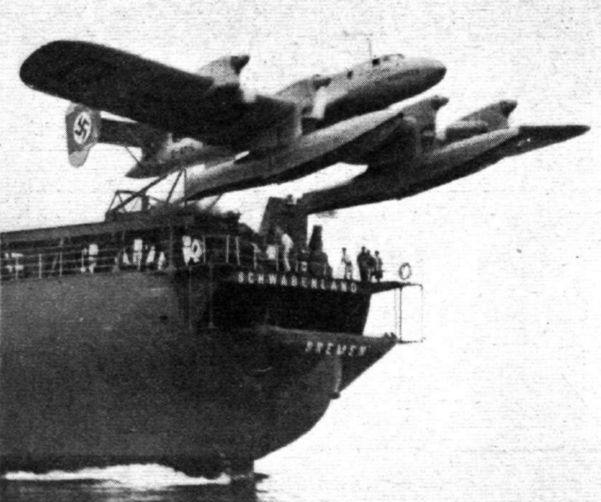
Ha 139 launched from a ship.
Despite the extensive modifications, the Umbau variant was never deemed suitable for military operations, perhaps in part due to the fact it was never designed for Luftwaffe use in mind, and as a result it was not extensively used in any of the roles the Luftwaffe demanded of it.
Lack of spare parts for the aircraft soon became a problem and resulted in the Ha 139 being grounded and then retired from frontline use in the early stages of the war and other, more specifically designed aircraft taking over its military roles.
Modified variants
Although the Ha 139’s military use was short lived, there was discussion within the Luftwaffe of taking its existing airframe and creating a land based and bomber variant.
Design ideas were considered and brainstormed but the project ultimately came to nothing.
Although the Ha 139 did not fly again, its body and fuselage did go on to form the basis for the proposed Blohm & Voss Ha 142 bomber. Like the Ha 139, the 142 had also begun life as a prototype aircraft intended for a Lufthansa specification to transport mail and airfreight.

Ha 142, which was based on the Ha 139 but equipped with landing gear.
The Ha 142 took much of the Ha 139’s design with four low mounted engines on the gull wing and a double vertical tail. The one major difference was replacing the floats with undercarriage.
The Ha 142 did see some operational service as a maritime observational plane in 1940 and later as a transport aircraft in occupied Denmark and Norway. There was also talk of fitting the aircraft to carry a guided torpedo for naval warfare. However, like its predecessor, the Ha 142 was also not deemed suitable as a tactical bomber. Only four prototypes were produced in total and they were withdrawn from all forms of Luftwaffe service in 1942.
Legacy
The Ha 139 had a checkered and short operational history with its commercial and military variants never being put into mass production beyond a handful of prototypes. Although it benefitted from the abandonment of the terms set by the Treaty of Versailles, it also found its career ended by the subsequent outbreak of the war.