The wait is finally over. After a series of digital renderings and speculative whispers, the Williams FW48 has officially hit the asphalt. In a shakedown that has the entire Formula 1 paddock buzzing, the Grove-based team gave us our first real-world look at their 2026 challenger. And let me tell you, while it retains the soul of the renderings we analyzed just yesterday, seeing the car in motion has revealed a treasure trove of technical secrets that paint a fascinating picture of the team’s philosophy for the new regulation era.
From a nose design that hints at behind-the-scenes struggles to a suspension setup that is nothing short of extreme, the FW48 is a machine of contradictions. It is part “old school” pragmatism and part radical aerodynamic gambling. Let’s dive deep into the details of the car that Williams hopes will propel them back up the grid.

The “Boxy” Nose: Function Over Form?
The first thing that grabs your attention—and perhaps not for the best reasons—is the nose. It is undeniably wide and boxy. In an era where teams often strive for slender, elegant aerodynamic penetrators, Williams has presented a blunt instrument.
But there is a very specific, and somewhat dramatic, reason for this. The nose sits noticeably further forward relative to the front wing elements than what we typically see. This strongly suggests that the rumors were true: Williams likely faced significant hurdles passing the FIA crash tests. When a team struggles with the frontal impact structure, the safest and quickest fix is often to bulk it up and extend it, ensuring it absorbs the necessary energy. It’s a pragmatic solution, but one that inevitably compromises the aesthetic and, potentially, the aerodynamic efficiency at the very front of the car.
Interestingly, the mechanism for adjusting the front wing flaps reveals another layer of this pragmatic approach. We can clearly see the actuator located underneath the nose rather than buried inside it. This is a simpler mechanical solution, prioritizing reliability and ease of access over the ultra-tight packaging other teams might pursue.
However, this leads to a fascinating “old school” quirk. On many modern F1 cars, we’ve seen teams utilize a single adjustment point—often a hole right in the center of the nose—that alters the flap angle for both sides simultaneously. It’s a brilliant system for pit stops, allowing one mechanic to make a quick twist that adjusts the entire front downforce balance. Williams, however, has opted for individual adjusters on the left and right sides.
This means if they need to add front wing angle during a frantic pit stop, a mechanic (or two) will have to adjust each side separately. It’s a split-second difference, but in a sport measured in milliseconds, these “old school” choices stand out. It raises the question: is this a deliberate choice for granular control, or a compromise forced by the crash-structure issues?
Suspension Secrets: The Pull-Rod Gamble
Moving past the nose, we arrive at the most technically intriguing part of the FW48: the front suspension. We finally have a clear view, and it confirms that Williams has committed to a pull-rod front suspension layout. But it’s not just that they chose pull-rod; it’s how they’ve executed it.
The geometry is extreme. The team has implemented a severe “anti-dive” setup. For the uninitiated, anti-dive geometry is designed to stop the front of the car from dipping down under heavy braking, which helps maintain a stable aerodynamic platform. On the FW48, this is achieved by mounting the forward leg of the upper wishbone as high as possible, while the rearward leg is mounted astonishingly low—almost in line with the lower wishbone.
This creates a massive separation between the suspension arms, but the real genius lies in the aerodynamic alignment. When viewed from the front, the rearward leg of the upper wishbone and the pull rod itself seem to occupy the same space.
Why does this matter? Aerodynamics. In Formula 1, every cylindrical suspension arm is an obstacle to the air. By aligning these two elements so that one “hides” behind the other relative to the airflow, Williams essentially reduces the aerodynamic blockage. They are effectively getting two structural elements for the aerodynamic price of one. It’s a clever trick to clean up the airflow heading toward the sidepods and floor.
The Great Debate: Pull-Rod vs. Push-Rod
The video analysis provides a fantastic primer on why a team like Williams would choose a pull-rod system over the more conventional push-rod, especially given the trade-offs.
Mechanically, suspension engineers almost always prefer a push-rod. The kinematics are generally better, the diagonal push-rod sits at a nicer angle for transferring forces, and the suspension components (dampers, springs) end up on top of the chassis, making them easy to work on.
A pull-rod system, by contrast, is a headache. The rod pulls up from the wheel to the chassis, meaning the internal components have to be mounted low down, often underneath the driver’s legs or the nose structure. It’s harder to access and mechanically less efficient.
So why do it? The answer, as always in modern F1, is aero.
With a pull-rod, the bulky internal components (“pedal box” area) are moved lower. This physically raises the chassis volume in that area, creating more open space underneath the nose. This higher “pedal box” allows for a cleaner, higher volume of airflow to rush underneath the car and feed the all-important floor. Williams has clearly decided that the aerodynamic gain of feeding the floor is worth the mechanical headache of a pull-rod setup. It is a philosophy that prioritizes peak downforce over ease of setup.
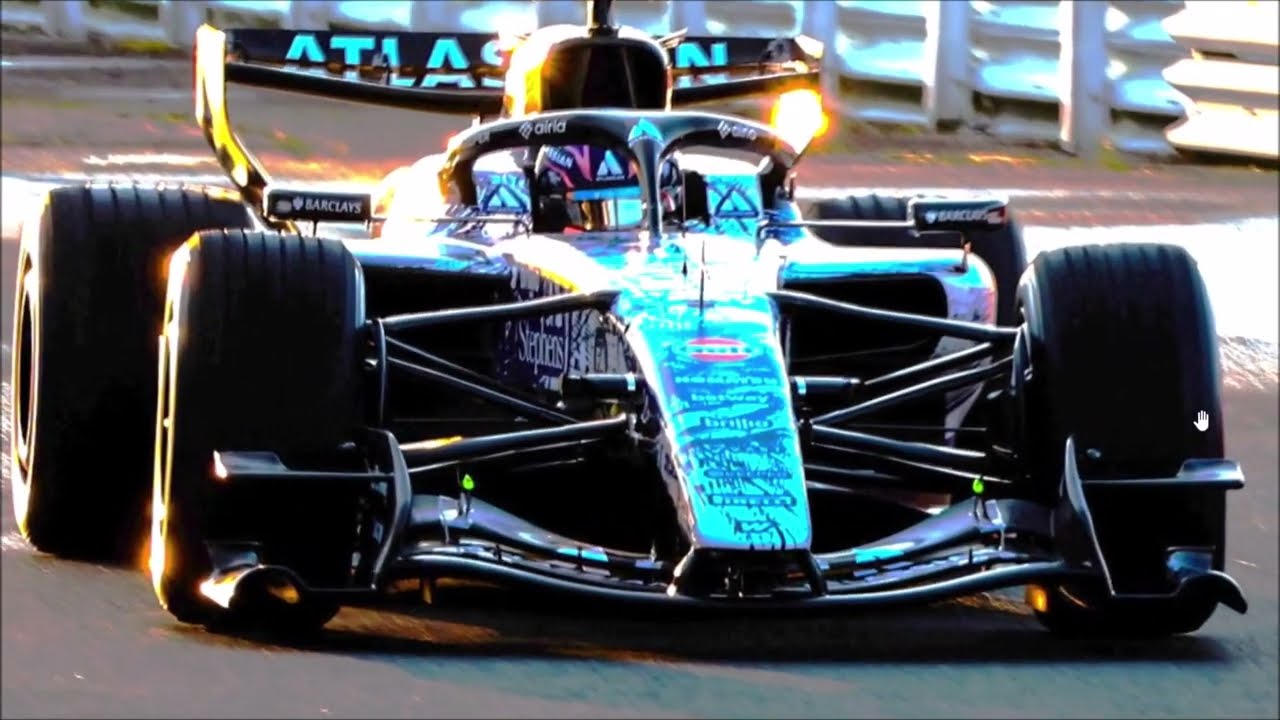
Cooling Wars: Williams vs. Mercedes
One of the most telling details on the FW48 is the size of the air inlets on the sidepods. They are notably larger than what we expect to see on the factory Mercedes car, despite both teams likely sharing the same power unit architecture.
This points to a divergence in cooling philosophy. The speculation—backed by spec sheets—is that Williams is utilizing air-to-air intercoolers. This technology is generally simpler but requires more volume and airflow to work efficiently, hence the larger, gaping intakes.
Mercedes, the works team, is expected to utilize water-to-air intercoolers. This system is more complex and heavier but is incredibly efficient at heat transfer, allowing for much smaller radiators and, consequently, tinier air inlets. This “cooling war” between a customer team and their supplier highlights how different design priorities can lead to visibly different cars, even with the same engine. Williams is accepting the drag penalty of larger inlets, perhaps to save weight or complexity elsewhere.
Aero details: Controlling the Wake
Finally, looking at the rear and flanks of the car, we see Williams engaging in the dark art of vortex management. The car features a large shark fin, a staple of modern F1 cars, but it’s the details that matter.
Perched atop the airbox are small winglets designed specifically to interact with the shark fin. Their job is to push the turbulent “tip vortex”—the spiraling air that comes off the top of the fin—downwards. Why? To ensure it doesn’t smash into the rear wing and disrupt its efficiency.
Similarly, there is a small vein on the side of the cockpit. This isn’t just decoration; it’s a barrier. It prevents “cockpit losses”—the messy, turbulent air caused by the driver’s helmet and the cockpit opening—from spilling down into the smooth airflow along the sidepods. It guides that dirty air up and over, aiming to deposit it harmlessly under the rear wing so it can exit the car without killing downforce.
The sidepods themselves remain conservative. There is an undercut, but it disappears quickly as the sidepod widens. Unlike the radical “zero-pod” or extreme excavation concepts we might see from top teams, Williams is playing a safer game. They are trying to keep the turbulent wake from the front tires “outboard” (pushed away from the car) rather than trying to manipulate it through complex channels along the car’s body.
Conclusion: A Season of Discovery
The Williams FW48 is a fascinating mix of forced compromises and aggressive engineering. The nose tells a story of safety hurdles overcome, while the suspension screams of a desire to maximize aerodynamic potential at all costs. It is a conservative body shape hiding a radical front-end mechanical concept.
Will this “anti-dive,” pull-rod gamble pay off? Can the simpler cooling and “old school” wing adjustments hold up against the multi-million dollar complexities of the front runners? We won’t know for sure until the lights go out, but one thing is certain: Williams isn’t just making up the numbers. They are trying to engineer their way out of the midfield, one strange suspension angle at a time.
News

Inside Shane Richie’s love life: Drug – fuelled orgy with six blondes; real reason he split from Coleen Nolan; six-year ‘affair with fan’
Inside Shane Richie’s love life: Orgy with six blondes; real reason he split from Coleen Nolan; six-year ‘affair with fan’ He’s popular with the ladies… Shane Richie…

SH0CKING REVELATI0N:A sh0cking behind-the-scenes secret revealed about Lizzie Rizzini, the woman replacing Carol Kirkwood on the 6pm weather bulletin
BBC viewers still reeling from the departure of Carol Kirkwood got another surprise last night when presenter Lizzie Rizzini appeared to flash her black lace stockings on…

HEARTBREAKING: Peter Andre’s Tearful Message to Son Junior After SHOCKING Revelation About How He Truly Feels Toward Mum Katie Price — Katie Price’s reaction scares fans.
Peter Andre’s emotional message to son Junior after it’s revealed how he really feels about mum Katie Pri… PETER Andre has shared an emotional message to his…

Ben Shephard opens up about the devastating health battle his wife is facing: “She wakes up crying every single morning…”
Inside This Morning Ben Shephard’s Life Including Rarely Seen Wife and Health Battle Ben Shephard is a name synonymous with British television, renowned for his engaging presentation…

🚨 LIVE TV HEARTBREAK: Good Morning Britain Host Announces ‘Devastating’ Dɘath of Guest Minutes Into Show
Viewers of Good Morning Britain were met with heartbreaking news just minutes into Friday’s (January 30) episode, as co-hosts Kate Garraway and Ranvir Singh reported the tragic…

Emmerdale legend Cain Dingle will never be the same again after a shock cancer diagnosis turns his world upside down
FROure Desk. Full Terms and conditions are available on the website http://www.itv.com/presscentre/itvpictures/terms Emmerdale wouldn’t be Emmerdale without the glowering, grunting embodiment of manliness that is Cain Dingle (Jeff Hordley) But…
End of content
No more pages to load






