The Sleeping Giant Awakes
As the dust settles on the 2025 Formula 1 season, a strange and electric energy pulses through the paddock. It is not coming from the usual suspects at the front of the grid—the Red Bulls, Ferraris, or McLarens—but from a garage that, for nearly a decade, was synonymous with struggle, heartache, and the back of the pack. Williams Racing, the once-mighty titan of the sport, has finished the year in a stunning fifth place in the Constructors’ Championship. It is a result that defies the grim expectations of just a few years ago and signals a seismic shift in the sport’s competitive landscape. But as impressive as this resurgence has been, the whispers in the pit lane suggest that 2025 was merely the prologue. The real story, the one that has rival team principals looking nervously over their shoulders, begins now, with the dawn of the 2026 regulations.
To understand the magnitude of this moment, one must appreciate the depth of the abyss from which Williams has crawled. For newer fans of the sport, the Williams name might evoke sympathy rather than fear. The dominance of the 1990s, where the team collected championships with the regularity of a ticking clock, feels like ancient history. By the late 2010s, the team had not just fallen from grace; it had crashed into the bedrock of financial ruin. The nadir came in 2020, a year where the very existence of this historic marque hung by a thread. The choice was stark: sell the team or close the doors forever. The sale to Dorlton Capital was not just a business transaction; it was a lifeline, a final gasp of air for a drowning entity.

The Dorlton Difference: Patience Over Panic
The acquisition by Dorlton Capital marked the turning point, though it wasn’t immediately obvious to the outside world. In a sport addicted to quick fixes and instant gratification, Dorlton did something radical: they waited. They understood that the rot within the infrastructure of Grove went deep—years of underinvestment had left the team fighting with one hand tied behind its back. They didn’t just throw money at the problem in a chaotic spray; they provided long-term security. They allowed the team to rebuild its foundations, brick by brick, without the terrifying specter of bankruptcy looming over every decision.
This patience is now bearing fruit. Today, Williams is no longer the “plucky underdog” surviving on scraps. They are a fully funded racing operation, hitting the cost cap limit just like their rivals at Mercedes and Ferrari. They have poured millions into new facilities, commissioning a state-of-the-art wind tunnel, upgrading simulators, and modernizing infrastructure that had been collecting dust since the glory days. The transformation is physical, visible, and palpable within the factory walls. The team that entered 2026 is unrecognizable from the skeleton crew of 2020.
The Vowles Effect: Leadership with a Vision
Central to this renaissance is James Vowles. When he arrived from Mercedes in 2023, he brought more than just technical know-how; he brought the blueprint of a dynasty. having spent years at the right hand of Toto Wolff, helping to orchestrate one of the most dominant runs in sporting history, Vowles knows exactly what winning looks like. He knows the smell of it, the texture of it, and, most importantly, the culture required to sustain it.
Vowles did not come to Williams to manage a decline; he came to engineer an ascent. His leadership style—candid, analytical, and ruthlessly ambitious—has injected a new belief into the workforce. He has been unafraid to expose the team’s weaknesses, speaking openly about the outdated systems he inherited, not to shame the past, but to galvanize the future. Under his stewardship, Williams has shifted from a survival mindset to a competitive one. The comfortable P5 finish in 2025 is a testament to this operational overhaul. It is a result that was achieved not by luck, but by design—and frighteningly for their rivals, it was achieved while the team was supposedly focusing all its real energy on the 2026 car.
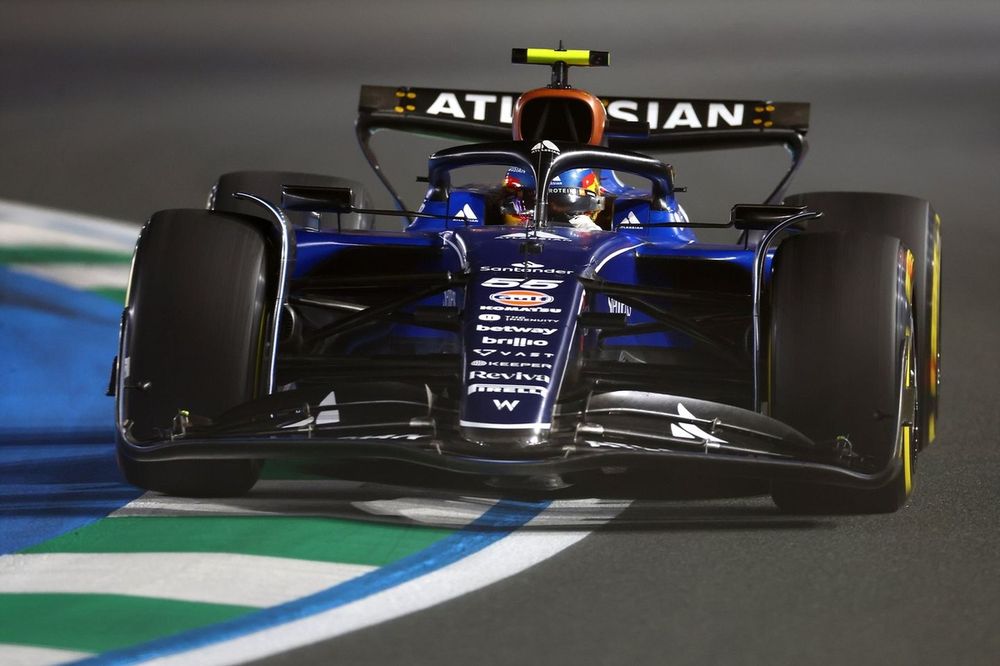
A Driver Lineup Envy of the Grid
Perhaps the boldest declaration of Williams’ intent is its driver lineup. In Alex Albon, they found a leader who was willing to bet his career on the project. Albon’s rehabilitation from a shaken Red Bull junior to one of the most consistent and highly-rated drivers on the grid is a story in itself. He has been the rock upon which this new church was built, extracting performance from cars that had no business being in the points.
But the arrival of Carlos Sainz in 2025 was the thunderclap that truly announced Williams’ return. Sainz is not a midfield driver. He is a race winner, a tactician, and a talent capable of fighting for world championships. That a driver of his caliber—who had options at Audi and Alpine—chose to commit his prime years to Williams speaks volumes. It validates everything Vowles has been preaching. Sainz didn’t sign up for nostalgia; he signed up because he saw the data. He saw the trajectory. The combination of Albon and Sainz gives Williams one of the strongest pairings on the grid, a duo capable of extracting the maximum from any machinery given to them. In 2026, having two elite drivers will be a critical weapon in the development war.
The 2026 Opportunity: The Great Equalizer
Now, the eyes of the sporting world turn to 2026. The new regulation cycle represents the single greatest opportunity for a team to leapfrog the competition. History has shown that regulation changes are where dynasties are born and destroyed. For Williams, the timing could not be more perfect.
The team will be running the Mercedes power unit in 2026. If the rumors and historical precedence hold true, Mercedes often nails the engine side of new regulations. Having the best engine in the back of the car instantly solves a massive part of the performance equation. But it’s not just the engine. Williams has spent the better part of two years preparing specifically for this moment. While others were squabbling over 2024 and 2025 points, Vowles and his technical team were quietly prioritizing the 2026 concept.
The fact that they managed to secure fifth in the championship in 2025 while “distracted” by 2026 is an ominous sign for the midfield. It suggests that the team’s baseline performance has improved so drastically that they can now compete comfortably even when their primary focus is elsewhere.
Realistic Expectations: The Climb Continues
However, in the midst of this euphoria, a note of caution is necessary. James Vowles has been careful to manage expectations, and rightly so. “Title contender” is a label that carries a heavy burden, and realistically, Williams is not there yet. The gap to the “Big Four” is not just about money; it is about time and efficiency.
Despite the influx of cash, Williams is still playing catch-up in terms of institutional knowledge and facility optimization. The cost cap, while designed to level the playing field, actually acts as a brake on rapid expansion. A team like Mercedes or Red Bull spent hundreds of millions on infrastructure before the cap existed; Williams has to update their facilities within the constraints of the CapEx allowance. They are running a race where they started a lap down. Catching up to the pack is one thing; overtaking the leaders is another entirely.
Therefore, the realistic target for 2026 is not to win the World Championship, but to become a consistent nuisance to those who think they will. We should expect Williams to fight for podiums on merit, not just luck. We should expect them to be the team that capitalizes when a Red Bull or McLaren falters. The “odd win” is no longer a fantasy; it is a tangible possibility if the stars align.
A New Era
The Williams of 2026 is a team transformed. It has the money, the leadership, the drivers, and the engine. The 2025 season proved that the path they are on is the right one. They have successfully navigated the treacherous waters of rebuilding and have emerged as a solid, upper-midfield contender.
For the first time in over a decade, fans of the British marque can look at a new season not with dread, but with genuine, heart-pounding excitement. They are not yet the kings of the sport, but the crown is no longer invisible to them. The road to 2030—the timeline Vowles has hinted at for a true title challenge—is long, but the vehicle they are driving is finally up to speed. Williams is back, and Formula 1 is all the better for it.
News

Inside Shane Richie’s love life: Drug – fuelled orgy with six blondes; real reason he split from Coleen Nolan; six-year ‘affair with fan’
Inside Shane Richie’s love life: Orgy with six blondes; real reason he split from Coleen Nolan; six-year ‘affair with fan’ He’s popular with the ladies… Shane Richie…

SH0CKING REVELATI0N:A sh0cking behind-the-scenes secret revealed about Lizzie Rizzini, the woman replacing Carol Kirkwood on the 6pm weather bulletin
BBC viewers still reeling from the departure of Carol Kirkwood got another surprise last night when presenter Lizzie Rizzini appeared to flash her black lace stockings on…

HEARTBREAKING: Peter Andre’s Tearful Message to Son Junior After SHOCKING Revelation About How He Truly Feels Toward Mum Katie Price — Katie Price’s reaction scares fans.
Peter Andre’s emotional message to son Junior after it’s revealed how he really feels about mum Katie Pri… PETER Andre has shared an emotional message to his…

Ben Shephard opens up about the devastating health battle his wife is facing: “She wakes up crying every single morning…”
Inside This Morning Ben Shephard’s Life Including Rarely Seen Wife and Health Battle Ben Shephard is a name synonymous with British television, renowned for his engaging presentation…
🚨 LIVE TV HEARTBREAK: Good Morning Britain Host Announces ‘Devastating’ Dɘath of Guest Minutes Into Show
Viewers of Good Morning Britain were met with heartbreaking news just minutes into Friday’s (January 30) episode, as co-hosts Kate Garraway and Ranvir Singh reported the tragic…

Emmerdale legend Cain Dingle will never be the same again after a shock cancer diagnosis turns his world upside down
FROure Desk. Full Terms and conditions are available on the website http://www.itv.com/presscentre/itvpictures/terms Emmerdale wouldn’t be Emmerdale without the glowering, grunting embodiment of manliness that is Cain Dingle (Jeff Hordley) But…
End of content
No more pages to load






