The final checkered flag of the 2025 Formula 1 season descended upon a sport reeling from one of its most dramatic and tightly contested championship battles in modern history. Lando Norris, the young British prodigy, stood atop the world, securing the title for McLaren in a high-stakes, season-long duel. Yet, as the champagne dried and the statistics were tallied, a controversial truth emerged from the collective wisdom of the paddock: the World Champion was not, in fact, the best driver of the year.
The 2025 season concluded with a razor-thin two-point margin separating the champion from the runner-up, Max Verstappen—the narrowest gap recorded since the current points system was introduced in 2010. This near-impossible finish line drama was the signature of the year, a reflection of the intense, fluctuating fortunes of three primary contenders. But to accurately assess driver performance, one must look beyond the trophy count and examine the intangible: the relentless consistency, the ability to maximize an underperforming car, and the sheer mental fortitude to wage a war of attrition at the front of the grid.
In an exhaustive ranking of the year’s top performers, the conclusion is stark: Max Verstappen, despite missing the ultimate prize, delivered what has been universally described as his finest-ever season in Formula 1, establishing an “entire tier” of separation between himself and the rest of the elite. This is the story of the 2025 F1 campaign—a narrative of triumph, collapse, and the tragic wasting of generational talent, analyzed through the lens of the top five drivers who shaped the sport.

1. Max Verstappen (Red Bull): The Relentless Ghost in the Machine
Max Verstappen’s status as the undisputed top driver of 2025 is not merely a statement of opinion; it is a testament to the improbable. His championship bid was defined not by a dominant car, but by a miraculous rescue mission. Early in the season, the Red Bull machinery struggled to hit its usual mark, leaving Verstappen facing an abyss: a 104-point deficit to the then-championship leader, Oscar Piastri, following the Zandvoort Grand Prix.
What followed was a masterclass in relentless consistency, the hallmark of true sporting greatness. Verstappen systematically dismantled the lead with a calculated fury that broke the competition. He secured the highest number of wins (eight) and pole positions (eight) on the grid, in addition to leading the most laps—a raw statistical indication of pace and control. His mere presence, his shadow looming large in the rear-view mirrors of the McLaren drivers, was enough to induce costly errors. The championship battle transformed into a psychological pressure cooker, and it was Verstappen’s indomitable will that turned up the heat.
The analysis suggests the championship was ultimately decided by factors outside Verstappen’s control—namely, Red Bull’s delayed delivery of a true title-challenging car—and one single, human error: the moment of “head loss” in Barcelona. This solitary, uncharacteristic mistake stands out precisely because it was so rare in a season of otherwise flawless execution. For a driver to drag a sub-optimal package into a winner-takes-all finale, defying the gravity of early-season deficiencies, confirms his unparalleled position. Even in defeat, Verstappen elevated his game, proving that sometimes, the best performance does not yield the crown. This, he himself acknowledges, was his best-ever F1 season, a season where he was, undeniably, the uncrowned king.
/sportsinfo/media/media_files/2025/04/07/max-verstappen-japan-gp-521654.jpg)
2. Lando Norris (McLaren): The Champion Who Clutched It Up
The 2025 World Champion, Lando Norris, deserves immense credit for accomplishing the ultimate feat. His season was a journey of maturity, culminating in a demonstration of mental toughness required to cross the finish line first. Sharing an almost identical statistical profile with his teammate—seven wins, seven poles, and an impressive 18 podiums—the difference lay in his ability to deliver when it mattered most.
While not a flawless campaign, with acknowledged errors like the costly qualifying crash in Jeddah, Norris found an extra gear under the most intense pressure. His back-to-back victories in Mexico and Brazil late in the season were not just race wins; they were championship-defining moments of clutch performance that wrested control from a faltering rival. He successfully managed the high-stakes title decider, driving a “circumspect” race to finish on the podium, exactly where he needed to be.
Norris’s victory was a massive psychological victory for McLaren, alleviating immense pressure on the team’s management and driver lineup. He managed to secure the title despite his rival—Verstappen—performing at a higher level, which is a testament to consistency and capitalizing on the opportunities presented by a competitive car. He took the title fight, earned the trophy, and proved he has the capability to handle the immense pressure of a championship battle, even if he still has areas to refine, such as stringing together a dominant run of consecutive wins. In the end, he was the winning driver, a formidable performer who mastered the championship’s closing stages.

3. Oscar Piastri (McLaren): The Collapse Under Pressure
Oscar Piastri’s 2025 season is a tragedy of unfulfilled potential, a stark reminder that sheer pace is only one ingredient in a championship recipe. For a significant portion of the year, the young Australian looked unstoppable, leading the championship and holding his more experienced teammate, Lando Norris, at bay. With seven wins, six poles, and 16 podiums, the foundational statistics of a champion were all there.
However, the season analysis pinpoints the moment Piastri’s promising campaign began to unravel: the arrival of relentless pressure, primarily from the invisible force of Max Verstappen’s comeback. The momentum swung dramatically as Piastri started to make “far, far too many mistakes,” ultimately “crumbl[ing] under pressure.” The specific mention of the unacceptable Baku weekend serves as a permanent scar on his title bid, signaling a loss of mental fortitude that allowed a 104-point lead to be completely wiped out.
While an excellent season “in isolation,” the context—leading the championship for so long only to be dramatically overtaken by both his teammate and a driver who started with a huge deficit—relegates him to third place. His decline illustrates a crucial lesson in F1: championships are often won not by the fastest driver, but by the one who can suppress their errors and remain clinical when the stakes are highest. Piastri’s 2025 campaign will forever be viewed as the season where a title was lost due to inexperience and a psychological inability to withstand the heat of the chase.
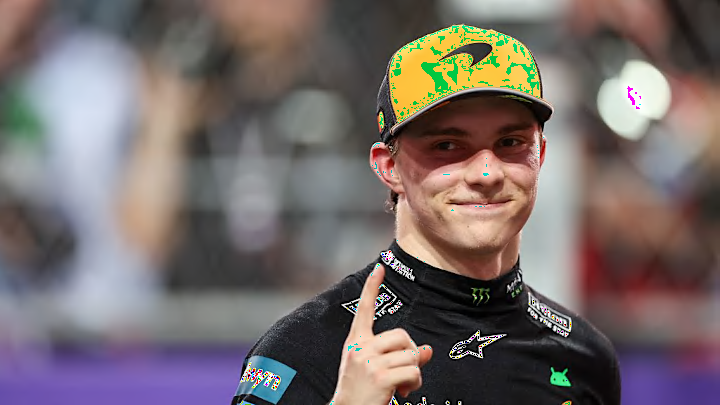
4. George Russell (Mercedes): The Capitalist of Opportunity
George Russell continues to cement his status as one of the elite, consistent performers on the grid, placing him at number four. His season, however, was framed by a bitter disappointment: the Mercedes team failed to supply him with a championship-calibre car, once again delaying his shot at the highest honors.
Despite the team’s relative struggles, Russell exhibited clinical precision whenever a window of opportunity opened. He capitalized on the only two races where the Mercedes W16 was genuinely competitive enough for a victory, qualifying on pole and winning both times. This 100% strike rate on the team’s slim chances, combined with nine total podium finishes, underscores his development into a highly consistent, error-free driver. Gone are the days of small, costly mistakes; Russell is now a mature, reliable force, perpetually fighting just at the heels of the McLarens and Red Bulls in qualifying.
His placement in the ranking reflects a driver who has maximized his machinery and is demonstrably ready for a title fight. The question now looming over Mercedes is not whether Russell can deliver, but whether the team can solve the technical challenges of the new regulations in 2026 to finally give him the chance he has earned.
5. Charles Leclerc (Ferrari): The Wasted Years
Charles Leclerc’s 2025 season at Ferrari is a heartbreaking narrative of unparalleled talent being systematically wasted by a team that cannot meet his standards. Despite the grim statistic of no wins and only seven podiums—a result of Ferrari’s poor performance—Leclerc’s ranking at number five is a tribute to his individual brilliance relative to his own team.
The clearest metric of his performance is the brutal domination of his legendary teammate, Lewis Hamilton, who was struggling in his first season with the Scuderia. Leclerc not only dominated Hamilton in the race head-to-heads but consistently out-qualified the seven-time World Champion by an average of two and a half tenths. To establish such a qualifying deficit over a driver of Hamilton’s pedigree, especially while carrying the weight of the Tifosi on his shoulders, speaks volumes about his raw speed and mental resilience.
The analysis bitterly concludes that Leclerc is not “a driver for the future,” but an “elite driver for right now,” who possesses the quality to challenge Verstappen for a title. The 2025 campaign is simply recorded as “another year of his career” that has been wasted. The controversial pole position in Hungary, achieved under the cloud of a potentially “illegal” car setup, encapsulates the frustration: even when speed was found, it was often marred by technical confusion or misstep. Leclerc’s performance was elite; Ferrari’s was not. The sporting world watches on, increasingly depressed, as the prime of a generational talent continues to bleed out into a succession of red, disappointing seasons.
Looking Ahead to the Great Uncertainty
The 2025 season will be remembered for its champion’s perseverance, the runner-up’s perfection, and the heartbreak of those trapped behind. The dramatic intensity of the Verstappen-Norris fight, culminating in the closest-ever modern title finish, has set an impossibly high bar.
However, the conclusion also casts a long shadow over the future. With new regulations looming in 2026, the power balance is expected to shift. The question of Verstappen’s loyalty to Red Bull now enters the conversation, with the explicit acknowledgement that if Red Bull fails to deliver a winning power unit for the new era, Verstappen will have “his pick of the litter” in 2027 or 2028. This potential future driver market shock, fueled by the disappointing performance of legacy teams like Mercedes and Ferrari, adds a layer of immense uncertainty to the already captivating world of Formula 1. The 2025 rankings prove that while a trophy can be won by a great driver, the title of ‘best’ must be earned through a relentless, faultless demonstration of skill against the backdrop of mechanical destiny.






