In the high-octane world of Formula 1, few figures command as much passionate debate as Charles Leclerc. Since donning the iconic scarlet racing suit of Scuderia Ferrari in 2019, the Monégasque driver has been the protagonist of a story that reads less like a sports biography and more like a Shakespearean tragedy. As we settle into 2026, looking back on eight seasons of promise, heartbreak, and polarizing performances, the question looms larger than ever: Is Charles Leclerc a generational talent cursed by circumstance, or is he simply not as good as the Tifosi want him to be?
The narrative of Leclerc is one of extreme duality. On one side, you have the “Predestined”—a driver of such raw speed and qualifying prowess that he is frequently compared to legends like Ayrton Senna. On the other, you have a resume littered with “what could have been” moments, unforced errors, and a trophy cabinet that feels disproportionately light compared to his talent. To understand the enigma of Charles Leclerc, we must peel back the layers of his tumultuous tenure at Maranello, a journey that has tested the patience of fans and the resolve of the driver himself.

The Honeymoon From Hell: 2019
The stage was set perfectly in 2019. Ferrari, a team historically known for favoring experienced world champions, broke tradition to promote the young gun after just one rookie season. The pressure was immense, but so was the promise. It didn’t take long for the cracks in the fairytale to appear.
In only his second race for the Scuderia in Bahrain, Leclerc stunned the paddock by snatching pole position and dominating the race. He was leading by a comfortable margin, seemingly destined for his maiden victory. Then, disaster struck. On lap 46, his engine began to fail—a cylinder issue that turned his dominant drive into a limping survival mission. He fell to third, a podium finish that felt more like a funeral for a win that was rightfully his. It was the first sign that luck would not be a passenger in Leclerc’s car.
The season continued with a mix of brilliance and bafflement. At his home race in Monaco, a strategic blunder by Ferrari saw him eliminated in Q1, a humiliation that forced him into a desperate, aggressive drive in the race that ended in retirement. In Germany, he crashed out from a winning position in the rain. In Singapore, he was arguably sacrificed on strategy to hand the win to teammate Sebastian Vettel. By the time the season wrapped up, the narrative was already forming: Leclerc was fast, yes, but the synergy between driver and team was fraught with missed opportunities.
The Dark Ages: 2020 and 2021
If 2019 was a tragedy, 2020 was a farce. Driving the SF1000—a car often derisively referred to as a “tractor”—Leclerc was forced to overdrive just to scrape into the points. The lows were comical, such as the spin at the chicane in Spain where his engine simply cut out, followed by his seatbelt unbuckling, forcing him to retire. It was a year where the car’s deficiencies masked the driver’s struggles, yet moments like his crash in Monza reminded everyone that Leclerc was still prone to pushing too hard.
2021 was meant to be a reset, but the bizarre misfortune continued. The Monaco Grand Prix that year stands as a microcosm of his career. He qualified on pole, a heroic feat, only to crash on his final run. The real heartbreak, however, came on Sunday. On the way to the grid, a driveshaft failure—a consequence of the crash that the team failed to diagnose properly—forced him to retire before the lights even went out. To watch a driver secure pole at his home race and not even start is a pain few can imagine. Later that year in Hungary, he was taken out at Turn 1 by Lance Stroll in a chaotic bowling-alley crash that was entirely out of his control. The pattern was undeniable: for every mistake Leclerc made, the universe seemed to invent a new way to punish him.
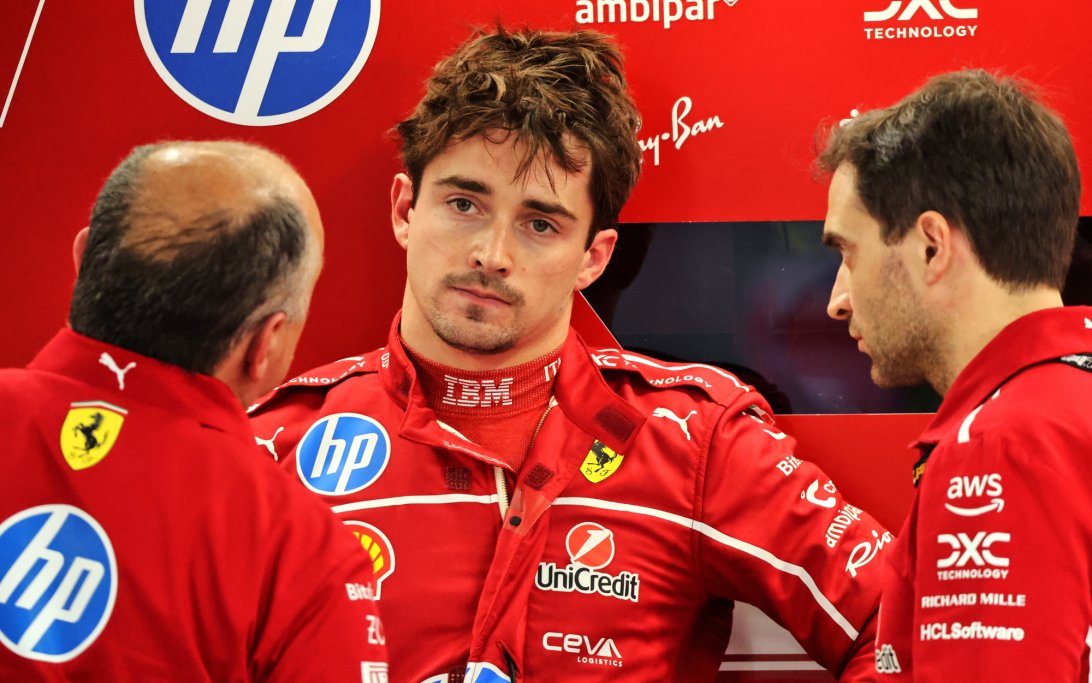
The Year Hope Died: 2022
Then came 2022. New regulations, a competitive car, and a genuine shot at the title. This was supposed to be the year the “Prince” finally became King. Instead, it became the most painful chapter yet.
The season started strong, but the collapse was spectacular. In Spain, he was leading comfortably when his engine blew up. In Baku, another engine failure. In Monaco, he was leading in the wet, poised for redemption, when a panicked Ferrari pit wall called him in, then shouted “Stay out!” too late. He was forced to double-stack behind his teammate, dropping from first to fourth in a matter of seconds. The image of Leclerc screaming in frustration became the defining visual of the season.
Even when the car held together, the strategy often fell apart. At Silverstone, with a safety car bunching the pack, Ferrari inexplicably left Leclerc out on old hard tires while pitting his teammate for softs. He was a sitting duck, eaten alive by the pack. In Hungary, the team put him on hard tires in cool conditions—a strategy so obviously flawed that rivals were left scratching their heads. While Leclerc did make mistakes, notably crashing out of the lead in France, the sheer volume of points lost to reliability and strategic incompetence was staggering. The narrator of our source material estimates that nearly half of the races that season saw Leclerc “screwed over” by factors outside his control.
The Stagnation: 2023–2025
As we look back at the recent years leading up to today in 2026, the story has sadly remained consistent. The 2023 season kicked off with an immediate engine failure in Bahrain and a grid penalty, setting a bleak tone. The curse seemingly peaked in Brazil 2023, where a hydraulics failure on the formation lap sent him into the barriers before the race even started. “Why am I so unlucky?” he asked over the radio—a question that has no satisfying answer.
The 2024 season offered a glimmer of stability, with fewer disasters but still plenty of unforced errors, such as a poor showing at Silverstone. However, the 2025 season—fresh in our memories—was a return to the doldrums, marred by technical directives and a car concept that simply didn’t work, characterized by the infamous “plank” issues that compromised the ride height and performance. It was a year to forget, a year where the fight seemed to finally leave the eyes of the man who had given everything for the badge.
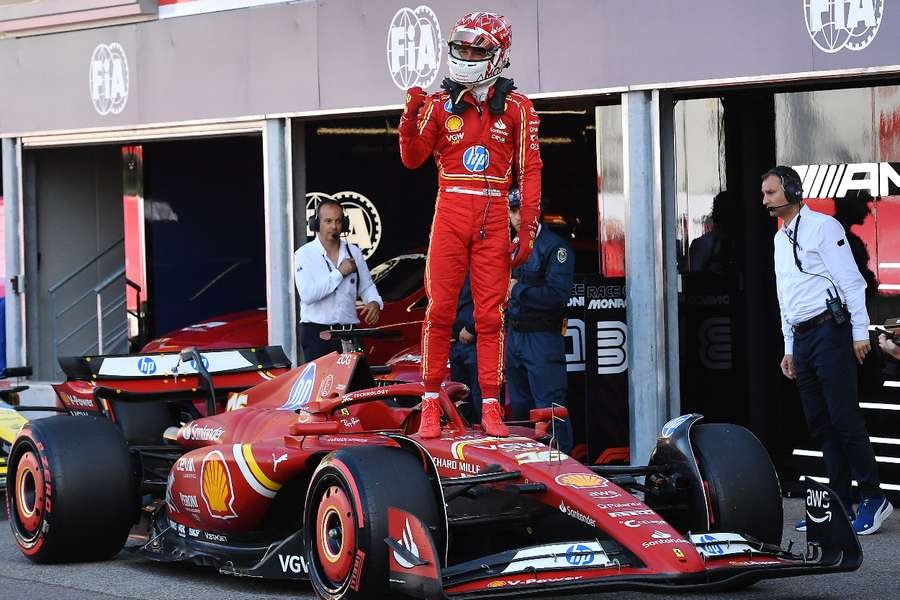
The Verdict: Unlucky or Overrated?
So, where does this leave us? Is Charles Leclerc overrated? The evidence suggests otherwise. He is a driver capable of matching the raw pace of generational talents like Max Verstappen. However, a distinction must be made. As noted by analysts, there is a difference between being a “generational” talent—one who redefines the sport—and being a “wickedly talented” driver who can fight them. Leclerc falls into the latter category. He is an 8 or 9 out of 10 driver, incredible on his day, but perhaps lacking that final percentage of relentless consistency and political ruthlessness that defines the absolute greats like Hamilton or Verstappen.
But to call him overrated is to ignore the mountain of evidence against Ferrari. No driver, no matter how talented, can win championships when their engine explodes while leading, or when their team puts them on the wrong tires, or when their car fails on the formation lap. Leclerc’s statistics are artificially depressed by a team that has, for the better part of a decade, failed to provide the operational excellence required to win titles.
Conclusion
The tale of Charles Leclerc is not one of a lack of talent, but of a tragic misalignment of potential and reality. He is the right driver at the wrong time, in the right car with the wrong team. The loyalty he has shown to Ferrari is commendable, but it has come at a steep cost to his legacy.
As we stare down the barrel of another season, the sentiment among the F1 community is shifting from frustration to pity, and finally to a plea: Charles, for the sake of your career, you must leave. The romance of Ferrari is dead; all that remains is the heartbreak. Until he finds a seat that can match his ambition with competence, Charles Leclerc will remain Formula 1’s greatest “what if”—a king without a crown, ruling over an empire of broken dreams.
News

Inside Shane Richie’s love life: Drug – fuelled orgy with six blondes; real reason he split from Coleen Nolan; six-year ‘affair with fan’
Inside Shane Richie’s love life: Orgy with six blondes; real reason he split from Coleen Nolan; six-year ‘affair with fan’ He’s popular with the ladies… Shane Richie…

SH0CKING REVELATI0N:A sh0cking behind-the-scenes secret revealed about Lizzie Rizzini, the woman replacing Carol Kirkwood on the 6pm weather bulletin
BBC viewers still reeling from the departure of Carol Kirkwood got another surprise last night when presenter Lizzie Rizzini appeared to flash her black lace stockings on…

HEARTBREAKING: Peter Andre’s Tearful Message to Son Junior After SHOCKING Revelation About How He Truly Feels Toward Mum Katie Price — Katie Price’s reaction scares fans.
Peter Andre’s emotional message to son Junior after it’s revealed how he really feels about mum Katie Pri… PETER Andre has shared an emotional message to his…

Ben Shephard opens up about the devastating health battle his wife is facing: “She wakes up crying every single morning…”
Inside This Morning Ben Shephard’s Life Including Rarely Seen Wife and Health Battle Ben Shephard is a name synonymous with British television, renowned for his engaging presentation…

🚨 LIVE TV HEARTBREAK: Good Morning Britain Host Announces ‘Devastating’ Dɘath of Guest Minutes Into Show
Viewers of Good Morning Britain were met with heartbreaking news just minutes into Friday’s (January 30) episode, as co-hosts Kate Garraway and Ranvir Singh reported the tragic…

Emmerdale legend Cain Dingle will never be the same again after a shock cancer diagnosis turns his world upside down
FROure Desk. Full Terms and conditions are available on the website http://www.itv.com/presscentre/itvpictures/terms Emmerdale wouldn’t be Emmerdale without the glowering, grunting embodiment of manliness that is Cain Dingle (Jeff Hordley) But…
End of content
No more pages to load






