The history of motorsport is often written in the ink of inevitability. We look back at the eras of Fangio, Clark, Senna, and Schumacher, and their dominance feels preordained, a natural alignment of talent and machinery. But the 1964 Formula 1 World Championship was different. It did not end with a coronation of the expected king; it ended in confusion, discomfort, and a stark realization that the sport had been outsmarted by an outsider.
When the dust settled on the season finale in Mexico City, the man standing at the summit was not Jim Clark, the ethereal Scotsman whose speed was terrifyingly effortless. It was not Graham Hill, the embodiment of British grit and reliability. It was John Surtees. And for the established order of Formula 1, that was a problem. Surtees wasn’t just another driver; he was a visitor from another dimension—the terrifying, raw world of Grand Prix motorcycle racing—and he had just done the impossible.
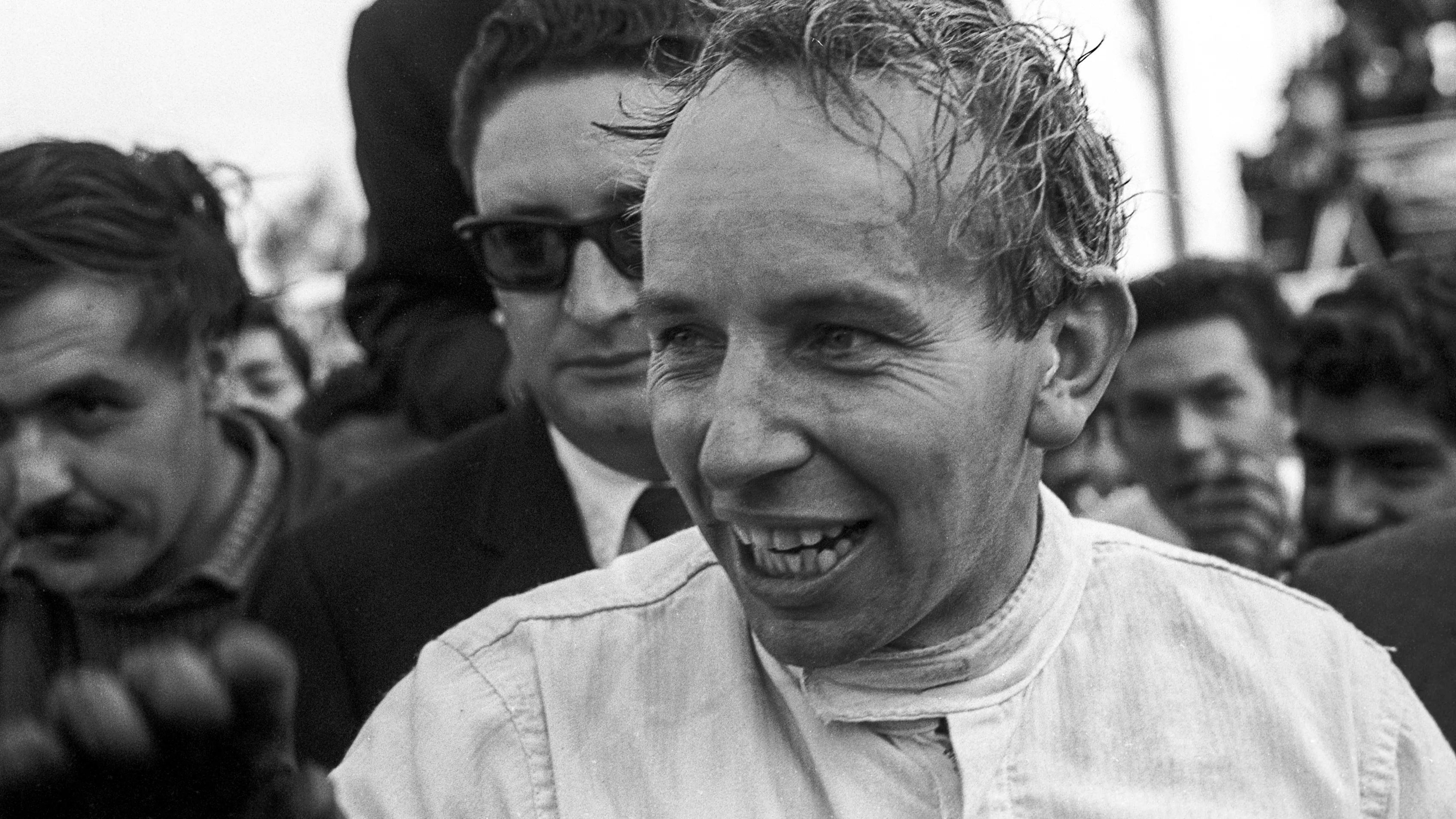
The Monarch of Two Wheels
To understand the shock of 1964, you have to understand the man who engineered it. John Surtees didn’t enter Formula 1 looking for relevance; he entered it because he had run out of worlds to conquer. By 1960, Surtees was already a deity in the motorcycle world. He possessed multiple world championships, absolute authority over his machines, and a reputation for clinical perfection.
Motorcycle racing in the 1950s and 60s was a discipline that tolerated zero ambiguity. There was no roll cage, no crumple zone, and no seatbelt. There was only the rider, the machine, and the air. A mistake on a bike didn’t result in a spin; it resulted in catastrophe. This environment forged a specific type of mind. While car drivers were learning to correct slides and exploit the grip of four wide tires, Surtees was trained to sense the limit before he arrived at it. He didn’t react to the loss of control; he anticipated it.
When he transitioned to four wheels, he brought this “rider’s mindset” with him. To the engineers at Ferrari and the pundits in the paddock, his feedback sounded alien. He spoke of nuance and sensitivity in a sport that was increasingly rewarding aggression. He didn’t wrestle the car; he persuaded it. And because his style was so restrained, so devoid of the frantic hand-over-hand combat that defined the era, many mistook it for caution. They were wrong. It wasn’t caution; it was the translation of total dominance from one language to another.
The Skepticism of the Elite
Formula 1 has always been an insular club. It tends to view outsiders with a mixture of curiosity and disdain, and Surtees was the ultimate outsider. The press questioned if his success on bikes could truly translate to the pinnacle of car racing. Rival drivers, protective of their hierarchy, wondered how long his precise, smooth style would survive in a pack of snarling V8s and V12s.
There was a subtle, pervasive sense that Surtees was a novelty—a fast one, certainly, but a novelty nonetheless. He challenged the established narrative simply by being there. He hadn’t come up through the traditional ranks of junior formulas. He hadn’t paid his dues in the way they understood. He had simply stepped off a bike and into a car, and by 1960, he was already taking pole positions.
This created an unusual dynamic in the paddock. The tension wasn’t hostile, but it was thick with skepticism. Surtees later noted that the press didn’t like how quickly he challenged the big names without following the “script.” But while the humans were skeptical, the machines were responsive. Engineers loved him because his feedback was razor-sharp. He could isolate mechanical variables in a way that drivers who relied on instinct often couldn’t.

The 1964 Chess Match
The 1964 season stands as one of the most fascinating tactical battles in the history of the sport. On paper, it should have been Jim Clark’s year. The Lotus driver was, by most accounts, the fastest man on Earth. When his car finished, he won. But that was the caveat: when it finished.
Graham Hill, meanwhile, was the steady hand, the man B.R.M. trusted to bring the car home. Surtees, driving the Ferrari 158, took a third path. He treated the championship not as a series of individual glory runs, but as a complex arithmetic problem. The points system of the time was brutal, counting only the best six results. Reliability was as valuable as velocity.
Surtees didn’t chase margin; he chased position. At high-speed temples of terror like the Nürburgring and Monza, he pushed. At Monza, he took pole and the win, not just for the points, but to send a psychological message. He was forcing his rivals to redline their own performance to keep up. He was making them take risks.
While Clark lost championships to fragile components and Hill lost them to bad luck and on-track skirmishes, Surtees kept collecting the metrics that mattered. He was a ghost in the machine, haunting the top of the leaderboards, applying pressure simply by remaining in contention.
The Mexican Standoff
It all came down to Mexico City. The high altitude thinned the air, robbing engines of power and drivers of breath. Three men arrived with a chance at the title: Clark, Hill, and Surtees.
The scenario was a nightmare of permutations. Clark needed to win. Hill needed Surtees to fail. Surtees needed the stars to align. For much of the race, it looked like the establishment would hold. Jim Clark led with his trademark brilliance, his Lotus seemingly immune to the pressure. Graham Hill was fighting in the pack, doing exactly what he needed to do to secure the title.
Surtees was there, but he wasn’t leading. He didn’t need to. He was managing the race, preserving his Ferrari, waiting for the attrition that defined the era. And then, the collapse began.
Hill’s hopes were dashed in a collision, his car damaged, his race run. That left Clark. But with just laps to go, the cruel hand of mechanical failure struck the Scot. An oil line seized, and the Lotus began to bleed its life onto the track. The fastest man slowed.
Surtees, who had spent the entire season positioning himself for exactly this moment, swept through. He didn’t need to win the race; he just needed to secure second place. His teammate, Lorenzo Bandini, moved aside, and Surtees crossed the line.
The arithmetic was undeniable. John Surtees was the World Champion. He had beaten the fastest driver and the most experienced driver not by being faster or more experienced, but by being smarter. He had understood the assignment in a way they hadn’t.
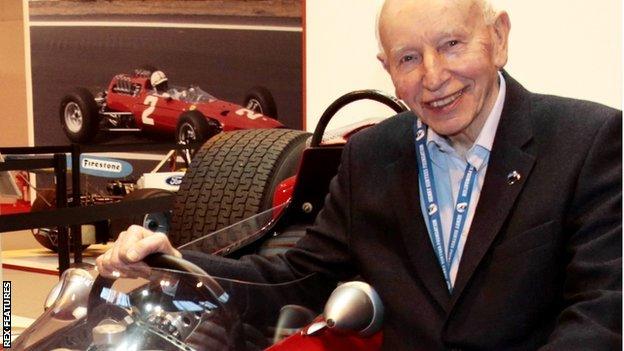
The Ferrari Divorce and a Lonely Legacy
Victory should have cemented Surtees as a Ferrari legend, but the union was fraught with friction. At Ferrari, the driver is often secondary to the politics of the Scuderia. Surtees, a man used to the absolute clarity of motorcycle racing where the rider is the final decision-maker, found the foggy hierarchy of Ferrari intolerable.
He wanted control over testing, over strategy, over the car’s development. Ferrari wanted obedience. The split was inevitable. Surtees walked away from the team that had given him the title, proving once again that he was driven by principle, not just trophies.
In the decades since, Formula 1 has seen thousands of drivers. Many have been fast. Some have been brilliant. But none have been John Surtees. He remains the only person in history to win the World Championship on two wheels and four. It is a statistic that feels increasingly mythological as the sports diverge further apart.
Surtees didn’t just change the record books; he challenged the very assumption of what a racing driver is. He proved that the principles of speed—balance, anticipation, mechanical sympathy—are universal languages, provided you have the genius to speak them. He forced Formula 1 to confront the reality that its “specialists” could be beaten by a “generalist” with a superior mind.
The paddock may have laughed or scoffed at the beginning, but by the time John Surtees hung up his helmet, the silence he left behind was deafening. It was the silence of a question that still hasn’t been answered: Will we ever see his like again? The answer, almost certainly, is no.
News

Inside Shane Richie’s love life: Drug – fuelled orgy with six blondes; real reason he split from Coleen Nolan; six-year ‘affair with fan’
Inside Shane Richie’s love life: Orgy with six blondes; real reason he split from Coleen Nolan; six-year ‘affair with fan’ He’s popular with the ladies… Shane Richie…

SH0CKING REVELATI0N:A sh0cking behind-the-scenes secret revealed about Lizzie Rizzini, the woman replacing Carol Kirkwood on the 6pm weather bulletin
BBC viewers still reeling from the departure of Carol Kirkwood got another surprise last night when presenter Lizzie Rizzini appeared to flash her black lace stockings on…

HEARTBREAKING: Peter Andre’s Tearful Message to Son Junior After SHOCKING Revelation About How He Truly Feels Toward Mum Katie Price — Katie Price’s reaction scares fans.
Peter Andre’s emotional message to son Junior after it’s revealed how he really feels about mum Katie Pri… PETER Andre has shared an emotional message to his…

Ben Shephard opens up about the devastating health battle his wife is facing: “She wakes up crying every single morning…”
Inside This Morning Ben Shephard’s Life Including Rarely Seen Wife and Health Battle Ben Shephard is a name synonymous with British television, renowned for his engaging presentation…

🚨 LIVE TV HEARTBREAK: Good Morning Britain Host Announces ‘Devastating’ Dɘath of Guest Minutes Into Show
Viewers of Good Morning Britain were met with heartbreaking news just minutes into Friday’s (January 30) episode, as co-hosts Kate Garraway and Ranvir Singh reported the tragic…

Emmerdale legend Cain Dingle will never be the same again after a shock cancer diagnosis turns his world upside down
FROure Desk. Full Terms and conditions are available on the website http://www.itv.com/presscentre/itvpictures/terms Emmerdale wouldn’t be Emmerdale without the glowering, grunting embodiment of manliness that is Cain Dingle (Jeff Hordley) But…
End of content
No more pages to load






