In the high-stakes, hyper-technical world of Formula 1, victories are supposed to be quantifiable. They should be the result of superior engine horsepower, aerodynamic efficiency, or perhaps a daring, perfectly executed strategic pit stop. Yet, every once in a while, a moment occurs that defies all engineering expectations, forcing fans, rivals, and even the most seasoned technical directors to ask a simple, unsettling question: How?
This question was perhaps never louder than at the 2020 British Grand Prix at Silverstone. On the final lap, Lewis Hamilton’s front-left tire exploded at full speed. His car, suddenly unbalanced and careening, seemed doomed to surrender the lead. But somehow, through sheer will and what appeared to be mechanical magic, he guided the three-wheeled machine across the finish line, securing one of the most improbable victories in F1 history. Was it luck? Absolutely not. That dramatic finish was merely the spectacular conclusion of a skill Hamilton has refined into a championship-winning weapon: the mastery of tire management.
Engineers call it the art and science of tire conservation. Drivers who lack it watch their dreams disintegrate into useless shreds of overheated rubber. Drivers like Lewis Hamilton use it to extend their stints, manipulate the race pace, and conquer degradation itself. His ability is so refined that it often seems physically impossible, leading many to label him F1’s “Tire Whisperer.” This is the full engineering breakdown of how Hamilton manages tires better than 99% of F1 drivers, and why this invisible weapon is set to redefine his legacy at Ferrari.
The Cruel Physics of the F1 Tire
To truly appreciate Hamilton’s brilliance, one must first understand the enemy he faces: tire degradation. Modern Formula 1 tires are intentionally fragile. They are designed to suffer, operating within a painfully narrow thermal window, typically between 90 to 110 degrees Celsius. They are a constant, ticking time bomb designed not to last, but to test a driver’s discipline, precision, and endurance.
The degradation process is insidious. Push the car too hard, and the tires overheat, leading to thermal degradation. Slide even slightly too much in a corner, and you begin to shred the surface integrity. Brake too aggressively, and you blister the compound. The tire is a real-time feedback loop: every micro-slip, every vibration, and every temperature fluctuation is information that the best drivers must process and react to instantly.
Hamilton doesn’t succeed through simple restraint; he achieves control through perfectly calculated control. He doesn’t just manage the tire; he reads it like a musician reads sheet music. This real-time, symbiotic relationship allows him to execute maneuvers that appear superhuman and defy the expected performance curve.
The Masterclasses: Defining Moments of Tire Mastery
Hamilton’s career is littered with strategic victories and defensive masterclasses that only happened because of his uncanny relationship with the black circular rubber gripping the tarmac.
Silverstone 2020: Preparation, Not Luck While the three-wheel finish is iconic, the real story happened in the 37 laps prior. That front-left tire was theoretically designed to last around 25 laps. Hamilton stretched it to 38 laps at race-winning pace. He meticulously avoided unnecessary heat generation in the early and middle stints, building a massive performance bank. When disaster struck with the puncture, the massive time gap he had created was the literal and figurative tire life he had banked to survive. It was preparation, not providence.
Spanish Grand Prix 2021: The Strategic Pincer The battle against Max Verstappen in Spain showcased Hamilton’s ability to manipulate the entire race pace. While Verstappen attempted a one-stop strategy, Mercedes opted for a two-stop. What is often forgotten is that Hamilton’s early laps were not slow due to a lack of pace, but were intentionally conservative. He was gently reducing the thermal load and protecting the surface integrity of the tires. When he pitted for the final, late-race stint, his fresh rubber suffered almost zero degradation drop-off. His lap times became relentless, consistent, and eventually, unstoppable, proving he didn’t just manage his own tires, but weaponized their endurance to dismantle his rival’s strategy.
Mexico Grand Prix 2019: The Impossible Stint In 2019, the Ferraris had straight-line speed superiority, and the Red Bulls had better overall race pace. It was not supposed to be Hamilton’s race. Yet, he executed a 48-lap stint on the hard tire compound—a tire designed to last only about 40 laps. Most drivers would have collapsed off a performance cliff, but Hamilton’s input was so extraordinarily smooth that the data revealed almost no unnecessary sliding, no chaotic transitions, and no alarming temperature spikes. He maintained a pace that allowed him to beat two objectively faster cars on a worse theoretical strategy.
Turkish Grand Prix 2020: Driving on “Canvas” Perhaps the most shocking demonstration occurred during the wet-dry chaos of the 2020 Turkish Grand Prix. As the intermediate tires wore down, most drivers shredded their rubber into useless strips, struggling for grip. Hamilton, however, deliberately managed the transition, controlling wheel spin and degradation so perfectly that by the time he crossed the finish line to win by nearly half a minute, his tires were, in his own words, “driving on canvas.” To pull away from the field under such conditions, essentially running on a tire compound that was structurally finished, is a feat that speaks to an almost spiritual connection between driver and machine.
The Engineering Secrets: How He Does It
Lewis Hamilton’s mastery is not a mystery; it is a synthesis of hyper-precise techniques honed over decades.
1. Optimal Slip Angle and Smoothness: At the core of his success is ultra-smooth control. His inputs are micro-adjustments, not sudden reactions. In the punishing, slow corners of the 2018 Singapore Grand Prix—the hottest, most tire-killing race on the calendar—Hamilton’s onboard footage was “frightening in its perfection.” There were almost zero steering corrections, no aggressive wheel spin, and no lockups. His slip angle (the difference between the tire’s direction and the car’s direction) was nearly ideal. This minimal sliding keeps the tire molecules intact, avoiding the rubber tearing that destroys performance faster than anything else.
2. Perfect Thermal Balance: Hamilton excels at controlling the tires’ temperature through both the surface and the core. At the 2017 British Grand Prix, he stretched his soft tires to 32 laps—far exceeding the expected 20-25 laps—with no performance drop-off. Mercedes engineers confirmed his temperature control was perfect, avoiding both overheating the surface (which causes blistering) and overcooling the core (which reduces grip). Maintaining this impossible balance is what makes his long stints viable.
3. Precise Trail Braking and Modulation: His ability to preserve tires under pressure, such as his legendary defensive drives against Verstappen in Bahrain 2021 and against Nico Rosberg in Bahrain 2014, relies on impeccable brake modulation. He uses defensive lines that minimize tire strain, employing tight corner entries, straighter exits, and perfect trail braking to ensure that stress is evenly distributed across the tire surface, preventing the localized heat spikes that lead to premature degradation. Rosberg, in their 2014 duel, had fresher tires and DRS, yet Hamilton used his defensive lines to preserve his own worn tires while simultaneously defending his position—a rare achievement in motorsport history.

The Future Cliffhanger: A Weapon Reborn at Ferrari
Hamilton’s tire management skill is not a mere talent; it is, quite literally, a weapon. It’s built on ultra-smooth brake modulation, precise trail braking, momentum driving, and a unique racecraft that predicts degradation before it even begins.
The motorsports world is currently holding its breath over the greatest impending shift in the F1 landscape: Lewis Hamilton’s move to Scuderia Ferrari. The irony is palpable: Ferrari is a team historically haunted by tire degradation issues, their strategy often undermined by a car philosophy that eats its own rubber.
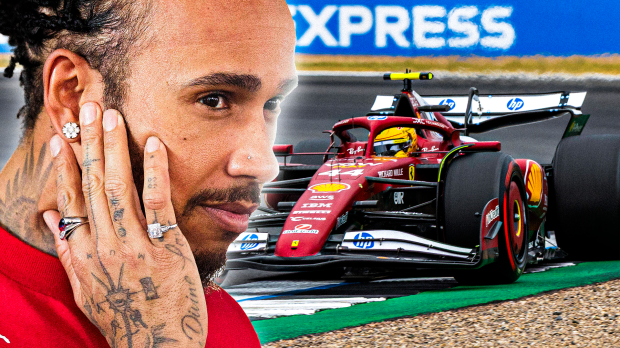
However, the narrative is already shifting. Reports indicate that Ferrari is redesigning its 2025 car around Hamilton’s feedback—prioritizing improved rear stability, better tire cooling, and a more predictable balance. If Hamilton’s almost mystical tire mastery merges with Ferrari’s newfound engineering philosophy and their powerful engine, the results could be genuinely terrifying for his rivals. It could signal the rebirth of a champion whose greatest weapon is currently invisible to the naked eye, poised to conquer the one weakness that has plagued the legendary Italian team for decades.






