It is a date etched in sorrow for every Formula 1 fan: October 5, 2014. Under the torrential rain of Suzuka, the bright light that was Jules Bianchi was dimmed forever. But what if fate had intervened? What if the slippery asphalt of the Dunlop Curve had been just a little more forgiving? In a compelling exploration of “what could have been,” we dive into a detailed alternate timeline where the French prodigy survives, thrives, and reshapes the history of the sport we love.
The Survival and the Struggle
In this vision of a parallel universe, the 2014 Japanese Grand Prix proceeds with a heart-stopping near-miss. Adrian Sutil crashes, but Bianchi’s Marussia passes by unharmed. He finishes the race, and while the financial realities of F1 still see the Marussia team collapse, Bianchi’s career is far from over.
As a prized Ferrari junior, his path remains clear, though arduous. Instead of fading away, he finds refuge at Sauber for the 2015 season. Here, the alternate history begins to diverge in fascinating ways. Partnered with Marcus Ericsson, Bianchi becomes the reliable backbone of a struggling team. He fights tooth and nail in the midfield, extracting performance from cars that had no business scoring points. His tenacity earns him a move to the newly formed Haas team in 2017, where he partners with fellow Frenchman Romain Grosjean.
This period defines Bianchi not just as a talent, but as a grinder—a driver willing to wait for his moment while battling in the trenches of the midfield. He outperforms teammates, survives the chaotic politics of pay-drivers, and keeps his eyes firmly locked on the ultimate prize: the seat at Scuderia Ferrari.
The Prancing Horse Finally Calls
The dream finally becomes reality in 2019. After Kimi Räikkönen’s departure, Ferrari promotes their loyal son. Jules Bianchi finally dons the scarlet race suit alongside Sebastian Vettel. It is a moment of pure emotional payoff for fans who watched him rise through the ranks.
But the fairytale isn’t without its nightmares. In this timeline, the F1 world is rocked by a different tragedy. During the 2018 Belgian Grand Prix, it is Charles Leclerc—Bianchi’s godson and protégé—who suffers a horrific accident, struck by Fernando Alonso’s McLaren. The incident leaves Leclerc in a coma, a dark inversion of reality that shakes Bianchi to his core.
Fueled by this trauma, Bianchi becomes a crusader for safety. He works tirelessly with the FIA, personally testing and refining the “Halo” device. When it is introduced in 2020, it is largely thanks to Bianchi’s advocacy. The emotional payoff comes later that year in Bahrain, when Romain Grosjean survives his fiery crash. In this world, Grosjean has Jules Bianchi to thank for his life.
Triumphs and Betrayals
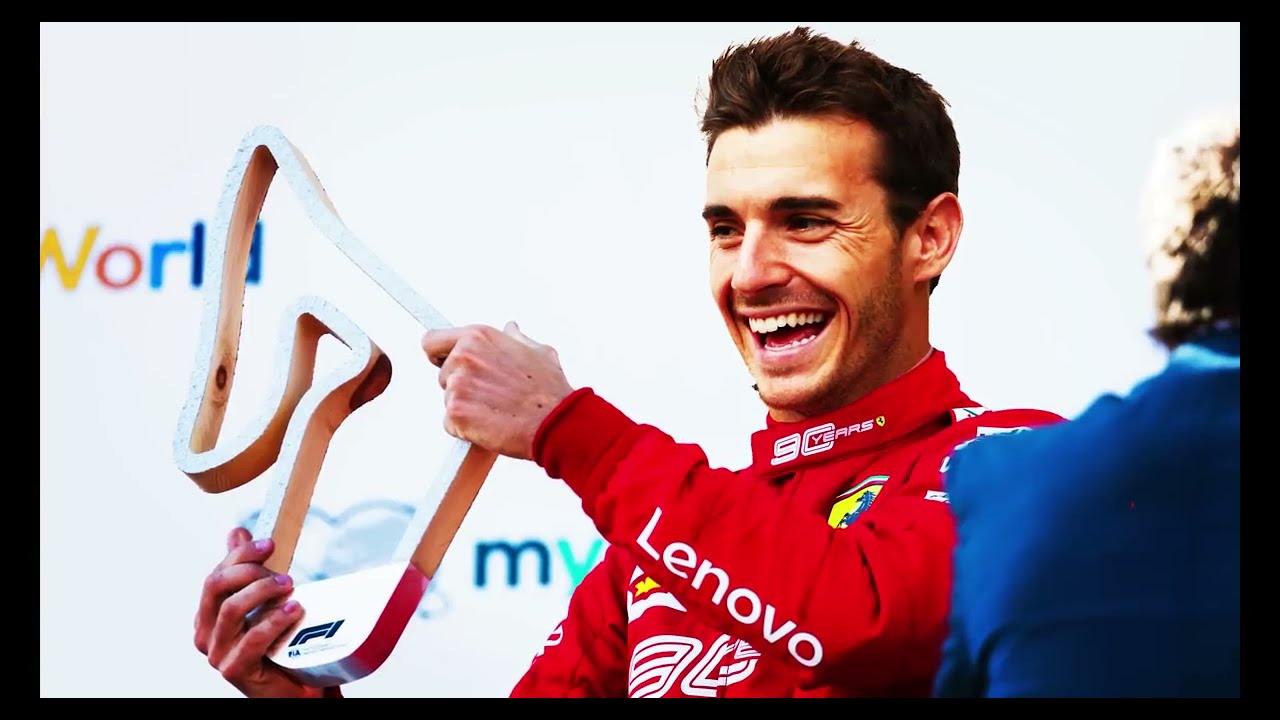
On the track, Bianchi proves his worth. He secures his first emotional victory at the Austrian Grand Prix in 2019, holding off Max Verstappen in a thriller. He follows it up with a win at Monaco in 2021—a home race victory that cements his status as a top-tier driver. Over his tenure at Ferrari, he racks up nine Grand Prix wins, battling against the dominance of Mercedes and the rising tide of Red Bull.
However, Formula 1 is a cruel business, even in fiction. The partnership with a recovered Charles Leclerc at Ferrari from 2022 onwards creates a “mentor vs. student” dynamic that eventually tips in favor of the younger star. As the team shifts its focus to the future, Bianchi finds himself in the role of the elder statesman—respected, but expendable.
The ultimate heartbreak arrives in early 2024. Just as Bianchi prepares for another campaign, the bombshell drops: Ferrari has signed Lewis Hamilton for 2025. After years of loyalty, development work, and race wins, Bianchi is cast aside. The feeling of betrayal is palpable. He is viewed as a “modern-day Jean Alesi”—a driver of immense passion and talent who gave his heart to the Scuderia, only to be left without a championship.
A Legacy Rewritten
The timeline concludes in 2025 with Bianchi moving to Kick Sauber (the future Audi team), partnering with Nico Hülkenberg. Now 35, married, and a father, his priorities have shifted. He didn’t win the World Championship, but his legacy in this alternate world is arguably greater.
He is the man who saved lives through the Halo. He is the driver who brought Ferrari back to the top step of the podium at Monaco. He is the godfather who raced alongside Charles Leclerc.
This alternate history serves as a bittersweet reminder of the potential that was lost in 2014. It paints a picture of a driver who was destined for greatness, not just for his speed, but for his character. While we cannot change the past, imagining this journey allows us to honor Jules Bianchi’s memory, reminding us that in our hearts, he will always be a champion.
News

Inside Shane Richie’s love life: Drug – fuelled orgy with six blondes; real reason he split from Coleen Nolan; six-year ‘affair with fan’
Inside Shane Richie’s love life: Orgy with six blondes; real reason he split from Coleen Nolan; six-year ‘affair with fan’ He’s popular with the ladies… Shane Richie…

SH0CKING REVELATI0N:A sh0cking behind-the-scenes secret revealed about Lizzie Rizzini, the woman replacing Carol Kirkwood on the 6pm weather bulletin
BBC viewers still reeling from the departure of Carol Kirkwood got another surprise last night when presenter Lizzie Rizzini appeared to flash her black lace stockings on…

HEARTBREAKING: Peter Andre’s Tearful Message to Son Junior After SHOCKING Revelation About How He Truly Feels Toward Mum Katie Price — Katie Price’s reaction scares fans.
Peter Andre’s emotional message to son Junior after it’s revealed how he really feels about mum Katie Pri… PETER Andre has shared an emotional message to his…

Ben Shephard opens up about the devastating health battle his wife is facing: “She wakes up crying every single morning…”
Inside This Morning Ben Shephard’s Life Including Rarely Seen Wife and Health Battle Ben Shephard is a name synonymous with British television, renowned for his engaging presentation…

🚨 LIVE TV HEARTBREAK: Good Morning Britain Host Announces ‘Devastating’ Dɘath of Guest Minutes Into Show
Viewers of Good Morning Britain were met with heartbreaking news just minutes into Friday’s (January 30) episode, as co-hosts Kate Garraway and Ranvir Singh reported the tragic…

Emmerdale legend Cain Dingle will never be the same again after a shock cancer diagnosis turns his world upside down
FROure Desk. Full Terms and conditions are available on the website http://www.itv.com/presscentre/itvpictures/terms Emmerdale wouldn’t be Emmerdale without the glowering, grunting embodiment of manliness that is Cain Dingle (Jeff Hordley) But…
End of content
No more pages to load






