It was supposed to be the glorious final chapter of a legendary book. When Lewis Hamilton announced his move to Ferrari, the Formula 1 world held its breath, envisioning the seven-time world champion clad in scarlet red, roaring toward an eighth title. The promise was intoxicating: a rebirth for the sport’s greatest icon and a return to dominance for its most storied team.
But as the sun sets on the 2025 season, that dream has dissolved into a stark, unforgiving nightmare.
Current realities in December 2025 paint a picture no one predicted. Instead of fighting for championships, Hamilton finds himself trapped in a cycle of instability and frustration. The statistics are damning, almost impossible to reconcile with the man who rewrote the sport’s record books. Twenty-two races deep into the season, Hamilton has failed to score a single Grand Prix podium. His solitary moment of triumph—a sprint race victory in Shanghai back in March—now feels like a cruel mirage, a fleeting glimpse of what could have been before the darkness set in.
The low point arrived under the neon lights of Las Vegas, where Hamilton, a master of street circuits, qualified last. It was the first time in his entire illustrious career that he started a race from the very back of the grid on pure pace. He called the weekend “horrendous,” admitting freely that this is the “worst season ever.” Ferrari, once the promised land of legends, now resembles a trap.
But how did we get here? How does the most successful driver in history suddenly look lost? The answer isn’t simple, and it isn’t just about a driver past his prime. Beneath the headlines lies a complex web of broken promises, mechanical failures, and a shocking strategic decision that effectively abandoned Hamilton in the middle of the fight.
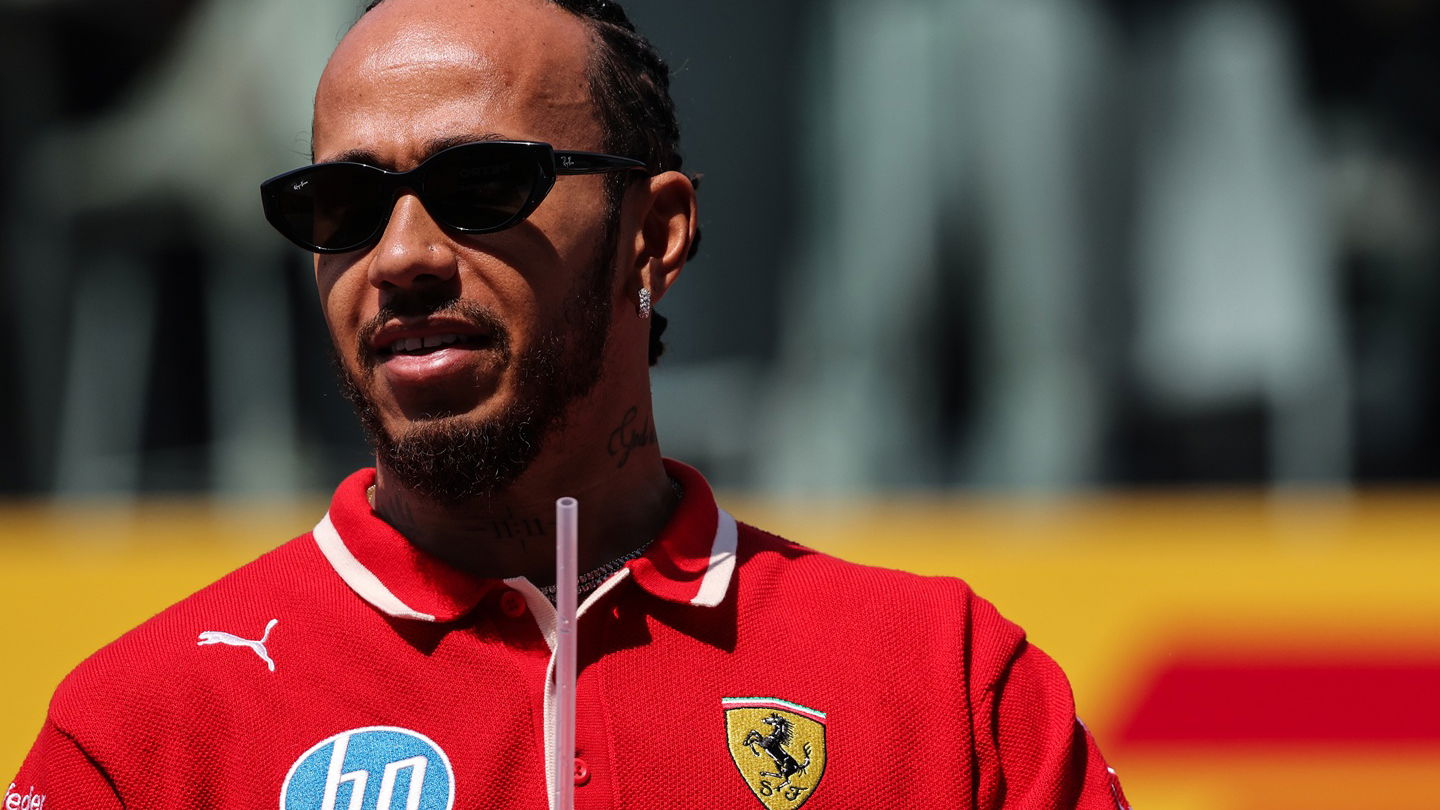
The Mechanical Betrayal: The Myth of the “Stable Rear”
The core of the problem begins with the machine itself: the Ferrari SF25. Before the season began, engineers sold this car as a “rebirth.” It was marketed internally as a machine with a stable rear end and high mid-speed cornering capabilities. On paper, this was the Holy Grail for Hamilton. His driving style, honed over decades, relies heavily on a planted rear axle that allows him to attack corners with late braking and smooth rotation.
Reality, however, had other plans. As the season wore on, the “stable rear” philosophy proved to be a myth. At the Qatar Grand Prix, the disparity was brutally exposed during sprint qualifying when Hamilton lined up 18th. He described the car as a “fight like you couldn’t believe,” lamenting that the rear simply wouldn’t stay planted.
The SF25 turned out to be a “slippery trap.” It isn’t that the car lacks theoretical downforce; it lacks consistency. It demands a perfect storm of setup precision, tire management, and aerodynamic balance to function. If even one link in that chain breaks—a gust of wind, a slight temperature drop, a bump in the track—the car becomes a “beast of pain.” For a driver like Hamilton, who thrives on the razor-sharp predictability he enjoyed at Mercedes, this unpredictability is kryptonite.
The Strategic Abandonment
If the mechanical issues were the gun, Ferrari’s strategic decisions were the bullet. Halfway through the 2025 season, the team made a brutal, calculating choice: they paused major development on the SF25 to shift their entire focus to the 2026 regulations.
In the cutthroat world of F1, standing still is moving backward. While rivals brought upgrades, tweaked wings, and refined aerodynamics, Hamilton was left fighting a war with “broken weapons.” Team Principal Fred Vasseur admitted the move was pragmatic, born from the realization that chasing 2025 glory was futile against dominant rivals. But for Hamilton, this decision had devastating consequences.
It meant that the problems plaguing the car in March were essentially the same problems plaguing it in December. The feedback, finesse, and technical insight Hamilton poured into the team were effectively wasted because the car wasn’t evolving to meet his needs. Both he and teammate Charles Leclerc expressed open disillusionment. For a driver accustomed to the relentless development culture of Mercedes—where the car gets faster every weekend—this stagnation felt like a betrayal.
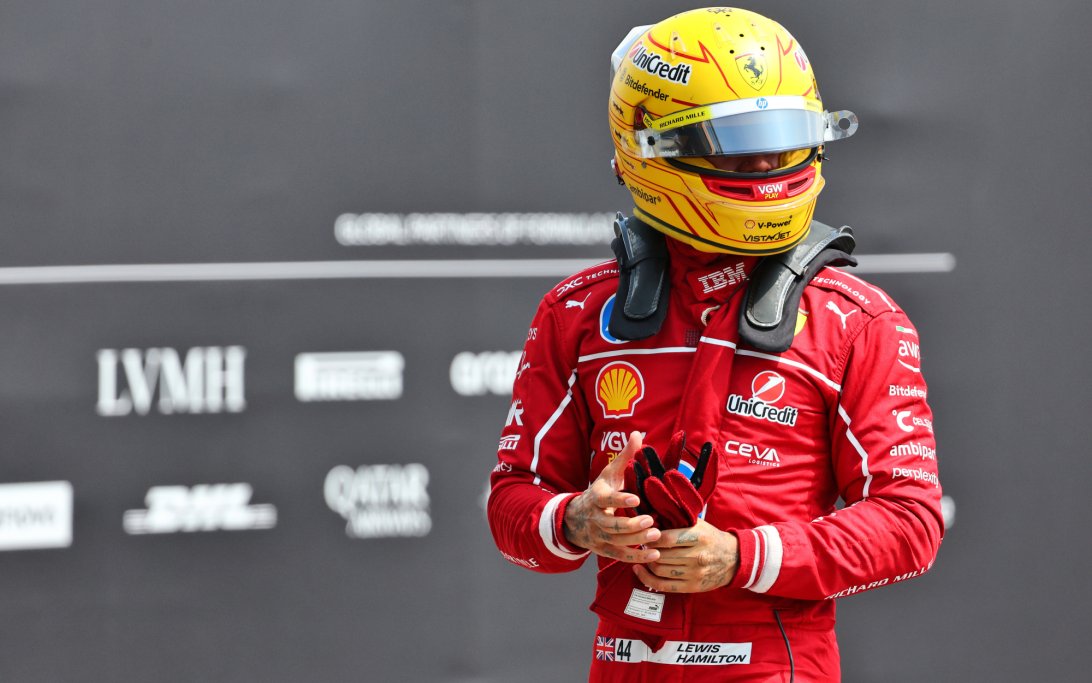
The Style Clash: Muscle Memory vs. Machinery
Beyond the mechanics and strategy, there is a deeply human element to this struggle. Hamilton is not just fighting a car; he is fighting his own instincts.
He has spent 18 seasons—two full decades—mastering a specific way of driving. His throttle modulation, his steering inputs, and his tire conservation techniques were all tailored to the philosophies of McLaren and Mercedes. Now, at 40 years old, he is being asked to relearn how to drive.
The SF25 requires a counter-intuitive approach to handle its unstable rear. The gap between what the car demands and what Hamilton’s instincts provide is enormous. This disconnect manifests in the data: massive inconsistencies in lap times, overheating rear tires, and a flickering balance that evaporates when pushed.
When you compare him to Leclerc, the psychological dagger twists deeper. Leclerc, while also struggling with the car’s “zero performance,” has occasionally managed to extract bursts of pace, scraping into Q3 when Hamilton is knocked out in Q1. This isn’t just a performance deficit; it is an identity crisis for a man whose identity is built on being the fastest.
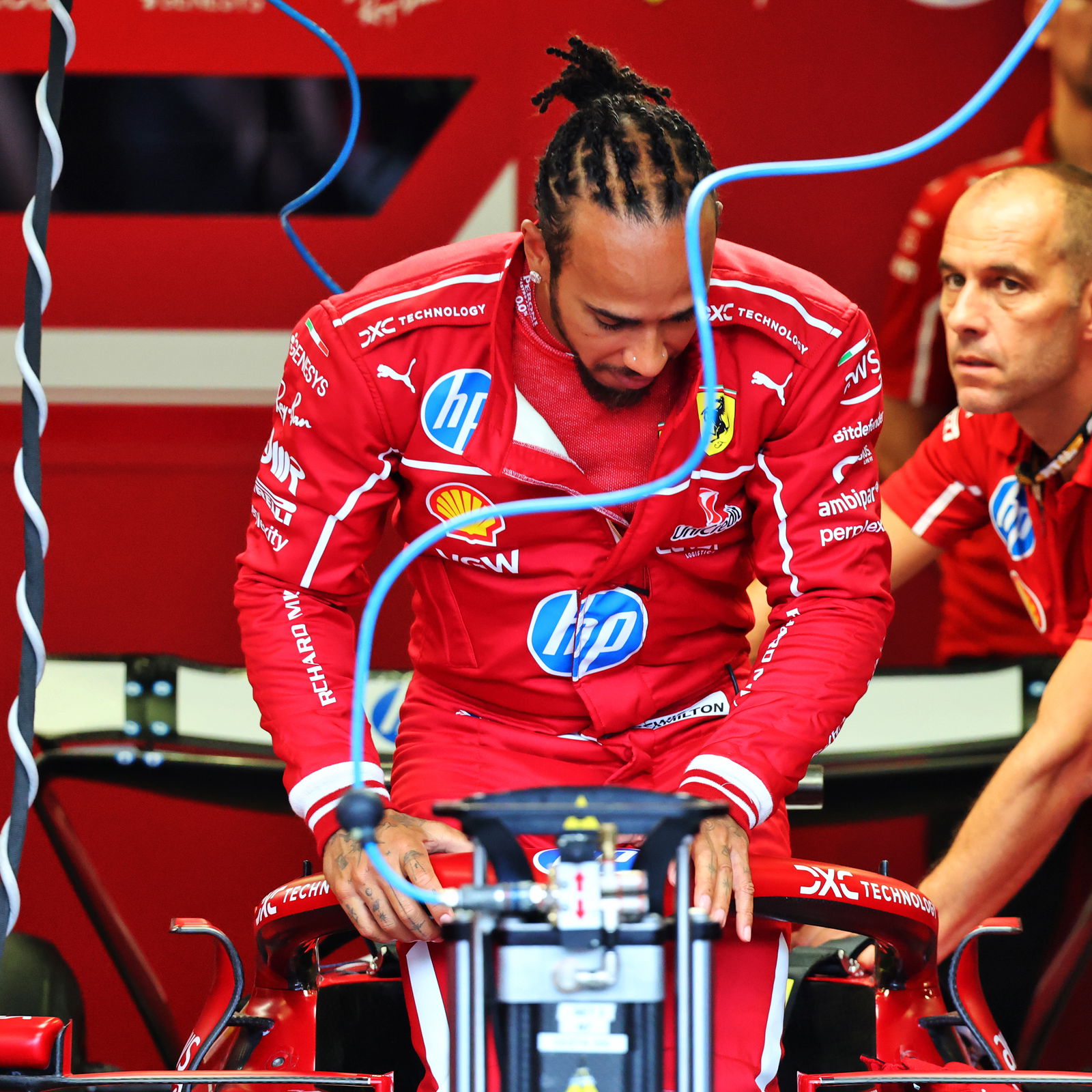
The Verdict: A Collapse, Not Just a Slump
The 2025 season stands as a stark demonstration that even legends are not immune to the laws of physics and engineering. The “worst season ever” is not hyperbole; it is a factual description of a collapse brought on by a perfect storm of misengineering and bad timing.
Yet, amidst the chaos, Hamilton remains defiant. He has stated publicly that he does not regret joining Ferrari. He still believes in the history of the Prancing Horse and hopes for a rebuild. But faith alone cannot fix downforce. The clock is ticking loudly.
If Ferrari fails to deliver a perfect car for the 2026 regulation reset, this chapter of Hamilton’s career risks becoming one of the most tragic “what-if” stories in sports history. A champion who switched teams at twilight, only to be swallowed whole by ambition and bad machinery.
As the season concludes, the question isn’t whether Hamilton still has the talent—it’s whether Ferrari can give him a car that doesn’t fight him every inch of the way. Until then, the dream remains a nightmare, and the legend waits in the garage, hoping for a car that is finally worthy of his hands.






