For more than a decade, Formula 1 has been haunted by a necessary evil. It was a mechanism that solved a problem but stole the soul of the battle: the Drag Reduction System, or DRS. We all know the drill—stay within one second, wait for the detection point, press a button, open the rear wing, and breeze past your opponent before the braking zone even comes into view. It was clinical. It was effective. And, let’s be honest, it was often incredibly boring.
The outcome of a wheel-to-wheel battle was frequently decided by a line on the track rather than the bravery of the driver. But come 2026, that entire philosophy is being thrown into the scrapyard. Formula 1 is not just introducing a new set of regulations; it is fundamentally redefining how speed, advantage, and risk are created on the racetrack. The “Overtake Mode” is coming, and it promises to turn the sport from a highway procession back into a high-stakes chess match played at 220 miles per hour.

The Electrical Revolution
To understand why this change is so monumental, you first have to grasp the sheer insanity of the 2026 cars. We aren’t talking about a minor hybrid tweak here. The new power units are beasts of a different breed. The electrical component, the MGU-K, has been unleashed. It can now deliver up to 350 kilowatts of power. In old-school terms, that is roughly 470 horsepower.
Think about that for a second. Nearly half of the car’s total performance potential will no longer come from burning fuel or aerodynamic trickery; it will come from software-controlled electrical deployment. This shift changes the very physics of racing. Under standard conditions, this power isn’t just given to the driver freely. It is heavily restricted by a set of “speed-dependent” rules that feel almost cruel in their strictness.
In “standard mode,” as the car gets faster, the electrical help fades away. It’s a deliberate design to prevent runaway speeds that would make the tracks unsafe. At 338 km/h, a standard car might get 110 kW of boost. But push just a little faster, to 345 km/h, and the electrical deployment drops to zero. You hit a wall—not a physical one, but a performance wall where you are left relying solely on the combustion engine. It forces teams to prioritize efficiency over raw grunt.
The “Manual Override”: A Weapon, Not a Gift
This is where the new “Overtake Mode” (often called Manual Override) enters the arena. It doesn’t just tweak the rules; it bends them.
When a driver activates this mode, the car switches to an entirely different power curve. Remember that standard car struggling with 110 kW at 338 km/h? The attacking driver, in Overtake Mode, suddenly has access to 340 kW at that exact same speed. That is more than triple the electrical power. It’s not a nudge; it’s a rocket booster.
And the advantage keeps going. While the defending car loses all electrical assist at 345 km/h, the attacker can keep deploying power all the way up to 355 km/h. That extra 10 km/h of assisted acceleration might sound like a small number on a spreadsheet, but on the asphalt, it is massive. It extends the acceleration phase, allowing the attacker to carry momentum deep into the straight.
But here is the critical difference between this and DRS: DRS was binary. You either had it, or you didn’t. It worked, or it didn’t. Overtake Mode is conditional. It builds progressively. And most importantly, it is finite.
The Return of Consequence
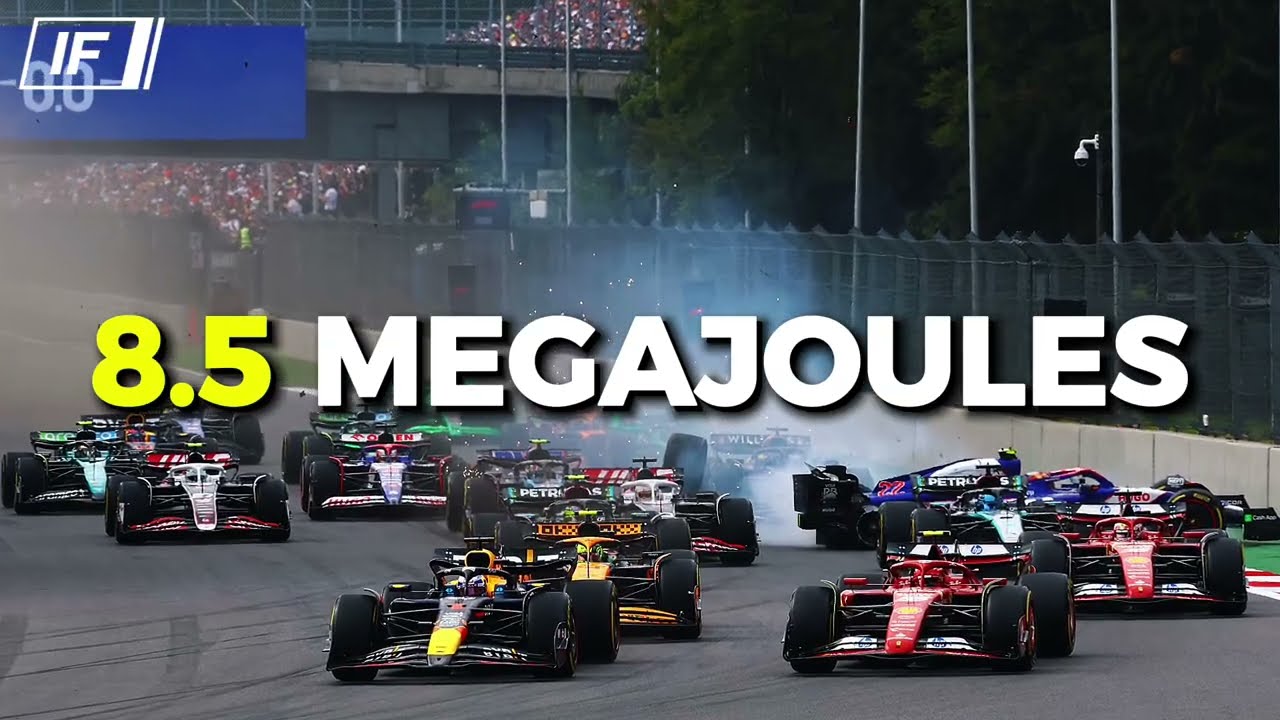
This is the emotional hook of the 2026 regulations. The “free lunch” era of overtaking is over. Energy in these new cars is a scarce resource. Drivers are capped at harvesting 8.5 megajoules of energy per lap (with a tiny bonus for attackers). That sounds like a lot, but when you are dumping 470 horsepower into the rear wheels to chase someone down, that energy evaporates instantly.
Every joule you spend attacking on the main straight is a joule you do not have for the next section of the track. If you burn your battery trying to pass and fail, you are effectively a sitting duck for the rest of the lap. You cannot just “try again” immediately. You have to recharge. You have to wait. You have to suffer the consequences of your failed gamble.
This transforms overtaking from a reflex—”I see light, I press button”—into a complex calculation. Drivers will have to ask themselves terrifying questions in split seconds: Do I have enough energy to finish this move? If I use it now, will I be vulnerable in the next DRS zone? Should I wait and let him think he’s safe?
The Art of Defense and the “Bait”
Defense, a dying art in the DRS era, is about to make a spectacular comeback. In recent years, defending against a powerful DRS pass was often futile. You just let them go and tried to get them back later. But with Overtake Mode, the defender has agency again.
A smart defending driver can manipulate the attacker. They can position their car to force the attacker to deploy their energy early, perhaps on the corner exit. If the attacker panics and dumps their battery too soon, they might run out of electrical assist before the braking zone. Suddenly, the attacker is left with no momentum, overheated tires, and a depleted battery, while the defender sails on.
We are going to see drivers “baiting” each other into wasting energy. We will see aborted overtakes where a driver realizes halfway down the straight that they’ve miscalculated and has to back out to save face—and energy. This isn’t failure; this is high-level strategic racing. It reintroduces the multi-lap battle, where a pass is set up over three or four laps of feints, parries, and energy traps.
The Human Element: Confusion and Panic
Let’s not overlook the potential for human error, which is the spice of any good sport. The complexity of this system is high. Teams will have “deployment maps,” and engineers will be in the drivers’ ears constantly. But in the heat of battle, at 200 mph, mistakes will happen.
We can expect to see drivers confused. We will hear radio messages of pure panic: “Why do I have no power?!” “You burned it all in Turn 3, mate!” We will see cars that look blindingly fast on one lap suddenly look like they’ve hit a brick wall on the next because they are in “harvest mode.”
Qualifying will also be affected. Since Overtake Mode is available in quali sessions, teams have to decide how aggressively to deploy on a single lap versus saving energy for a second attempt. A miscalculation here could see a top driver knocked out in Q1 simply because they ran out of battery at the final corner.
A Philosophy of “Earned” Speed
There is a delicious irony in all of this. Formula 1 removed DRS to make racing more “natural,” and they did it by replacing it with one of the most mathematically complex systems in sporting history. But the philosophy holds water. The new system rewards thinking, not just proximity. It rewards patience, rhythm, and planning.
Drivers who have relied on the crutch of DRS to save their races after poor qualifying sessions may find themselves exposed. The ability to manage the car’s systems—to be a computer processor as well as a gladiator—will separate the greats from the good.
The FIA also retains more control. Unlike the fixed “one-second gap” of the past, the parameters for Overtake Mode can be tweaked track-by-track. They can adjust the power boost, the duration, and the activation zones to ensure the racing remains balanced. It prevents teams from “solving” the regulations on day one and dominating forever. Every weekend becomes a bespoke puzzle.
Conclusion: A Better Product
Will we see more overtakes in 2026? Maybe not. But the overtakes we do see will be better. They will be earned. They will be the result of a driver out-thinking and out-driving their opponent, managing their resources, and taking a calculated risk.
The era of the “highway pass” is ending. In its place, we get a system that is flawed, complex, human, and unpredictable. It brings the consequence of failure back into the equation. If you want the position, you have to pay for it with energy, and if you get it wrong, the track will punish you. That is exactly how Formula 1 should be.
News

Inside Shane Richie’s love life: Drug – fuelled orgy with six blondes; real reason he split from Coleen Nolan; six-year ‘affair with fan’
Inside Shane Richie’s love life: Orgy with six blondes; real reason he split from Coleen Nolan; six-year ‘affair with fan’ He’s popular with the ladies… Shane Richie…

SH0CKING REVELATI0N:A sh0cking behind-the-scenes secret revealed about Lizzie Rizzini, the woman replacing Carol Kirkwood on the 6pm weather bulletin
BBC viewers still reeling from the departure of Carol Kirkwood got another surprise last night when presenter Lizzie Rizzini appeared to flash her black lace stockings on…

HEARTBREAKING: Peter Andre’s Tearful Message to Son Junior After SHOCKING Revelation About How He Truly Feels Toward Mum Katie Price — Katie Price’s reaction scares fans.
Peter Andre’s emotional message to son Junior after it’s revealed how he really feels about mum Katie Pri… PETER Andre has shared an emotional message to his…

Ben Shephard opens up about the devastating health battle his wife is facing: “She wakes up crying every single morning…”
Inside This Morning Ben Shephard’s Life Including Rarely Seen Wife and Health Battle Ben Shephard is a name synonymous with British television, renowned for his engaging presentation…

🚨 LIVE TV HEARTBREAK: Good Morning Britain Host Announces ‘Devastating’ Dɘath of Guest Minutes Into Show
Viewers of Good Morning Britain were met with heartbreaking news just minutes into Friday’s (January 30) episode, as co-hosts Kate Garraway and Ranvir Singh reported the tragic…

Emmerdale legend Cain Dingle will never be the same again after a shock cancer diagnosis turns his world upside down
FROure Desk. Full Terms and conditions are available on the website http://www.itv.com/presscentre/itvpictures/terms Emmerdale wouldn’t be Emmerdale without the glowering, grunting embodiment of manliness that is Cain Dingle (Jeff Hordley) But…
End of content
No more pages to load






