It feels almost surreal to say this, but the highly anticipated 2026 Formula 1 season—a year promised as a “Great Reset”—may effectively be over before a single car has turned a wheel. The paddock is currently embroiled in a high-stakes controversy that threatens to shatter the competitive balance of the sport’s new era. At the heart of this storm is a loophole so ingenious yet so contentious that it has forced rivals Ferrari, Honda, and Audi to form an unprecedented coalition against Mercedes and Red Bull.
The “Shapeshifting” Engine Trick
To understand the fury, one must look under the hood of the 2026 technical regulations. The rules were designed to be a clean slate, leveling the playing field with new power units and aerodynamics. However, a specific interpretation of the engine rules has sparked chaos.
The controversy centers on the compression ratio of the engine. For 2026, the FIA lowered the maximum allowed compression ratio from 18:1 to 16:1. This was intended to limit internal combustion power, forcing teams to rely more on the hybrid electrical systems. On paper, it seems fair. The catch? The regulations state that this ratio must be measured at ambient temperature—effectively, when the engine is cold and sitting in the garage.
This is where the genius—or deception, depending on who you ask—comes in. Allegations have surfaced that Mercedes, and potentially Red Bull, have designed engine components that exploit the physics of thermal expansion. When the engine is cold during inspection, it complies perfectly with the 16:1 limit. However, once the engine fires up and reaches scorching racing temperatures, specific materials expand. This expansion effectively shrinks the combustion chamber, driving the compression ratio back up toward the old 18:1 level.
Microscopic Margins, Massive Gains
We are talking about margins thinner than a stack of paper—a piston moving less than half a millimeter closer to the cylinder head. Yet, in the surgical world of Formula 1, this is an eternity.
This “thermal trick” is estimated to unlock around 10 kilowatts of power, translating to roughly 13 to 15 horsepower. While that might sound modest to a road car driver, in F1, it is the difference between winning and losing. That extra power is worth approximately three to four-tenths of a second per lap. Over the course of a Grand Prix, that advantage is not just a gap; it is a chasm. It is the difference between fighting for a podium and struggling to stay in the points.

The Hamilton Irony
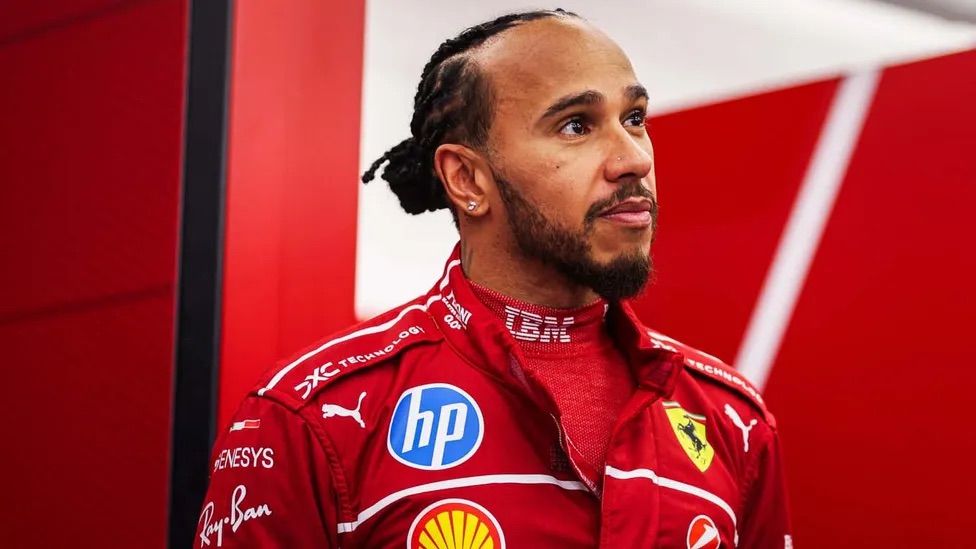
Perhaps the most stinging aspect of this saga is the human element involving Lewis Hamilton. The seven-time world champion shocked the world by announcing his departure from Mercedes to join Ferrari for the 2026 season. His move was a long-term bet, driven by the belief that Ferrari would master the new regulations while Mercedes might falter.
Ferrari sold Hamilton a vision of a regulatory reset where their engineering philosophy would reign supreme. But now, in a twist of cruel irony, it appears the team he left behind may have found the “silver bullet” for the new era. If this loophole stands, Hamilton could find himself in a Ferrari that is fundamentally slower than the Mercedes he walked away from. He famously admitted after the Las Vegas Grand Prix that he wasn’t “looking forward” to the new cars, a comment that now carries a heavier weight given the context.
The Revolt: A Coalition of the Concerned
The reaction from the rest of the grid has been swift and severe. Ferrari, Honda, and Audi have not just raised eyebrows; they have formally raised the issue with the FIA. They argue that while the trick might comply with the letter of the law regarding cold testing, it violates the spirit of the rules which require cars to be compliant “at all times” during competition.
Their fear is compounded by the ticking clock. With homologation deadlines looming—the dates by which engine designs must be frozen—teams who didn’t pursue this thermal expansion concept are effectively locked out. They cannot simply “copy” the design in a few weeks; it would require a fundamental restructuring of their engine architecture, something that takes months, if not a full year.
This has led to genuine threats of protests at the season opener. We are looking at a scenario where the results of the first race of 2026 could be decided in a courtroom rather than on the asphalt.
History Repeats Itself
Veteran F1 fans will recognize this pattern. It echoes the 2009 Double Diffuser controversy, where Brawn GP found a loophole that propelled them from the back of the grid to a championship double. It also recalls the 2020 DAS (Dual Axis Steering) system developed by Mercedes, which was declared legal for one season before being banned.
The difference here is the transparency. Reports suggest Mercedes maintained an open dialogue with the FIA throughout the development of this concept, receiving assurances that their interpretation was valid. If true, this isn’t a case of a team hiding a cheat; it’s a team outsmarting the rule-makers with the rule-makers’ permission.
What Happens Next?
The immediate future of the sport hangs in the balance. The FIA is now caught between a rock and a hard place. If they ban the concept now, they punish innovation and potentially unfairly penalize teams that followed the agreed process. If they allow it, they risk a two-tier championship where Mercedes and Red Bull run away with the title while major manufacturers like Ferrari and Audi serve as mere background actors.
Rumors of a compromise are circulating—perhaps allowing the system for one year before closing the loophole. But for competitors like Ferrari, even one year of baked-in disadvantage undermines the entire purpose of the 2026 reset.
As the pre-season approaches, the silence from the FIA is deafening. Will the 2026 season be defined by brilliant engineering or bitter legal battles? For Lewis Hamilton and Ferrari, the answer to that question could define the final chapter of a legendary career. One thing is certain: the “Great Reset” has already begun, and it is far messier than anyone predicted.
News

Inside Shane Richie’s love life: Drug – fuelled orgy with six blondes; real reason he split from Coleen Nolan; six-year ‘affair with fan’
Inside Shane Richie’s love life: Orgy with six blondes; real reason he split from Coleen Nolan; six-year ‘affair with fan’ He’s popular with the ladies… Shane Richie…

SH0CKING REVELATI0N:A sh0cking behind-the-scenes secret revealed about Lizzie Rizzini, the woman replacing Carol Kirkwood on the 6pm weather bulletin
BBC viewers still reeling from the departure of Carol Kirkwood got another surprise last night when presenter Lizzie Rizzini appeared to flash her black lace stockings on…

HEARTBREAKING: Peter Andre’s Tearful Message to Son Junior After SHOCKING Revelation About How He Truly Feels Toward Mum Katie Price — Katie Price’s reaction scares fans.
Peter Andre’s emotional message to son Junior after it’s revealed how he really feels about mum Katie Pri… PETER Andre has shared an emotional message to his…

Ben Shephard opens up about the devastating health battle his wife is facing: “She wakes up crying every single morning…”
Inside This Morning Ben Shephard’s Life Including Rarely Seen Wife and Health Battle Ben Shephard is a name synonymous with British television, renowned for his engaging presentation…

🚨 LIVE TV HEARTBREAK: Good Morning Britain Host Announces ‘Devastating’ Dɘath of Guest Minutes Into Show
Viewers of Good Morning Britain were met with heartbreaking news just minutes into Friday’s (January 30) episode, as co-hosts Kate Garraway and Ranvir Singh reported the tragic…

Emmerdale legend Cain Dingle will never be the same again after a shock cancer diagnosis turns his world upside down
FROure Desk. Full Terms and conditions are available on the website http://www.itv.com/presscentre/itvpictures/terms Emmerdale wouldn’t be Emmerdale without the glowering, grunting embodiment of manliness that is Cain Dingle (Jeff Hordley) But…
End of content
No more pages to load






