The future of Formula 1 has officially arrived, and it is louder, wider, and more technically diverse than anyone predicted. The 2026 season might feel like a distant dream on the calendar, but for the engineering giants of the grid, the war has already begun.
We have finally received our first genuine look at the machinery that will define the next era of motorsport. From the secretive studios of Milton Keynes to the wet tarmac of Silverstone and Barcelona, the covers are coming off. Red Bull Racing, VCARB (Racing Bulls), Cadillac, and Audi have all played their opening hands, revealing renders and completing shakedowns that give us our first tantalizing taste of the 2026 regulations.
Forget what you thought you knew about “spec series” or restrictive rules. If these early glimpses are anything to go by, we are entering a golden age of divergent thinking and radical engineering. Let’s dive deep into the secrets, the surprises, and the shocking design splits that have just been exposed.

Red Bull RB22: The Champion’s Evolution or Revolution?
When the kings of the current era drop a car, the world stops to listen. The RB22 renders are here, and they are anything but conservative. While teams often hide their true cards during launch season, the specific details visible on the Red Bull challenger suggest a team that is aggressively chasing performance rather than playing it safe.
The most striking feature immediately grabs you by the collar: the front wing. It’s a trip down memory lane, evoking the aggressive aerodynamics of the 2013-2014 era with a massive slot gap. But look closer, and you see the future. The nose connects directly to the first element, flanked by a central support that likely doubles as an airflow splitter. This isn’t just about holding the wing up; it’s about managing the chaotic air before it even touches the rest of the car.
We are seeing a clear focus on “active aero” capabilities. The central piece appears to house the actuator for the active wing elements—a critical component of the 2026 ruleset. The curvature of the elements is fascinating, with vertical fins and end plates canted inwards. The goal? A powerful “inwash” effect, sucking air in to manipulate the destructive wake turbulence generated by the front tires.
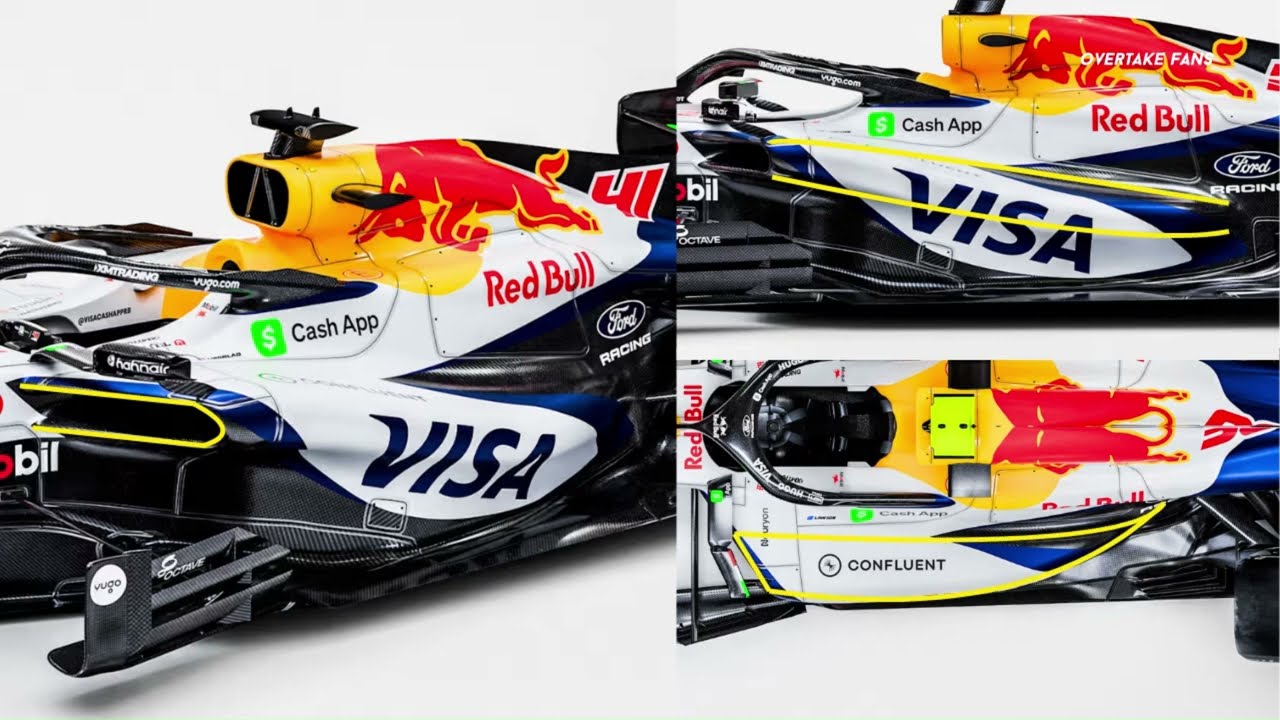
Moving downstream, Red Bull hasn’t abandoned their current philosophy entirely. The sidepods retain the “overbite” style with those intricate water slides we’ve come to admire in 2025, but they are noticeably more compact. The RB22 features a tightly integrated cooling package, shrinking the bodywork to maximize aerodynamic efficiency.
But here is the detail that has everyone talking: the cockpit position. In a significant shift from the standard FIA models, Red Bull has moved the driver’s seat slightly rearwards. This is a deliberate play for physics optimization, likely shifting the center of gravity to aid rear traction. Combined with a rumored switch to a double push-rod suspension—mirroring whispers coming out of Maranello regarding Ferrari—it seems Red Bull is completely rethinking the mechanical platform of their car.
VCARB: The “Little Brother” Bites Back
If you expected the Racing Bulls (VCARB) to simply photocopy the Red Bull blueprints, think again. The 2026 VCARB challenger is a rebellious statement of intent, sporting design philosophies that are diametrically opposed to its senior sibling.
The visual differences start right at the nose. VCARB has opted for a much bulkier nose section and, crucially, a completely different actuation system for the active aero, utilizing two distinct “pods” rather than Red Bull’s central pillar. It’s a cleaner, perhaps more robust solution that suggests they are finding their own path in the wind tunnel.
The most shocking divergence, however, is in the chassis geometry. While Red Bull moved their cockpit back, VCARB has shifted theirs forward. This is massive. It fundamentally changes the aerodynamic balance and the driver’s feel for the car. It proves that despite shared ownership, these two teams are operating with genuine technical independence.
Their floor design is equally intriguing. They’ve introduced an “L-shaped” slot configuration at the rear floor corner—a complex geometry designed to generate longitudinal vortices. This is high-risk, high-reward aerodynamics. While Red Bull sticks to vertical slots, VCARB is betting on a more intricate flow structure to seal the floor. To aid this, they’ve added a support stay to the floor fence, hinting at a desire to push the floor edges harder and generate aggressive outwash without structural flexing.
The sidepods are a love letter to the Ferrari F-175, featuring wide, periscope-style inlets. It’s a voluptuous, fuller design compared to Red Bull’s shrink-wrapped approach, proving that there is more than one way to skin a cat—or in this case, cool a hybrid power unit.
Cadillac: The American Gambler
Welcome to the grid, Cadillac. The American giant didn’t just release a render; they rolled a real car out onto the historic asphalt of Silverstone for a shakedown. And they did not come to play it safe.
The Cadillac challenger, clearly a “Spec A” launch car, already shows a willingness to break convention. The headline grabber here is the suspension. In a field seemingly moving toward push-rod geometry at the front, Cadillac has bolted on a pull-rod front suspension.
Why does this matter? It lowers the center of gravity and changes the airflow characteristics into the floor inlets. It’s a contrarian move that suggests Cadillac’s engineers have found a loophole or a specific benefit that the others might have missed.
Visually, the car borrows from the best. The sidepod inlets remind us of the Ferrari SF23, but with a heavy “downwashing” ramp designed to feed air directly to the rear diffuser. The front wing features two distinct fins compared to Red Bull’s one, creating a powerful outwash effect to push dirty air away from the car. For a new team, the level of detail on the “curved foot plates” and the endplate integration is impressive. They aren’t just here to make up the numbers; they are here to race.
Audi: The Silent Threat
Audi was the first to hit the track, conducting their shakedown in Barcelona. True to stereotype, perhaps, the car looks efficient, basic, and purposeful.
The Audi design features a high nose and a “double push-rod” suspension layout, aligning them with the majority consensus (unlike Cadillac). The bodywork is distinctively simple, with a “high-waisted” sidepod design that creates a large sidewall before tapering into a gentle downwash.
Critics might call it plain, but in F1, “plain” often means a solid baseline. The rear wing is notably the “skinniest” of the group, suggesting a low-drag philosophy or perhaps a confidence in the underbody downforce that allows them to trim the wings. It’s a “Spec A” car in the truest sense—a blank canvas that will likely evolve massively before the lights go out in Melbourne. But make no mistake, the German manufacturer is on the board.
The Verdict: A Season of Discovery
We are looking at the birth of a new species of Formula 1 car. The most exciting takeaway from these reveals is the diversity. We have pull-rods vs. push-rods. We have forward cockpits vs. rearward cockpits. We have shrink-wrapped sidepods vs. bulky periscopes.
This isn’t a spec series. This is a technical war.
And the sound? While it’s not the screaming V10s of old, early reports from the trackside suggest the new power units have a distinct, throaty character that is a step up from the current hybrids. They sound “okay”—which, in modern F1 terms, is a win.
As we march toward pre-season testing, keep your eyes on the details. The floor edges, the wing actuators, and those suspension geometries will decide the championship. Red Bull looks dangerous, VCARB looks bold, and the newcomers are hungry. 2026 can’t come soon enough.
News

Inside Shane Richie’s love life: Drug – fuelled orgy with six blondes; real reason he split from Coleen Nolan; six-year ‘affair with fan’
Inside Shane Richie’s love life: Orgy with six blondes; real reason he split from Coleen Nolan; six-year ‘affair with fan’ He’s popular with the ladies… Shane Richie…

SH0CKING REVELATI0N:A sh0cking behind-the-scenes secret revealed about Lizzie Rizzini, the woman replacing Carol Kirkwood on the 6pm weather bulletin
BBC viewers still reeling from the departure of Carol Kirkwood got another surprise last night when presenter Lizzie Rizzini appeared to flash her black lace stockings on…

HEARTBREAKING: Peter Andre’s Tearful Message to Son Junior After SHOCKING Revelation About How He Truly Feels Toward Mum Katie Price — Katie Price’s reaction scares fans.
Peter Andre’s emotional message to son Junior after it’s revealed how he really feels about mum Katie Pri… PETER Andre has shared an emotional message to his…

Ben Shephard opens up about the devastating health battle his wife is facing: “She wakes up crying every single morning…”
Inside This Morning Ben Shephard’s Life Including Rarely Seen Wife and Health Battle Ben Shephard is a name synonymous with British television, renowned for his engaging presentation…

🚨 LIVE TV HEARTBREAK: Good Morning Britain Host Announces ‘Devastating’ Dɘath of Guest Minutes Into Show
Viewers of Good Morning Britain were met with heartbreaking news just minutes into Friday’s (January 30) episode, as co-hosts Kate Garraway and Ranvir Singh reported the tragic…

Emmerdale legend Cain Dingle will never be the same again after a shock cancer diagnosis turns his world upside down
FROure Desk. Full Terms and conditions are available on the website http://www.itv.com/presscentre/itvpictures/terms Emmerdale wouldn’t be Emmerdale without the glowering, grunting embodiment of manliness that is Cain Dingle (Jeff Hordley) But…
End of content
No more pages to load






