Formula 1 is a sport of constant evolution, a high-speed chess match played at 200 miles per hour where the rules of engagement change every few years. As fans, we are constantly sold the dream of “better racing.” We are promised closer battles, more overtaking, and cars that can follow each other nose-to-tail without sliding off the track. The massive regulation overhaul planned for 2026 is supposed to be the next great leap forward in this quest. However, a startling new aerodynamic analysis suggests that instead of a dream, we might be sleepwalking into a familiar nightmare.
Recent simulations using detailed 3D models of the proposed 2026 cars have shed light on the invisible war being fought between the air and the asphalt. The results? They are far from the silver bullet the regulators—and the fans—were hoping for. In fact, the data indicates that the “dirty air” problem, the arch-nemesis of exciting racing, might not only persist but could potentially worsen as teams get their hands on the new designs.
The “Dirty Air” Dilemma: A Quick Refresher
To understand why this is such a bombshell, we have to look at why F1 cars struggle to overtake in the first place. It all comes down to the wake—the turbulent, chaotic air left behind by a race car.
An F1 car is essentially an inverted airplane wing; it uses air pressure to push itself down onto the track, generating “downforce” that allows it to corner at insane speeds. But to generate that downforce, the car must rip through the air, leaving a trail of “dirty,” low-energy air behind it. When a following car drives into this turbulent wake, its wings and floor can’t work properly. The car loses grip, the tires overheat as the car slides, and the driver is forced to back off.
The 2022 regulations, written by Ross Brawn and his team, tried to fix this by generating downforce from the floor (ground effect), which is less sensitive to dirty air. It worked—briefly. But as teams act in their own self-interest, they found ways to push that dirty air outwards (outwash) to protect their own car, inadvertently throwing it back into the path of the car behind.
The 2026 Promise: Inwash vs. Outwash
Enter the 2026 regulations. The FIA creates these rules with a specific philosophy in mind: force the cars to be “inwashing.” The goal is to design a car where the dirty air is sucked in and pushed upwards, high above the track, allowing fresh, “clean” air to close in underneath and feed the car behind.
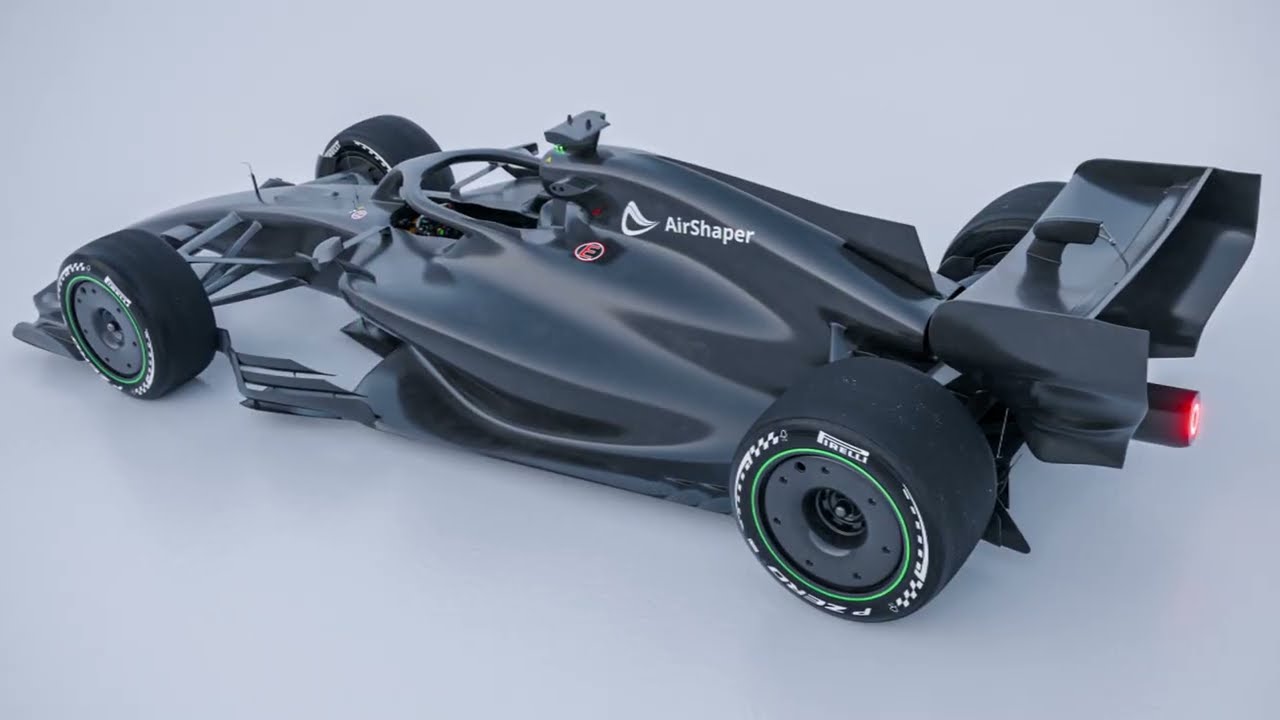
The 2026 design features a return to flat floors, a heavier reliance on wings, and specific aerodynamic devices like floorboards behind the front wheels intended to manage this wake. On paper, it looks like a solid plan. The theory is that if the dirty air goes up, the car behind can breathe.
However, theory and reality rarely shake hands in Formula 1.

The Simulation: A Warning Sign
Thanks to a detailed 3D model designed by talented artist Amir Quist and simulations run via Air Shaper, we now have a visual representation of what actually happens when one 2026 car follows another with a 10-meter gap. The results are a mixed bag with some alarming red flags.
Visually, the simulation shows the “high energy” (clean) air in dark red and the “low energy” (dirty) air in yellow and blue.
The good news? The regulators’ plan works to some extent. You can see the wake being pushed upwards, and some clean air does close in around the following car. But—and it’s a massive “but”—the critical areas of the following car are still getting hammered.
The simulation reveals a distinct “yellow line” of disturbed air hitting the center of the following car’s front wing. While the floor seems relatively unaffected, the rear wing sits squarely in a zone of low-energy, turbulent air. This is catastrophic for performance. The rear wing is a primary device for balance and grip. If it’s sitting in a “dead zone” of air, the car becomes unstable at the rear, making it terrifyingly difficult for a driver to commit to a corner while chasing an opponent.
The “Bubble” of Bad Air
Perhaps the most concerning aspect of this analysis is the 3D path of the low-energy air. The visualization shows that while clean air is wrapping around the sides, the entire center of the car behind the front axle is effectively driving in a bubble of bad air.
This means the car isn’t just losing a little bit of performance; it is being starved of the aerodynamic pressure it needs to function. The front wing loses downforce, causing understeer (the car won’t turn in). The rear wing loses downforce, causing oversteer (the rear slides out). It is a double whammy that destroys tires and confidence in equal measure.
Why This is the “Best Case” Scenario
If you think these results sound bad, it is important to realize that this simulation likely represents the best-case scenario.
The model used in this test represents an early interpretation of the rules. It generates some outwash, but it is relatively “polite” compared to what a ruthless F1 engineering team will produce.
In Formula 1, no team cares about the quality of the racing; they care about winning. Aerodynamic departments are paid millions of dollars to find loopholes. Their goal is to push the wake as far outboard as possible to ensure their car runs in clean air. They do not care if that wake destroys the race for the driver behind them. In fact, that’s a competitive advantage.
As the video analysis points out, if a single artist and a simulation tool can identify these outwash issues now, imagine what a team of 100 PhD-level engineers will do. They will maximize outwash to seal their floors, and in doing so, they will throw even more dirty air directly into the face of the trailing car.
Reintroducing Old Problems
The fear is that 2026 will simply reintroduce the problems we thought we were solving. We are moving back to a reliance on wings—parts that are notoriously sensitive to turbulence—while simultaneously creating an environment where that turbulence is unavoidable.
If the “best case” shows significant downforce loss on the front and rear wings, the “real world” scenario in 2026 could be a return to the dark ages of the mid-2010s, where overtaking was impossible without a massive speed advantage.
The Verdict
We must give credit to the regulators for trying. The intention to manipulate the wake upwards is noble. But physics is a cruel mistress. As we look at these yellow and blue streaks of suffocated air in the simulation, it’s hard not to feel a sense of foreboding.
The 2026 cars will feature active aerodynamics and new power units, which will add other variables to the mix. But aerodynamics remains king. If a car cannot follow through a high-speed corner because its wings are dead, no amount of engine power will save the show.
As we inch closer to this new era, the question remains: Are we fixing the sport, or are we just designing a new way for cars to struggle? Only time—and perhaps a few frustrated drivers screaming over the radio—will tell.






