The lights dimmed in Munich, the music swelled, and the covers were pulled back to reveal… a paint job.
In the high-stakes world of Formula 1, appearances are everything, and Audi’s official entry into the sport was supposed to be the moment the German giant stomped its authority on the grid. Instead, what fans and pundits witnessed was a masterclass in smoke and mirrors. The car on stage—a stunning fusion of 1930s Auto Union heritage and futuristic titanium aesthetics—was undeniably beautiful. But let’s be clear: it was a show pony. The real weapon, the Audi R26, remains a ghost, hidden away in the shadows of the team’s factory and restricted to grainy, Zapruder-style footage shot through the fences of a Barcelona circuit.
As the newest “works” team on the grid, Audi has arrived with immense fanfare, taking over the Sauber operation and promising to challenge the titans of McLaren, Red Bull, Mercedes, and Ferrari. Yet, beneath the glossy surface of their launch event lies a tangled web of technical intrigue, conservative engineering, and a potentially explosive controversy regarding the 2026 engine regulations that could hamstring their efforts before the five red lights even go out.
The Ghost in the Machine
It is a strange paradox: Audi was technically the first team to hit the track in 2026, beating newcomers Cadillac and the rebranded Racing Bulls to the punch. On January 9th, amidst the winter chill of Barcelona, the R26 completed an early shakedown. But if you were expecting high-definition glamor shots of this historic moment, think again. The team released a few “teaser” images that revealed almost nothing. The only genuine glimpses came from dedicated spies camped outside the circuit perimeter, capturing blurry videos of a car that looked… well, basic.
This secrecy isn’t just about protecting intellectual property; it’s about managing expectations. The real R26, according to insiders, is an “early iteration” design. It features push-rod suspension on both the front and rear and sports very rudimentary aerodynamic features. It is a car built for one purpose: survival.
Audi is acutely aware of the mountain it has to climb. Unlike an established team refining a winning concept, Audi is building from the ground up while simultaneously navigating a complete overhaul of the sport’s technical regulations. The car that ran in Barcelona wasn’t chasing lap times; it was checking systems. In fact, despite being allowed 200 kilometers of running during a filming day, Audi only managed about a quarter of that distance.
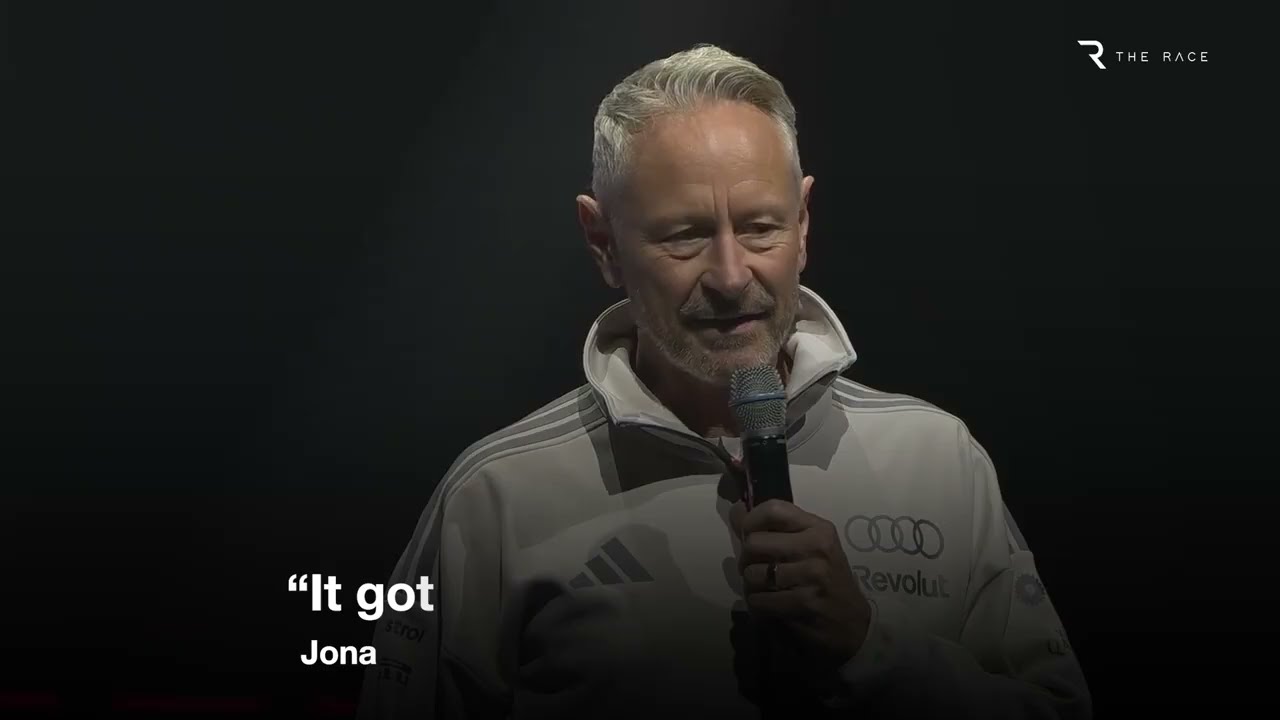
Team Principal Jonathan Wheatley, a man who knows a thing or two about winning from his Red Bull days, described the car as one designed “from front to back with one purpose.” That purpose is integration—making sure the chassis and the new Audi power unit talk to each other without exploding. But the cautious approach suggests that the “real” Audi, the one that will eventually fight for podiums, is still a long way from the tarmac.
The Engine War: A “Dirty Trick” or Smart Engineering?
While the car’s aerodynamics might be basic, the real drama is unfolding under the engine cover. F1 is entering a new engine era in 2026, and with it comes the first major controversy of the cycle. It centers on a seemingly dry technical specification: the compression ratio.
The new regulations mandate a compression ratio of 16:1, a reduction from the previous 18:1, to be measured under static conditions at ambient temperature. It sounds simple enough. However, in the cutthroat world of F1 engineering, “simple” is just another word for “opportunity.”
A fierce debate has erupted behind the scenes. Audi, aligning with fellow manufacturers Honda and Ferrari, interprets this rule as a hard limit that applies at all times. In their view, the engine should never exceed that 16:1 ratio, regardless of the conditions.
Mercedes and, to a lesser extent, Red Bull Ford Powertrains, reportedly see it differently. Their interpretation is that the engine only needs to meet the 16:1 limit when measured statically. Once the car is on track, engines get hot. Components expand. Physics takes over. Their argument is that if the compression ratio naturally rises above 16:1 due to thermal expansion during a race, that’s perfectly legal.
Why does this matter? Because a higher compression ratio equals more power.
Estimates suggest that exploiting this loophole could yield a performance advantage of up to three-tenths of a second per lap. In a sport where pole positions are decided by thousandths, three-tenths is an eternity. It is a “significant gap,” admitted Mattia Binotto, the former Ferrari boss now steering the Audi ship.
Audi is furious, or at least as furious as a corporate giant allows itself to appear. They believe this interpretation essentially legalizes a trick that violates the spirit of the cost-cap and the new efficiency rules. Binotto sidestepped direct accusations during the launch, playing the diplomat, but his frustration was palpable. When pressed on the reality of this disadvantage, he conceded that it would make a massive difference in competition.
The bad news for Audi is that the FIA is unlikely to issue a clarification or close this loophole for the 2026 season. Any changes would likely come in 2027 at the earliest. This means that if Mercedes and Red Bull have indeed designed their engines to exploit this “thermal expansion” trick, Audi—along with Ferrari and Honda—could be baked into a performance deficit for the entire debut season. For a new manufacturer trying to prove its worth, starting on the back foot due to a semantic debate in the rulebook is a nightmare scenario.

Mission 2030: The Long and Winding Road
Perhaps sensing the turbulence ahead, Audi’s leadership is playing the long game. They have dubbed their journey “Mission 2030.”
It is a timeline that feels both realistic and dangerously corporate. In F1, five-year plans are often the things team principals cite right before they are fired. However, Binotto and Wheatley are preaching patience. The goal for 2026 is modest to the point of being humble: finish the first race. Get through the first weekend without a major failure. By the end of the year, they hope merely to be “perceived as a strong and serious competitor.”
This is not the talk of a team expecting to win. It is the talk of a team that knows it is still a construction site. Sauber, the entity Audi purchased, has been struggling for years. They are still recovering from the financial crater left when BMW pulled out in 2009. The team is currently expanding its Hinwil base, building a new “Audi Motorsport Technology Center” in the UK to tap into British engineering talent, and waiting on a new driver-in-the-loop simulator.
Binotto was candid about the targets. He reframed the objective not as “winning a championship by 2030” but as being in a position to fight for one. “You can never guarantee being able to win it,” he noted, “and you certainly have no divine right to do so.”
It is a refreshing dose of honesty in a sport often fueled by hubris. But it also highlights the scale of the challenge. Audi isn’t just building a car; they are building a culture. Wheatley has been instrumental in this, trying to instill a winning mentality into a workforce accustomed to the midfield. But culture doesn’t put lap times on the board—engineering does.

The Verdict
Audi’s entry into Formula 1 is undeniably a good thing for the sport. A major manufacturer, a historic brand, and serious investment are all positive indicators. But the “phantom” launch of the R26 and the brewing storm over engine regulations suggest that the honeymoon period will be short.
They have managed to get ahead of the game logistically—firing up their engine in December and hitting the track in early January—but they are walking into a minefield. If the rumors of the compression ratio loophole are true, Audi could find itself bringing a knife to a gunfight, armed with an engine that is legally “pure” but competitively obsolete.
For now, the R26 remains a mystery, a basic machine hidden from prying eyes, likely because there isn’t much yet to show off. The flashbulbs in Munich illuminated a bright future, but the reality on the track in Bahrain next month might be a stark, gritty struggle for survival.
Audi has arrived. But the race is only just beginning, and they may already be starting from the pit lane.
News

Inside Shane Richie’s love life: Drug – fuelled orgy with six blondes; real reason he split from Coleen Nolan; six-year ‘affair with fan’
Inside Shane Richie’s love life: Orgy with six blondes; real reason he split from Coleen Nolan; six-year ‘affair with fan’ He’s popular with the ladies… Shane Richie…

SH0CKING REVELATI0N:A sh0cking behind-the-scenes secret revealed about Lizzie Rizzini, the woman replacing Carol Kirkwood on the 6pm weather bulletin
BBC viewers still reeling from the departure of Carol Kirkwood got another surprise last night when presenter Lizzie Rizzini appeared to flash her black lace stockings on…

HEARTBREAKING: Peter Andre’s Tearful Message to Son Junior After SHOCKING Revelation About How He Truly Feels Toward Mum Katie Price — Katie Price’s reaction scares fans.
Peter Andre’s emotional message to son Junior after it’s revealed how he really feels about mum Katie Pri… PETER Andre has shared an emotional message to his…

Ben Shephard opens up about the devastating health battle his wife is facing: “She wakes up crying every single morning…”
Inside This Morning Ben Shephard’s Life Including Rarely Seen Wife and Health Battle Ben Shephard is a name synonymous with British television, renowned for his engaging presentation…

🚨 LIVE TV HEARTBREAK: Good Morning Britain Host Announces ‘Devastating’ Dɘath of Guest Minutes Into Show
Viewers of Good Morning Britain were met with heartbreaking news just minutes into Friday’s (January 30) episode, as co-hosts Kate Garraway and Ranvir Singh reported the tragic…

Emmerdale legend Cain Dingle will never be the same again after a shock cancer diagnosis turns his world upside down
FROure Desk. Full Terms and conditions are available on the website http://www.itv.com/presscentre/itvpictures/terms Emmerdale wouldn’t be Emmerdale without the glowering, grunting embodiment of manliness that is Cain Dingle (Jeff Hordley) But…
End of content
No more pages to load






