The polite handshakes of pre-season testing are over. In the dark corridors of power within Formula 1, the knives are out. As the teams pack their freight for the season-opening Australian Grand Prix in Melbourne, a frantic political battle has erupted behind the scenes—one that could decide the championship before a single wheel turns in anger.
At the center of the storm is Mercedes. The German manufacturer, looking revitalized and dangerously fast, is the target of a coordinated strike by its rivals. The accusation? They have found a way to circumvent the strict engine regulations, unlocking performance that the rest of the grid simply cannot match.
The weapon of choice for the opposition is not a better car, but a rule change. And they are racing against the clock to get it pushed through before the lights go out at Albert Park.
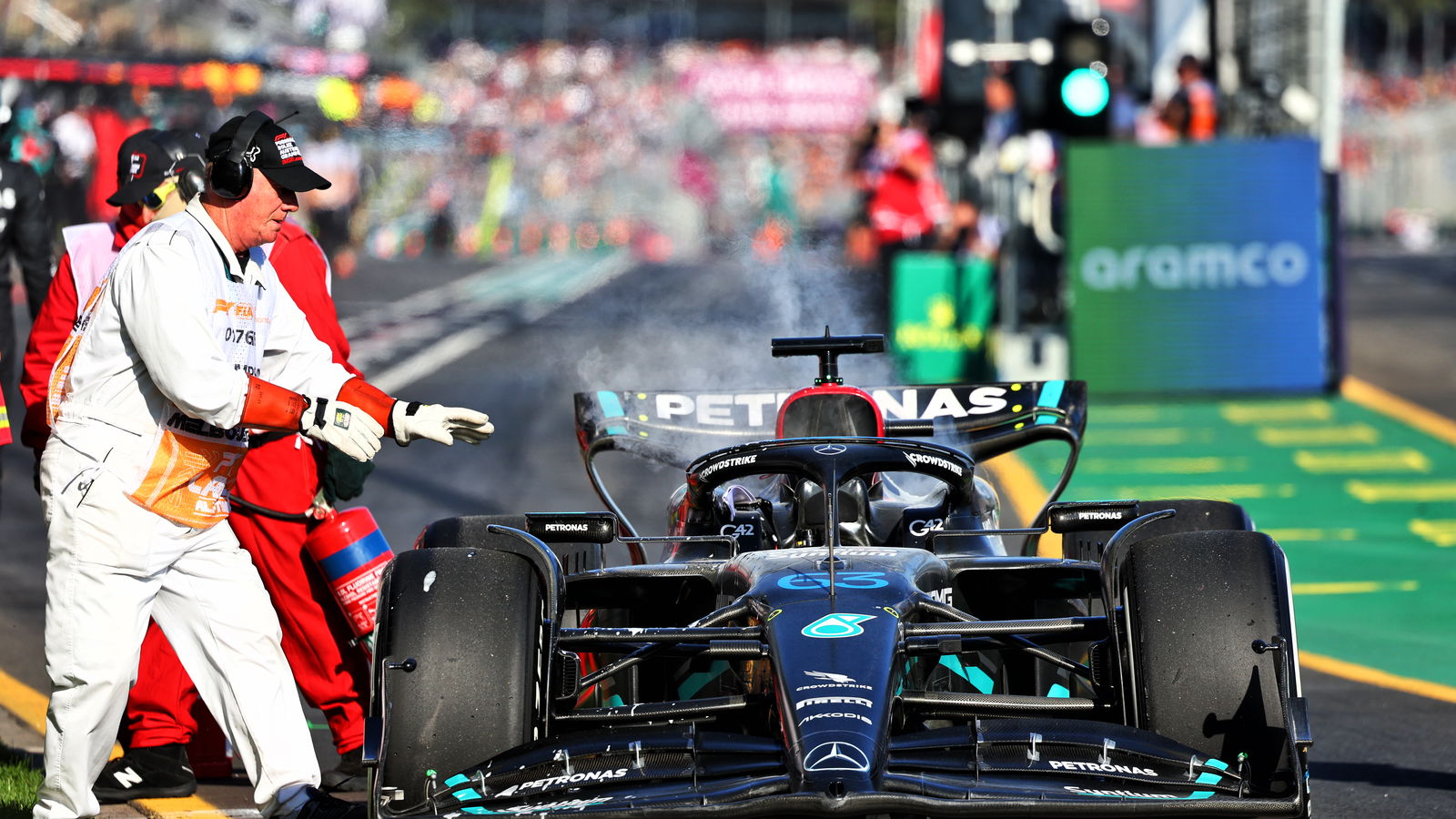
The “Hot Engine” Loophole
To understand the panic, one must understand the technicality at play. The dispute revolves around the “compression ratio” of the internal combustion engine—a critical factor in determining how much power and efficiency can be squeezed out of the fuel.
The regulations state a strict limit: a compression ratio of 16:1. This rule is designed to keep a lid on development costs and ensure a level playing field. However, there is a catch. The rulebook explicitly states that compliance checks for this ratio are conducted at “ambient temperature”—essentially, when the engine is cold and sitting in the garage.
This is where Mercedes is suspected to have played their ace card.
Reports indicate that the Silver Arrows have engineered a system that respects the 16:1 limit when cold, but effectively alters the compression physics once the engine is running at blistering operating temperatures on the track. By managing thermal expansion or using materials that behave differently under heat, they are allegedly achieving a much higher effective compression ratio during the race.
The result? More power, better efficiency, and a significant lap time advantage.
Technically, under the current wording of the rules, it is legal. The car passes the test as written. But practically, rivals are furious, claiming it violates the “spirit” of the regulations—a phrase often used in F1 when a team has been outsmarted.
The Revolt of the Manufacturers
The opposition is led by a powerful triumvirate: Audi, Ferrari, and Honda. These manufacturers have been the most vocal, writing letters to the FIA and demanding clarification. They argue that checking a race engine when it is cold is nonsensical and that the procedure must be updated to reflect real-world conditions.
But they know that complaining isn’t enough. To stop Mercedes, they need action.
Two crucial meetings have taken place in recent days to address the crisis—one involving technical experts on Monday, and a high-stakes gathering of the Power Unit Advisory Committee (PUAC) on Thursday. The goal of the rebel alliance was clear: force an immediate change to the testing procedures. They proposed new methods, including using on-board sensors to monitor compression while the car is on track, or conducting physical checks immediately after sessions when the engines are still scorching hot.
So far, however, they have hit a brick wall.
Sources confirm that no agreement was reached in these meetings. The FIA, the sport’s governing body, has reportedly stood firm, aligning with Mercedes’ interpretation. Their stance is simple: the rule says “ambient temperature,” Mercedes passes at ambient temperature, therefore Mercedes is legal.

The Red Bull Twist
Perhaps the most intriguing development in this saga is the position of Red Bull.
Initially, it was whispered that the reigning champions were quiet on the matter because they, too, had found a similar loophole. If you are using the same trick, you don’t call the police on your neighbor.
However, the winds have shifted. Recent reports suggest that Red Bull may be pivoting to join the opposition. Why the sudden change of heart? The paddock theory is ruthless: Red Bull tried to replicate the Mercedes gain but failed.
If Red Bull’s engineers found that they couldn’t make the “hot compression” trick work reliably—or if the gains weren’t as significant as what Mercedes achieved—their strategy would logically switch from “let’s copy it” to “let’s ban it.” If they can’t have the advantage, they must ensure Mercedes doesn’t keep it either.
This potential flip is massive. For a rule change to be forced through at this late stage—under the “immediate modification” governance protocols—it requires a “super-majority.” Specifically, four out of the five current manufacturers must agree, along with the FIA and Formula One Management (FOM).
With Audi, Ferrari, and Honda already on board, Red Bull’s vote would provide the crucial fourth manufacturer signature. That would leave Mercedes isolated, fighting alone against the entire grid.
The Race Against Melbourne
The clock is ticking. The rebel teams are currently drafting a formal proposal to be voted on by the PUAC, with the explicit aim of having new testing procedures in place for the Australian Grand Prix.
This is an incredibly aggressive timeline. Changing a fundamental compliance check days before the season opener is almost unheard of. It would require logistical changes, new equipment for the scrutineers, and a complete shift in how the cars are policed.
Moreover, even if the teams get the four votes, they still need the FIA to agree. Historically, the FIA is reluctant to change rules mid-game effectively punishing a team for being clever. If Mercedes has followed the letter of the law, banning their innovation at the eleventh hour could be seen as unfair penalization of engineering excellence.
What’s at Stake?
The implications of this battle are enormous. If the rule remains as is, Mercedes heads to Melbourne with a locked-in advantage. In an era of cost caps and frozen engine specs, an engine advantage is gold dust. It forces rivals to overdrive their cars, take risks with aerodynamics, and burn through tires just to keep up on the straights.
If the rule is changed, Mercedes could be forced to detune their engines or frantically re-engineer parts of their power unit to pass the new “hot” tests, potentially compromising their reliability or speed.
The silence from the Mercedes camp has been deafening. They know they are under siege. Toto Wolff’s previous comments about rivals needing to “get their act together” take on a new weight in light of these specific maneuvers. He knows they are trying to legislate him out of a win.
As the freight containers arrive in Albert Park, the real race isn’t on the asphalt; it’s in the meeting rooms. The 2026 season hasn’t just brought new cars; it has brought a new war. And right now, the first casualty might be the rulebook itself.
Will the FIA hold the line, or will the pressure from the united front of Ferrari, Honda, Audi, and Red Bull force a change? We will find out in Melbourne.
News

Inside Shane Richie’s love life: Drug – fuelled orgy with six blondes; real reason he split from Coleen Nolan; six-year ‘affair with fan’
Inside Shane Richie’s love life: Orgy with six blondes; real reason he split from Coleen Nolan; six-year ‘affair with fan’ He’s popular with the ladies… Shane Richie…

SH0CKING REVELATI0N:A sh0cking behind-the-scenes secret revealed about Lizzie Rizzini, the woman replacing Carol Kirkwood on the 6pm weather bulletin
BBC viewers still reeling from the departure of Carol Kirkwood got another surprise last night when presenter Lizzie Rizzini appeared to flash her black lace stockings on…

HEARTBREAKING: Peter Andre’s Tearful Message to Son Junior After SHOCKING Revelation About How He Truly Feels Toward Mum Katie Price — Katie Price’s reaction scares fans.
Peter Andre’s emotional message to son Junior after it’s revealed how he really feels about mum Katie Pri… PETER Andre has shared an emotional message to his…

Ben Shephard opens up about the devastating health battle his wife is facing: “She wakes up crying every single morning…”
Inside This Morning Ben Shephard’s Life Including Rarely Seen Wife and Health Battle Ben Shephard is a name synonymous with British television, renowned for his engaging presentation…

🚨 LIVE TV HEARTBREAK: Good Morning Britain Host Announces ‘Devastating’ Dɘath of Guest Minutes Into Show
Viewers of Good Morning Britain were met with heartbreaking news just minutes into Friday’s (January 30) episode, as co-hosts Kate Garraway and Ranvir Singh reported the tragic…

Emmerdale legend Cain Dingle will never be the same again after a shock cancer diagnosis turns his world upside down
FROure Desk. Full Terms and conditions are available on the website http://www.itv.com/presscentre/itvpictures/terms Emmerdale wouldn’t be Emmerdale without the glowering, grunting embodiment of manliness that is Cain Dingle (Jeff Hordley) But…
End of content
No more pages to load






