In the high-stakes world of Formula 1, championships are rarely lost in a blaze of glory. They aren’t usually decided by a fiery engine failure or a dramatic last-lap crash. More often than not, they are lost in a quiet, air-conditioned room full of brilliant engineers who, for just a split second, misread the room.
That is precisely the horror story that unfolded for McLaren at the 2025 Qatar Grand Prix.
What was supposed to be a coronation—a calm, controlled march toward a Drivers’ Championship for Lando Norris—transformed into a strategic catastrophe that has left the team fractured, the drivers alienated, and the title fight blown wide open.

The “Perfect” Weekend That Wasn’t
Going into the Qatar weekend, the mood at McLaren was bordering on invincible. The MCL39 was a masterpiece of engineering: stable, efficient, and blistering fast. Lando Norris arrived at the Lusail International Circuit with a commanding lead, sitting comfortable with a buffer that made the final races feel like a formality. His teammate, Oscar Piastri, was equally formidable, and the duo had locked out the front row.
The script was written: control the race, manage the tires, and head to the season finale in Abu Dhabi with the champagne already on ice. But Formula 1 has a cruel way of shredding scripts.
The turning point came early, on Lap 7. A minor collision scattered debris across the track, triggering a Safety Car. It was a standard racing incident, but it carried heavy strategic weight due to a mandated tire rule imposed by the FIA and Pirelli for the weekend: no tire could run more than 25 laps.
This rule meant pit stops were not just necessary; they were mathematically critical. A Safety Car this early was a golden ticket—a chance to clear a mandatory stop while the field was bunched up and slow.
The Decision That Changed Everything
When the Safety Car lights flashed, the pit lane erupted with activity. Red Bull reacted instantly, pulling Max Verstappen in. Mercedes followed suit with George Russell. Even Ferrari, often criticized for strategic hesitancy, seized the moment.
But McLaren stayed out.
It was a baffling decision. Norris and Piastri were left circulating on old rubber while their rivals banked “free” pit stops. The confusion was audible over the radio. Norris, usually calm, asked politely if they had missed something. His voice didn’t carry anger, but it carried the distinct tremor of a driver who had done the math and realized it didn’t add up.
His engineer’s reply was vague, citing “flexibility.” In reality, that flexibility was a trap. By the time the race resumed, the pack had shuffled. When McLaren finally did pit, they didn’t emerge in clean air. They dropped straight into traffic, forced to wrestle cold, hard tires onto a dirty track behind slower cars.
The consequences were immediate and painful. The clean air and rhythmic pace the MCL39 thrived on were gone. Norris and Piastri were now fighting for scraps, bleeding lap time to Verstappen, who was cruising in clean air on fresh rubber.

Internal Fractures: The Piastri Problem
If the strategic blunder was the wound, the team dynamics were the salt rubbed into it. As the race unraveled, a second, more dangerous narrative began to emerge.
Oscar Piastri was fast—arguably faster than Norris at key stages. GPS traces and sector times showed the Australian had superior traction and confidence in the medium-speed corners. He had the pace to potentially salvage a win or at least pressure Verstappen.
But the call never came to let him loose. Instead, the order was given: Hold position.
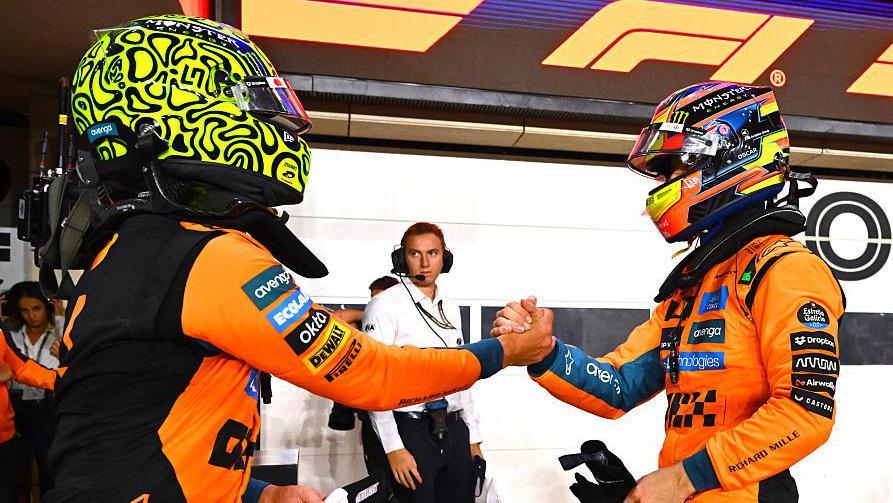
For a driver like Piastri, who has spent two seasons playing the loyal team player, this was a bitter pill to swallow. He didn’t explode over the radio—that isn’t his style. But his body language post-race screamed frustration. Shoulders slumped, eyes tired, a look of resignation mixed with simmering anger. He knew he had the car to win, but he was shackled by a team trying to protect a crumbling championship lead for his teammate.
This decision exposed a harsh truth: McLaren is no longer a team of two equals. In the heat of a title fight, they chose Norris. And Piastri felt it.
The Predator Awakens
While McLaren imploded, Max Verstappen did what he does best: he waited.
The Red Bull ace didn’t need to have the fastest car on the grid. He just needed to be perfect when his rivals weren’t. Verstappen’s drive in Qatar was a masterclass in patience. He let the race come to him, watching the papaya cars trip over their own strategy, and then stepped through the open door without hesitation.
His victory didn’t just earn him maximum points; it shattered McLaren’s psychological armor. The gap between Norris and Verstappen, once a comfortable ocean, has evaporated into a puddle. Heading into Abu Dhabi, only 12 points separate them.
In Formula 1 terms, 12 points is nothing. It’s a single bad pit stop. A sensor failure. A moment of hesitation.
The Road to Abu Dhabi
Now, the paddock turns its eyes to the Yas Marina Circuit for a finale that promises unparalleled drama. McLaren enters the final week not as confident conquerors, but as a team looking over its shoulder.
The pressure is immense. Norris is fighting the ghosts of previous near-misses. Piastri is fighting for his own identity within the team. And the entire McLaren pit wall is fighting to regain the trust of their drivers.
Meanwhile, Verstappen arrives with the calm of a three-time champion who has nothing to lose. He knows he has rattled them. He knows they are second-guessing every call. And he knows that in the desert heat of Abu Dhabi, hesitation is fatal.
The 2025 season won’t be decided by who has the fastest car. It will be decided by who blinks first. In Qatar, McLaren blinked, and it cost them a dynasty. In Abu Dhabi, they will find out if they can open their eyes in time to save it.






