In the high-octane world of Formula 1, championships are often won or lost in the blink of an eye. But at the 2025 Las Vegas Grand Prix, the title fight took a dramatic and devastating turn—not on the asphalt, but in the sterile, fluorescent-lit inspection bay of the FIA.
In a shocking development that has sent shockwaves through the paddock, McLaren has been stripped of 30 crucial championship points following a double disqualification. Both Lando Norris and Oscar Piastri saw their hard-fought results erased from history after post-race scrutineering revealed their cars were in breach of technical regulations. The culprit? A discrepancy of less than three-tenths of a millimeter.
As the dust settles on the Las Vegas strip, the Woking-based team is left scrambling for answers, launching an urgent internal investigation to save their season. with Lando Norris still clinging to a precarious 24-point lead in the Driver’s Championship, the margin for error has completely evaporated. Here is the full story of the technical disaster that threatens to hand the title to Max Verstappen.
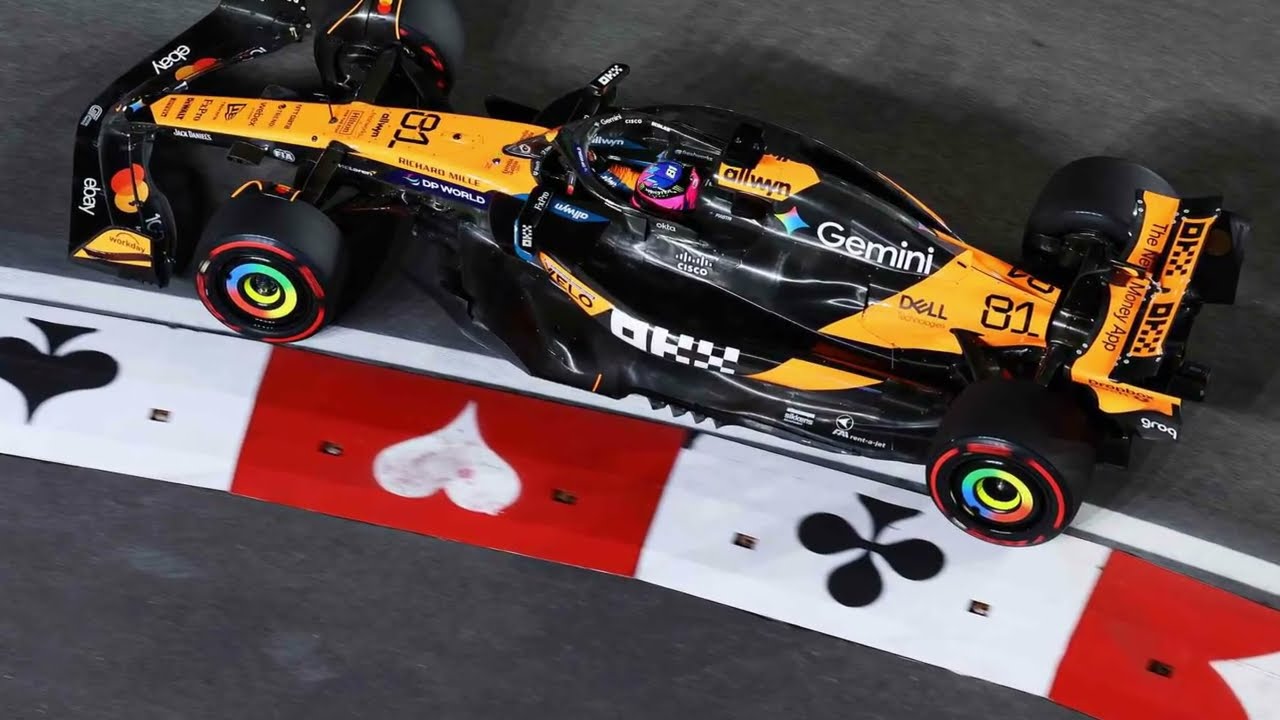
The “Perfect Storm” in Las Vegas
The issue centers on the “skid blocks”—the titanium planks mounted underneath the F1 cars that make contact with the track surface. According to FIA regulations, these blocks must maintain a minimum thickness of 9 millimeters. It is a black-and-white rule designed to prevent teams from running their cars too close to the ground to gain aerodynamic advantages.
However, when the FIA calipers were applied to the McLarens after the checkered flag, the numbers spelled disaster. Lando Norris’s skid block measured 8.88 mm at its rearmost point. Oscar Piastri’s was even thinner, coming in at 8.74 mm. Both cars were immediately deemed illegal.
So, how did a team renowned for its engineering precision get it so wrong?
According to McLaren’s initial findings, the team was hit by a “perfect storm” of factors that they failed to predict during practice sessions. The primary villain was the sudden and unexpected return of “porpoising”—the violent bouncing motion that plagued the previous generation of ground-effect cars. Despite a clean run in practice, both McLaren drivers reported severe bouncing during the race itself. This vertical oscillation forced the skid blocks to hammer against the abrasive Las Vegas street surface repeatedly, grinding them down at an accelerated rate.
A Gamble on Aggressive Engineering
To understand why this happened, we must look at McLaren’s design philosophy. The team has been running an incredibly aggressive setup all season, designed to maximize performance by inducing a “front-biased skid wear pattern.” When executed correctly, this approach unlocks immense downforce and speed—it is a key reason why the McLaren has been the fastest car on the grid for much of the year.
However, this high-reward strategy comes with high risks. It requires razor-thin margins and precise ride height calculations. In Las Vegas, those calculations failed.
The circuit is a temporary street track, significantly bumpier than permanent facilities like Silverstone or Suzuka. While rivals like Mercedes, Ferrari, and Red Bull adjusted their setups to account for the bumps, leaving a safety margin, McLaren appear to have underestimated the track’s severity. They cut it too close. The combination of the aggressive setup, the bumpy surface, and the unexpected porpoising pushed the wear beyond the legal limit.

Hidden Damage and Secret Messages
The post-mortem revealed another layer to the tragedy: accidental damage. Inspections showed that both cars sustained floor damage during the race, likely from the punishing track surface. This damage loosened the floor’s rigidity, allowing for more movement and variation in ride height. As the floor flexed, the skid blocks hit the ground harder and more frequently, exacerbating the wear.
Perhaps the most telling sign that something was wrong came during the race itself. Observers noted curious radio messages to Lando Norris, instructing him to “lift and coast.” At the time, pundits and fans assumed this was a standard fuel-saving measure. We now know the truth: the pit wall was frantically trying to manage the skid block wear. The engineers likely saw the data and realized they were in the danger zone, attempting to limp the cars home legally. Unfortunately, it was too little, too late.
The Fuel and Tire Factor
The investigation is also looking into why the porpoising only appeared on race day. Two critical variables likely played a role: fuel load and tire degradation.
As a car burns through its 100kg fuel load, it becomes lighter, causing the ride height to rise slightly and the aerodynamic balance to shift. If a car is operating on the jagged edge of stability, this shift can trigger aerodynamic instabilities like porpoising. McLaren may have set their cars up perfectly for a heavy fuel load at the start, but failed to account for how the car’s behavior would evolve as it got lighter.
Furthermore, as tires wear down, their diameter decreases, physically lowering the chassis closer to the ground. If McLaren was already running minimum clearance, this natural tire degradation could have been the final straw that pushed them into illegal territory.

Red Alert for Qatar
The timing of this blunder could not be worse. The paddock is now packing up and rushing to Qatar for the next round, leaving McLaren with just days to solve a complex engineering puzzle.
The urgency of the internal investigation cannot be overstated. The team needs to determine if this was a simple data error—garbage in, garbage out regarding the track surface—or a fundamental flaw in their aggressive setup philosophy.
Qatar’s Losail International Circuit is a permanent facility with a smoother surface, which should theoretically suit the McLaren better. However, the psychological damage is done. The team now faces a brutal dilemma: do they stick with their aggressive, race-winning setup and risk another disqualification? Or do they raise the ride height, play it safe, and accept a significant drop in performance?
The latter option is dangerous. A slower car could easily fall prey to Max Verstappen. But another disqualification would almost certainly hand the Dutchman the championship title.
The Final Verdict
Jos Verstappen, Max’s father, didn’t mince words, calling McLaren’s error a “huge blunder.” It is hard to argue with that assessment. In a season defined by tight margins, throwing away 30 points is a cardinal sin.
The “Cheating!” accusations in the headlines might be harsh—there is no evidence of malicious intent—but in the strict rulebook of Formula 1, intent doesn’t matter. You are either legal, or you are not. McLaren crossed the line, and they have paid a heavy price.
As we head to Qatar, all eyes will be on the papaya-colored cars. Lando Norris is still 24 points ahead, but the momentum has shifted. The Las Vegas Grand Prix has proven that having the fastest car is meaningless if it can’t finish the race legally. The next few days will define McLaren’s season: will they learn from this heartbreaking mistake, or was Las Vegas the beginning of a championship collapse?
Formula 1 waits for no one. The clock is ticking.






