The automotive world held its collective breath this morning as the Scuderia Ferrari garage doors rolled up at the private Fiorano test track in Italy. In a moment that will likely be replayed for decades, the world got its first proper look at the machine built to define the next generation of Formula 1: the Ferrari SF-26.
This isn’t just another car launch. This is the dawn of the 2026 regulatory revolution—a complete reset of the sport’s technical landscape featuring active aerodynamics, revamped power units, and a chassis philosophy that has forced every engineer in the paddock to tear up their old notebooks. But for the Tifosi, and indeed the wider motorsport community, the stakes are even higher. This is the weapon Lewis Hamilton chose. This is the car designed to end the drought.
As the SF-26 hit the tarmac, with both Hamilton and Charles Leclerc sharing driving duties, it became immediately apparent that Ferrari has not chosen the path of caution. In a striking contrast to the early glimpses of the Mercedes challenger, Ferrari has unveiled a machine bristling with aggressive aerodynamic intent and “controversial” design choices that suggest the team is swinging for the fences from day one.
The “Overbite” and the Airbox: A Design Statement
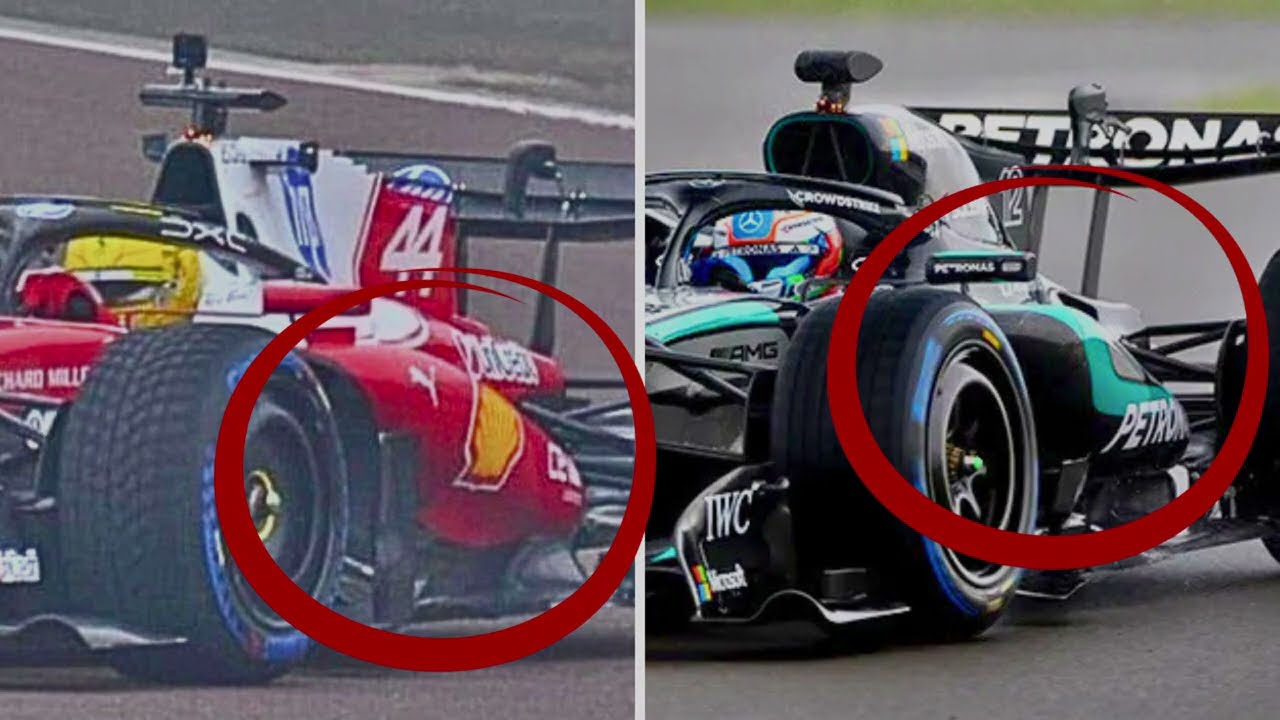
The most immediate visual shock comes from the car’s upper bodywork. While competitors like Mercedes appear to be running stockier, more bulbous sidepod shoulders—likely to prioritize packaging reliability and cooling in these early stages—Ferrari has gone for the jugular.
The SF-26 features a distinctively aggressive “downward overbite” on its sidepods. The upper surface rolls over dramatically, pushing airflow down toward the rear of the car with a clear intent to energize the floor edge. In a regulatory era where managing tire wake and maintaining a stable floor seal is paramount, this suggests Ferrari is already chasing complex aerodynamic mapping rather than just trying to get the car to run reliably.
Even more telling is the airbox. Compared to the gaping intake seen on the Mercedes development car, Ferrari’s inlet is noticeably tighter and smaller. This is a gamble. It implies one of two things: either Ferrari is supremely confident in the efficiency of its new cooling architecture, or they are deliberately sacrificing cooling safety margins in this “validation spec” to prioritize airflow quality to the rear wing.
It is a visual message that screams confidence. While others may be building “rolling laboratories” just to check if the systems work, Ferrari’s body language—mechanical and aesthetic—suggests they are already hunting for performance.
The Battle of Philosophies: Ferrari vs. Mercedes
The true intrigue of this shakedown lies in the direct comparison with their historic rivals at Brackley. Thanks to the eagle-eyed analysis of the shakedown footage, we can see a divergence in philosophy that could define the early part of the 2026 season.
Take the front wing, for instance. In this simplified aero era, where engineers have fewer legal tools to manipulate airflow, marginal gains are everything. The Mercedes front wing appears more refined, with a sculpted endplate that curves inward and a pronounced “hump” on the outer elements, suggesting a focus on detailed wake conditioning.
Ferrari, however, has taken a blunter, perhaps more structural approach. The connector area between the nose and the front wing is bulkier—almost “mustache-like” in its presence. Is this simply a structural necessity, or is it a clever flow-conditioning device designed to guide air under the nose? While Mercedes seems to be pursuing a minimal, low-drag pylon presentation, Ferrari is using that volume for a purpose we have yet to fully understand.
Furthermore, the floor edge—the critical area that generates the bulk of an F1 car’s downforce—shows a stark difference. Mercedes has left a more open, rectangular gap, likely to allow for versatile airflow management as they learn the new rules. Ferrari’s interpretation is tighter, lower, and more “sealed.” It’s a design that looks less like an experiment and more like a statement of intent.
The “Validation Spec” Warning
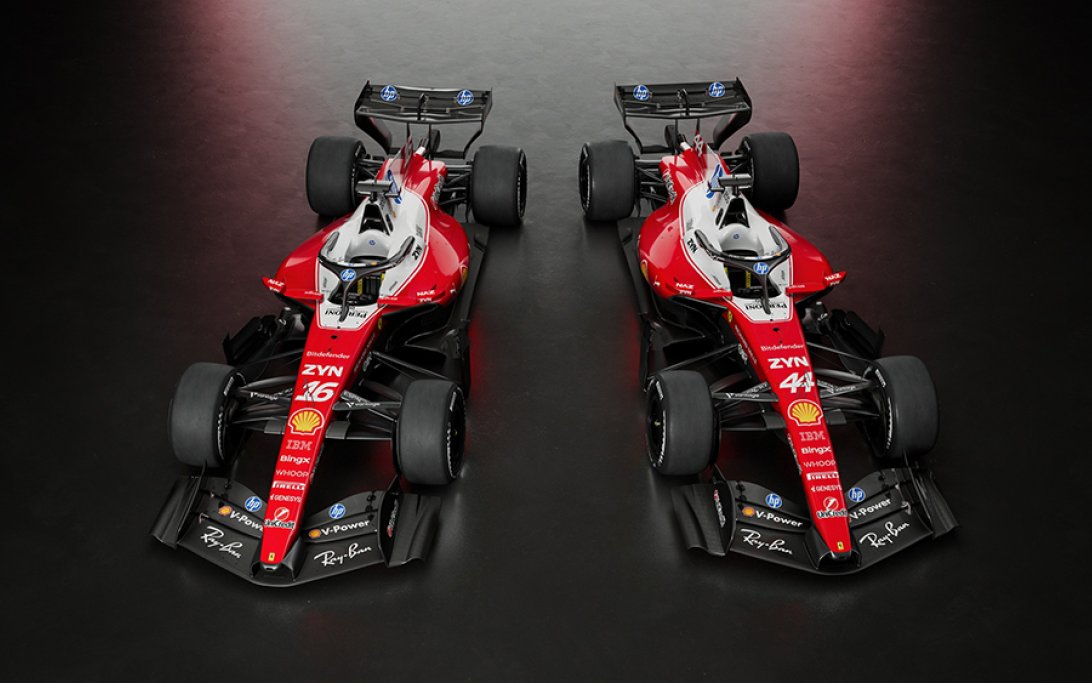
It is crucial, however, to temper this excitement with a dose of engineering reality. As stressed by technical analysts, what rolled out at Fiorano is an “early validation specification.” It is not the car that will sit on the grid in Melbourne or Bahrain.
These initial runs are about correlation. They are designed to prove that the simulation data matches the real world. Does the suspension compress as predicted? Does the cooling system handle the heat rejection of the new hybrid unit? Does the active aero transition smoothly without upsetting the car’s balance?
Yet, the differences we see today are not accidental. They reveal the “design intent” of the teams. Ferrari’s intent appears to be high-risk, high-reward. They are testing a tighter packaging limit from the start. If it works, they have a head start on aerodynamic development. If it fails, they may face a frantic redesign to open up cooling louvers and compromise their drag levels—a nightmare scenario in a formula where efficiency is king.
The Hamilton Factor and the “New Era”
Beyond the carbon fiber and flow-viz paint, the emotional weight of this shakedown cannot be overstated. Seeing Lewis Hamilton in the garage, preparing to drive a car built to his team’s new era specifications, makes the theoretical reality of his transfer tangible.
The 2026 regulations were a major factor in Hamilton’s decision to switch teams. He gambled that Ferrari would master this new rule set better than Mercedes. Today’s reveal offers the first hint that his gamble might be based on Ferrari’s willingness to be bold. While Mercedes looks to be building a robust baseline, Ferrari is building a thoroughbred racer right out of the box.
The livery, too, signals a break from the past. The “controversially refreshed” red and white scheme is more than just paint; it’s a visual reset. It separates the failures of the 2025 campaign from the potential of 2026. It tells the world, and perhaps the team itself, that this is not a continuation of the old Ferrari—this is something new.

What Comes Next?
As the SF-26 completes its initial kilometers, the data gathered will be flown back to Maranello to be crunched by the team’s supercomputers. The “overbite” sidepods and the tight airbox will be scrutinized to see if the real-world physics match the wind tunnel dreams.
For the fans, the speculation is just beginning. We have seen the first cards played in the high-stakes poker game of 2026. Mercedes has played a safe hand, looking for stability and consistency. Ferrari has pushed a pile of chips into the center of the table, betting on aggressive aerodynamics and tight packaging.
In Formula 1, fortune favors the brave, but history is littered with the wreckage of the over-ambitious. As the SF-26 cools down in the Fiorano pit lane, one question hangs in the air: Has Ferrari built the car that will crown a new king, or have they flown too close to the sun? Only the stopwatch will tell, but for now, the Prancing Horse has certainly captured the world’s attention.
News

Inside Shane Richie’s love life: Drug – fuelled orgy with six blondes; real reason he split from Coleen Nolan; six-year ‘affair with fan’
Inside Shane Richie’s love life: Orgy with six blondes; real reason he split from Coleen Nolan; six-year ‘affair with fan’ He’s popular with the ladies… Shane Richie…

SH0CKING REVELATI0N:A sh0cking behind-the-scenes secret revealed about Lizzie Rizzini, the woman replacing Carol Kirkwood on the 6pm weather bulletin
BBC viewers still reeling from the departure of Carol Kirkwood got another surprise last night when presenter Lizzie Rizzini appeared to flash her black lace stockings on…

HEARTBREAKING: Peter Andre’s Tearful Message to Son Junior After SHOCKING Revelation About How He Truly Feels Toward Mum Katie Price — Katie Price’s reaction scares fans.
Peter Andre’s emotional message to son Junior after it’s revealed how he really feels about mum Katie Pri… PETER Andre has shared an emotional message to his…

Ben Shephard opens up about the devastating health battle his wife is facing: “She wakes up crying every single morning…”
Inside This Morning Ben Shephard’s Life Including Rarely Seen Wife and Health Battle Ben Shephard is a name synonymous with British television, renowned for his engaging presentation…

🚨 LIVE TV HEARTBREAK: Good Morning Britain Host Announces ‘Devastating’ Dɘath of Guest Minutes Into Show
Viewers of Good Morning Britain were met with heartbreaking news just minutes into Friday’s (January 30) episode, as co-hosts Kate Garraway and Ranvir Singh reported the tragic…

Emmerdale legend Cain Dingle will never be the same again after a shock cancer diagnosis turns his world upside down
FROure Desk. Full Terms and conditions are available on the website http://www.itv.com/presscentre/itvpictures/terms Emmerdale wouldn’t be Emmerdale without the glowering, grunting embodiment of manliness that is Cain Dingle (Jeff Hordley) But…
End of content
No more pages to load






