In the high-stakes world of Formula 1, silence can be deafening, but the noise of a broken relationship is impossible to ignore. After a debut season marred by awkward radio silences, reactive strategies, and visible frustration, Ferrari has made one of its most decisive personnel moves in recent history. The Scuderia has officially confirmed that Riccardo Adami will no longer serve as Lewis Hamilton’s race engineer, marking the end of a partnership that never quite found its rhythm.
This is not merely a reshuffle; it is a declaration of intent. By removing a veteran engineer who has served the likes of Sebastian Vettel and Carlos Sainz, Ferrari is admitting that their standard operating procedure was simply not good enough for a seven-time World Champion. The message from Maranello is clear: the team is finally willing to bend to the driver, rather than forcing the driver to break for the team.
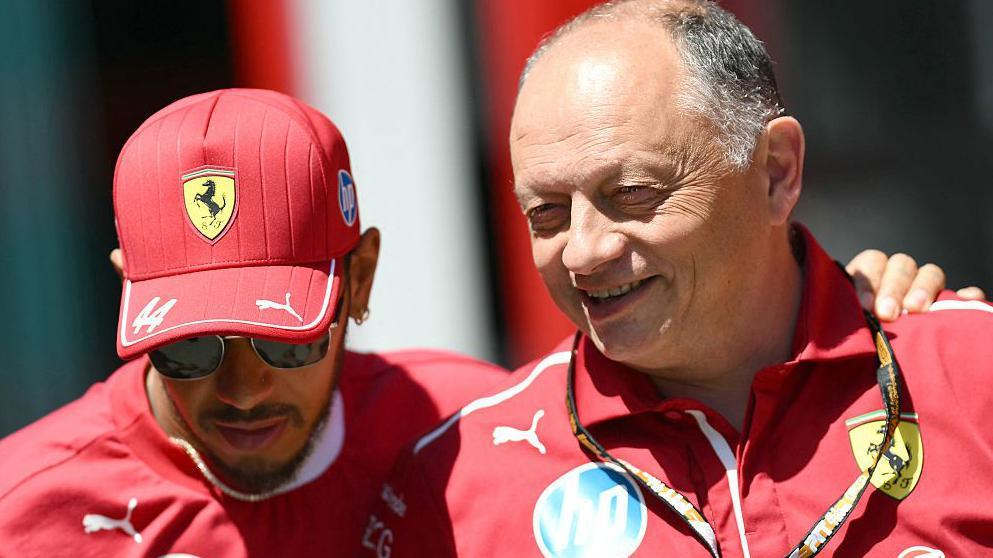
The Breaking Point: Why Adami Had to Go
To understand why this decision was inevitable, one only needs to look back at the transcripts of the past season. The relationship between Hamilton and Adami was defined not by hostility, but by a fundamental disconnect in communication styles. Hamilton, a driver who thrives on proactive, concise, and forward-looking information—a style perfected during his decade-long partnership with Peter “Bono” Bonnington at Mercedes—found himself constantly second-guessing the voice in his ear.
The cracks were visible early. The low point arguably came during the Monaco Grand Prix, where a confused Hamilton, struggling with tire management and strategy, asked his engineer, “Are you upset with me or something?” The subsequent silence and delayed response were symbolic of a partnership that lacked the intuitive “shorthand” required at the pinnacle of motorsport.
The situation reached a fever pitch at the season finale in Abu Dhabi. After a disastrous qualifying session saw Hamilton eliminated in Q1, the British driver described his emotions as an “unbearable amount of anger and rage.” It was the sound of a driver who felt isolated in his own cockpit. Hamilton didn’t just need a race engineer; he needed a partner who could anticipate his needs before he even pressed the radio button. Adami, for all his experience and technical acumen, was reactive where Hamilton needed him to be proactive.
A “Soft” Landing for a Hard Decision
Ferrari’s official announcement was couched in the polite, diplomatic language typical of the sport. Adami has not been fired; instead, he has been reassigned to a new role as the manager of the Ferrari Driver Academy and the “Testing of Previous Cars” (TPC) program.
“Scuderia Ferrari HP announces that Riccardo Adami has moved to a new role… where his extensive trackside experience and Formula 1 expertise contributes to the development of future talent,” the statement read.
However, in the cutthroat paddock of F1, this is effectively a demotion from the front lines. Moving from the race engineering seat of the most famous driver in the world to a role overseeing junior drivers and old machinery is a significant step back from the limelight. It is a “safe landing,” yes, but it signals that Ferrari recognized the Hamilton-Adami pairing was beyond repair. They chose to protect the internal harmony of the garage by removing the friction point entirely, rather than risking another season of missed messages and lost points.

The Mercedes DNA: Enter Luca Diella
With Adami out of the picture, the spotlight turns to his replacement. While Ferrari has stated the new appointment will be announced “in due course,” the paddock grapevine is already buzzing with one name: Luca Diella.
Diella is not just another internal promotion; he represents a strategic injection of “Mercedes DNA” into the heart of Maranello. A former trackside performance engineer at Mercedes, Diella worked directly with Hamilton from 2019 to early 2025. He was the man crunching the numbers on tire behavior, power unit optimization, and software development—the very details Hamilton felt were being lost in translation at Ferrari.
Crucially, Diella followed Hamilton to Ferrari, joining the team quietly in 2025. His potential promotion to race engineer would be a masterstroke. He already speaks “Lewis-speak.” He understands the nuances of Hamilton’s feedback, his emotional cadence during a race, and the precise type of data he needs to extract maximum performance.
Sky Sports F1 pundit Martin Brundle noted that such a change was overdue, stating, “Lewis needs to go there with a team, so at least they understood ‘Lewis-speak’ when he’s inside the car… I think he needed some help to really flourish there quickly.”
Promoting Diella would be Ferrari’s way of acknowledging that to get the best out of Hamilton, they must replicate the environment in which he thrived. It bridges the gap between the structured, driven world of Mercedes and the passionate, sometimes chaotic world of Ferrari.
A Culture Shift in Maranello
Perhaps the most significant aspect of this story is what it says about Ferrari’s evolving culture under Team Principal Frédéric Vasseur. Historically, Ferrari has been an institution that demands drivers adapt to its ways. Legends like Alain Prost and Sebastian Vettel ultimately found themselves isolated when they tried to reshape the team around them.
This move suggests that the “Scuderia First” dogma is softening. By removing a long-standing employee to accommodate their star driver, Ferrari is showing a newfound flexibility. They are acknowledging that in the modern era, the driver-engineer relationship is a performance differentiator as critical as the aerodynamics or the engine.
If Hamilton is to challenge for that elusive eighth world title, he needs total psychological security in the cockpit. He needs to know that when he asks for a gap, he gets it instantly. When he questions a strategy, the answer is decisive. This shake-up is the first real proof that Ferrari is serious about giving him that foundation.
.webp)
The Verdict
The removal of Riccardo Adami is a ruthless but necessary act of housekeeping. It clears the air of the frustration that hung over the garage throughout the last season. For Lewis Hamilton, it is a victory—a sign that his voice is being heard and his requirements are being met.
As the team prepares for the new season, all eyes will be on the new voice in Hamilton’s ear. If it is indeed Luca Diella, or another figure who understands the Briton’s modus operandi, we could see a very different Lewis Hamilton in 2026: calmer, sharper, and dangerously fast. Ferrari has rolled the dice on change; now they must prove it was the right call.
News

Inside Shane Richie’s love life: Drug – fuelled orgy with six blondes; real reason he split from Coleen Nolan; six-year ‘affair with fan’
Inside Shane Richie’s love life: Orgy with six blondes; real reason he split from Coleen Nolan; six-year ‘affair with fan’ He’s popular with the ladies… Shane Richie…

SH0CKING REVELATI0N:A sh0cking behind-the-scenes secret revealed about Lizzie Rizzini, the woman replacing Carol Kirkwood on the 6pm weather bulletin
BBC viewers still reeling from the departure of Carol Kirkwood got another surprise last night when presenter Lizzie Rizzini appeared to flash her black lace stockings on…

HEARTBREAKING: Peter Andre’s Tearful Message to Son Junior After SHOCKING Revelation About How He Truly Feels Toward Mum Katie Price — Katie Price’s reaction scares fans.
Peter Andre’s emotional message to son Junior after it’s revealed how he really feels about mum Katie Pri… PETER Andre has shared an emotional message to his…

Ben Shephard opens up about the devastating health battle his wife is facing: “She wakes up crying every single morning…”
Inside This Morning Ben Shephard’s Life Including Rarely Seen Wife and Health Battle Ben Shephard is a name synonymous with British television, renowned for his engaging presentation…
🚨 LIVE TV HEARTBREAK: Good Morning Britain Host Announces ‘Devastating’ Dɘath of Guest Minutes Into Show
Viewers of Good Morning Britain were met with heartbreaking news just minutes into Friday’s (January 30) episode, as co-hosts Kate Garraway and Ranvir Singh reported the tragic…
Emmerdale legend Cain Dingle will never be the same again after a shock cancer diagnosis turns his world upside down
FROure Desk. Full Terms and conditions are available on the website http://www.itv.com/presscentre/itvpictures/terms Emmerdale wouldn’t be Emmerdale without the glowering, grunting embodiment of manliness that is Cain Dingle (Jeff Hordley) But…
End of content
No more pages to load






