The 2026 Formula 1 season was supposed to be a fresh start—a reset button for the sport with new power unit regulations designed to level the playing field. But before a single wheel has turned in anger, the paddock is already engulfed in a political firestorm that threatens to derail the championship. At the center of the storm are the sport’s two titans, Mercedes and Red Bull, who have reportedly exploited a “shocking” loophole in the new engine rules, leaving rivals Ferrari, Honda, and Audi furious and demanding action.
As the teams prepare for the first private tests in Barcelona on January 26, the atmosphere is toxic. What was meant to be a year of exciting unknowns has potentially turned into a two-horse race before the lights even go out in Melbourne. Here is everything you need to know about the controversy that has the FIA scrambling for a solution.
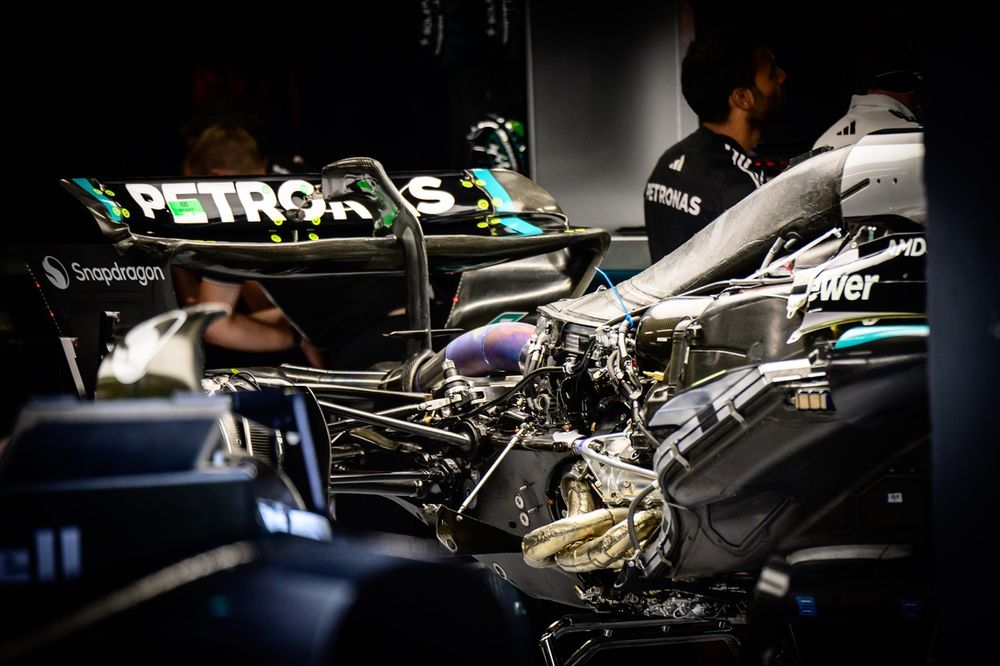
The “Thermal Expansion” Trick Explained
To understand the fury in the pit lane, we have to look at the technical fine print. The 2026 regulations introduced a strict limit on the engine’s compression ratio, capping it at 16:1. This rule was intended to keep costs down and prevent a spending war on exotic combustion technologies.
However, the rulebook contains a critical flaw: it states that the compression ratio is measured when the engine is static—meaning it is checked when the car is stationary and at room temperature.
According to reports, Mercedes engineers, renowned for their mastery of the hybrid era, spotted this wording and drove a truck through it. They have designed a connecting rod—the part linking the piston to the crankshaft—that utilizes thermal expansion. When the engine heats up during a race, the rod expands in a calculated way, pushing the piston higher into the cylinder. This effectively increases the compression ratio to approximately 18:1 while the car is on track.
The result? A more efficient combustion cycle and an estimated boost of 10 to 15 horsepower. In the world of Formula 1, where margins are measured in thousandths of a second, this is an eternity. Analysts estimate this “trick” is worth roughly 0.25 to 0.4 seconds per lap. Over a race distance, that is the difference between a comfortable victory and a desperate fight for the podium.
Red Bull Joins the Party; Rivals Left Behind
While Mercedes appears to be the architect of this loophole, they aren’t the only ones benefitting. Red Bull, who have aggressively recruited engine talent from Mercedes for their new Red Bull Powertrains division, reportedly caught wind of the concept. They have implemented a similar solution, though sources suggest they are still refining it compared to Mercedes’ more mature design.
This has left the other manufacturers—Ferrari, Honda (supplying Aston Martin), and newcomer Audi—staring at a significant performance deficit. These teams designed their engines to strictly adhere to the 16:1 limit under all conditions. They didn’t see the “invisible” gap in the regulations until it was too late. With engines already built and homologated for the season start, they cannot simply copy the design overnight. A redesign would take months, effectively writing off their 2026 championship hopes.
The reaction has been explosive. Ferrari has already hinted at lodging a formal protest at the season opener in Melbourne. Audi, desperate to make a strong impression in their debut year, is lobbying hard behind the scenes. They argue that while the design might follow the letter of the law, it violently violates the spirit of the regulations.
The FIA’s Dilemma: “Not What We Wrote”
The situation has placed the FIA in an impossible position. According to respected F1 journalist Julianne Cerasoli, the governing body has privately admitted that the regulations were interpreted in a way they never intended. Cerasoli reported that the FIA told her, “Someone read something in the regulations that wasn’t what we wrote.”
Crucially, however, Mercedes did not hide their homework. They reportedly approached the FIA early in the development process, showed them the design, and asked if it was legal. The FIA, bound by the specific wording of their own rulebook, had to say yes.
This creates a legal and ethical nightmare. If the FIA bans the device now, they are punishing a team for being clever and transparent—a move that would set a dangerous precedent for innovation. It would also require Mercedes and Red Bull to scrap their entire power unit philosophy just days before testing, which is practically impossible.
On the other hand, if the FIA does nothing, they risk a commercially disastrous season where two teams run circles around the rest of the grid. Liberty Media, the sport’s owners, are terrified of a return to the predictable dominance that drove fans away in previous eras. The “modern philosophy” of F1 is about competitive balance; if one team finds a “silver bullet” that breaks the sport, the commercial reality often forces a rule change.
The “Crunch Meeting”
All eyes are now on the critical meeting taking place today, January 22, between the FIA and the engine manufacturers. This high-stakes summit is the battleground where the immediate future of the sport will be decided.
There are a few potential outcomes, none of them perfect:
Immediate Ban: The FIA invokes a clause to close the loophole instantly. This satisfies Ferrari and Audi but declares war on Mercedes and Red Bull, who would likely sue or threaten to quit, arguing they relied on FIA approval.
The “Compromise”: The most likely scenario is a political fudge. The FIA might allow the trick for 2026 to avoid legal blowback but ban it strictly for 2027. This gives Mercedes and Red Bull a one-year advantage—a “reward” for their ingenuity—while promising rivals that parity will be restored eventually.
Open Season: The FIA could loosen the rules to allow other manufacturers to implement “catch-up” upgrades more quickly than usual, breaking the strict homologation freeze.
 A Momentum Shift
Regardless of the decision, the damage to the paddock’s harmony is done. Ben Hodgkinson, Red Bull’s technical director, remains defiant, calling the complaints “noise about nothing” and insisting their car is completely legal. But the tension is palpable.
For fans, this controversy adds a delicious layer of intrigue to the 2026 launch. When the cars roll out for private testing in Barcelona on January 26, the stopwatch will tell the truth. If the Mercedes-powered cars are suddenly half a second clear of the field, the political pressure on the FIA will become unbearable.
We are witnessing F1 in its purest, most ruthless form. It’s not just about who has the fastest driver, but who has the smartest lawyers and the most creative engineers. The 2026 season hasn’t started, but the war has already begun.
News

Inside Shane Richie’s love life: Drug – fuelled orgy with six blondes; real reason he split from Coleen Nolan; six-year ‘affair with fan’
Inside Shane Richie’s love life: Orgy with six blondes; real reason he split from Coleen Nolan; six-year ‘affair with fan’ He’s popular with the ladies… Shane Richie…

SH0CKING REVELATI0N:A sh0cking behind-the-scenes secret revealed about Lizzie Rizzini, the woman replacing Carol Kirkwood on the 6pm weather bulletin
BBC viewers still reeling from the departure of Carol Kirkwood got another surprise last night when presenter Lizzie Rizzini appeared to flash her black lace stockings on…

HEARTBREAKING: Peter Andre’s Tearful Message to Son Junior After SHOCKING Revelation About How He Truly Feels Toward Mum Katie Price — Katie Price’s reaction scares fans.
Peter Andre’s emotional message to son Junior after it’s revealed how he really feels about mum Katie Pri… PETER Andre has shared an emotional message to his…

Ben Shephard opens up about the devastating health battle his wife is facing: “She wakes up crying every single morning…”
Inside This Morning Ben Shephard’s Life Including Rarely Seen Wife and Health Battle Ben Shephard is a name synonymous with British television, renowned for his engaging presentation…

🚨 LIVE TV HEARTBREAK: Good Morning Britain Host Announces ‘Devastating’ Dɘath of Guest Minutes Into Show
Viewers of Good Morning Britain were met with heartbreaking news just minutes into Friday’s (January 30) episode, as co-hosts Kate Garraway and Ranvir Singh reported the tragic…

Emmerdale legend Cain Dingle will never be the same again after a shock cancer diagnosis turns his world upside down
FROure Desk. Full Terms and conditions are available on the website http://www.itv.com/presscentre/itvpictures/terms Emmerdale wouldn’t be Emmerdale without the glowering, grunting embodiment of manliness that is Cain Dingle (Jeff Hordley) But…
End of content
No more pages to load






