The Formula 1 world is officially back in full swing, and if the early launch season for 2026 is anything to go by, we are in for one of the most chaotic, opinionated, and technically fascinating years in the sport’s history. As the rain lashes down on Silverstone and the teams prepare for the pivotal tests in Barcelona, two major narratives have emerged that stand in stark, dramatic contrast to one another. On one side, we have the newcomer, Audi, stumbling out of the gate with a livery that has been branded “unfinished” and “disappointing.” On the other, the sleeping giant, Mercedes, has awoken with a bold new look and, more importantly, swirling rumors of a power unit advantage that could see them reclaim their iron grip on the grid.
From the Racing News 365 studios, Nick Golding and Lead Editor Ian Parkes have dissected every angle of these reveals, and their verdict sets the stage for a thrilling season. Let’s dive deep into the hits, the misses, and the “astounding” targets that are defining the start of F1’s new era.

The Audi Disappointment: “Half a Paint Job”
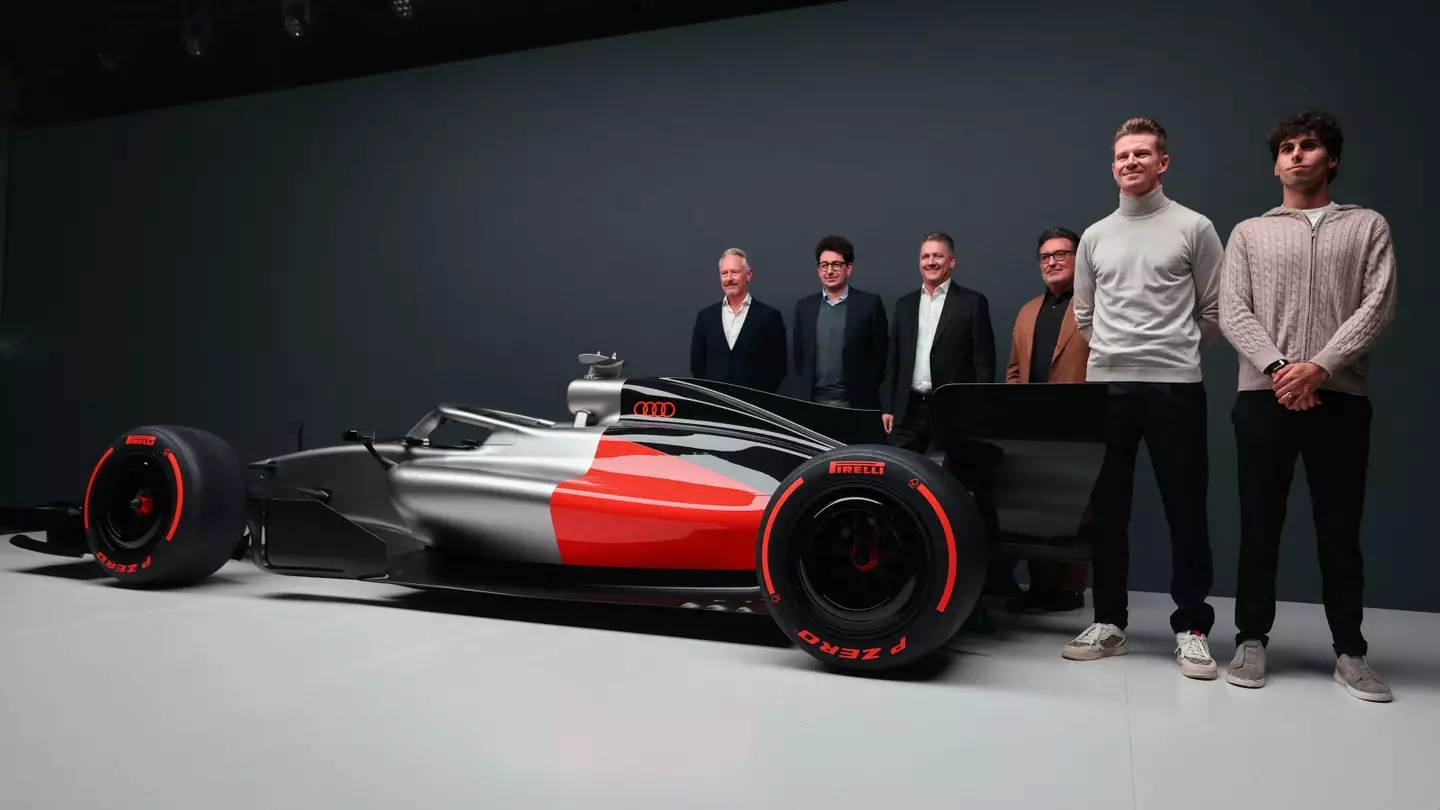
When a brand as iconic as Audi announces its entry into Formula 1, the expectations are naturally sky-high. This is the German manufacturer known for dominance in Le Mans and rallying, a brand that doesn’t just participate—it wins. However, their first official offering for the 2026 season, the R26, has landed with a thud rather than a bang, at least aesthetically.
The criticism has been sharp and immediate. Following a “soft launch” in December that teased the color scheme, fans and experts alike were expecting the full reveal to add polish, detail, and flair. Instead, the final livery has been met with confusion. Ian Parkes didn’t mince words, describing the car as looking “unfinished.”
“It looks like somebody’s done either half a job with one part of the car and forgot the rest,” Parkes noted, expressing a sentiment shared by many underwhelmed observers. The design, which features a stark split between different sections, fails to flow cohesively, giving the impression of two different concepts mashed together without a unifying vision.
In the brutal world of “Parky Ratings,” where liveries are scored out of ten, Audi’s effort plummeted to the bottom of the pile with a dismal 4 out of 10. For context, the new Red Bull scored a mighty 9.5, and even the often-criticized Haas livery managed a respectable 7. The consensus is clear: for a team that wants to be taken seriously as a premium competitor, showing up with a car that looks like a “half-hearted paint job” is a stumbling block. It lacks the intimidation factor of a Mercedes or the sleek aggression of a Ferrari. As Parkes bluntly put it, “I just hope the car goes better on track than it looks right now.”
Audi’s “Astounding” Ambition: Chasing Ghosts
If the livery is underwhelming, the rhetoric coming out of the Audi camp is anything but. In fact, it borders on the unbelievable. During their launch in Berlin, Audi didn’t just say they wanted to compete; they declared an intention to become the “most successful team in Formula 1.”
Let that sink in for a moment. To hold that distinction, you have to look at Ferrari, the Prancing Horse, which has been the heartbeat of F1 for 75 years. Ferrari has racked up 16 Constructors’ Championships and 15 Drivers’ Championships over nearly a century of racing. For Audi to target that record is not just ambitious; it is historically audacious.
They have set a timeline of 2030—a mere five-year window—to be winning championships and dominating the sport. Parkes rightly pointed out the sheer scale of this mountain. “You’re going to have to win an awful lot of titles in a very short period of time to take that honor from Ferrari,” he remarked.
However, despite the questionable aesthetics of their car, no one should mistake Audi for a unserious entity. The comparisons to the failed Toyota project of the 2000s—where billions were spent for zero wins—are inevitable, but likely inaccurate. Audi has not started from scratch; they have taken over the existing Sauber infrastructure, giving them a foundation of personnel and facilities that Toyota lacked initially. They are “all in,” and unlike the recent Cadillac entry which is building from the ground up, Audi has a head start. But as they aim for the stars, the pressure to deliver on these massive promises will be crushing.
The Strategy Split: To Run or To Wait?
Beyond the paint and the promises, a fascinating strategic divergence has emerged between the teams regarding their pre-season testing. Audi, perhaps eager to prove their readiness, was the first team to put their car on track, conducting a filming day back on January 9th.
This “early bird” approach allows them to check systems and ensure their brand-new power unit matches the data they’ve seen on the dyno (engine testing simulator). Parkes analyzed this move as essential for a new manufacturer. They need to verify that the complex hybrid systems are operational before the precious few days of official testing in Barcelona.
Contrast this with McLaren. The Woking-based team has chosen a completely different path, opting not to do a shakedown before the Barcelona tests. Their car is currently not even at their Technology Centre but at a specialized testing facility in Austria, undergoing rigorous dyno running. McLaren’s philosophy is to maximize development time, keeping the car in the design phase for as long as possible to squeeze out every ounce of aerodynamic performance.
It’s a classic F1 gamble: Do you run early to fix reliability, or wait late to find speed? Audi, with everything to learn, went early. McLaren, confident in their data, is waiting. As Parkes noted, it will be fascinating to see who got it right when the lights go out in Melbourne.
Mercedes Returns: The “W7” and the Adidas Factor
While Audi battles skepticism, Mercedes has swaggered into 2026 with a vibe that feels dangerously reminiscent of their glory days. Their new challenger, referred to as the W7, has ditched the uncertainty of recent years for a look that is “bold,” “striking,” and “innovative.”
Visually, the car is a hit. Featuring prominent branding from new partner Adidas, the livery breaks away from the uniform black or silver of the past, utilizing the car’s geometry to create a design that looks fast even when standing still. It earned a glowing 8.5 out of 10 rating from Parkes, who praised the team for trying something different and succeeding.
But in Formula 1, beauty is only carbon-fiber deep. The real story with Mercedes is what lies underneath that striking bodywork.
The Engine War: Is 2014 Happening Again?
The year 2026 brings a major overhaul to the engine regulations, shifting the focus heavily onto the electrical power and sustainable fuels. Students of F1 history will remember exactly what happened the last time the engine rules were rewritten in 2014: Mercedes turned up with a power unit so superior it effectively ended the competition before the first race was run. They dominated the sport for eight years, leaving Ferrari, Red Bull, and Renault gasping for air.
Could history be repeating itself?
Rumors have been swirling all winter that Mercedes has “aced” the new regulations. There is talk of advanced compression ratios and innovative solutions that have caught the eye of the FIA. While technical details remain top secret, the confidence radiating from Brackley is palpable.
“Is this the team to beat, or is it the power unit to beat?” Golding asked, raising the pivotal question of the season. If Mercedes has indeed built a “rocket ship” engine, it won’t just benefit their factory team. It could propel their customer teams—McLaren, Williams, and the newly Mercedes-powered Alpine—to the front of the grid as well.
This creates a terrifying prospect for their rivals. In the aerodynamic era of the last few years, Red Bull held the edge. But if 2026 turns into an “engine formula,” the Silver Arrows (and their customers) could leave everyone in the dust.
The Unknowns: Alpine, Williams, and the Wet Weather
The intrigue doesn’t stop at the top. The Mercedes engine factor throws a lifeline to teams like Alpine, who suffered a miserable 2025 campaign, finishing bottom of the standings. Now armed with Mercedes power, could they be the surprise package of 2026? Similarly, whispers suggest Williams has produced a very strong car, potentially ready to leap into the midfield battle or higher.
However, getting concrete answers has been impossible due to the British weather. The shakedowns at Silverstone for Mercedes, Alpine, and Cadillac have all taken place in torrential rain. “Wet, wet, and very wet,” as the report described. While this allows for basic system checks, it tells the teams almost nothing about dry-weather performance.
This leaves the paddock in a state of high suspense. The real pecking order remains a mystery, hidden behind rain clouds and confident PR statements.
Final Thoughts: The Countdown to Australia
With the Australian Grand Prix just six weeks away, the tension is building. We have Audi aiming for the moon with a car that critics say looks half-finished. We have Mercedes looking sharp and potentially hiding a mechanical monster. And we have the likes of Ferrari and Alpine waiting in the wings to reveal their hands.
Will Audi’s 2030 target look genius or foolish? Will Mercedes dominate like it’s 2014? The beauty of F1 is that the stopwatch never lies. But for now, the livery war is won by Mercedes, and the talking war is definitely being led by Audi. Buckle up, folks—2026 is going to be a wild ride.
News

Inside Shane Richie’s love life: Drug – fuelled orgy with six blondes; real reason he split from Coleen Nolan; six-year ‘affair with fan’
Inside Shane Richie’s love life: Orgy with six blondes; real reason he split from Coleen Nolan; six-year ‘affair with fan’ He’s popular with the ladies… Shane Richie…

SH0CKING REVELATI0N:A sh0cking behind-the-scenes secret revealed about Lizzie Rizzini, the woman replacing Carol Kirkwood on the 6pm weather bulletin
BBC viewers still reeling from the departure of Carol Kirkwood got another surprise last night when presenter Lizzie Rizzini appeared to flash her black lace stockings on…

HEARTBREAKING: Peter Andre’s Tearful Message to Son Junior After SHOCKING Revelation About How He Truly Feels Toward Mum Katie Price — Katie Price’s reaction scares fans.
Peter Andre’s emotional message to son Junior after it’s revealed how he really feels about mum Katie Pri… PETER Andre has shared an emotional message to his…

Ben Shephard opens up about the devastating health battle his wife is facing: “She wakes up crying every single morning…”
Inside This Morning Ben Shephard’s Life Including Rarely Seen Wife and Health Battle Ben Shephard is a name synonymous with British television, renowned for his engaging presentation…

🚨 LIVE TV HEARTBREAK: Good Morning Britain Host Announces ‘Devastating’ Dɘath of Guest Minutes Into Show
Viewers of Good Morning Britain were met with heartbreaking news just minutes into Friday’s (January 30) episode, as co-hosts Kate Garraway and Ranvir Singh reported the tragic…

Emmerdale legend Cain Dingle will never be the same again after a shock cancer diagnosis turns his world upside down
FROure Desk. Full Terms and conditions are available on the website http://www.itv.com/presscentre/itvpictures/terms Emmerdale wouldn’t be Emmerdale without the glowering, grunting embodiment of manliness that is Cain Dingle (Jeff Hordley) But…
End of content
No more pages to load






