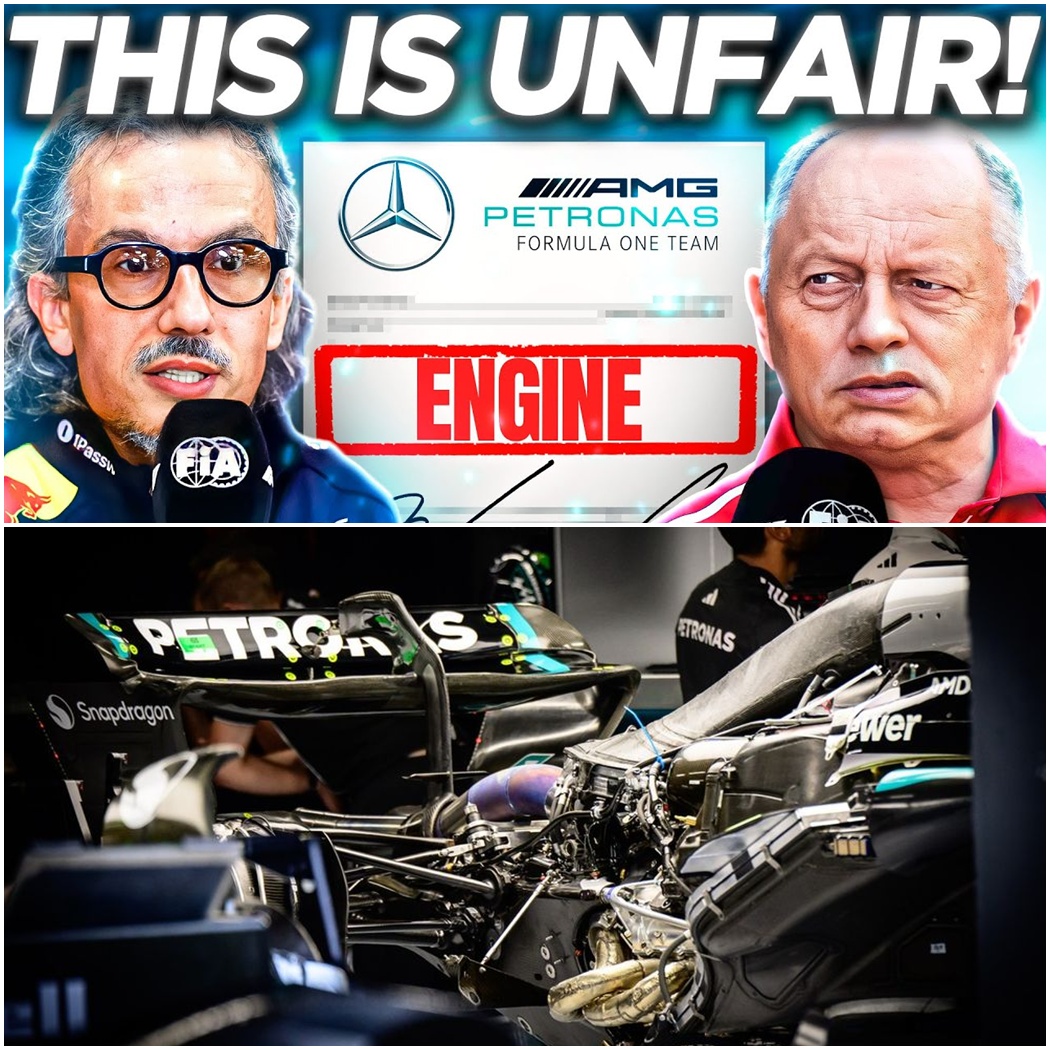
The 2026 Formula 1 season is still a speck on the horizon, yet the paddock is already engulfed in a firestorm that threatens to define the next era of the sport before a single wheel has turned in anger.
In a move that perfectly encapsulates the ruthless genius of Formula 1 engineering, Mercedes—and subsequently Red Bull—have reportedly exploited a massive loophole in the upcoming engine regulations. The discovery has unlocked a significant performance advantage, sent rival manufacturers into a panic, and placed the FIA in an impossible position between upholding the letter of the law and saving the commercial viability of the sport.
The “Magic” 15 Horsepower Trick
At the heart of the controversy is a piece of engineering so clever, yet so simple in principle, that it has left the rest of the grid scrambling. The 2026 regulations were designed to be strict, setting a hard limit on the engine’s compression ratio at 16:1. This rule was intended to level the playing field and prevent an arms race. However, the regulations specified that this ratio is measured when the engine is static—meaning turned off and at room temperature.
This specific wording was the crack in the door that Mercedes needed.
According to reports, Mercedes engineers have designed a connecting rod—the critical component linking the piston to the crankshaft—using materials with specific thermal expansion properties. When the engine is cold and scrutinized by FIA scrutineers, it complies perfectly with the 16:1 limit. However, once the engine fires up and reaches operating temperature, the connecting rod expands in a precisely calculated manner. This expansion pushes the piston higher into the cylinder, effectively shrinking the combustion chamber volume and skyrocketing the compression ratio to approximately 18:1.
In the world of high-performance internal combustion engines, compression is king. This increase allows for a more potent explosion with every cycle, translating to an estimated 10 to 15 additional horsepower.
To the uninitiated, 15 horsepower might sound negligible. In the road car world, it’s barely a noticeable tuning chip. But in the hyper-competitive arena of Formula 1, where gaps are measured in thousandths of a second, it is a chasm. Analysts estimate this power boost is worth roughly 0.25 seconds per lap. Over a standard 60-lap Grand Prix, that advantage compounds to a 15-second lead—easily the difference between a comfortable victory and a desperate fight for the podium.
The Spy in the Camp
The drama deepens with the revelation of how the secret spread. Red Bull, Mercedes’ arch-rivals, are not starting from zero. Reports indicate that Red Bull caught wind of the concept after hiring a senior engineer directly from the Mercedes power unit division. This defecting engineer brought the knowledge of the “expanding rod” concept to Milton Keynes, allowing Red Bull to implement their own version of the system.
However, typically in F1, the pioneer holds the advantage. Mercedes has likely spent months, perhaps years, refining the materials and tolerances to make this system reliable. Red Bull, while aware of the trick, is reportedly playing catch-up, trying to optimize a concept they didn’t invent.
This leaves the rest of the manufacturers—Ferrari, Honda (supplying Aston Martin), and newcomer Audi—completely out in the cold. They designed their 2026 power units strictly adhering to the spirit of the 16:1 limit. They have built engines that do not expand to create illegal compression, and as a result, they are staring down the barrel of a massive performance deficit.
The FIA’s Nightmare: Letter vs. Spirit
The most contentious aspect of this saga is the FIA’s role. Mercedes, in a display of supreme confidence, did not hide this innovation. They approached the governing body early in the development phase, presented their design, and asked a simple question: “Is this legal?”
The FIA, bound by the text of their own regulations, had to say yes. The rulebook dictated a static check; Mercedes passed the static check. Technically, legally, and procedurally, the Mercedes engine is compliant.
But now, the reality of the situation has set in. Journalist Giuliana Sarasulli reports that the FIA has privately admitted that “someone read something in the regulations that wasn’t what we wrote.” It is a candid admission of a regulatory failure. The governing body intended to cap compression at 16:1 permanently, but they failed to write the rule to cover the engine’s dynamic state.
This places the FIA in a “Kobayashi Maru” no-win scenario.
If they ban the device now, they are punishing Mercedes for being clever, transparent, and compliant. Mercedes and Red Bull have designed their entire car architecture around the cooling and packaging requirements of this specific engine. A sudden ban would force them to scrap their primary power unit designs, potentially costing millions and months of development time they do not have. It would set a dangerous precedent that innovation is punished if it is “too good.”
On the other hand, if the FIA does nothing, they risk a commercially disastrous season. Formula 1’s current popularity boom, driven by Liberty Media, relies heavily on the spectacle of close, unpredictable racing. If Mercedes (and their customer teams like McLaren and Williams) turn up to the first race with a quarter-second advantage locked in by the engine, the season is effectively over before it begins. Viewership could plummet if the result becomes a foregone conclusion.
The Rivals Revolt
The “Have-Nots”—Ferrari, Honda, and Audi—are not going down without a fight. Furious lobbying is already underway behind closed doors. Ferrari has reportedly threatened to lodge a formal protest at the season opener in Melbourne if the performance gap is as large as feared.
Their argument is based on the “spirit of the regulations,” a nebulous concept that F1 teams often invoke when they have been outsmarted. They argue that an 18:1 compression ratio violates the intent of the rules, even if it circumvents the text.
The anger is compounded by the timeline. It is simply too late for Ferrari or Audi to copy the Mercedes solution for the start of the 2026 season. Redesigning the internal components of a Power Unit to accommodate thermal expansion requires essentially building a new engine. If the loophole stands, the 2026 championship could be decided by a technicality discovered two years prior.

The January Showdown
All eyes are now fixed on a critical meeting scheduled for January 22nd. The FIA will sit down with all engine manufacturers to hash out a solution. The potential outcomes are messy:
Immediate Ban: The FIA invokes a “clarification” that forces the engine to maintain 16:1 compression at all times. This would spark immediate legal challenges from Mercedes and Red Bull.
The “BoP” Approach: The FIA allows the trick for 2026 but bans it for 2027, giving the other teams a year to suffer but promising a reset later.
Wait and See: The FIA does nothing until the first private tests in Barcelona on January 26th. If the Mercedes cars are visibly superior, the panic button will be pressed.
The situation highlights the eternal paradox of Formula 1. It is a sport defined by engineering brilliance, where the greatest victories are often won in the drawing office rather than on the tarmac. Mercedes found a gap, exploited it, and followed the correct protocol. In a pure engineering sense, they deserve to win.
But Formula 1 is also a multi-billion dollar entertainment business. “Absolute dominance,” as noted by insiders, is bad for the bottom line. The “share of the pie” grows only when the racing is good.
As the teams head to Barcelona, the paddock is holding its breath. We are about to find out if the 2026 season will be a thriller, or if a thermal expansion trick has just turned the championship into a one-horse race. The engineers have done their job; now, the lawyers and politicians take the wheel.
News

Inside Shane Richie’s love life: Drug – fuelled orgy with six blondes; real reason he split from Coleen Nolan; six-year ‘affair with fan’
Inside Shane Richie’s love life: Orgy with six blondes; real reason he split from Coleen Nolan; six-year ‘affair with fan’ He’s popular with the ladies… Shane Richie…

SH0CKING REVELATI0N:A sh0cking behind-the-scenes secret revealed about Lizzie Rizzini, the woman replacing Carol Kirkwood on the 6pm weather bulletin
BBC viewers still reeling from the departure of Carol Kirkwood got another surprise last night when presenter Lizzie Rizzini appeared to flash her black lace stockings on…

HEARTBREAKING: Peter Andre’s Tearful Message to Son Junior After SHOCKING Revelation About How He Truly Feels Toward Mum Katie Price — Katie Price’s reaction scares fans.
Peter Andre’s emotional message to son Junior after it’s revealed how he really feels about mum Katie Pri… PETER Andre has shared an emotional message to his…

Ben Shephard opens up about the devastating health battle his wife is facing: “She wakes up crying every single morning…”
Inside This Morning Ben Shephard’s Life Including Rarely Seen Wife and Health Battle Ben Shephard is a name synonymous with British television, renowned for his engaging presentation…

🚨 LIVE TV HEARTBREAK: Good Morning Britain Host Announces ‘Devastating’ Dɘath of Guest Minutes Into Show
Viewers of Good Morning Britain were met with heartbreaking news just minutes into Friday’s (January 30) episode, as co-hosts Kate Garraway and Ranvir Singh reported the tragic…

Emmerdale legend Cain Dingle will never be the same again after a shock cancer diagnosis turns his world upside down
FROure Desk. Full Terms and conditions are available on the website http://www.itv.com/presscentre/itvpictures/terms Emmerdale wouldn’t be Emmerdale without the glowering, grunting embodiment of manliness that is Cain Dingle (Jeff Hordley) But…
End of content
No more pages to load






