The atmosphere in the German capital today was nothing short of electric, a fitting backdrop for a moment that motorsport fans have been anticipating for years. On this crisp Tuesday, January 20, 2026, the covers were finally pulled off one of the most hyped projects in modern racing history. The Audi Revolut F1 Team has officially arrived, and if their launch event is anything to go by, the “Four Rings” are not here to merely make up the numbers. They are here to redefine the sport.
For decades, Audi has been the titan of motorsport, conquering everything from the gruelling rally stages of the 1980s to the endurance legends of Le Mans. Yet, there was always one glaring omission in their trophy cabinet: Formula 1. That changes now. The unveiling of the Audi R26 marks the end of an era of speculation and the beginning of a cold, hard reality for their rivals. This isn’t just a sponsorship deal or an engine supply contract; this is a full-blooded factory effort, built from the ground up with the might of the Volkswagen Group behind it.

A New Beast for a New Era
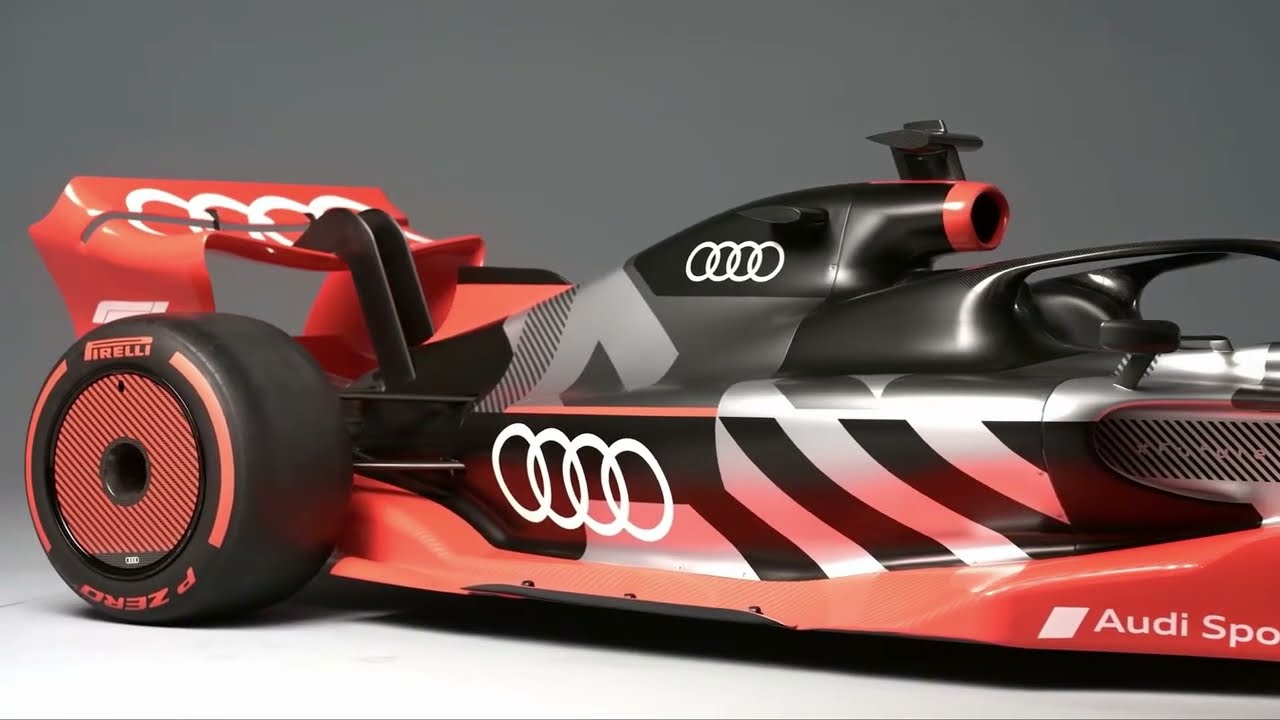
The car itself, designated the R26, is a striking piece of engineering that offers our first proper look at the radical 2026 regulation set. While today’s launch in Berlin was about the glitz and glamour of the team’s new visual identity—sporting the dynamic branding of their title partner, fintech giant Revolut—the real story lies under the carbon fiber skin.
Keen-eyed observers had already caught glimpses of the machine during a secretive “shakedown” at the Circuit de Barcelona-Catalunya earlier this month. The footage that emerged from that filming day revealed a design philosophy that is both aggressive and nostalgic. The most immediate visual shock is the return of the “shark fin” on the engine cover, a design element banned in 2018 but resurrected under the new rules to aid stability.
Perhaps more significant to the lap time is the suspension. The R26 features a double push-rod setup at both the front and rear, a major departure from the pull-rod front suspension that has dominated the grid in recent years. This technical shift is a direct response to the new aerodynamic regulations, which have moved away from the heavy “ground effect” reliance of the previous era, allowing cars to run at higher ride heights. It’s a bold gamble, suggesting that Audi’s engineers, working out of their dedicated facility in Hinwil, Switzerland, have found a different path to performance than their established rivals.
Powering the Future
The heart of this beast, however, beats in Neuburg, Germany. This is where Audi Formula Racing GmbH has built a state-of-the-art facility to develop the 2026 power unit. The regulations for this year represent the most dramatic shift in engine technology in a generation, and Audi has embraced the challenge with open arms.
The new power units are a marvel of efficiency. The complex and expensive MGU-H (Motor Generator Unit – Heat) has been scrapped entirely. In its place, the electrical component of the engine has been supercharged. The kinetic energy recovery system (MGU-K) now provides a staggering 50% of the total power output—roughly triple what we saw in 2025. Coupled with an internal combustion engine that runs on 100% sustainable, carbon-neutral fuel, the R26 is a technological manifesto for the future of the automotive industry.
For Audi, this alignment with road car sustainability was a non-negotiable condition for their entry. It allows them to justify the astronomical costs of F1 to their board and shareholders, framing the race track as the ultimate laboratory for tomorrow’s electric vehicles.
The Dream Team Management
Building a car is one thing; building a winning team is another. Audi knows that money alone doesn’t buy championships—just ask Toyota or BMW. To navigate the piranha tank of the F1 paddock, they have assembled a leadership team with serious pedigree.
Leading the charge is Mattia Binotto, the former Ferrari team principal who joined the project as Chief Operating and Technical Officer. Binotto’s tenure at Ferrari was a rollercoaster, but his technical brilliance is undeniable. He oversaw the Scuderia’s return to competitiveness in the early 2020s and knows exactly what infrastructure is needed to fight at the front.
Joining him is Jonathan Wheatley, who sent shockwaves through the sport when he left Red Bull Racing after nearly two decades to become Audi’s Team Principal. As Red Bull’s sporting director, Wheatley was the mastermind behind their pit-stop perfection and operational ruthlessness. His job is to instill that same winning mentality into a team that, until recently, was operating as the midfield Sauber outfit.
Youth Meets Experience
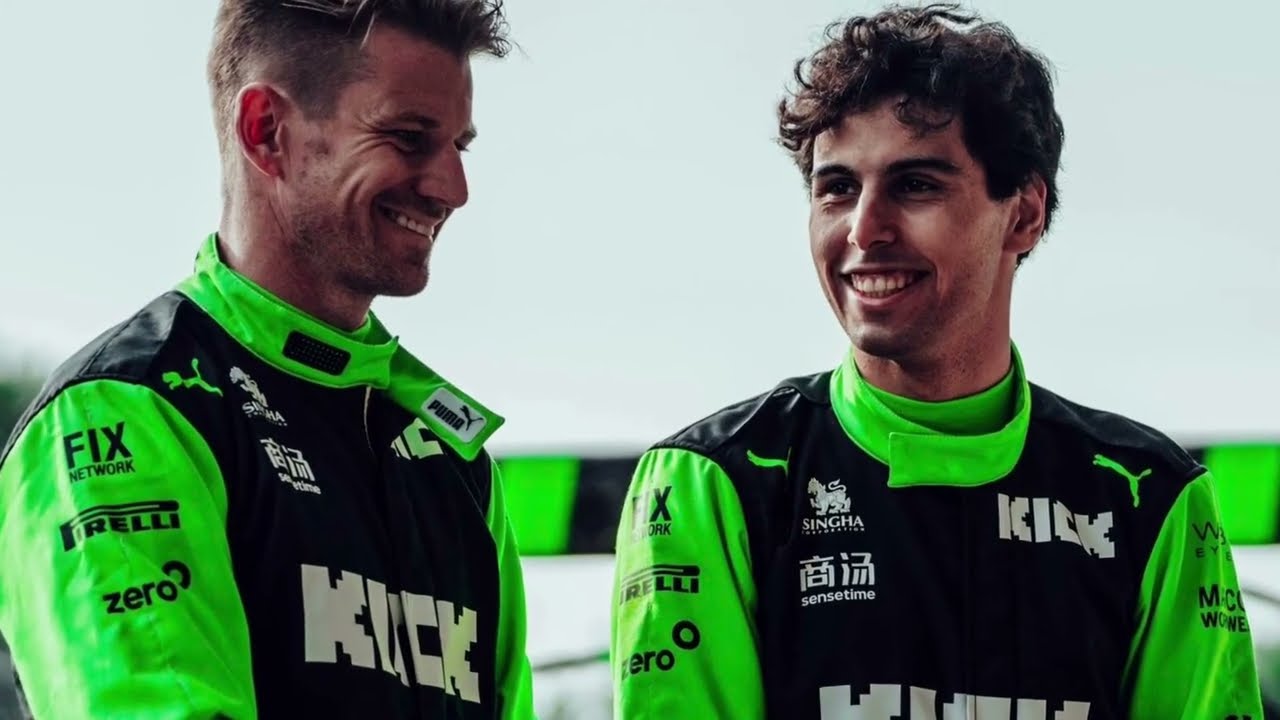
The driver lineup reflects the team’s pragmatic approach. There are no superstar egos here, just a calculated blend of development capability and raw speed.
In one seat sits Nico Hülkenberg, the German veteran who brings 17 years of F1 experience. “The Hulk” is renowned for his technical feedback and consistency—traits that are worth their weight in gold for a new manufacturer trying to troubleshoot a complex new car. He is the safe pair of hands, the benchmark who will help the engineers correlate their simulation data with track reality.
In the other seat is the future: Gabriel Bortoleto. The young Brazilian is one of the most exciting prospects to emerge in years, having torn through the junior categories with a ferocity that reminded many of a young Oscar Piastri or Charles Leclerc. One of the few drivers to win both the Formula 3 and Formula 2 championships in his rookie seasons, Bortoleto represents the long-term ambition of the project. If Audi’s five-year plan works, he is the man they hope to crown champion in 2030.
Managing Expectations
Despite the hype of the Berlin launch, the team has been refreshingly honest about the mountain they have to climb. Binotto has repeatedly tempered expectations, stating clearly that they do not expect to be winning races in 2026. “Our goal is to be a championship contender by 2030,” he told the press, a timeline that might frustrate fans used to instant gratification but one that reflects the immense difficulty of the task.
Honda spent years in the wilderness, enduring public humiliation before they built a championship-winning engine. Mercedes, Ferrari, and Red Bull have decades of accumulated data and cohesive teams that Audi is trying to replicate in a fraction of the time. The transition from Sauber—a team that finished last in the 2025 Constructors’ Championship—to Audi is not just a paint job. It involves upgrading wind tunnels, hiring hundreds of staff, and changing the entire culture of the workforce.
The Sleeping Giant Awakes
However, there is a silver lining. The 2026 regulation changes are the “great equalizer.” When the rulebook is torn up and rewritten, everyone starts from zero. History has shown that this is when the pecking order can be overturned. Brawn GP did it in 2009; Mercedes did it in 2014. By starting fresh, without the baggage of “legacy thinking” or old infrastructure that needs to be adapted, Audi has the unique opportunity to build a team perfectly optimized for these specific rules.
The investment is staggering. Reports suggest the acquisition of Sauber alone cost around $600 million, with hundreds of millions more poured into the Neuburg and Hinwil facilities. This is a commitment that screams intent.
As the champagne flows in Berlin and the world gets its first detailed look at the striking livery of the Audi Revolut F1 Team, one thing is certain: the grid has changed forever. The Four Rings have arrived, and while they may start cautiously, they have the resources, the talent, and the sheer will to succeed. The engine has been fired up, the shakedown is complete, and the testing begins in Barcelona on January 26th. The countdown to Melbourne is on, and the world is watching to see if the German giant can fly.
News

Inside Shane Richie’s love life: Drug – fuelled orgy with six blondes; real reason he split from Coleen Nolan; six-year ‘affair with fan’
Inside Shane Richie’s love life: Orgy with six blondes; real reason he split from Coleen Nolan; six-year ‘affair with fan’ He’s popular with the ladies… Shane Richie…

SH0CKING REVELATI0N:A sh0cking behind-the-scenes secret revealed about Lizzie Rizzini, the woman replacing Carol Kirkwood on the 6pm weather bulletin
BBC viewers still reeling from the departure of Carol Kirkwood got another surprise last night when presenter Lizzie Rizzini appeared to flash her black lace stockings on…

HEARTBREAKING: Peter Andre’s Tearful Message to Son Junior After SHOCKING Revelation About How He Truly Feels Toward Mum Katie Price — Katie Price’s reaction scares fans.
Peter Andre’s emotional message to son Junior after it’s revealed how he really feels about mum Katie Pri… PETER Andre has shared an emotional message to his…

Ben Shephard opens up about the devastating health battle his wife is facing: “She wakes up crying every single morning…”
Inside This Morning Ben Shephard’s Life Including Rarely Seen Wife and Health Battle Ben Shephard is a name synonymous with British television, renowned for his engaging presentation…

🚨 LIVE TV HEARTBREAK: Good Morning Britain Host Announces ‘Devastating’ Dɘath of Guest Minutes Into Show
Viewers of Good Morning Britain were met with heartbreaking news just minutes into Friday’s (January 30) episode, as co-hosts Kate Garraway and Ranvir Singh reported the tragic…

Emmerdale legend Cain Dingle will never be the same again after a shock cancer diagnosis turns his world upside down
FROure Desk. Full Terms and conditions are available on the website http://www.itv.com/presscentre/itvpictures/terms Emmerdale wouldn’t be Emmerdale without the glowering, grunting embodiment of manliness that is Cain Dingle (Jeff Hordley) But…
End of content
No more pages to load






