The long-awaited future of Formula 1 has finally materialized on the asphalt of Barcelona. For months, fans, engineers, and pundits have pored over the complex text of the 2026 technical regulations, theorizing what the next generation of Grand Prix machinery would look like. Now, the speculation has ended, and the reality has begun. Audi, the German automotive giant set to enter the sport as a full works team, has become the first to put a 2026-spec car on track, offering the world a fascinating—and surprising—glimpse into the sport’s new era.
Thanks to keen-eyed observers in Spain, we have moved beyond theoretical renderings and CFD (Computational Fluid Dynamics) models to physical hardware. This first shakedown is not merely a promotional run; it is a critical verification of a design philosophy that attempts to navigate one of the most significant rule changes in the sport’s history. The Audi prototype confirms several high-tech predictions while dropping a massive technical bombshell that contradicts the prevailing wisdom of the paddock.

The Return of the High Nose
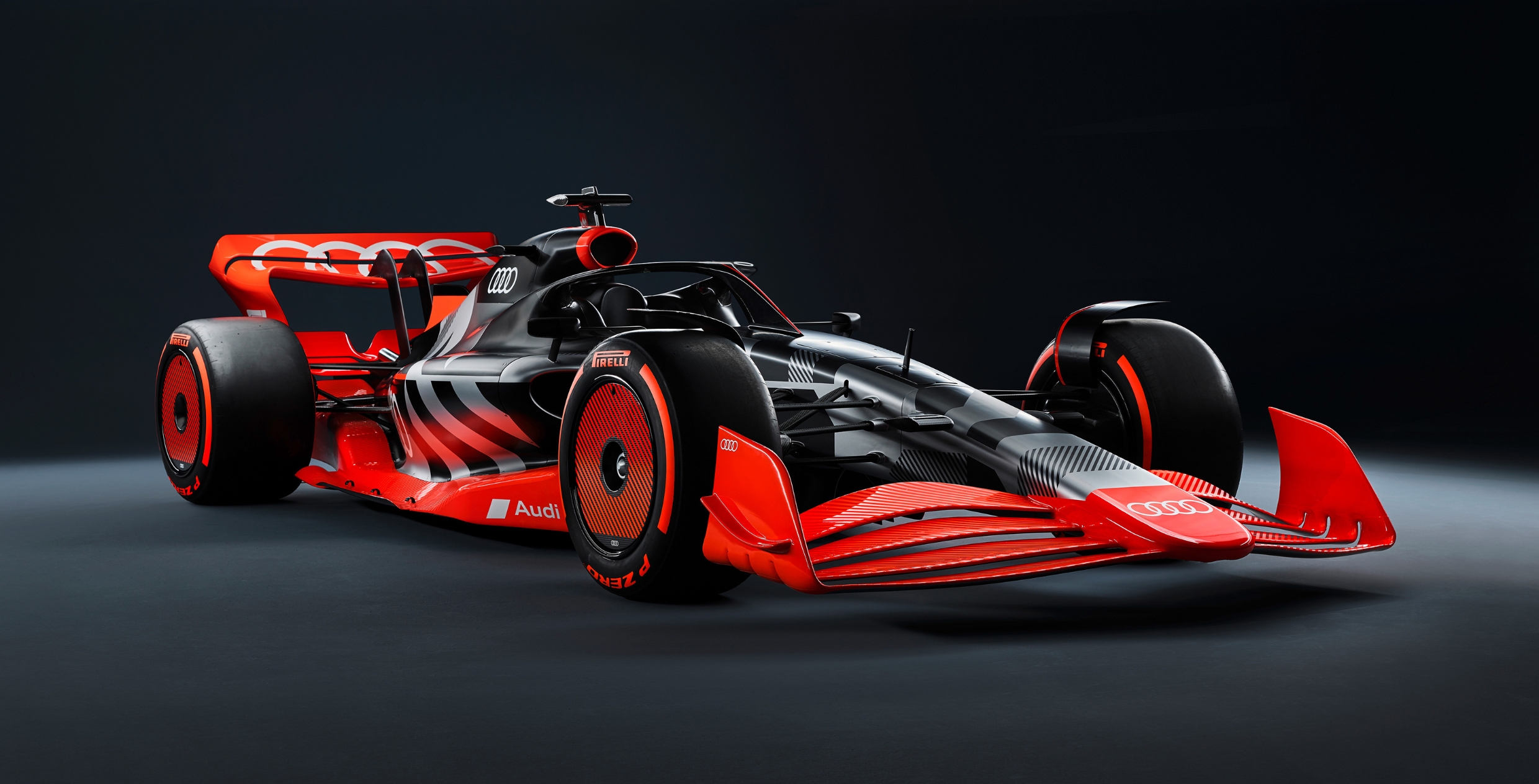
One of the most striking visual changes for 2026, confirmed instantly by the Audi chassis, is the geometric evolution of the nose cone. For the past few seasons, we have become accustomed to lower, flatter nose designs. However, the 2026 regulations have opened a door that Audi has walked right through: the return of the high nose.
This design shift is not purely aesthetic; it is a function of aggressive packaging. By positioning the cockpit further forward—a specific allowance in the new rules—designers can raise the nose structure. The benefits of this are twofold and critical for aerodynamic efficiency. First, it creates significantly more volume for the front wing mounting and interaction. Second, and perhaps more importantly, a higher nose clears the path for airflow to travel underneath the chassis.
In the world of Formula 1 aerodynamics, “clean” flow is king. By lifting the nose, Audi’s engineers are essentially opening a tunnel for air to rush towards the floor of the car unencumbered. This suggests that ground-effect downforce will remain a dominant performance differentiator in 2026, and feeding that underfloor beast is the primary objective of the car’s leading edge.
Aerodynamic Throwbacks: The Front Wing
Attached to that high nose is a front wing that looks both futuristic and strangely familiar to long-time fans. The Audi design features “inwashing” endplates, a concept that was largely prevalent in the pre-2019 era of the sport.
In recent years, the trend (and regulation intent) was to push air “outwash”—forcing it away from the car to minimize the dirty air wake that makes overtaking difficult. However, the 2026 rules seem to have created a loophole or a necessity that brings the inwash concept back. The Audi wing sports large blades at the sides, specifically sculpted to guide airflow around the front wheels.
Managing the “wake”—the turbulent air churned up by the rotating tires—is the holy grail of F1 design. If this turbulent air hits the bodywork behind the wheels, it destroys downforce. Audi’s solution is to use these large blades and endplates to meticulously corral that dirty air, steering it away from the sensitive floor edges that generate the car’s grip.
The Suspension Shock: Push vs. Pull
While the nose and wing designs were somewhat anticipated by technical analysts, the suspension layout of the Audi test car has delivered a genuine shock. In a move that contradicts the recent consensus of the grid, Audi has opted for a push-rod suspension system at both the front and the rear of the car.
To understand why this is surprising, one must look at the aerodynamic trade-offs. The expectation for 2026 was a move toward pull-rod suspension at the front. A pull-rod layout typically sits lower in the chassis, which would complement the high-nose design by keeping the suspension arms out of that precious clean airflow feeding the floor. Similarly, at the rear, a pull-rod design is generally preferred because it packages the weight lower and allows for slimmer bodywork, facilitating the “downwashing” of air over the diffuser.
Yet, Audi has gone the other way. They are using push-rods everywhere.
Why would they do this? The answer likely lies in the abolition of the complex diffuser channels that defined the current ground-effect era. In recent years, teams used push-rod rear suspension to lift the internal components up, creating a cavernous space underneath for massive diffuser expansion. In 2026, those specific diffuser channels effectively don’t exist in the same way.
Audi’s choice suggests a different priority. It implies that for their specific concept, the mechanical benefits or the specific packaging of the 2026 power unit and gearbox favored the push-rod geometry, or perhaps they have found an aerodynamic gain that isn’t immediately obvious. It is a bold divergence from the theoretical “ideal,” and it will be fascinating to see if other teams follow suit or if Audi is an outlier.
The Battle for the Sidepods
Moving further back along the chassis, the sidepods of the Audi machine offer a masterclass in wake management. The 2026 regulations have removed the “bargeboard” area—those complex, jagged vanes that used to sit behind the front wheels to condition airflow. In their place, the rules mandate a “floorboard” that is intended to create an inwash effect.
However, aerodynamicists hate letting turbulent air hit the center of the car. Audi’s solution is a “wide sidepod” philosophy. The sidepods feature a relatively simple shape with a lower intake and a high middle section that creates a large, flat sidewall.
This design is purposeful. By keeping the sidepods wide for as long as possible, Audi is physically blocking the front wheel wake from migrating inward. It is a “shielding” strategy. The air is forced to stay outboard, while the clean air is channeled through a deep undercut towards the rear of the car. This confirms that the “shrink-wrapped” bodywork style might not be the default solution for 2026; instead, managing the invisible wall of turbulence will dictate the physical width of the cars.
The “Skinny” Rear Wing
Finally, observers noted that the rear wing of the Audi looked incredibly thin, or “skinny,” despite the car running at Barcelona—a track traditionally known for requiring maximum downforce.
This is not a sign that Audi is lacking drag or looking for top speed; rather, it is a visual confirmation of the restrictive nature of the new regulation “boxes.” The 2026 rules have tightened the dimensional allowances for the rear wing, simply not allowing for the deep, barn-door style wings we see today.
This puts even more pressure on the efficiency of the beam wing and the diffuser. The Audi design shows a clear, dedicated path to guide “losses” (turbulent air) from the cockpit and halo area effectively between the rear wing and the beam wing. If this dirty air were to spill down into the diffuser area, it would rob the car of rear grip. The “skinny” wing is a feature, not a bug, of the new rule set, forcing teams to be smarter with how they generate rear load.
A First Draft of History
It is crucial to remember that what we are seeing is likely a “mule” or an early prototype. In the high-speed development world of Formula 1, the car that rolls out of the garage for the first race of 2026 will undoubtedly look different. Surfaces will be refined, edges will be smoothed, and concepts will evolve.
However, the core DNA of the 2026 generation is now visible. Audi has shown us that the future involves higher noses, a battle to manage wheel wake without bargeboards, and potentially divergent thinking on suspension mechanics. As the first manufacture to show their hand, Audi has given the world a benchmark. Now, the question remains: what are Ferrari, Mercedes, and Red Bull cooking up behind closed doors to beat it?
The 2026 era has officially begun, and if this first look is anything to go by, the technical war is going to be just as fierce as the racing on track.
News

Inside Shane Richie’s love life: Drug – fuelled orgy with six blondes; real reason he split from Coleen Nolan; six-year ‘affair with fan’
Inside Shane Richie’s love life: Orgy with six blondes; real reason he split from Coleen Nolan; six-year ‘affair with fan’ He’s popular with the ladies… Shane Richie…

SH0CKING REVELATI0N:A sh0cking behind-the-scenes secret revealed about Lizzie Rizzini, the woman replacing Carol Kirkwood on the 6pm weather bulletin
BBC viewers still reeling from the departure of Carol Kirkwood got another surprise last night when presenter Lizzie Rizzini appeared to flash her black lace stockings on…

HEARTBREAKING: Peter Andre’s Tearful Message to Son Junior After SHOCKING Revelation About How He Truly Feels Toward Mum Katie Price — Katie Price’s reaction scares fans.
Peter Andre’s emotional message to son Junior after it’s revealed how he really feels about mum Katie Pri… PETER Andre has shared an emotional message to his…

Ben Shephard opens up about the devastating health battle his wife is facing: “She wakes up crying every single morning…”
Inside This Morning Ben Shephard’s Life Including Rarely Seen Wife and Health Battle Ben Shephard is a name synonymous with British television, renowned for his engaging presentation…

🚨 LIVE TV HEARTBREAK: Good Morning Britain Host Announces ‘Devastating’ Dɘath of Guest Minutes Into Show
Viewers of Good Morning Britain were met with heartbreaking news just minutes into Friday’s (January 30) episode, as co-hosts Kate Garraway and Ranvir Singh reported the tragic…

Emmerdale legend Cain Dingle will never be the same again after a shock cancer diagnosis turns his world upside down
FROure Desk. Full Terms and conditions are available on the website http://www.itv.com/presscentre/itvpictures/terms Emmerdale wouldn’t be Emmerdale without the glowering, grunting embodiment of manliness that is Cain Dingle (Jeff Hordley) But…
End of content
No more pages to load






