The first true day of the 2026 Formula 1 season has concluded in Bahrain, and while the timing screens show Lando Norris on top, the real story—the one that has sent a shiver down the spine of every team principal in the paddock—is happening in the Red Bull garage.
As the sun set over the Sakhir circuit, the pecking order of the revolutionary new era began to emerge from the desert haze. And for Mercedes, Ferrari, and McLaren, the view is terrifying.
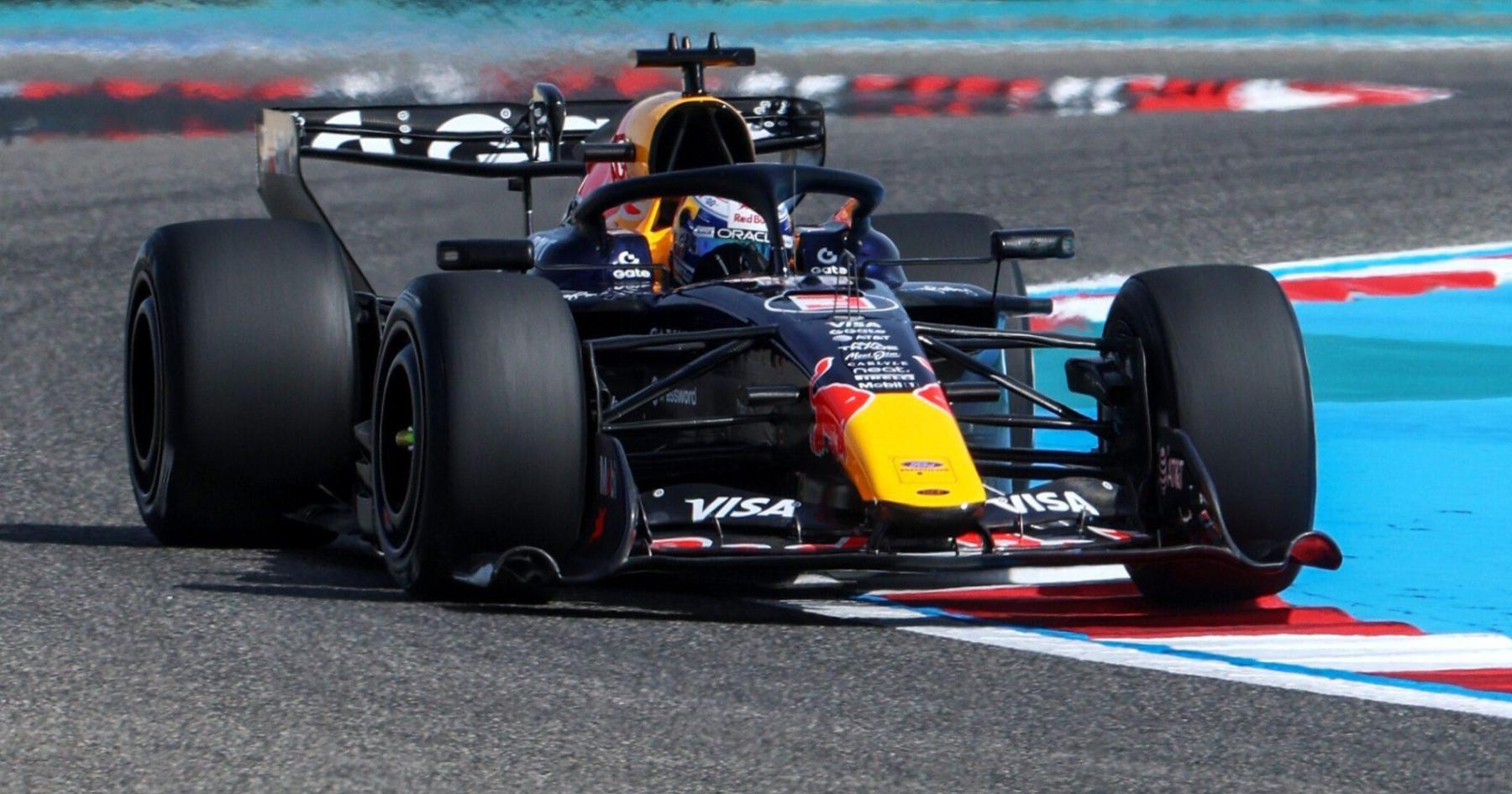
Mercedes Team Principal Toto Wolff, rarely one to heap praise on his bitter rivals without a hidden agenda, was forced to make a stunning admission: Red Bull Racing has set the “benchmark.” And it’s not just by a tenth or two. According to Mercedes’ initial data analysis, the new Red Bull RB22, powered by its in-house Ford engine, is gaining a staggering one second per lap on the field purely through energy deployment.
The “One-Second” Weapon
The 2026 regulations were supposed to reset the field. With a 50/50 split between internal combustion and electrical power, efficiency is king. But it appears Red Bull has found a way to weaponize this efficiency.
Wolff noted that the Red Bull is able to deploy its electrical energy much earlier and more aggressively than anyone else. While other cars are derating (running out of battery boost) halfway down the straight, the Red Bull is still pulling.
“It builds up a second per lap over its rivals,” Wolff revealed, clearly rattled. “That is quite something at this particular stage.”
Trackside observers backed up the data. Ian Parkes, RacingNews365’s lead editor, noted that the Red Bull engine has a distinct, guttural “roar” that separates it from the competition. “It seemed to be louder than any of the others—Audi, Honda, Mercedes,” Parkes observed from the Turn 10 braking zone. “It just had a bit more of a roar to it as it was powering down.”
If Red Bull has indeed found a mechanical or software solution that allows for such superior harvesting and deployment, the 2026 championship could be decided before the first light goes out in Melbourne. A one-second advantage on power alone renders aerodynamics almost irrelevant.
Hamilton’s “University Degree” Meltdown
While Red Bull surged, Lewis Hamilton simmered. The seven-time world champion, now in Ferrari red, cut a frustrated figure after his first proper day in the SF26.
Hamilton, never shy about voicing his displeasure with regulations he dislikes, made a bizarre claim that the new 2026 cars feel “slower than GP2” (now Formula 2). It was a comment that channeled his inner Fernando Alonso, but the data suggests it might be more frustration than fact.
“Your lap today was actually around 8.5 seconds quicker than the F2 pole position,” noted analyst Nick Golding, debunking the claim immediately.
But Hamilton’s complaints went deeper than just speed. He highlighted the immense cognitive load required to drive these new machines. With the removal of the MGU-H and the introduction of complex manual override modes for overtaking and energy management, the steering wheel has become a computer terminal.
“I feel like I need a university degree to understand how to get the best out of this car,” Hamilton griped.
Is this the sound of a champion struggling to adapt? Hamilton has always thrived on instinct and natural feel. The 2026 regulations, which demand constant switch changes and strategic calculations mid-corner, might be neutralizing his greatest strengths. If the car requires a mathematician to drive it, Ferrari might be in trouble.
The “Surge” That Sent Bottas Flying
Hamilton’s complaints about complexity were validated in a scary way by Valtteri Bottas. The Finnish veteran, driving for the rookie Cadillac team, suffered a bizarre off at Turn 10 that highlighted the potential dangers of the new power units.
Bottas revealed that as he approached the corner, the car’s energy deployment system suddenly kicked in unexpectedly.
“It gave him an extra 15 to 20 km/h more going into that corner than he’d ever experienced,” Parkes reported.
Imagine approaching a hairpin at 300 km/h, hitting the brakes, and suddenly having your engine shove you forward with a burst of torque. Bottas missed his braking point and sailed off the track. It was a teething problem, sure, but it underscores a frightening reality: these cars are still experimental. If a software glitch tells the 350kW electric motor to fire at the wrong moment during a street race like Monaco or Baku, the consequences could be devastating.
The Red Bull Achilles Heel
However, it wasn’t all champagne and high-fives in the Red Bull camp. While Max Verstappen clocked a monstrous 136 laps without issue, his sister team, Racing Bulls (RB), suffered a catastrophic failure.
The RB car, which shares the same Red Bull Powertrains (RBPT) unit, was sidelined for most of the afternoon with a “fluid leak” in the power unit.
This is the duality of the Red Bull situation. They have built a “monster” of an engine that is seconds faster than the rest, but they have built it in a “field” (as per their own admission) with a brand-new manufacturing team. The Racing Bulls failure is the first crack in the armor.
If the engine is fast but fragile, Verstappen could face a season of heartbreaks. A one-second advantage is useless if the car is parked on the side of the road with steam pouring out of the back.
Aston Martin’s Nightmare Continues
At the other end of the pit lane, the mood at Aston Martin is approaching funeral levels. The team, now powered by Honda, is enduring a catastrophic start to the new era.
After managing just four laps in the Barcelona shakedown, Lance Stroll managed only a handful of laps in Bahrain before the car ground to a halt again. The team cited a “data anomaly” in the Honda power unit.
“That’s a grand total of not well,” Golding quipped.
With every other team racking up centuries of laps—Audi did 190, Williams over 100—Aston Martin is sitting at the bottom of the mileage charts. In a year where data is gold, they are bankrupt. The partnership with Honda was supposed to be their ticket to the title; right now, it looks like an anchor dragging them to the back of the grid.
Audi’s “Uncomfortable” Debut
Finally, a word on the newcomers. Audi, the German giant making its full works debut, clearly has work to do. Observations from trackside described the car as looking “very uncomfortable” through the twisty sections.
“It didn’t quite seem to have the handling going into the corners like some of the other cars,” Parkes noted. While they logged impressive mileage (190 laps), the quality of those laps is questionable. Audi has reliability, but speed and ride quality seem to be elusive.
The Verdict
Day 1 in Bahrain has confirmed one thing: The 2026 regulations have not leveled the playing field—they have blown it wide open.
We have a field spread that looks terrifying. We have Red Bull with a potential “super-engine,” Mercedes panicking, Hamilton confused, and rookie teams facing dangerous software glitches.
Toto Wolff’s admission is the headline. If Red Bull really has a one-second advantage in their pocket, the rest of the grid needs to find a miracle, and fast. Because right now, the RB22 sounds louder, looks faster, and feels more dangerous than anything else on the track. The King is dead? Long live the King.
News

Inside Shane Richie’s love life: Drug – fuelled orgy with six blondes; real reason he split from Coleen Nolan; six-year ‘affair with fan’
Inside Shane Richie’s love life: Orgy with six blondes; real reason he split from Coleen Nolan; six-year ‘affair with fan’ He’s popular with the ladies… Shane Richie…

SH0CKING REVELATI0N:A sh0cking behind-the-scenes secret revealed about Lizzie Rizzini, the woman replacing Carol Kirkwood on the 6pm weather bulletin
BBC viewers still reeling from the departure of Carol Kirkwood got another surprise last night when presenter Lizzie Rizzini appeared to flash her black lace stockings on…

HEARTBREAKING: Peter Andre’s Tearful Message to Son Junior After SHOCKING Revelation About How He Truly Feels Toward Mum Katie Price — Katie Price’s reaction scares fans.
Peter Andre’s emotional message to son Junior after it’s revealed how he really feels about mum Katie Pri… PETER Andre has shared an emotional message to his…

Ben Shephard opens up about the devastating health battle his wife is facing: “She wakes up crying every single morning…”
Inside This Morning Ben Shephard’s Life Including Rarely Seen Wife and Health Battle Ben Shephard is a name synonymous with British television, renowned for his engaging presentation…

🚨 LIVE TV HEARTBREAK: Good Morning Britain Host Announces ‘Devastating’ Dɘath of Guest Minutes Into Show
Viewers of Good Morning Britain were met with heartbreaking news just minutes into Friday’s (January 30) episode, as co-hosts Kate Garraway and Ranvir Singh reported the tragic…

Emmerdale legend Cain Dingle will never be the same again after a shock cancer diagnosis turns his world upside down
FROure Desk. Full Terms and conditions are available on the website http://www.itv.com/presscentre/itvpictures/terms Emmerdale wouldn’t be Emmerdale without the glowering, grunting embodiment of manliness that is Cain Dingle (Jeff Hordley) But…
End of content
No more pages to load






