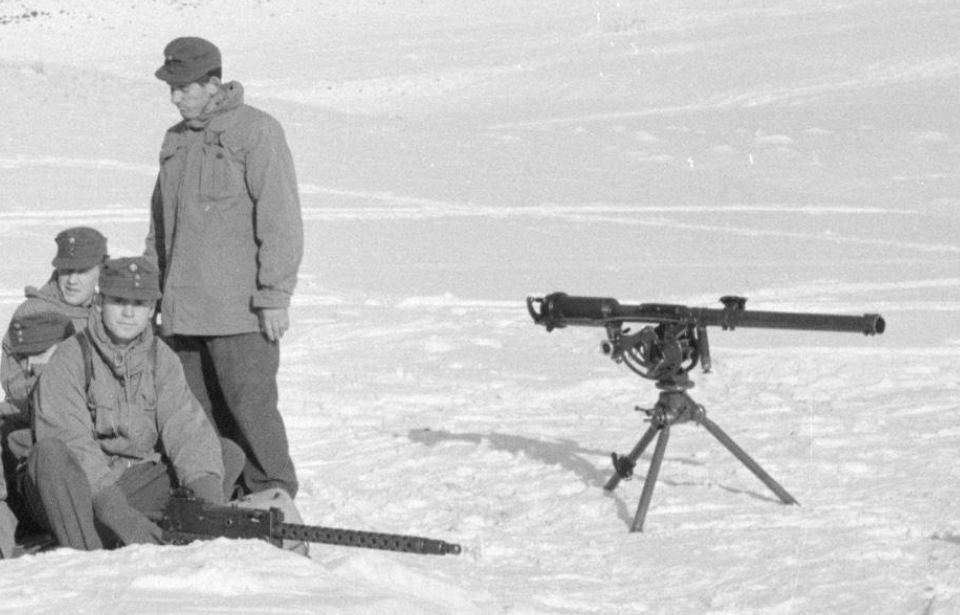
The M18 is a 57 mm shoulder-fired, anti-tank recoilless rifle the US Army equipped troops with during the Second World War and in Korea. The United States exported the weapon to various countries, and while it’s now considered obsolete, it’s recently seen service with the Syrian National Army during the Syrian Civil War.
Development of the M18 recoilless rifle

M18 recoilless rifle. (Photo Credit: Alf van Beem / Wikimedia Commons CC0 1.0)
As the US Army’s Artillery Section worked on a 105 mm recoilless cannon based upon captured German 10.5 cm Leichtgeschütz 40s (LG 40s), its Infantry Section was designing a smaller 57 mm recoilless rifle that could be easily carried and operated by just two soldiers.
The M18 was based upon the British 3.45-inch RCL. Instead of using a blowout plug like German recoilless rifles, the American design used cartridge cases with small holes in their sides and a plastic lining to keep the elements out until fired. To reduce friction upon firing, pre-engraving bands were used on the shells – a feature unique to the M18.
The M18 was nicknamed the “Kromuskit,” a play on the names of the two engineers involved in the weapon’s development. It was officially named the T15, and was first tested in November 1943. These trials found the recoilless rifle was superior to the 105 mm cannon being designed, leading to the latter’s cancellation. Before the end of 1944, the T15 was renamed “M18.”
By early 1945, over 2,000 M18s and 800,000 rounds of ammunition had been ordered.
M18 recoilless rifle specs

M18 recoilless rifle. (Photo Credit: Department of Defense / Department of the Army / Fort Leavenworth, Kansas / U.S. National Archives and Records Administration / Wikimedia Commons / Public Domain)
The M18 recoilless rifle was a fairly heavy weapon at 44.4 pounds. Its shells added an additional 5.3 pounds. The weapon was 61.6 inches long, and could be operated by one soldier, if necessary, but was almost always manned by two: a gunner and a loader. In addition to the M18 itself, the latter would carry a wooden crate containing the weapon’s shells.
Fired from either a prone, kneeling or standing position, the M18 was typically used with a T3 monopod and bipod or a cradle mounted on an M1917A1 machine gun tripod. To assist in moving the weapon, crews used a T27 cover with padded shoulder straps, allowing its operators to carry it slung from one shoulder.
By the end of the Second World War and into the latter part of the 1940s, the M18 fired various types of ammunition, including High Explosive (HE), anti-tank HEAT, Smoke/White Phosphorus and Training Practice (TP) rounds. A canister round was added later. With a muzzle velocity of 1,200 feet per second, the rifle was effective at 490 yards, with a maximum firing range of 4,340.
Service during the Second World War

M18 recoilless rifle on Okinawa, 1945. (Photo Credit: U.S. Army Signal Corps / Wikimedia Commons / Public Domain)
The first M18 recoilless rifles were sent to the European Theater in March 1945. Soon after, they also began deliveries to those fighting in the Pacific. The weapon first saw action with the US Army’s 17th Airborne Division near Essen, Germany and with American troops in Italy’s Po Valley during the 1945 Spring Offensive.
The M18 performed impressively when paired with the HE round. The HEAT cartridge was slightly less impressive and was only effective at penetrating armor up to 76.2 mm at 90 degrees. This meant the rifle was less effective than other weapons, such as the Bazooka, which could penetrate up to 100 mm with its M6A3 rocket, and the German Army’s Panzerschreck, effective at up to 216 mm.
The M18 was most effective when firing at the rear of a tank. If used properly, it could disable a tank, after which a Bazooka team, anti-tank guns or field artillery could destroy the target vehicle. Despite these limitations, the M18 was found to be more accurate and have a longer range than the M1 and M9 Bazookas.
In the Pacific, the recoilless rifle was an instant success. First seeing action during the Battle of Okinawa, it made waves with its HE and White Phosphorus rounds, taking out the heavily dug-in Japanese. The only complaint from those serving in the theater was that they didn’t have more ammunition.
Service during the Korean War

M18 recoilless rifle in Korea, 1951. (Photo Credit: U.S. Government / National Archives / Wikimedia Commons / Public Domain)
When the US entered the Korean War, each rifle company had three M18 recoilless rifles. By this time, it was clear the weapon was too weak against the Soviet-built T-34 tanks, which were taken care of by the M20 Super Bazooka. That being said, it was reported that the M18 was exceedingly effective against enemy machine gun nests.
Following the Korean War, the US Army retired the rifle. Despite this, it was exported to the Army of the Republic of Vietnam, along with HE and White Phosphorus rounds and the NATO-standard M74 tripod.
Non-American variants of the M18 recoilless rifle

French soldiers equipped with the M18 recoilless rifle during the First Indochina War, 1953. (Photo Credit: Warner Pathé News / Wikimedia Commons / Public Domain)
A number of nations, including France, the Netherlands, the Philippines, South Korea, South Vietnam and Turkey, purchased and used the M18 recoilless rifle. It was also copied by the People’s Republic of China and equipped as the “Type 36.” China supplied the variant to the North Vietnamese during the Vietnam War, and units were also delivered to Tanzania.
More from us: The Darne Machine Gun Could Be Used as Both a Ground and Aerial Weapon
The M18 was also produced by Brazillian manufacturer Hydroar in São Paulo as late as 1984. Most recently, the rifle has seen service with the Syrian National Army throughout the Syrian Civil War, which has been waged since March 2011.
News
Sharon Osbourne lashes out at Prince Harry and Meghan Markle over ‘moaning’ as popularity ‘dwindles’ over ‘moaning’ as popularity ‘dwindles’
Sharon Osbourne lashes out at Prince Harry and Meghan Markle over ‘moaning’ as popularity ‘dwindles’ Sharon Osbourne hasn’t held back as she shared her views on Prince…
Meghan Markle reveals, “I detest the royal family, and I wish they would ignore Harry and me, but they envy our blissful life.”
Meghan Markle is “worried” over Prince Harry’s attempts to reconnect with the Royal Family, sources have claimed. meghan and harry in south africa in 2019 Meghan ‘can…
Meghan Markle ‘wanted to be a superstar’ after quitting Royal Family
Meghan Markle and Prince Harry left their senior royal roles in 2020 but a royal commentator said the former Suits star would have liked to have been…

EXCLUSIVE: Meghan Markle will ‘no doubt’ overtake Kate Middleton in popularity, says expert..
Rumours have been circulating that Meghan Markle is set to make a big return to Instagram, with one expert suggesting she could overtake Kate Middleton in terms…
Meghan Markle shed tears on television revealing the hidden side of royal life: “Not many people ask me if I’m okay or not”..
On the evening of October 18, a short trailer about the documentary of Prince Harry and Meghan Markle on their trip to Africa continued to be released….
Royal fans call for Meghan and Harry to return to the royal family, but Princess Anne opposes, saying “they cannot return.
Amid Princess Anne’s increased royal duties, there’s growing chatter about Meghan and Prince Harry’s potential return to the fold. As Princess Anne reportedly takes on 70% of…
End of content
No more pages to load






