A detailed investigation of asteroid Ryugu samples has provided further evidence that the organic molecules which gave rise to life to our planet were brought here by ancient comets.
These space rock samples were returned to Earth by Japan’s Hayabusa2 mission, which visited the spinning-top-like space rock Ryugu in 2018. Hayabusa2 spent around 18 months studying the asteroid and collecting surface material, which has proved to be a treasure trove of information about our solar system.
Ryugu, formally known as 162173 Ryugu, is a 2850-foot (870-meter) wide near-Earth asteroid that lacks a protective atmosphere. This means its surface is directly exposed to space and can gather interplanetary dust, which changes the asteroid’s surface composition when struck.
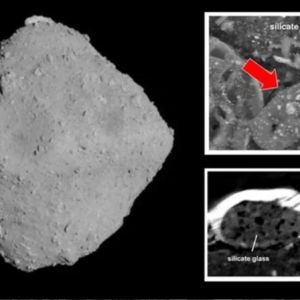
(Main) the asteroid Ryugu. (Inset top) A melt splash from the surface of Ryugu (inset bottom) a CT slice of the melt showing voids.(Image credit: (Main) JAXA/ (Inse) Megumi Matsumoto et al.)
The team of scientists behind the new developments in the quest to find life’s origins found 5 to 20-micrometer-wide “melt splashes” created when cometary dust in particular pelted the surface of Ryugu. And within these melt splashes, the researchers found small carbonaceous materials similar to primitive organic matter.
“This organic matter might be the small seeds of life once delivered from space to Earth,” team member and Tohoku University Graduate School of Science assistant professor Megumi Matsumoto said in a statement.
Comets tend to exist in wide orbits around the sun, which means they spend most of their time at the frigid outer edges of the solar system. But when they do sweep into the inner solar system, solar radiation heats their inner, icy material. That causes the material to transform straight into a gas, a process called sublimation.
As this gaseous material explodes from the comet, it carries with it some of the object’s surface material. Not only does this create the characteristic tails and auras, or “comas,” of comets, but it also leaves trails of cometary dust around the sun. When Earth passes through these trails, we witness meteor shows as the dust fragments burn up in our planet’s atmosphere.
This cometary material is far more likely to make it to the surface of atmosphere-less bodies like Ryugu, where it can be preserved, however. Thus, studying those dusty remnants on the Hayabusa2 samples could reveal clues about the material in the early solar system.
A CT scan shows carbonaceous material found in the melt splash from Ryugu. (Image credit: Megumi Matsumoto et al.)
The melt splashes studied by the team were created when the asteroid’s surface material was struck by cometary dust, with the two materials melting and mixing together during impact-caused heating and eventually cooling off.
The spongy carbonaceous materials found in the Ryugu melts differ chemically from organic matter usually found in cometary material because they lack oxygen and nitrogen. This could, however, hint at how the material was formed in the first place.
“We propose that the carbonaceous materials formed from cometary organic matter via the evaporation of volatiles, such as nitrogen and oxygen, during the impact-induced heating,” Matsumoto said. “This suggests that cometary matter was transported to the near-Earth region from the outer solar system.”
Sealed with the melts as further evidence of their origin are tiny voids caused when the impacts released water vapor from materials on Ryugu’s surface; this water was captured by the impact heated matter.
“Our 3D CT imaging and chemical analyses showed that the melt splashes consist mainly of silicate glasses with voids and small inclusions of spherical iron sulfides,” Matsumoto added. “The chemical compositions of the melt splashes suggest that Ryugu’s hydrous silicates mixed with cometary dust.”
Matsumoto and the team are continuing to examine Ryugu samples collected by Hayabusa2 in the hope of discovering more melts that may hold within them evidence of cometary dust strikes.
The hope is that that will deliver more insight into the transportation of primordial organic material to the space around Earth over 4 billion years ago prior to the emergence of life.
The team’s research is published in the journal Science Advances.
The Donut Dollies of Vietnam left a lasting legacy, and their stories continue to be remembered as part of the broader narrative of the Vietnam War. Their dedication to providing a sense of normalcy, entertainment, and comfort to soldiers in the midst of
Amidst the backdrop of conflict, where the harsh realities of war paint the landscape with uncertainty, a poignant scene unfolds—a meeting of the humanitarian spirit and the efficiency of military transport. Against this tumultuous canvas, a Red Cross Donut Dolly, clad in the iconic Red Cross uniform, finds herself hitching a ride in a helicopter, embarking on a mission that blends compassion with the swift mobility of military operations.
The helicopter, a mechanical bird of war, awaits with whirring blades ready to create a symphony of sound as it hovers, poised to lift off. Assisted by military personnel, the Donut Dolly, carrying the emblem of compassion and aid, ascends into the sleek and purposeful design of the aircraft. In this moment, the helicopter becomes a symbol of rapid response, an instrument of both conflict and relief.
Inside the helicopter, amidst the hum of the engine, the Donut Dolly takes her seat. The Red Cross insignia she wears becomes a beacon of hope against the military backdrop. The chopper rises into the sky, offering a bird’s-eye view of the complex tapestry below – a mosaic where military infrastructure converges with diverse landscapes.
The journey unfolds with a mix of anticipation and purpose. The Donut Dolly, dedicated to providing comfort and support to military personnel, gazes out, observing the ever-changing scenery. The rhythmic thump of rotor blades and the rush of wind through open doors add a dynamic element to the experience, a constant reminder of the fluidity of the mission.
As the helicopter approaches its destination, the military base sprawls before them—a complex network of tents, vehicles, and dedicated personnel. The Red Cross Donut Dolly, embodying the humanitarian mission, readies herself to disembark. Her presence becomes a symbol of warmth and care in the midst of the military environment.
The helicopter gently descends, and the Donut Dolly steps onto the base, a figure of compassion in the heart of the military operation. Ready to offer refreshments, engage in conversation, and bring a touch of normalcy, she becomes a beacon of humanity in a world often defined by conflict. Her unique journey, hitching a ride in the helicopter, becomes a distinctive chapter in the broader narrative—a story of compassion soaring through the skies to reach those in need, a reminder that even in the face of war, humanity prevails.
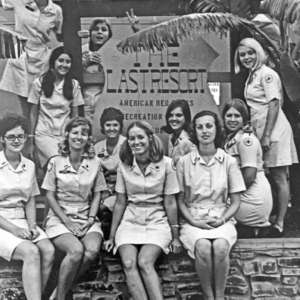
The Donut Dollies of Vietnam were young American women who volunteered with the American Red Cross to provide recreational and morale-boosting services to U.S. military personnel during the Vietnam War. The term “Donut Dolly” originated from the Red Cross practice of offering coffee and donuts to soldiers as a means of boosting their spirits and providing a taste of home.
These women were often college-educated, adventurous, and driven by a sense of duty to contribute to the war effort. They were deployed to Vietnam, where they worked in military support units, hospitals, and recreation centers. The Donut Dollies became a vital part of the U.S. military’s efforts to boost the morale and well-being of soldiers stationed in a challenging and hostile environment.
The roles of the Donut Dollies were diverse and multifaceted. They organized recreational activities, such as games, contests, and entertainment shows, to provide soldiers with a break from the stresses of war. They also facilitated communication between soldiers and their families back home, offering a link to the world beyond the war zone.
One of the most iconic contributions of the Donut Dollies was their mobile recreation units, which often involved traveling to remote or front-line areas in helicopters. These units brought a touch of home to soldiers by providing games, entertainment, and, yes, donuts and coffee. The sight of the Donut Dollies arriving in their Red Cross uniforms and offering a moment of respite from the harsh realities of war became a symbol of comfort for many troops.
The experiences of the Donut Dollies were unique, as they navigated the challenges of working in a war zone while trying to maintain a positive and supportive presence for the military personnel. Their contributions were not only appreciated by the soldiers but also acknowledged by the military as an essential component of the overall well-being of the troops during a difficult time.
The Donut Dollies of Vietnam left a lasting legacy, and their stories continue to be remembered as part of the broader narrative of the Vietnam War. Their dedication to providing a sense of normalcy, entertainment, and comfort to soldiers in the midst of conflict highlighted the resilience of the human spirit in challenging circumstances.
Serena will face Anastasia Potapova at the 2021 Australian Open in their third round match Thursday
Venus and Serena Williams.Photo: Serena Williams/instagram
Venus Williams and Serena Williams were able to get in some sister time while abroad for the 2021 Australian Open.
Venus, 40, posted a silly photo with Serena, 39, on Instagram as they enjoyed a meal.
In the photo, the sisters Venus wrapped her arm around Serena who was sticking her tongue out and throwing up a peace sign. They both coordinated in Gucci ensembles.
“The Scenes 🎬: Big sister acting like the little sister and then me staring at my true love ❤️ @serenawilliams #sisters,” Venus captioned the moment.
“COUPLE GOALS 🔥,” one fan commented.
Venus responded, “right?!”
The Williams sisters have a tight bond connected even further through the sport of tennis.
“For me, I can say for sure that tennis really binds me and Venus together because no one in the world on this planet understands what I go through and it’s because she’s been there and she’s won as many titles as I have,” Serena told Naomi Campbell last April on her YouTube channel No Filter.
She continued, “Nobody else has that experience. So for me, it’s like a special bond. Yeah we’re sisters and we’re really close and we’ve always been really close.”
“But this is another level in a professional world outside of growing up together and being siblings that just takes it to a whole other level. She is the only person I will talk to after I lose, not my husband nobody,” Serena concluded.
On Tuesday, Venus lost in the second round of the Australian Open to Sara Errani, while won her second round match against Nina Stojanović and will face Anastasia Potapova in their third round match Thursday.
On his very first night, he witnessed a Chinese attack on a position to his left.
Michael Caine is one of the most well-known and highly-regarded British actors of the 20th and 21st centuries. He is famous for roles in movies like Zulu, Get Carter, The Eagle Has Landed, The Italian Job, Austin Powers in Goldmember, Christopher Nolan’s Batman films, and a host of others spanning an acting career of 70 years.
GETTY
While he has become a household name across the globe, a fact that many people don’t know about Michael Caine is that he served in the British Army and saw combat in the Korean War. It was a harrowing experience for the actor and one that would scar him for many years.
Caine’s birth name was Maurice Joseph Micklewhite, and he was born in 1933 in South London to a working-class family. Caine’s father fought in the Second World War. His family, including the young Maurice (Michael), was evacuated from London due to the risk of bombing by the Luftwaffe.
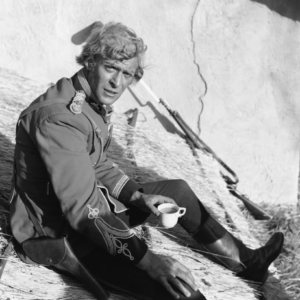
Behind the scenes on the location set of the film Zulu with stars Michael Caine and Stanley Baker.
After gaining his School Certificate at the age of sixteen, he worked for a time as a messenger and filing clerk for a film company in order to a get a foot into the door of the industry.
He was called up for national service from 1952 to 1954. He served with the British Army’s Royal Fusiliers, an infantry regiment.
At first, he was posted to serve with the British Army Of The Rhine (BAOR), the British occupation force that had been stationed in Germany after the end of the Second World War. However, after serving there for a few months, he opted to transfer to Korea where a war was raging.
Royal Navy and Army personnel are watching guns being towed across the Rhine after completing building of the bridge.
The British Army in North-west Europe 1944-45. Assault on the Rhine and Capture of Wesel. Commandos make their way over a bomb crater.
Going into combat would turn out to be an experience that would change Caine forever.
Caine landed at Kure, in southern Japan, and underwent two weeks of combat training. After this, he was sent to the South Korean front, near Pusan.
The front was unlike anything Caine had ever experienced. There were hordes of rats and vast swarms of mosquitoes as well as the ever-present stink of human excrement used to fertilize the fields. And, of course, there was the presence of thousands of North Korean and Chinese soldiers hell-bent on killing Caine and every other opposing soldier there.
He spent his first few nights in a trench on a hill around a mile from the Chinese lines. On his very first night, he witnessed a Chinese attack on a position to his left. He watched with both awe and horror as the Chinese troops – who were clearly unafraid of death and fanatical in their cause – charged headlong into machine gun fire.
Troops await North Korean attacks across the Naktong River from positions on the Pusan Perimeter, September 4, 1950.
He would end up being on the receiving end of more than one of these charges while manning an American .30 caliber machine gun. Some nights he would go out on patrol, and these were the most terrifying experiences he underwent in Korea.
Sometimes, enemy bombardment of the trenches would continue for up to 24 hours without pause. Caine would simply lie in his camp bed in the bunker, listening to the shells whining and exploding, and wonder how he was going to get out alive.
Soldier takes aim with a tripod-mounted M1919A4 in Korea, 1953
On one occasion, he came alarmingly close to being killed. Caine and two other men were out on patrol, creeping through the elephant grass at night. They suddenly heard the tell-tale clicking of rifle bolts snapping shut all around them, accompanied by hushed voices speaking excitedly in Chinese.
They were surrounded and heavily outnumbered, and all three men were convinced they were about to die.
In that moment, however, Caine recalls that he felt no fear. He “decided that whoever was going to take [their] lives was going to pay dearly.” So the three of them charged, roaring maniacally, at the voices.
A .50 Cal. Machine gun squad fires on North Korean patrols along the north bank of the Naktong River, Korea.
The Chinese opened up but were firing at the place where Caine and his companions had been a few seconds earlier, not where they were running to. The British mortars spotted the Chinese muzzle-flares in the darkness and opened up on them, scattering the enemy. Caine and his friends managed to get back to British lines and lived to fight another day.
Caine stated that as the child of a working family who had grown up poor, he had been sympathetic to communism prior to his experience in Korea. But after he had fought the fanatical proponents of communism and saw firsthand how it dehumanized people, he changed his mind about it and came to greatly oppose the idea.
M26 tank west of Masan during Pusan Perimeter engagement, late summer 1950.
All in all, he was in Korea for a year. He spent six weeks at a time in the trenches followed by two weeks in Seoul for R&R, during which time many of his fellow soldiers were infected with gonorrhea. Caine, due to his refusal to see prostitutes, never contracted the disease.
He left Korea a profoundly changed man, grateful at having survived the war. He had been forced to grow up very quickly, and he’d learned a lot about himself and the world.
Michael Caine stars in “Ashanti,” filmed at the Moon Valley above Eilat, Israel.Photo: Government Press Office (Israel) CC BY-SA 3.0
He used his military experience in a number of roles in which he played military men and, despite his humble background, ended up becoming an icon of British and international film.
Caine, currently 90 years old, is still acting and has no plans to retire as yet.
Williams shares daughters Olympia, 6, and three-month-old Adira with tech entrepreneur husband, Alexis Ohanian
Serena Williams gets candid about reality of being a mom.Photo: Taylor Hill/FilmMagic; Serena Williams TikTok
Serena Williams is getting candid about being a mom!
The tennis legend, 42, shared a light-hearted TikTok clip of her real-life parenting world Wednesday that opened with her posed in the black sequin gown with puff sleeves she wore to the recent 2023 CFDA Awards.
In a relatable moment for parents everywhere, the camera then switched to an image of her pumping breast milk and letting out a deep sigh.
“What my life is really like… It’s not as glamorous as you think,” the mother-of-two wrote in her caption.
Earlier this month, Williams — who shares daughters Olympia, 6, and three-month-old Adira with tech entrepreneur husband, Alexis Ohanian — revealed that Olympia is successfully “navigating” being an older sister to Adira.
“She loves it,” Williams told Entertainment Tonight at the CFDA Awards. “Adira’s like a tiny little baby, so Olympia just calls her her little sis.”
Per the outlet, Williams explained that Olympia “prayed for a sister” but revealed she herself was a little “worried” ahead of Adira’s arrival.
“I was like, ‘OK, I don’t know if I can like anyone as much as I love Olympia,’” Williams said. “I was really nervous about that. But I feel like it all worked out.”
Serena Williams gets candid about being a mom. Serena Williams TikTok
Despite Williams sharing her reality of motherhood, the star became the first athlete to win the fashion icon honor from the Council of Fashion Designers of America at the CFDA Awards, following in the footsteps of Beyoncé, Naomi Campbell, Rihanna and Zendaya.
“Ever since I was a little girl, I’ve used fashion as an outlet to express myself,” Williams told the CFDA ahead of the ceremony while wearing the elegant black dress designed by CFDA Chairman Thom Browne. “Fashion gave me the confidence to step on the court and own who I was, and where I knew I was going,”
New research suggests the Chelmno group followed their water burials with mass deposits of bronze jewelry and artifacts
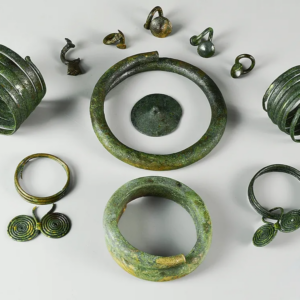
An excavation of the dry Papowo Biskupie lakebed unearthed over 550 bronze artifacts. A. Piasecka / Antiquity Publications Ltd.
Researchers have determined that a hoard of bronze jewelry found in a Polish lakebed may be related to ancient ritualistic water burials.
Metal detectorists discovered the jewelry last year at Papowo Biskupie, the site of a long dried-up lake in Poland. In the excavations that followed, researchers recovered over 550 bronze artifacts, as well as human bones—making the site “one of the most eloquent testimonies of ritual activity from the Lusatian period in Poland,” according to a study published this week in the journal Antiquity.
Between 1200 and 450 B.C.E., the site was occupied by the Chełmno group, a faction of a larger northern European culture called the Lusatian population, which was active during the late Bronze and early Iron Age, according to the researchers. Previously, historians knew that other Lusatian groups used metal for ritualistic purposes, but the Chelmno group wasn’t thought to have engaged in this practice—until the recent findings at Papowo Biskupie.
A recreation of a multistrand necklace, complete with beads and charms, found at the site A. Fisz / Antiquity Publications Ltd.
“The scale of metal consumption at the site is extraordinary,” study co-author Łukasz Kowalski, an archaeologist at the AGH University of Science and Technology in Krakow, tells Live Science’s Jennifer Nalewicki. “Until now, we thought that metal was a weak partner in the social and ritual strategies of the Chełmno group, in contrast with the metal-hoarding madness [practiced by the other Lusatians].”
Researchers also recovered skeletal remains from at least 33 human bodies—including infants, children, adolescents and adults—in the lakebed. After conducting radiocarbon testing, they determined the bones date to between 1040 and 780 B.C.E.
The trove of artifacts found at the site includes arm and neck accessories, such as a necklace made with oval- and tube-shaped beads and “swallow-tail pendants,” write the researchers, who think many of the metal pieces were made by locals. However, a glass bead from the same necklace appears to have traveled a longer distance, offering new insights into the community’s participation in trade.
“The bead is made of low-magnesium glass that was sourced from the Eastern Mediterranean region,” Kowalski tells Live Science. “This increases the use of evidence that power-elites of the Chełmno group became parties to a metal trading network that connected much of the European continent in the first millennium B.C.E.”
Researchers created this example of a Chełmno woman’s burial using the jewelry found at the site. A. Fisz / Antiquity Publications Ltd.
Radiocarbon dating suggests that the metal jewelry was buried in the lake sometime after the bodies. According to a Facebook post from Antiquity, this gap sheds light on a cultural shift within the Chelmno group: The community may have first buried only bodies in the lake, later adding the metal as they adopted new traditions.
“While the Chelmno group differed in many ways from others in Lusatian culture, it seems the ritual practices and their belief system aligned later on,” writes Newsweek’s Robyn White.
The researchers completed their study with illustrations imagining what a Chelmno woman’s burial might have looked like. In one of these images, she is seen lying down with her head turned to the side, adorned with some of the metal jewelry recovered from the site.
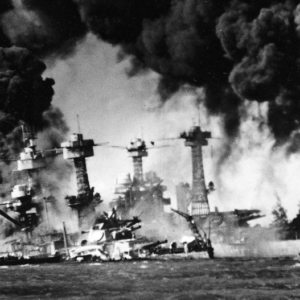
Although over 80 years have passed since the Japanese attack on Pearl Harbor, many details of the event remain shrouded in mystery and debate. Even so, historical researchers and scientists have been able to shed light on at least some of the many lingering questions. Here are nine stories of secrets and science from the “date which will live in infamy.”
Purple/Magic
A long-standing conspiracy theory suggests that U.S. President Franklin Roosevelt or his military advisors knew in advance of a Japanese attack on Pearl Harbor but neglected to act on the warnings, for political purposes, hoping to force the U.S. to join World War II.
The accusations were first made public by FDR’s political opponents during his campaign for re-election in 1944, but all of the 10 official inquiries into the events of the attack on Pearl Harbor have dismissed these ideas. The latest such inquiry took place in 1995.
Much attention has focused on a U.S. espionage effort, code-named Purple, which aimed to decipher Japanese radio communications picked up by U.S. listening stations around the Pacific Ocean. The deciphered messages produced by the Purple decipherment machine (pictured above) were code-named Magic.
But making sense of the Magic messages involved a complex and slow process; they were protected by two layers of codes and ciphers that changed each day, and most of these messages also needed to be translated from Japanese.
Although the Purple program was able to read some Japanese diplomatic communications before 1941, researchers have shown that the codes and ciphers used by the Japanese military were not broken until much later in the war. Japan’s military was distrustful of the country’s Foreign Office, and shared no details of the impending secret attack on Pearl Harbor with their ambassadors in the U.S.
One key Magic communication did relate to the attack: the famous “14-part message” between the Japanese foreign office in Tokyo and the Japanese embassy in Washington, D.C., which was intercepted on Dec. 6, 1941.
The message indicated that Japan would formally break off peace negotiations with the U.S. at 1 p.m. in Washington, D.C., the next day. This corresponded to dawn in Hawaii on the day of the Japanese attack.
Several U.S. officials read the message, and interpreted it as a strong sign that a Japanese attack was imminent.
But the message did not say anything more, and at the time, the U.S. was expecting Japan to invade Thailand and the British colony of Malaya — which the Japanese did do on Dec. 8, the day after the Pearl Harbor attack.
Spies in Hawaii
Several foreign spies are known to have operated in Hawaii on behalf of the Japanese military before the Pearl Harbor attack. (Image credit: U.S. National Archives)
Several foreign spies are known to have operated in Hawaii on behalf of the Japanese military before the Pearl Harbor attack.
Among them was Otto Kuhn, a “sleeper agent” for Germany’s Abwehr military intelligence service, who had lived for many years in Hawaii with his family before the war. Kuhn was related to the Nazi propaganda minister Joseph Goebbels, who arranged for Kuhn’s posting to Hawaii in 1935 to spy for the Japanese.
Kuhn trained his teenage son and daughter to listen for military secrets, while his wife was responsible for compiling the information the family gathered. Although the Kuhns diligently produced many espionage reports for many years, the family of spies failed to impress their Japanese controllers. Historical researchers have said the Kuhns gathered little information of real value. All four members of the family were arrested in February 1942, a few weeks after the attack on Pearl Harbor. Kuhn, his wife and his daughter were imprisoned for spying, and returned to Germany after the war.
Japan, however, had its own master spy in Hawaii: a young intelligence officer in the Imperial Japanese Navy named Takeo Yoshikawa, who worked undercover at the Japanese consulate in Honolulu as a junior diplomat named Tadashi Morimura.
Yoshikawa was posted to Honolulu in March 1941, and lost no time making a thorough inventory of U.S. naval activity by touring the island via car and boat, taking photographs from hills overlooking the harbor, and chatting with taxi drivers. He even rented a small plane for aerial reconnaissance and went diving near the warships in the harbor while breathing through a hollow reed.
U.S. counterspies intercepted and deciphered some of the many messages Yoshikawa transmitted to Japan, but none of these messages gave any direct warning of an attack on Pearl Harbor — until his final message. This transmission, sent on Dec. 6, described the positions of the U.S. warships in the harbor. Unfortunately, U.S. experts did not decipher that message until after Japanese attack had begun.
Secret Fleet
Many historical researchers highlight two major factors in the success of the Pearl Harbor attack: the effectiveness of Japanese torpedoes and the strict secrecy surrounding the movements of the Japanese warships making the attack.
Japan went to a great deal of trouble to disguise the movements of its strike force (Kido Butai) of six aircraft carriers, 414 aircraft, and more than 40 other warships and submarines. This force left northern Japan under strict radio silence in late November 1941.
Many of the radio operators from the ships were left behind at their bases in Japan, where they continued to send transmissions as if still on board their vessels. This was an effort to fool the U.S. military, which was known to be listening in on Japanese radio communications.
At first, the Japanese fleet sailed almost due east, far north of the regular shipping lanes. The force had orders to destroy any commercial ships it encountered that might betray the fleet’s position, but reportedly only a single Japanese ship was sighted.
On the Dec. 4, 1941, the strike force turned southeast toward Hawaii, and finally approached the islands from the north — where the Japanese spy Takeo Yoshikawa had reported few U.S. air patrols were carried out, because the seas there were thought to be too rough for an attack.
Thunder Fish
The Japanese spy Takeo Yoshikawa also reported that the water in Pearl Harbor was not deep enough to use torpedoes. The U.S. Navy apparently thought the same, and later U.S. inquiries into the attack found that this was one of the reasons that no anti-torpedo nets were installed to protect the largest warships on Pearl Harbor’s Battleship Row.
The Japanese answer to the shallow waters was to devise a new type of aerial torpedo (shown here in the center) that could be dropped from an aircraft into shallow water without burying itself in the mud of the harbor floor.
Two wooden fins were added to the torpedo to keep it stable after it dropped from the aircraft. The fins broke off when the torpedo entered the water, where a sophisticated control mechanism prevented the weapon from rolling out of control as it sped toward its target, a few feet below the surface.
The Japanese aerial torpedoes, nicknamed “thunder fish in the sky” (“koku gyorai”), devastated warships in the harbor, sinking more vessels than any other weapon used by the attacking aircraft, which included regular aerial bombs and armor-piercing anti-ship bombs.
At least 13 of the 40 torpedoes launched in the first wave of the Japanese aircraft attacks hit the U.S. battleships, which were then considered the most important warships in the American fleet.
“Missing” Carriers
That all three U.S. aircraft carriers based at Pearl Harbor were away at sea on the day of the Japanese attack has fueled rumors that senior U.S. officials knew in advance about the attack, and that they had dispatched the carriers on a distant mission to protect them from harm.
The fortunate survival of the carriers USS Lexington (shown here), USS Saratoga and USS Enterprise was an important boost to U.S. morale in the days after the Pearl Harbor attack. But historical researchers point out that the U.S. Navy did not consider aircraft carriers important until after the Pearl Harbor attack had shown the effectiveness of air attacks on warships.
Although aircraft carriers would later dominate the war in the Pacific, in December 1941, the U.S. Navy thought its battleships would be the most important warships in any war to come, as the ships had been since the First World War.
The Japanese also considered the American battleships to be their main target. And thanks to the country’s spy in Hawaii, Takeo Yoshikawa, Japan already knew that the U.S. carriers were not in harbor on the day before the attack, but that eight U.S. battleships were.
Naming the Dead
After 75 years, efforts continue to identify the remains of many of the victims of the Japanese attack on Pearl Harbor, where more than 2,400 Americans died.
Researchers for the Department of the Defense based at Pearl Harbor are trying to establish the identity of hundreds of sailors and marines from the wreck of the battleship USS Oklahoma, using DNA analysis and dental records.
The Oklahoma capsized on Pearl Harbor’s Battleship Row with more than 400 crew on board on the day of the attack, after Japanese torpedoes hit the ship.
Most of the badly damaged human remains from the Oklahoma were initially buried in mixed caskets at the National Memorial Cemetery of the Pacific in Honolulu, but the researchers have said they hope to eventually identify each individual.
So far, the Defense POW/MIA Accounting Agency has identified 392 distinct sets of DNA in the remains from the Oklahoma, and has positively identified the remains of more than 60 servicemen.
Mystery Catalina
Alongside the major wartime shipwrecks in Pearl Harbor, including those of the battleships USS Arizona and USS Utah, many smaller military wrecks still hold secrets.
Among them is the wreck of a Catalina PBY flying boat in Kane’ohe Bay, on the northeast side of the main island of Hawaii, which underwater archaeologists investigated in 2015.
Investigators have tried to identify the wrecked seaplane for many years, but so far its identity and that of its crew remain unknown.
The researchers said it may have been destroyed soon after it took off during the Japanese attack.
Submarine Wrecks
A remotely operated underwater vehicle (ROV) has explored the wrecks of two Japanese submarines that took part in the attack on Pearl Harbor, to mark the 75th anniversary of the events.
Researchers from the National Oceanic and Atmospheric Administration (NOAA) live-streamed video from the ROV as it explored the wrecks.
The subs were among five Japanese submarines sent to infiltrate Pearl Harbor before the first air attacks. Each was armed with two torpedoes, but all failed in their mission.
One of the Japanese subs explored by the ROV was sunk by the USS Ward near the entrance of the harbor. Divers re-discovered the wreck in 2002.
The wreck of the second sub was found in 1951, before it was raised by the U.S. Navy and dumped in deeper waters.
Leaking Oil
The damage to U.S. warships by the Japanese raid has left a lasting impact on the marine environment of Pearl Harbor.
Oil continues to leak from the USS Arizona, which had taken on nearly 1.5 million gallons (5.7 million liters) of fuel on the day before the attack, in preparation for its return to the U.S. mainland that month.
Today, the wreck of the USS Arizona spills more than 2 gallons (8 L) of fuel oil a day, and some scientists have warned of a potential environmental disaster if the estimated half a million gallons of fuel remaining in the wreck escapes.
The National Park Service, which administers the wreck of the USS Arizona as a national monument, monitors the fuel spilling from the ship, but so far no major efforts have been made to contain the leakage.
But the fuel leaking from the ship may not be the greatest environmental threat to the waters of Pearl Harbor. According to the Environmental Protection Agency, more than 5 million gallons (19 million L) of spilled fuel have collected in an underground plume beneath a fuel storage area near the main gate of the Pearl Harbor military base.
The U.S. Navy said some of the spilled fuel in the plume dates back to activities at the base during World War II – the rest comes from fuel spills and leaks that have occurred at the base in years since then. Although the Navy said there is no danger of the heavy fuel seeping into the water, scientists have warned of a major environmental disaster if such seepage ever occurs.
“She wears dresses all day every day, and insists on heels,” Venus Williams says of her niece Olympia
Photo: Alexis Olympia Ohanian, Jr./Instagram; Bertrand Rindoff Petroff/Getty
Venus Williams sees a future in fashion for her niece Olympia!
During Monday night’s Met Gala, the athlete, 41, chatted with Access Hollywood on the red carpet about her stylish niece, 4, and her love for fashion.
“She wears dresses all day every day, and insists on heels, so she’ll be here next year,” Venus said of the daughter of Serena Williams and Alexis Ohanian.
“Next year she’ll probably be chair,” Venus teased.
The toddler loves to get dressed up — especially when it’s to match her tennis pro mom.
Back in June, Olympia sported a miniature version of the iconic catsuit her mom, 39, wore at the Australian Open earlier this year. Olympia’s father documented the adorable matching moment on his daughter’s Instagram account.
Alexis’ post included several photos of Olympia on the tennis court, wearing her hair in two buns with hair ties that matched the red, pink and black suit. She also wore matching black, gray and pink Nike tennis shoes as she posed with her racket for the camera.
Serena Williams and her daughter Olympia.olympia ohanian/instagram
As perfect as Olympia looked, Alexis was apparently preemptive in showing off his daughter’s cute outfit.
“Awwwww mannnnnn I asked you to save this post until I was next to her side by side in my same outfit 🙄🙄,” Williams wrote in a comment on the post.
“Oophhh I guess I’ll have to pull the plug from your phone tonight,” she added. “And you wake up wondering why you have no battery 🤷🏿♀️🤷🏿♀️ LOL.”
Watch the sun spew out a giant eruption of plasma in incredible footage (video)
Miguel Claro is a professional photographer, author and science communicator based in Lisbon, Portugal, who creates spectacular images of the night sky. As a European Southern Observatory Photo Ambassador and member of The World At Night and the official astrophotographer of the Dark Sky Alqueva Reserve, he specializes in astronomical “Skyscapes” that connect both Earth and the night sky.
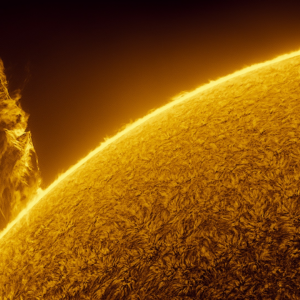
On Feb. 22, 2022, a gigantic solar prominence formed on the surface of the sun, blasting a large coronal mass ejection (CME) into space.
Solar prominences, or filaments, are large loops of plasma flowing along twisted magnetic fields that extend outward from the sun’s surface. They are attached to the sun’s photosphere, or visible outer layer of its atmosphere, and while they can form in just a day, they can last for months. Some prominences can extend for thousands of miles into space. Solar scientists still aren’t exactly sure how they form.
This was likely the highest prominence I have witnessed and recorded to date. The prominence appears so tall when compared to the sun’s disk that it appears that we dozens of Earths could fit inside of it.
An image of a solar prominence captured by astrophotographer Miguel Claro on Feb. 22, 2022. (Image credit: Miguel Claro)
This was my most stressful and luckiest capture. As soon as I realized that the prominence was growing so fast and so drastically, I had to quickly decide what to do. So I decided to interrupt the first sequence and rotate the camera, framing again for the new composition, to be able to keep capturing this growing giant ejection.
That day, the conditions for solar photography were good, not perfect, but nice enough for a time-lapse. So I made a huge effort of gathering as much images as possible. The final result is a 4K high resolution solar movie comprising around 2 hours and 15 minutes, captured from the Dark Sky® Alqueva region of Portugal.
With a total solar eclipse arriving on April 8, 2024, you may want to take your own photos or videos of the sun. If so, be sure to take all precautions.
The first thing to be aware of is that viewing the sun or a solar eclipse can be dangerous without the right equipment. Never look directly at the sun with the naked eye, especially through additional optics like telescopes or binoculars. Whatever gear you use, make sure it has a certified solar filter, or a smart telescope with a solar filter like the Unistellar Equinox 2 might be your best bet.
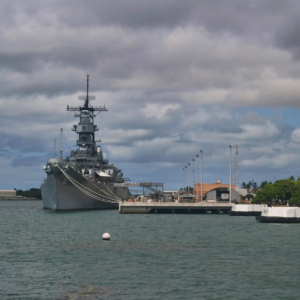
There are three other ships in the United States Navy which were named after the state of Missouri besides the battleship USS Missouri (BB 63), and although she became associated with the history of the Japanese raid at Pearl Harbor, she never took part in the event. So, why is she known by so many around the world?
Missouri, a.k.a. “Mighty Mo” stands out in the history of the Second World War not just as the last battleship of the U.S. Navy, but also as the battleship which hosted the end of the Second World War in the Pacific.
A kamikaze plane about to hit Missouri 11 April 1945
The life of Mighty Mo began after her commissioning on 11 June 1944 as the last Iowa-class battleship of the U.S. Navy. She had a full-load displacement of 58,000 long tons, a length of 887.2 feet and a beam that measured about 108 feet. At her maximum speed of 33 knots, she possessed a range of about 14,900 miles.
USS Missouri (BB-63) (left) transferring personnel to USS Iowa (BB-61), while operating off Japan on 20 August 1945.
Just like the rest of the Iowa-class battleships, her main armament comprised nine 16-inch .50 caliber Mark 7 guns which could fire shells that weighed up to 2,700 lb at a target 20 miles away. Subordinate armament comprised twenty 5-inch .30 caliber Mark 12 guns that could hit a target 10 miles away. She was also fitted with anti-aircraft guns to defend Allied aircraft carriers from air attacks.
https://youtu.be/gHW7xhCx_t0
Missouri was one of the battleships that took part in the invasion of Iwo Jima, which is known as the fiercest battle of the war’s Pacific theater.
On 18 March 1945, she was part of the battleship group that struck airfields and naval bases along the coast of Japan’s Seto Inland Sea. During this event, she gunned down four enemy planes and provided cover for the badly damaged carrier Franklin.
Missouri moves through the Panama Canal en route to the United States in October 1945.
On March 24 and April 1, Mighty Mo was with the Task Force 58 battleship group during the raids at Okinawa. She shot down five airplanes, provided support in the downing of another six, helped repel numerous waves of attacks during the day and night of the invasion, and destroyed military and government infrastructure. Also, the sinking of the Japanese submarine I-56 was initiated by Missouri, whose radar had detected it.
After her contributions at Okinawa, she took part in the bombardment of the Japanese home islands. Her battle group devastated Japanese infrastructure such as the Nihon Steel Company and the Wanishi Ironworks, in Hokkaido, and several other industrial targets in Honshū, before the release of the second atomic bomb which would lead to Japan’s surrender in 1945.
Allied sailors and officers watch General of the Army Douglas MacArthur sign documents during the surrender ceremony aboard Missouri on 2 September 1945. The unconditional surrender of the Japanese to the Allies officially ended the Second World War.
The signing of the official instrument of surrender was done aboard Missouri, and thus, the end of the war was marked onboard this ship, the main fact for which she is remembered.
The outbreak of the Korean War saw Missouri back in action, providing support and going on bombardment missions. Her last of such missions was the bombardment of Kojo on 25 March 1953.
Missouri was accidentally grounded early on the morning of 17 January 1950.
On 26 February 1955, she was decommissioned. Following her decommissioning, one idea to move Missouri to Pearl Harbor as a museum ship was thwarted by the National Park Service because of fears that with her towering popularity she would overshadow Arizona, the battleship that had become a symbol of the Japanese attack on Pearl Harbor following her very dramatic end.
Missouri was instead mothballed in Bremerton, west of Seattle, Washington. However, more than 30 years later, she was reactivated and modified during the 600-ship Navy project.
USS Missouri at sea in her 1980s configuration
The resurrected version was equipped with Quad Cell Launchers to fire Harpoon missiles and Armored-box launchers for firing Tomahawk missiles. For protection against enemy missiles, a Phalanx CIWS was installed on the ship.
In 1991, during the Gulf War, she was back in combat again, serving until 31 March 1992, when she saw her final decommissioning. Missouri received 11 battle stars throughout her lifetime of service, and was used by the USS Missouri Memorial Association as a museum ship at Pearl Harbor after her retirement.
More photos
A kamikaze plane about to hit Missouri 11 April 1945
USS Missouri (BB 63) prior to her being launched at the New York Navy Yard, January 29, 1944. Note the unusual view of the bow.
USS Missouri (BB-63). Photographed while on her shakedown cruise, August 1944.
The U.S. Navy battleship USS Missouri (BB-63), with the destroyer USS Renshaw (DD-499) alongside, manning the rails during Navy Day ceremonies in the Hudson River, New York City (USA).
Aerial view of warships at the base piers of Norfolk Naval Base, Virginia (USA), circa August 1944. Among them are: the battleship USS Missouri (BB-63), the largest ship; the battlecruiser USS Alaska (CB-1), on the other side of the pier; the escort carrier USS Croatan (CVE-25), and two destroyers, a Fletcher-class destroyer at the pier and a Clemson/Wilkes-class-destroyer moored outboard.
View of the U.S. Navy battleship USS Missouri (BB-63) looking aft towards the number three battery and the superstructure. Note the 20 mm antiaircraft gun mounts in the foreground and the SG surface-search radar antenna atop both mainmasts and the circular antenna for the SK-2 air-search radar on the foremast. Also visible are two Mk 37 gun directors with Mk 12 fire control radar for the 12.7 cm artillery and the Mk 38 gun director with Mk 8 fire control radar (“hedgehog”) for the 40.6 cm artillery.
View of the forecastele of the U.S. Navy battleship USS Missouri (BB-63) in heavy seas.
The U.S. Navy battleship USS Missouri (BB-63) during battle practice in Chesapeake Bay on 1 August 1944. She is wearing Camouflage Measure 32 Design 22D.
USS Missouri leading USS Iowa into Tokyo Bay, Japan, 30 August 1945. Note destroyer USS Nicholas in escort.
Warships of the U.S. Third Fleet and the British Pacific Fleet in Sagami Wan, 28 August 1945, preparing for the formal Japanese surrender a few days later. Mount Fuji is in the background. Nearest ship is USS Missouri (BB-63), flying Admiral William F. Halsey’s four-star flag. The British battleship HMS Duke of York is just beyond her, with HMS King George V further in. USS Colorado (BB-45) is in the far center distance. Also present are U.S. and British cruisers and U.S. destroyers.
American aircraft fly over USS Missouri after the surrender.
USS Renshaw (DD 499) dwarfed in comparison, stands alongside USS Missouri (BB 63) to pipe President Harry S. Truman onboard for Navy Day luncheon, October 1945
USS Augusta, USS Midway, USS Enterprise, USS Missouri, USS New York, USS Helena, and USS Macon in the Hudson River in New York, New York, United States for Navy Day celebrations, 27 October 1945.
USS Missouri (BB-63) in drydock at Norfolk Navy Yard, Norfolk, Virginia, November-December 1949.
Missouri (BB-63) bombarding Communist positions off Chong Jin, Korea. She is only about forty miles from the Soviet border, so all hands are at General Quarters, 21 October 1950.
The U.S. Navy battleship of USS Missouri (BB-63) upon arrival at Norfolk, Virginia (USA), after service in the Korean War on 27 April 1951.
Crew members man the rail as the battleship USS Missouri (BB-63) arrives in port prior to a cruise to Australia and around the world, 1986.
The No. 1 and 2 Mark 7 16-inch/50-caliber gun turrets are fired during a main battery firing exercise aboard the battleship USS Missouri (BB-63). The ship is en route to Sydney, Australia, during a cruise around the world, 1986.
The battleship USS Missouri (BB-63) transits the Suez Canal while en route to Istanbul, Turkey. The ship is on an around the world shakedown cruise, 1986.
The Iowa class battleship USS Missouri (BB-63) arrives off the coast of Australia for a ceremonial visit to Australia in honour of the Royal Australian Navy’s 75th anniversary.
An aerial starboard view of the fleet oiler USNS Kawishini (T-AO-146), center, the battleship USS Missouri (BB-63), bottom, and the aircraft carrier USS Kitty Hawk (CV-63), participating in an underway replenishment operation, 25 July 1986.
An aerial port view of the forward half of the battleship USS Missouri (BB-63) while the ship is underway.
An aerial bow view of the battleship USS Missouri (BB-63) underway.
Smoke billows from the muzzles of the Mark 7 16-inch/50-caliber guns in each of the three main gun turrets aboard the battleship USS Missouri (BB-63) after the ship fired multiple salvos during exercise RimPac “90 near Hawaii.
Read another story from us: Pearl Harbor Survivor – The USS California “Prune Barge”
An elevated port bow view of the battleship USS Missouri (BB-63) en route to recommissioning in San Francisco.