Author: bangc

  • I lay in a hospital bed after a major surgery for my neck. The man I had loved for 15 years was in the next room, taking care of his mistress, who was also in the hospital and who put me here.

    I lay in a hospital bed after a major surgery for my neck. The man I had loved for 15 years was in the next room, taking care of his mistress, who was also in the hospital and who put me here.

    The chemical smell of the antiseptic was the only thing anchoring me to the present. Everything else was a blur of excruciating pain and the rhythmic, terrifying beep of the monitor beside my head.

    “She’s out of mortal danger,” a voice said, distant and muffled.

    “A week in the hospital for observation. Contact her family to pay the fees and care for her.”

    Family.

    The word echoed in the numb cavern of my chest. I tried to call out, to say his name, but my throat was raw. My fingers twitched, searching for a phone that wasn’t there.

    Linguan.

    I fumbled for the call button, my vision swimming. A nurse appeared, her face a mask of professional indifference.

    “We couldn’t reach the family member on your surgical consent form,” she stated, not unkindly.

    “You… you must sign it yourself.”

    She held the clipboard over me. I saw the words “Severed Artery,” “Immediate Resuscitation,” “Blood Loss.” My hand, pierced with an IV, could barely hold the pen. I signed my own life over, my signature a jagged smear of ink and terror.

    And then I was alone again, listening to the drip of the IV and the frantic pounding in my ears.

    Sometime later, I heard a commotion outside my door. A man’s voice, rushed and panicked. His voice. Linguan’s voice.

    “Where’s the girl from the car accident?”

    Hope, violent and desperate, surged through me. He came. He was here. He knew.

    “You’re Jangu’s family member?” the nurse at the desk asked.

    “Wait, not her,” Linguan said, his voice sharp with impatience.

    “A girl named Yu Chiang. What’s her relation to the patient?”

    My heart stopped.

    “I’m her brother,” he said.

    “The patient’s in room 303. Register here to go in,” the nurse replied, her voice flat.

    “Okay.”

    I heard his footsteps fade. Not toward me. Away from me.

    Room 303. I was in 302. We were separated by a single, thin wall.

    “Shu Linguan,” I heard the nurse mutter to her colleague.

    “Strange. Not the family member in Jangu’s contact.”

    “Who knows?” the other replied.

    “That Jang Shu is still in critical care. No family members have come. This Guian only has minor scrapes, yet her family’s so worried. People really can’t be compared.”

    Their voices faded, but the words hung in the air, sharp as glass. Minor scrapes.

    And then, through the wall, I heard her voice. Guian’s voice. Weak, pathetic, and utterly fake.

    “Brother Linguan, you came back…”

    “You were burning up,” he replied, his voice thick with a tenderness I hadn’t heard in months. A tenderness that used to be mine.

    “Why didn’t you call me immediately?”

    “Auntie Shu said you were with a client. My little issue… it wasn’t…”

    “Silly girl,” he cooed.

    “Nothing’s more important than you. From now on, whatever happens, call me first. I’ll always be here.”

    A sob caught in my throat. I tried to bang on the wall. My arm wouldn’t lift.

    “But Sister Shushu is your future wife,” Guian whispered, a masterful performance of innocence.

    “She’s an orphan,” Linguan’s voice was cold, sharp, and full of a venom I had never heard. “My parents took her in for their charity work. How could I marry her? A vicious woman like her, how could she ever deserve to enter the Shu family’s doors?”

    Vicious? Orphan? Charity?

    “Brother Linguan, I want oranges,” she murmured.

    “Open your mouth,” he said softly.

    I lay there, paralyzed, the monitor beeping faster as my world dissolved. He thought the accident was my fault. He thought I was the vicious one.

    He was right next door, feeding oranges to the woman who tried to kill me.

    The last thing I remembered before the blackness took me again was Guian’s face, illuminated by the dashboard lights, her eyes wide with a manic thrill.

    “You’re so boring, Shushu!” she had giggled, slamming her foot on the accelerator. “Isn’t this exciting?”

    “Guian, slow down!” I screamed, my hands gripping the dash.

    “You can’t stop! We’re going to die!”

    “Great!” she yelled over the roar of the engine.

    And then, the sound of tearing metal and shattering glass.

    I had been adopted by the Shu family for fifteen years. Fifteen years of gratitude, of service, of quiet devotion. Everyone assumed I would marry Shu Linguan, the young master, the boy I had grown up with, the boy I had loved with every fiber of my being.

    But ever since Guian, our new neighbor, had appeared, everything changed.

    “Hello, neighbor brother,” she’d smiled, offering him a homemade pastry.

    “We’re neighbors now. Please take care of me.”

    And just like that, fifteen years of my life began to unravel.

    He changed. The warmth in his eyes when he looked at me frosted over. The shared secrets, the inside jokes, the promises of a future… they all evaporated.

    He became a stranger, one who looked at me with impatience and annoyance.

    “Shushu, why are you being so petty?” he’d snap, when Guian “accidentally” broke the lipstick he’d given me for my 18th birthday.

    “It’s just a cake, Shushu,” he’d sigh, when Guian “tripped” and knocked my carefully baked birthday cake for him onto the floor, the one he’d once said was his favorite gift.

    “She’s three years younger than you, can’t you be more mature?” he’d demand, when Guian “accidentally” spilled ink all over the portrait he had painted of me years ago, a portrait I cherished more than anything.

    My young love, so bright and full of hope, was brutally crushed by his casual cruelty, day after day.

    And now, here I was. The Shu family was in a business crisis, a massive hole in their financing. The only solution was a marriage alliance with the powerful Lu family.

    I had agreed.

    I had agreed to marry a stranger, Lu Jinang, to repay the Shu family for raising me. I had agreed because it was my duty. I had agreed because it was a way out, a new life, a chance to finally let go of the past.

    I just had to survive this hospital. I had to survive this betrayal.

    A week later, I was discharged. Every step was a fresh agony, my ribs screaming in protest. I took a cab back to the Shu residence, the only home I had ever known.

    I walked in, and the laughter from the living room stopped.

    Linguan was on the sofa. Guian was curled up next to him, her head on his shoulder.

    “Sister Shushu, I’m sorry,” Guian whimpered, jumping up.

    “I didn’t mean to… the accident…”

    “Why are you apologizing to her?” Linguan sneered, not even getting up. He looked at me with pure disgust.

    “She wasn’t watching where she was going.”

    He was still talking about the crash. He still believed her.

    “Jang Shu, you finally came back, huh?” he said, his voice dripping with sarcasm. “Thought you’d die in that hospital.”

    “Brother Linguan, don’t say that,” Guian said, rushing to his side and placing a hand on his arm.

    “Sister Shushu was also injured. She’s just been pampered too much. Such a minor injury, and yet she stayed in the hospital for a week.”

    Minor injury. I touched the thick bandage on my side, where an artery had been severed.

    “Brother Linguan, please don’t be angry with Shushu. It’s good enough that she came back,” Guian continued, her voice the epitome of sweet reason.

    “Where else could she go?” Linguan laughed, a harsh, ugly sound.

    “Her parents died because of her. She has no home.”

    The words hit me like a physical blow. I have no home.

    “Don’t worry,” I said, my voice a hoarse whisper. “I’ll leave.”

    “Leave?” Linguan stood up, suddenly interested. “Jang Shu, what game are you playing now? Another runaway act? My leaving just makes room for you two to enjoy your couple time, doesn’t it?”

    “Sister Shushu, is there any misunderstanding between me and Brother Linguan?” Guian cried, tears welling in her eyes.

    “I know you’re Auntie Shu’s chosen daughter-in-law. I’m sorry if it’s because of my presence… I’ll just leave.”

    “No need,” Linguan snapped, pulling her behind him.

    “Jang Shu, you’re just a parasite the Shu family keeps. You have no right to be jealous. Have you forgotten your place after pretending to be a lady for so long?”

    “I know my place,” I said, my voice shaking.

    “Since you admit your mistake,” he said, “I won’t be petty about it. Stay and celebrate Chenchen’s homecoming with me.” (He called her Chenchen. A pet name.)

    “No need. Celebrate by yourselves,” I said, turning to go to my room.

    “Jang Shu, what’s with that attitude?” he yelled.

    “Chenchen cares for you! Don’t be ungrateful!”

    Ungrateful.

    I turned back, my hands clenched.

    “Shu Linguan, play your games. I won’t be a pawn in your drama anymore.”

    “Brother Linguan,” Guian sobbed, “what did I do wrong? Why does Sister Shushu dislike me so much?”

    “Chenchen, you did nothing wrong,” he said, his voice softening instantly as he comforted her. “I’ll make her apologize to you.”

    “Don’t, brother Linguan,” she cried.

    “Sister Shu isn’t at fault. It’s all my fault.”

    “Don’t waste your kindness on someone like her,” he spat.

    I ignored them and walked up the stairs, each step a mountain. I just wanted to get my things and go.

    But when I reached my room, Aunt Shu, Linguan’s mother, was waiting for me.

    “I forgot to tell you,” she said, her face cold and impassive.

    “Shissi just discharged from the hospital. She needs someone to care for. There’s no one at her home. From today, she’ll stay with the Shu family. You’ll vacate your room for Shissi.”

    I stared at her. Shissi. Another name for Guian.

    “Then where do I stay?” I asked, my voice hollow.

    “You’ll stay in the storage room for now,” she said without blinking.

    “This is compensation for Shissi. Remember this. This time it’s just a small warning. If there’s a next time, it won’t be the storage room. You’ll be kicked out of the Shu family.”

    “Fine,” I whispered.

    “Since you’ve agreed, get your room cleaned up quickly. Make sure she can move in tonight.”

    “Understood.”

    As Aunt Shu walked away, Guian appeared at the top of the stairs, a smirk playing on her lips before it vanished into a look of concern.

    “Sister Shushu, I wanted to move to the storage room,” she said, “but Brother Linguan wouldn’t allow it. If you’re upset, I’ll talk to him again…”

    “Don’t move,” I said, cutting her off. “I’ll be the one staying in the storage room.”

    I pushed past her and opened the door to my room. My old room.

    The room Linguan had decorated for me when I turned sixteen. He had painted the walls my favorite shade of blue. He had built the bookshelf with his own hands. He had hung a sign over the door: “Shushu’s Haven.”

    He had told me, “I’ll sleep with my door open. If you get scared, just call out to me. I’ll always respond immediately.”

    He had called me his muse, his goddess. He had given me a signed copy of my favorite book.

    And now, all of it was gone.

    My books were gone from the shelf. My clothes were gone from the closet. On the bed, in a heap, were Guian’s things.

    I turned to the trash can by the desk.

    Inside, I saw it. A silver chain.

    I pulled it out. It was the necklace he had given me for my 20th birthday, the one he said he designed himself. He called it “Seeking Her.”

    “A thousand searches for you,” he had whispered, fastening it around my neck.

    “There you are, amidst the fading lights.”

    Underneath it was the signed book. And under that, torn in half, was the portrait he had painted of me.

    My treasures. My life. My love. All of it, in the trash.

    I sank to my knees, the cold metal of the necklace biting into my palm. He hadn’t just thrown me away. He had erased me.

    I moved my few remaining belongings into the damp, windowless storage room in the basement. I sat on the cot, the smell of mildew and dust filling my lungs. I was a ghost in my own home.

    Days passed. I was invisible. I ate alone, after everyone else had finished. I saw no one. I was healing, physically, but my heart was a cold, dead stone.

    One afternoon, I came up to the kitchen for a glass of water. Linguan and Guian were in the entryway, about to go out.

    “Brother Linguan, let’s go!” Guian said, pulling on his arm. She “accidentally” stumbled, falling dramatically into his chest.

    “Ah!” she yelped, then looked at me, her eyes wide with fake fear.

    “Sister Shushu, are you okay?”

    I hadn’t moved. I was ten feet away.

    “Brother Linguan,” she whispered, “how could you hit Sister Shushu? Even though she pushed me, it couldn’t have been intentional!”

    I froze. What?

    Linguan spun around, his face dark with rage.

    “Jang Shu, apologize to Shissi.”

    “I didn’t touch her,” I said, my voice dead.

    “Apologize!” he roared.

    “I’m not the one who should apologize.”

    “Jang Shu, have you grown rebellious?” he snarled, striding toward me.

    “You’re disobeying me now?”

    “It’s impossible,” I said.

    “You…” His hand came up.

    SLAP.

    The sound cracked through the silent house. My head snapped to the side, my cheek burning.

    He had hit me.

    After fifteen years, for a lie, for a woman he barely knew… he had hit me.

    “Sister Shushu,” Guian cried, “you know Brother Linguan’s temper. Don’t antagonize him! Brother Linguan, don’t fight with her over me. If Aunt Shu finds out, she’ll scold you.”

    “Jang Shu,” Linguan said, his voice low and threatening as he pointed a finger in my face, “now that you have my mother’s favor, you’re getting arrogant. Listen, the Shu family isn’t a place you can do as you please. Because of your mistake, Shissi got into a car accident. She didn’t blame you, and even defended you. If you act high and mighty, know when to stop. Don’t push your luck.”

    I looked at him, really looked at him. The boy I loved was gone. This man was a monster.

    “So,” I whispered, my cheek throbbing.

    “This is how it feels when someone’s biased. Not caring what’s right.”

    “Brother Linguan,” Guian sobbed, “you should go comfort Sister Shushu. Don’t stay angry. I’m sorry. It’s all my fault. My existence made you unhappy. If I didn’t exist…”

    “Shissi, this isn’t about you,” he said, turning to her, his voice instantly gentle.

    “We spoiled Jang Shu. If not for you, I wouldn’t have seen her true colors.”

    He turned back to me. “Jang Shu, aren’t you tired? Playing the innocent lamb for 15 years. How disgusting.”

    “I am tired,” I said. My voice was suddenly clear. The shock was gone, replaced by a cold, sharp certainty. “Fine. I’ll go.”

    “Huh? Jang Shu, the Shu family raised you for 15 years. Walk away so easily?” he mocked.

    “Don’t worry,” I said, looking him straight in the eye.

    “I’ll repay the Shu family with gratitude. But our bond… it ends with this slap. From now on, our debts are settled. No more debts.”

    “What do you mean?” he asked, a flicker of uncertainty in his eyes.

    “Exactly what it means.”

    I turned and walked back down to the storage room. I had one small suitcase. It didn’t have clothes. It didn’t have jewels. It held the only things in the world that were truly mine.

    When I came back up, Linguan and Guian were waiting.

    “Fine,” Linguan sneered.

    “I’ll let this matter drop. Leave your luggage. Auntie will clean your room later. Change your clothes. I’ll take you and Chenchen for hot pot.”

    “Right, Sister Shushi,” Guian smiled.

    “Hot pot fixes bad moods. Come with us.”

    “No need,” I said, walking toward the door.

    “Jang Shu, I’m giving you a way out,” Linguan’s voice turned hard.

    “If you don’t take it, there won’t be another chance.”

    I kept walking. I passed the hall closet. The housekeeper, Honu, was there, holding a black trash bag. Inside, I saw the glint of silver. My “Seeking Her” necklace.

    “Honu, where are you taking those?” I asked.

    “Young Miss,” she said, looking ashamed.

    “Young Master told me to trash them.”

    “What? Jang Shu, what are you doing?” Linguan yelled, stalking over.

    “My gifts were precious! How dare you discard them?”

    I just looked at him. “How much?” I asked.

    “I’ll refund you.”

    “You think I need your money?” he roared.

    “I gave you those treasures, and you treat them like trash! Jang Shu, have you no heart?”

    “Sister Shushu, how could you?” Guian chimed in.

    “If I had such a brother to give me gifts, I’d treasure them forever.”

    “If you like them,” I said, my voice ice, “take them.”

    “Jang Shu, how did you get so heartless and ungrateful?” Linguan shouted.

    “Fine! You want to cut ties completely? Leave everything I gave you. Including your clothes! Your shoes! Fine! I’ll give you everything!”

    I stopped. Slowly, I took off the jacket. I dropped it at his feet. I took off my shoes.

    “Can I leave now?” I asked, standing there in my socks.

    “All right, Jang Shu,” he hissed.

    “You’re eager to draw a line. Open the suitcase. Let me see if anything from the Shu family is inside.”

    My blood ran cold.

    “Shu Linguan. Everything in here has nothing to do with your family. Don’t push this too far.”

    “Unless I see it myself, how would I know?” he sneered, grabbing the handle.

    “She’s acting nervous. Did she steal from the family?”

    “Let go,” I whispered, my voice trembling for the first time.

    “Don’t touch it.”

    “Linguan,” Guian whispered, “she’s so panicked. Did she take something she shouldn’t have?”

    “Shut up!” I screamed.

    “You claim you didn’t steal, yet you won’t show it,” Linguan taunted.

    “I’m curious what treasure is hidden in this case. No? What’s the combination?”

    “Stop! Don’t touch that! Give it back!”

    “Won’t talk? Fine!” he yelled, grabbing a nearby golf club.

    “I’ll smash it open!”

    “DON’T!”

    He brought the club down. The lock shattered. The suitcase burst open.

    Two small, simple wooden urns fell out, hitting the marble floor and cracking open.

    A cloud of gray ash and bone fragments scattered across the entryway.

    The world went silent.

    “Dad… Mom…” I whispered.

    The air left my lungs. I fell to my knees, my hands shaking as I tried to scoop the ashes back.

    “Dad… Mom… how… ashes…”

    “Shushu,” Linguan said, his voice strange. He reached down.

    “DON’t TOUCH IT!” I shrieked, slapping his hand away.

    “Don’t you soil my parents’ ashes with your filthy hands!”

    “Jang Shu, have you gone mad?” Guian cried out.

    “Brother Linguan was trying to help! Besides, the Shu family raised you for 15 years. How could they mean less than these two urns of ashes? You’re heartless!”

    Heartless.

    I looked at the gray dust on my hands.

    “Dad… Mom… your daughter is unfilial… I frightened you… I’ll take you home. I’ll take you all home…”

    “Jang Shu,” Linguan said, his voice strained.

    “I’ll give you one more chance. Admit your mistake. We’ll go home. I’ll forgive your reckless words.”

    “Home?” I looked up at him, my eyes blurred with tears and dust.

    “Let’s go home. What home? Jang Shu, wake up. You no longer have a home.”

    “I… I shouldn’t have broken your parents’ ashes,” he stammered, “but it was an accident. Jang Shu, just admit you’re wrong. I’ll find them a burial plot. Let your parents rest in peace.”

    “Mom… Dad… come home.” I continued to gather the ashes, my fingers scraping the cold floor.

    “Jang Shu, you’re degrading yourself,” he said, his anger returning.

    “Are you trying to win my pity?”

    I stood up, clutching the broken urns to my chest.

    “Don’t touch me,” I said, as he reached for me.

    “Jang Shu, stop being unreasonable! Why can’t you be more like Shissi? Show some maturity!”

    “Maturity?” I looked at him, at the woman smirking behind him, at the ashes of my parents on the floor.

    “Shu Linguan, I wish I’d never met you. I wish I’d never been adopted by the Shu family.”

    “What’s that supposed to mean?”

    I took off the robe I was wearing over my thin clothes.

    “From this moment on, our bond will be like this robe.” I tore it in two.

    “Severed.”

    “Severed?” he roared.

    “Jang Shu, the Shu family cared for you for 15 years! Just because I accidentally broke your parents’ ashes, you want to cut all ties? You truly are heartless! Jang Shu, think carefully. If you step half a foot out this door today, there’ll be no turning back!”

    He pointed at the door.

    “Everyone listen! Jang Shu is no longer with the Shu family! The Shu residence gates will never welcome her again! Anyone who defies this is banished! Jang Shu, I’ll be waiting for your apology!”

    I walked past him. I walked past her. I clutched my parents’ broken urns.

    I opened the front door and stepped out into the cold air.

    As the door slammed shut behind me, I heard Guian’s triumphant giggle.

    “Jang Shu, you finally left. From now on, I’ll be the new mistress of the Shu family.”

    I stood on the sidewalk, barefoot, clutching the ashes, with nowhere in the world to go.

    And then, a fleet of black, shining cars pulled up to the curb.

    A man in a sharp suit stepped out of the lead car and opened the back door.

    “Young Miss,” he said, bowing deeply.

    “We’re here to escort you.”

    From the window, I saw Linguan’s and Guian’s faces, pale with shock.

    “What a grand display,” Guian’s voice was small.

    “Brother Lingchuan, could she be doing this to spite you? Renting an entire car fleet?”

    “Let me see where this orphan can go,” Linguan muttered, but his voice was shaking. “She’ll crawl back. She’ll…”

    I didn’t hear the rest. The door of the Rolls-Royce closed with a soft, expensive thud.

    I was driven to a mansion, larger and more beautiful than any I had ever seen. A woman was waiting at the door, her face a portrait of elegance and kind eyes. She looked at me, at my bare feet, at the broken urns clutched in my hands, and her face crumpled in pain.

    “My dear child,” she whispered, rushing forward and wrapping me in a warm embrace.

    I stiffened. I wasn’t used to kindness. But she smelled… familiar. Like a mother’s warmth. I hadn’t realized I was crying until she gently wiped a tear from my cheek.

    “Here, sweetie. Cry if you need to. From now on, no one will make my sweetie cry again.”

    She guided me inside.

    “Sweetie, your parents,” she said, her voice thick with emotion, “they were my dearest friends. When the accident happened, I… I couldn’t arrive in time. Now, will you give me this chance? To give them a proper burial?”

    I could only nod, tears streaming down my face.

    “Rest assured,” a man’s voice said. A younger, powerful man stood in the doorway.

    “Since Sweetie has married into our Lu family, I’ll treat her as my own daughter. She’ll suffer no harm.”

    “Go,” the woman said to an assistant.

    “Find the most auspicious burial site. Bury the young madam’s parents with full honors.”

    Young Madam?

    “Sweetie, come home with auntie,” the woman said gently.

    “Tell me everything. Don’t leave anything out.”

    I told her. Everything. The 15 years. The hospital. The oranges. The slap. The ashes.

    When I finished, her face was terrifying.

    “That Shu family!” she hissed.

    “How dare they mistreat my Yin Yin!” (Yin Yin. My childhood name. I had forgotten.)

    “The Jang family… they adopted my Yin Yin to claim the Jang family inheritance! I never confronted them, but I never imagined… Call Jinang immediately! That Shu Linguan can’t tell right from wrong! Without teaching him a lesson, I can’t swallow this humiliation!”

    “Wait,” I said, grabbing her hand.

    “Auntie… Aunt Shu… she did raise me for 15 years. She always treated me well… before. I’ve left. Let’s… let’s just forget the past. I just want no connection with Shu Linguan anymore.”

    “Enough,” she sighed, softening.

    “I respect your wishes.” She looked at my bruised cheek. “That bastard hit you this brutally. Absolute scum.”

    “Madam,” an older nanny said.

    “The young madam is timid. Be gentle.”

    “Nanny,” the woman said, “do you remember? Our families were neighbors. We were so close. When your family… had that accident, I was overseas. By the time I rushed back, you had already been adopted by the Shus.”

    “Aunt Lou,” I whispered.

    “I remember. But… as an orphan, how could I…?”

    “Dear, no matter what, now you’re marrying into our family. I promise, you will never suffer again,” she said.

    “When you were little, you’d always pester Jinang, swearing to marry him when you grew up. That boy… he took it seriously. He’s waited all these years, keeping that promise.”

    “Jinang?”

    “Yes, Lu Jinang. My son. He’s on a business trip, returns tomorrow. But the wedding is all settled. Your wedding gown… he designed it himself.”

    The next day, I was in a high-end bridal shop, surrounded by silk and lace.

    “She’s so stunning,” one of the attendants whispered.

    “Beautiful as a celestial being.”

    “This gown… President Lu designed it for his wife. The measurements are so precise,” another said.

    I looked in the mirror. A stranger looked back. A month ago, I was convinced I would marry Shu Linguan. Now… I was becoming someone else’s bride.

    The bell on the shop door jangled violently.

    “Jang Shu.”

    I turned. Shu Linguan was standing there, his face a mask of disbelief and rage. Guian was right behind him, looking shocked.

    “Who would have thought,” he sneered, “Jang Shu looks so stunning in a wedding dress. This gown suits you. If you like it, I’ll buy it for you. You can wear it at our wedding.”

    “I’m sorry, sir,” the manager said, stepping forward.

    “Our CEO designed this dress for his wife. It’s not for sale.”

    “Did you hear that?” I said, my voice cold.

    “Shu Linguan, we’ve severed all ties.”

    “Haven’t you caused enough drama?” he snapped.

    “That ‘severed ties’ nonsense… I took it as a child’s game. Come home with me now. I’ll forgive everything.”

    “Linguan,” Guian whined, “she won’t go with you. Why bother? She doesn’t want you. Let’s get out of here.”

    “Take your… Chenchen… and get out,” I said.

    “Jang Shu,” he said, his voice dropping, “are you competing with Chenchen for my affection? Our 15-year bond… I hate to admit it, you’ve always been special to me.”

    “Special? Like affection?” I asked, disgusted.

    “How could you think that?” he stammered.

    “Fine. Think whatever. Come home with me right now.”

    “Miss,” the manager said to me, “should I call security?” To him, “Please leave the premises.”

    “Did you hear that?” I said. “Leave.”

    “Jang Shu! Enough!” he roared, grabbing my arm.

    “Stop this act! You’ve achieved your goal. Come with me!”

    “Let her go.”

    A new voice, cold and powerful, cut through the room.

    A man I had never seen before stood in the doorway. He was tall, impossibly handsome, and radiated an aura of absolute authority. His eyes… they looked so familiar.

    “I’m sorry I was late,” he said to me, his voice softening. He gently removed Linguan’s hand from my arm.

    “Thank you,” I whispered.

    “Linguan,” he said, turning to him.

    “He’s Lu Jinang. My husband.”

    “Eldest Young Master Shu,” Lu Jinang said, his voice dropping to freezing.

    “Coveting another’s wife isn’t a decent thing to do.”

    “Another’s wife?” Linguan laughed.

    “What do you mean? Jang Shu is the Shu family’s eldest daughter. She’s the acknowledged daughter-in-law. She will be my wife.”

    “Your wife?” Lu Jinang raised an eyebrow.

    “And this… ‘Miss Yu’… who is she to you?”

    “She’s… my sister. This is a Shu family internal matter. It has nothing to do with you.”

    “I can’t be bothered with your family matters,” Lu Jinang said.

    “But Jang Shu agreed to marry into the Lu family. She will soon be Mrs. Lu. Harassing her in public… are you looking down on the Lu family?”

    “Your Madame Lou is spouting nonsense!” Linguan yelled.

    “If she were truly marrying you, how could I not know?”

    “Didn’t the Shu family tell you?” Jinang smiled, a cold, dangerous smile.

    “That Jang Shu and I are about to hold our wedding ceremony?”

    At that exact moment, Linguan’s phone rang. He snatched it up.

    “Mom… what? Impossible! Absolutely impossible!”

    He looked at me, his face pale.

    “Jang Shu, are you still angry with me? Did you deliberately bring him for this… this charade… just to provoke me? It’s true… No! You promised to marry me! How could you break your promise? You… you…”

    “Shu Linguan,” I said, “how do you manage to twist black and white? I’m not angry. Let’s go home? That’s impossible. Our paths have diverged. The Lu family is my choice. And my rightful place.”

    “No, Shushu!” he begged, “I know you couldn’t be this heartless! You’re still upset!”

    “Young Master Shu,” Jinang said, stepping in front of me.

    “My wife has made herself clear. If you keep harassing her, don’t blame me for ignoring the Shu family’s reputation.”

    “How could you do this?” Guian shrieked at me.

    “He did this because he loves you! You can’t just abandon your family! The Shu family raised you for 15 years!”

    “The Shu family’s upbringing, I will always remember,” I said.

    “But what does that have to do with Shu Linguan?”

    “You’re utterly heartless!” she spat.

    “Master Lu, don’t be fooled! She’s deceptively cunning! She abandoned her childhood sweetheart for power and status! She’ll discard you, too! How can a gold digger like her ever deserve you?”

    “Is that so?” Jinang asked, looking amused.

    “Absolutely!” Guian insisted.

    “I won’t,” I said, looking at Jinang.

    “You heard it,” Jinang said, smiling at me.

    “My wife said she wouldn’t. And if that day comes… if she abandons me for power… I’ll only blame myself. For not working hard enough to give her a better life.”

    I stared at him. For the first time, someone had defended me.

    “Shu Linguan,” I said, turning to him.

    “Haven’t you said enough?”

    “Get them out of here,” Jinang said to the security guards.

    “Let me go! Don’t touch me!” Linguan yelled as he was dragged out.

    “Jang Shu, except for the Shu family, no one will treat you this well! You’re digging your own grave! You’ll regret this!”

    The door shut. The shop was quiet.

    “Jang Shu,” Lu Jinang said, turning to me, his eyes serious.

    “If you regret marrying me, it’s not too late to back out.”

    “Mr. Lu,” I said, “I don’t know why you want to marry me. But I promise you, I won’t regret my decision. Are you… are you still willing to marry me?”

    “I do,” he said, a small smile touching his lips.

    In that moment, I knew. To have met him in this lifetime was my greatest fortune.

    I learned later what happened after Linguan was thrown out of the shop. He went home, raging.

    His mother, Aunt Shu, was waiting.

    “Kneel down,” she commanded.

    “Mom, what…?”

    SLAP. She struck him, hard.

    “How did I end up with such an unfilial son?” she wept.

    “Auntie Shu, what did Linguan do wrong?” Guian cried, rushing to his side.

    “This doesn’t concern you! Get lost!” Aunt Shu roared.

    To Linguan: “Do you know what you did? The Lou family told me! When Shushu was here, you didn’t cherish her. Now she’s engaged, you make a scene! Don’t you deserve this?”

    “Auntie,” Guian pleaded, “it’s Jang Shu’s fault! She’s a social climber! She heartlessly betrayed us!”

    “Do you think the same way?” his mother asked him.

    “Yes,” he spat.

    “She’s marrying whoever she wants! How can our family save face?”

    “Face?” his mother laughed, a terrible sound.

    “If the Shu family goes bankrupt, would that be honorable? Bankruptcy, Mom? What’s going on?”

    And so, she told him. The financing crisis. The billion-yuan hole.

    “The Lou family stated,” she said, her voice trembling, “that if Shushu agrees to the arranged marriage, they’ll fund us. They’ll save the Shu family.”

    “An arranged marriage? With… her?”

    “You only have eyes for this shameless woman!” his mother screamed.

    “How did I give birth to a son who’s both blind and foolish? You’ve mistaken a fisheye for a pearl!”

    “An orphan,” he muttered.

    “Why would the Lou family help us because of her?”

    “Orphan? How dare you call her an orphan!” his mother cried.

    “We adopted her, yes, but we also received the funding from her parents’ inheritance! Without that, the Shu family would still be a small-time business! We raised her, but it’s because of her that our family reached this level!”

    She threw a suitcase at his feet.

    “Open it.”

    Inside was my diary. The one he had given me. He read it. He read about the lipstick. He read about his birthday cake, the one I made, the one he gave to Guian. He read about the portrait. He read fifteen years of my love, and his casual, brutal destruction of it.

    “No,” he whispered.

    “It’s fake. It has to be fake.”

    “And this,” his mother said, holding up a phone.

    “This arrived from Lu Jinang. It’s the car accident footage.”

    He watched it.

    He saw Guian behind the wheel. He heard her laugh.

    “Doesn’t that feel thrilling?” He heard my scream.

    “We’re going to die!”

    He saw the crash. He saw Guian, with her “minor scrapes,” pull her phone out and call him.

    “What stupid things have I done?” he whispered, his face ashen.

    “Room 302… Room 303… they were just on the other side of the wall. I… I deserve to die. Guian… it’s all your fault.”

    The next day, Linguan hosted a banquet. He invited Guian and her entire family.

    “Brother Linguan,” she cooed, “thank you for this.”

    “Today,” he announced to the crowd, “I’m here to announce something important.” He presented her with a glittering diamond crown.

    “Do you want to wear it?”

    “I do!” she giggled.

    “Do you even deserve it?” he snarled, smashing the crown on the floor.

    “I’d rather smash it than let trash like you benefit!”

    He played the video. The car crash. For everyone to see.

    “What… what nonsense…” Guian stammered.

    “And this,” Linguan said, as police officers entered the hall.

    “The Gu family… ‘Goose Food Co. Limited.’ Using rotten meat, spoiled meat… passing off inferior goods. You two, come with us.”

    Her parents were arrested.

    “Linguan,” Guian shrieked, “I know I was wrong! Please, spare my parents! It was all my fault!”

    “You want me to spare them?” he said, his voice dead.

    “Fine. Kneel before Jang Shu. Apologize to her. If she forgives you, I’ll help.”

    “Apologize to her?”

    “If you don’t agree, there’s no other way.”

    So she ran. She ran from the banquet hall, straight to my wedding.

    The Marriott Hotel. I was in the bridal suite. Aunt Shu, Linguan’s mother, was combing my hair.

    “Shushu,” she said, her eyes wet.

    “I’m sorry. Auntie found out too late. I let you endure so much.”

    “Auntie, it’s all right,” I said, squeezing her hand.

    “It’s all in the past.”

    “I’ve always treated you as my own daughter,” she wept.

    “I know. You’ve always been family to me.”

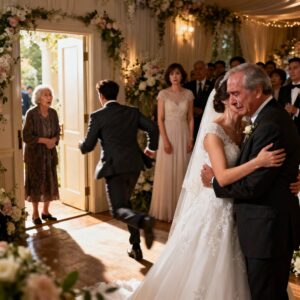
    The music started. Lu Jinang, my husband, was waiting.

    We walked down the aisle. We stood before the officiant.

    “Through life and death, I make this vow with you…”

    “STOP!”

    Guian, disheveled and frantic, ran into the ballroom. She fell to her knees in front of me.

    “Miss Jang! Miss Jang, I was wrong! I truly know my mistakes! I’ll kowtow! I beg you, show mercy! Save my parents! It was my shamelessness! I seduced Young Master Shu! I framed you! I lied! I’ll return Shu Linguan to you! Please, forgive me!”

    I looked down at her.

    “Are those crocodile tears? This no longer concerns me.” I turned to the guards.

    “Take her away.”

    “No! Miss Jang!”

    “Sorry, Shushu,” Jinang whispered.

    “I failed to handle this trash.”

    “It’s fine,” I said.

    “Let’s proceed.”

    “JANG SHU! YOU CAN’T MARRY HIM!”

    A second voice. Shu Linguan.

    He ran in, pushing past the guards. He was holding something. The “Seeking Her” necklace.

    “Jang Shu,” he panted, holding it out. ”

    It’s yours. I retrieved it for you.”

    I looked at him. The man I had loved for fifteen years.

    “Linguan,” I said, my voice clear and carrying through the silent hall.

    “Something you’ve given to others… why would I still want it?”

    “You find it objectionable?” he said, desperate.

    “It doesn’t matter! I’ll make you a new one! What I rejected… was never the object.”

    “Today is my wedding day,” I said, turning to him, to the crowd.

    “I’ll be clear. Linguan, I used to believe I’d marry you. But… it wasn’t Guian’s fault. Without her, there would have been a Jang Chen, or a Lien. Why do you always blame others?”

    “You took advantage of my affection. My dependence. You thought I couldn’t live without the Shu family. You thought you were in control. But now, I’ve broken free. And you finally panic. You start regretting. But even now, you can’t reflect on yourself. You still blame her.”

    “She has faults,” I said, “but she didn’t truly hurt me. The person who truly broke my heart… is you.”

    “Stop talking!” he cried, falling to his knees.

    “I was wrong! Scold me! Hit me! I can’t live without you! Just come back to me! I’ll do anything!”

    “Stop deluding yourself, Shu Linguan,” I said. I took Lu Jinang’s hand.

    “My husband is right behind me. From now on, for the rest of my life, he will be with me. I hope you never appear before me again. Stop interfering with my life.”

    “Shushu… is there no room…?”

    “See Young Master Shu out,” Jinang said.

    The guards dragged him away, his cries echoing.

    The wedding resumed.

    “And now,” the emcee announced, “CEO Lu has a gift for Mrs. Lu. The Heart of the Ocean.”

    A box was opened. A stunning blue diamond necklace.

    “The Heart of the Ocean,” the emcee said, “symbolizes an irreplaceable love.”

    I remembered, suddenly, Linguan complaining in my old room.

    “Valentine’s Day… I wanted to bid for the Ocean’s Heart to give it to you… but someone anonymously bought it.”

    I looked at Jinang. He smiled.

    And then, I remembered.

    A childhood memory. A boy with kind eyes.

    “Eat your carrots.”

    “Carry me.”

    “Brother Jingchan, when I grow up, will you be my bride?”

    “I’ll only be Brother Jinchan’s bride.”

    I remembered.

    “Brother Jinchan,” I whispered, my eyes filling with new tears.

    “I remember now. Thank you… thank you for waiting for me all this time.”

    He took my hand.

    “Mrs. Lu,” he said, his voice full of a love I had waited a lifetime for.

    “For the rest of our lives, let’s walk this path together.”

  • It started with a jacket on a frozen night—a simple act of warmth from one soldier to another. But in the silent world of military order, that small kindness would unravel a general, save his daughter, and redefine a command.

    It started with a jacket on a frozen night—a simple act of warmth from one soldier to another. But in the silent world of military order, that small kindness would unravel a general, save his daughter, and redefine a command.

    I still remember how the cold had teeth that night, sharper than I’d felt all winter out at Fort Mason. The kind of cold that doesn’t care about your layers; it just finds its way into your bones and makes itself at home. I was standing outside the infirmary, nursing some lukewarm coffee, just watching my breath hang in the air like a ghost.

    It was late, probably pushing one in the morning. The whole camp was buttoned up and quiet, save for the low thrum of a generator and the sound of boots crunching on frozen ground. I was pulling a double in the med tent, the usual rotation of flu symptoms and twisted ankles from training drills. That’s when I saw her.

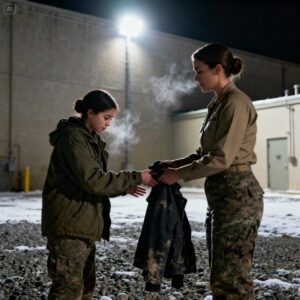
    She was standing over by the mess hall, caught in the spill of a single floodlight, and she had her arms wrapped around herself so tight it looked like she was trying to hold her own pieces together. She wore the standard-issue uniform, but her jacket was way too thin for that kind of weather, and maybe a size too small. Even from twenty feet away, I could see her shivering.

    At first, I figured she was on some kind of punishment detail, or maybe stuck with the graveyard watch. But there was something in the way she stood—not defiant, not tough, just…exposed. Like a person trying their best not to be seen at all. Before I even thought about it, I was walking over.

    She didn’t hear me coming. When I got close, I could see the edges of her lips were turning blue. Her fingers were trembling where they gripped her sleeves. She looked up at me with a jolt, like she was bracing to get chewed out. “You’re freezing,” I said. It wasn’t a question. She just gave a tiny, almost invisible nod.

    I shrugged off my own jacket—my personal one, not the government’s—and held it out. “Here. Take this.”

    “Ma’am, I can’t…” she started, her eyes wide, like nobody had ever offered her something without a catch.

    “It’s not about the rules tonight,” I said, shaking my head. “It’s about staying warm.”

    She took it, her hands so slow you’d think the fabric might burn her. I never knew what made me do it. Maybe it was the look in her eyes, or maybe I just remembered being twenty and scared and pretending I was neither. She mumbled a “thank you” so quiet the wind almost stole it, then she melted back into the shadows, wrapped in a jacket that was way too big for her but just warm enough to matter. I stood there for a minute, feeling the chill seep back into my skin, and wondered why that small moment felt so heavy.

    Back in the infirmary, I told myself it was nothing. Just a jacket. But I couldn’t shake the feeling I’d given away more than just wool and thread. I didn’t know her name, hadn’t even seen her face all that clearly. But I would. And when I did, nothing was ever going to be the same.

    The next morning, the world tried to tell me I’d dreamed it. But when I stepped into the infirmary for my shift, there she was, standing in the medical check-in line, still wrapped in my jacket. In the daylight, she looked different—her posture was straighter, her eyes more guarded. But for just a second, she glanced my way, and a flicker of something passed between us. Recognition. And in that same instant, I knew I’d seen those eyes before. Not on the base, not in person. In a photograph. An old, black-and-white portrait hanging in the hallway outside Colonel Anders’ office. A man in a dress uniform, a little girl beside him, no more than ten, with those same quiet, intense eyes.

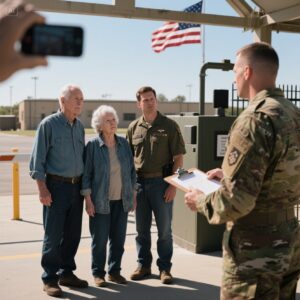
    I tried to shake it off. There were dozens of pictures in that hall. Ten minutes later, I was summoned to Major Lavine’s office. The kind of call that makes your stomach clench. I walked in, expecting a lecture about vaccine logs or something. Instead, he was sitting there holding a clipboard, looking more tired than mad.

    “Sergeant Tanner,” he said, not even looking up. “Did you, at any point during your rotation last night, distribute personal gear to an enlisted recruit?”

    I froze. “I lent a jacket, sir. It was freezing out. She was shivering.”

    He finally met my eyes. “That’s not your call to make, Sergeant.”

    It all went downhill from there. Someone had seen the whole thing and reported it. I was sure it wasn’t the girl. Probably some night watchman with a rulebook for a heart. I didn’t get a formal write-up, but a note went into my file: Deviation from supply policy. I left his office feeling hollow. It wasn’t the reprimand. It was the way he’d said personal gear, like I’d handed over state secrets. It was my jacket. It was just a damn jacket.

    For the rest of the day, I’d catch glimpses of the girl—Anna, I’d later learn—but she never looked my way again. She was quiet, followed orders, but I saw how the other recruits seemed to keep their distance, like she was a puzzle they couldn’t solve.

    That night, my feet carried me back to that hallway outside the colonel’s office. I found the photo. The man in the uniform was General Ward. And the little girl beside him… it had to be her. What in the world was she doing here, posing as just another recruit? The simple act of kindness from the night before was suddenly tangled in something much, much bigger.

    Three days later, a plain white envelope was sitting on my bunk. My name, written in a tight, careful script. Inside was a formal invitation to a private dinner at General Ward’s residence. Tucked behind it was a handwritten note that stopped my heart. Please wear what you wore that night. No signature. No explanation.

    My first thought was to toss it. Generals didn’t invite sergeants with fresh ink on their files to dinner. But that note… it felt less like an invitation and more like a summons. I didn’t know if I was being thanked or trapped.

    When the night came, I put on my dress uniform, then stared at that old jacket hanging in my locker. It smelled faintly of antiseptic and something like campfire. Feeling like a fool, I slipped it on over my uniform and walked toward the officer’s wing. The general’s house was set apart, fenced and quiet, glowing with a soft light that felt out of place on a military base.

    I walked into a foyer lit by a chandelier, all polished wood and flickering candles. Senior officers I’d only ever seen in briefings stood around in their dress blues, their eyes skimming right over me and my clumsy jacket. I wanted to turn and run. Then, across the room, I saw her. The young recruit. Anna. She was standing next to General Ward, wearing a simple black dress, and she laughed at something he said, touched his arm, and called him “Dad.”

    In that moment, the world just tilted on its axis. The girl from that freezing night, the one I thought was just another anonymous soldier, was Anna Ward. The general’s daughter. And before I could will myself to disappear, General Ward looked up and his eyes found mine. He gave a single, deliberate nod. It wasn’t a threat. It was an acknowledgment.

    A server guided me toward the center of the room, where my old jacket was hanging behind glass, perfectly cleaned and pressed. A small brass plaque beneath it read: For Compassion Beyond Protocol. The air left my lungs. The room went quiet as General Ward raised his glass. “Sometimes,” he said, his voice steady and clear, “leadership isn’t about orders. It’s about instinct. And sometimes, instinct saves more than rules ever could.” I just stood there, heart hammering, realizing I wasn’t being tested. I was being seen.

    Later, he led me to his library. Dark wood shelves reached for the ceiling, and the silence in there was so thick you could feel it. “Why did you help her?” he asked, his back to me as he stared out the window.

    “Because she was cold,” I said, my voice steadier than I felt. “Because she looked alone. I didn’t need to know her name to see that.”

    He turned. “And you didn’t think about the rules?”

    “No, sir. In that moment, I just thought about being human.”

    A muscle in his jaw tightened. “My daughter wasn’t supposed to be there,” he said, his voice softer now. “She enlisted because she said she needed to understand what I’d given my life to. To see if she deserved her last name. I didn’t even know she was struggling… not until I saw your jacket.”

    “Sir,” I said, stepping closer. “I didn’t help her because she’s your daughter. I helped her because I saw a person who needed some warmth.”

    He studied my face. “You think kindness belongs in the chain of command?”

    “I think it’s what makes a command worth following, sir.”

    He let out a long, weary breath and pointed to a photo on his desk. His late wife, her arm around a young Anna. “She believed in that, too,” he said quietly. “She died thinking the world I’d chosen had no place for it. I think… I think you just proved her wrong.” He looked at me, and for the first time, he wasn’t a general. He was just a father. “You weren’t supposed to be at that dinner,” he said. “But maybe that’s exactly why you had to be.”

    A few days after, another envelope appeared, this one with Anna’s handwriting. Inside, a letter began with a line that undid me completely: You saw me before my father did. She wrote that my jacket had made her feel visible for the first time in a world where everyone saw her last name before they saw her face. Tucked inside was a grainy photo of the moment I’d draped the jacket over her shoulders, and a small velvet box. In it was a silver insignia shaped like a flame. “This isn’t regulation,” she wrote, “but my father says it should be.” I sat there, holding the letter, feeling a quiet peace settle over me.

    Three years later, my name was on a door: Kenya Tanner, Lead Medical Officer, FieldMed Unit 7. Anna had created the unit with a foundation named after her mother. “My family’s name built enough walls,” she’d said. “It’s time it built a doorway.”

    On my desk sat a single photo of that old, worn jacket, with a line in her handwriting beneath it: Kindness only matters when it’s quiet. It was my morning reminder.

    Just then, a soft knock came at the door. A young recruit stood there, shifting on her feet, her sleeves a little too short. “Sorry, ma’am,” she whispered. “They said I need this prescription filled, but my stipend… it hasn’t cleared yet.” She didn’t have to finish. I knew that look—that cocktail of shame and hope.

    I stood, walked to the supply cabinet, and got what she needed. “It’s covered,” I said, handing it to her. “Just take care of yourself.”

    Her eyes widened. “But… people don’t usually…”

    I just smiled. “Maybe they should.”

    As the door closed behind her, the afternoon light caught the photo on my desk, making it glow. The circle had closed, not with a ceremony or an award, but with one more small, quiet gesture. And that was more than enough.

  • Thirty-eight seconds. That’s all it took to end my career. A viral clip showed me—a Commander—putting five recruits on the floor. The internet called me a monster. My bosses told me to stand down. They thought I was finished. They didn’t count on the full video. They didn’t count on the real storm that was about to hit. This is what really happened.

    Thirty-eight seconds. That’s all it took to end my career. A viral clip showed me—a Commander—putting five recruits on the floor. The internet called me a monster. My bosses told me to stand down. They thought I was finished. They didn’t count on the full video. They didn’t count on the real storm that was about to hit. This is what really happened.

    He hadn’t come alone.

    I saw the others fanned out, a human wall built of bravado and cheap aftershave. The one I’d learn later was called ‘Viper’—Moreno—was watching me like a chessboard. He wasn’t the loud one. He was the smart one. The dangerous one.

    Chairs scraped. Forks paused. Someone’s soda can snapped open in the silence, and it sounded like a gunshot.

    “If I’m as weak as you think,” I said, my voice cutting under the fluorescent hum, “prove it.”

    It was an invitation. Not a threat. A test.

    Five looks flickered between them: pride, panic, performance. The Grinner’s smirk thinned. He knew I’d called the bluff. Now they had to play the hand.

    The big one—the shoulder-roller—swung first. A haymaker, all wind-up, all show, designed to make a smaller person flinch.

    I didn’t flinch.

    I slid a half-step to the left, inside his arc. His fist cut the air where my head had been. I didn’t strike. I tapped. Two knuckles, a light, corrective metronome against a floating rib. Tap-tap. Just enough to make his brain register surprise instead of pain. Before that surprise could become anger, I caught the wrist he’d offered me, turned with his own momentum, and used a simple joint-lock pivot.

    Wood met cheek. The table shuddered. He just grunted, eyes wide with the shock of a bully who’s just discovered physics.

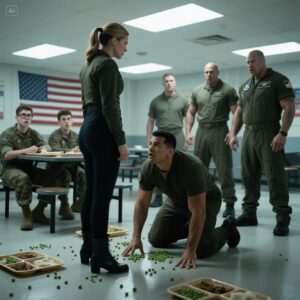
    Gasps rippled. The one with the neck tattoos lunged, a tackle that belonged on a football field, not in a room full of linoleum and chairs. I dropped my center of gravity, sidestepped, and let him run full-speed into his friend, who was just trying to stand up. Trays skidded. Peas scattered like ball bearings.

    Another came roaring. I dropped low, swept his ankle—no dramatics, just angles—and the air whooshed out of him in one shocked groan.

    Only Viper—Moreno—remained upright.

    He didn’t bluster. He didn’t roar. He stepped forward with a measured stance. This one had seen real contact. This one wasn’t a performance.

    My eyes sharpened. For the first time, I shifted my weight, settling into a stance I hadn’t used since my last tour. We recognized each other.

    He jabbed to test my range. I parried, a flick of the wrist that redirected his force, not met it. He hooked, tighter and smarter than the first man. I ducked under it, the air whispering past my ear, and placed an elbow where it would speak but not break—a nerve cluster below the shoulder.

    He breathed through it, eyes narrowing. He struck again.

    I caught the wrist. Pivoted. And set a controlled, non-injurious joint lock that brought him to one knee without tearing a single thing he’d need tomorrow. I held the pressure, steady as a heartbeat.

    “Tap,” I said, my voice even.

    His jaw set. I watched the war on his face: pride versus pain. Then, his palm met the floor. Once.

    I released him instantly and stepped back.

    The mess hall was a photograph. The three new recruits—Noah, Eli, Jonah—were sitting straighter. The wall of five was gone, replaced by five men breathing hard in a room that had just learned a different definition of ‘strong.’

    “Strength,” I said, my voice steady as I picked up my tray, “is discipline. Control. And knowing when not to fight.”

    I moved a chair back under a table with my foot and walked out. No one clapped. No one jeered. They just watched.

    That should have been the end of it.

    It wasn’t.

    By nightfall, the fire had started.

    A shaky, vertical clip hit every platform at once. Thirty-eight seconds long. No audio of what I’d said. No context. Just the takedowns, cut tight for impact. Just me, a woman in uniform, putting five “recruits” on the floor.

    The caption was a Rorschach test: “Officer assaults recruits at training center???”

    By midnight, the fire was an inferno. Strangers who had never smelled the bleach-and-steam of a mess hall were arguing in a language of pure outrage. Bully. Monster. Thug. She should be fired. She should be jailed. The comments didn’t need the truth. They just needed momentum.

    At 12:36 a.m., the knock came. It landed on my door like a metronome tick at the end of a bar.

    I opened it to a junior aide, a kid with tired eyes and a tablet clutched under his arm. “Commander Quinn,” he swallowed, “the CO needs you in the conference room. Now.”

    “What’s on the table?” I asked.

    He wouldn’t meet my eyes. “A review, ma’am. And a recommendation.”

    I slipped on my jacket. The hallway smelled like wax and the sharp salt of the sea air that crept under everything on this base. As I followed the aide into the blue-gray hours, a thought cut clean through the noise: the room had heard my words, but the world had only seen my hands.

    “There’s a million views in the last hour,” the aide whispered, almost to himself. “They only saw the thirty-eight seconds.”

    I exhaled once, steady. “Then I guess we’re about to find out,” I said, “what thirty-eight seconds are worth.”

    The conference room door was already open.

    Captain Adler stood with his arms folded, jaw tight. A Public Affairs officer I didn’t know hunched over a laptop, typing and backspacing the same sentence. A legal adviser sat with a notepad already half-filled with careful words: review of use of force… outside designated training environment… interim measures…

    “Commander,” Adler said. “Have a seat.”

    I stayed standing. “Sir, I’ll answer anything you ask.”

    Public Affairs turned the tablet so the screen faced me. The shaky clip played on loop. Mute. Vertical. Violent.

    “This is what they saw,” he said. “Just this. No audio. No setup. No kids getting crowded. No warning. Thirty-eight seconds of you putting five recruits on the floor.”

    I watched the clip all the way through, once. The camera never showed Noah’s glasses fogging with fear. Never showed the line about strength and cruelty. Never showed my invitation: If I’m as weak as you think, prove it.

    “Perception online is reality until it isn’t,” Public Affairs said. “We can’t fix the first part. We can try to hurry the second.”

    Adler cleared his throat. “Policy first. The mess hall isn’t a mats space. We have rooms for that. Even if your intent was protection, we have to look at whether this should have been de-escalated without contact.”

    “It was de-escalation,” I said. “Measured, non-injurious, time-limited. No one left with anything more than bruised pride.”

    “Pride bruises loudly,” Public Affairs murmured.

    Legal tapped his pen. “We’re recommending temporary stand-down from instruction pending a formal review. Publicly, a short statement expressing regret for the escalation and commitment to training standards. No admission of wrongdoing.”

    My blood went cold. “I won’t lie, and I won’t apologize for keeping three smaller recruits safe. If you need me to say I wish that room had never needed me—fine. But I won’t pretend there wasn’t a threat.”

    Adler’s eyes were tired. “No one is asking for a lie, Mara. We’re asking for language that keeps a hundred other things from blowing up.”

    “Language without truth is performance,” I said. “Performance is what those boys were doing.”

    The silence in the room was brittle. On the tablet, the clip restarted.

    “Stand down from instruction, effective immediately,” Adler said. “We’ll convene a board within forty-eight hours. Public Affairs will draft a statement. You can sign it or not. Either way, stay off the training floor.”

    “Understood,” I said.

    In the corridor, the salt in the air felt sharper, as if the ocean had moved an inch closer in the night. I passed a bulletin board: lost-and-found IDs, a flier for a blood drive at a downtown community clinic, a printed reminder about storm season protocols. Build a cache. Check your neighbor.

    The storm. I’d almost forgotten. A tropical system was spinning up off the coast, a lazy swirl on the weather maps that was starting to look less lazy.

    “Ma’am,” a voice said behind me.

    I turned. It was Moreno. Viper. The one who knew how to fight. He was leaning against a vending machine, arms crossed.

    “You okay?” he asked.

    “Are you?” I countered.

    He gave a dry breath that might have been a laugh. “I’ve had better days.” He watched his hands, not me. “For what it’s worth… you didn’t humiliate us. The room was ugly before you walked in.”

    “You have a statement to make for the review,” I said.

    He looked past me to the bulletin board. “Statements have a way of sticking. I came here on a waiver, ma’am. Took me two years to get my paperwork clean. My mother needs the health plan. I say the wrong thing one time… that’s my file forever.”

    “You’re telling the truth to me right now,” I said. “The board isn’t a stranger.”

    “The internet isn’t a board, either,” he shot back.

    He had a point. “You have until noon tomorrow to decide what kind of man you’re going to be in rooms that don’t have cameras,” I said. “That’s where strength starts.”

    His jaw twitched. “You made me tap,” he said. “Not with the lock. With the mirror.”

    I left him with his choice and went to find the recruits. I found them in their barracks, a sneaker wedged under the door. I knocked anyway.

    The door cracked open. Noah Park, glasses fogged, blinked at me. Eli Ruiz sat on his bunk, laces half-tied.

    “We heard,” Noah started. “About the video. We wanted to tell someone what really happened, but… my dad says keep your head down. ‘Don’t be the squeaky wheel.’”

    “You’re not a wheel,” I said, my voice harder than I intended. “You’re a person. And this place doesn’t work if people let fear pick their words. Write what you saw. You’re not testifying against anyone. You’re telling the truth for yourselves.”

    Noah nodded, trying on an expression that fit better than fear. “Okay,” he said. “Okay. We’ll write.”

    I left them and walked back into the main hall. The young Public Affairs officer was waiting, phone in hand.

    “If we record a short statement now,” she said, “we can post it before the morning cycle. You don’t have to say you’re wrong. Just that you regret the escalation.”

    “And what will that change?” I asked.

    “It buys time,” she said. “Time is the only thing that beats a bad first draft.”

    She led me to a small media room. A ring light glowed. She framed the shot. “Whenever you’re ready.”

    I looked at the lens and saw the thirty-eight seconds playing behind it, endless. I pictured Noah writing on notebook paper. I pictured Moreno at the vending machine, weighing rent against right.

    “Without the truth, an apology is a costume,” I said. “I don’t wear costumes when I teach. I’ll speak at the review.”

    Her thumb hovered over the record button, then pulled back. Her face softened. “That’s fair. I’ll tell them you declined.”

    On the way back to my quarters, my phone buzzed. Unknown number. One line, no hello:

    I have the full video. Not the cut. We need to talk. —T

    My blood froze. I stared at the screen. The hallway was empty except for the hum of the lights and the low, patient sound of the sea, testing the walls.

    I typed: Who is this?

    The reply was instant: Taylor. From the far table. I didn’t post it like that. Someone chopped it. I’m sorry.

    My thumb froze over the keys. Where are you?

    Not texting that. People are already in my DMs. Can we meet off-base? Please. Before they scare me into deleting everything.

    Deleting everything. That’s how stories died. That’s how thirty-eight seconds kept winning.

    I pocketed the phone. I had the truth, and I had a threat. But I wasn’t going to a parking lot. I was going back to Adler.

    Dawn was a gray smear against the windows. The wind was picking up; the storm was no longer a polite suggestion. I found Taylor in the visitor’s lot, hoodie pulled low, looking like a kid who’d stumbled into a war.

    “They sent me a picture of my car,” he whispered, handing me an SD card like it was a bomb. “Just the plate. And a message: keep quiet, hero.”

    “You’re not in trouble, Taylor,” I said. “You’re a witness.”

    “I sent the full clip to a friend,” he said, shame coiling in his voice. “To fix the flicker from the lights. He must have cut it. He must have posted it.”

    “Or someone else did,” I said. I looked at the SD card in my palm. The truth.

    I took it straight to Adler. He watched the full clip in his office, the audio on. He heard the taunts. He heard my calm reply. He heard the invitation. He heard the clean, non-injurious takedowns.

    When it finished, he was quiet for a long time. “The internet doesn’t care about context, Mara, until we force it to. The board is still 48 hours away. This helps. It doesn’t solve.”

    “What do I do for 48 hours, sir?” I asked.

    “Stay stood down,” he said.

    I looked out the window. The palm trees were bending, their fronds scraping the glass. The storm warning had been upgraded. Tropical Storm. Expected to make landfall.

    “No,” I said.

    Adler looked up.

    “I’m stood down from instruction,” I said. “I’m not stood down from service. The storm is coming. The town is opening a shelter at the community center. They’ll need hands.” I tapped the tablet, where the 38-second clip was still paused. “You want to see what real strength is? Let me show them. Let me take the recruits—Moreno, Noah, Eli, all of them—and let’s pilot the ‘Respect Lab’ for real. Let’s go fill sandbags. Let’s go run a shelter. Let’s teach them that strength isn’t about hitting. It’s about holding.”

    Adler looked from me to the storm advisory. He nodded. Once. “Don’t make me regret this, Commander.”

    We called it the Respect Lab.

    I gathered them in the gym: Moreno, Noah, Eli, and two of the other bullies from the mess hall. Their faces were sullen, confused.

    “You think strength is about being loud,” I said, “about taking space. For the next 48 hours, strength is about making space. For other people. We’re not training for a fight. We’re training for a storm.”

    I brought in Mia Torres, the woman from the clinic flier. She was sharp, no-nonsense, and carried the quiet authority of someone who had seen it all. She ran them through drills: De-escalation scripts. Bystander intervention, what she called the “Bystander Ladder.” How to triage panicked people. How to carry the weight—not of a pack, but of a story.

    “Loud isn’t urgent,” she taught them. “Urgent isn’t always loud.”

    Then the call came. The storm had a name. It was coming faster. The community center was opening now.

    We arrived in a downpour. The center was already a mess of cots, crying kids, and the smell of wet wool and fear. This was the real lab.

    A man, built like the shoulder-roller from the mess hall, was screaming at Mia, jabbing a finger in her face. “I need a cot by a wall! I need power!”

    I saw Moreno tense. Old habits. I put a hand on his arm. “Not your fight,” I murmured. “Your room. Make it whole.”

    He took a breath. He walked up, not to the man, but beside him, standing at an angle. He didn’t puff up. He made himself calm.

    “Sir,” Moreno said, his voice low and steady. “I’m safe. You’re safe. We’re moving.”

    The man paused, startled by the script.

    “I hear you need power,” Moreno said. “We have a charging bank over here. Let me walk you to it, and we’ll find the next available cot. My name is Moreno. I’ll be your guy.”

    The man’s shoulders dropped. The fight drained out of him, replaced by exhaustion. He just nodded. Moreno had won. He hadn’t thrown a punch.

    I watched it happen all night. I saw Noah and Eli working check-in, using the “Bystander Ladder” to spot a non-verbal elderly woman who was shivering. They realized her bag was wet. Her insulin was inside. They got her new meds. They saved her life.

    My team was living the definition of strength. It was working.

    Then my phone buzzed. A text from Public Affairs.

    We have a problem. A new video just dropped. It’s a deepfake.

    My heart stopped. I opened the link. It was the 38-second clip, but now it had audio. My voice. My face.

    But the words were monstrous.

    “Prove it or I end you,” my voice snarled.

    It was a lie. A synthetic, generated lie, dropped at the moment of maximum chaos.

    A volunteer at the shelter was watching it on her phone. She looked from the screen to me, her eyes wide with horror. She grabbed her child’s hand and pulled him away from me.

    The storm outside was raging. But the real storm, the one designed to kill my career, had just made landfall.

    “The board is moved up. Now.”

    Adler’s call cut through the shelter’s noise. I had to leave, in the middle of the storm. I grabbed Moreno, Noah, and Taylor. We drove through wind and sheeting rain to the conference room. It felt like a tribunal.

    They played the deepfake first. It was chilling. My voice, my face, threatening to “end” a recruit.

    “This is what the internet is seeing right now,” Legal said, his face grim.

    “It’s a lie,” I said.

    “Prove it,” the legal adviser said.

    Public Affairs stepped in. “We can.” She broke it down on the screen. “The plosives—the ‘p’ in ‘prove it’—they don’t match her mouth formation. The background noise is a static loop. It doesn’t change. It’s synthetic.”

    Then, I slid Taylor’s SD card across the table. “Now play this.”

    They played the full-context video. The real one.

    The room was silent. They heard the clatter of trays. They heard the taunt: “Respect has to be earned.”

    They heard my calm reply: “Agreed. So—what have you five done to earn it?”

    They heard the challenge. They heard my quiet invitation: “If I’m as weak as you think, prove it.”

    They heard the clean tap-tap on the ribs. They heard me tell Moreno, “Tap.” They heard his hand hit the floor.

    When it was over, the legal adviser just stared at the screen.

    “Now call the witnesses,” I said.

    Noah went first. His voice was small, but it didn’t shake. “I was scared. They were boxing us in. Commander Quinn made it stop. She didn’t hit anyone. She used… angles.”

    Eli went next. “I thought strength was being the loudest. She showed me it was about making the room safer. I used her script last night at the shelter. It worked.”

    Then, Adler called Moreno.

    Moreno stood. He looked at the board, then at me.

    “I was one of the five, sir,” he said. “I was the last one standing. I came here good at fights and bad at listening. That day, I thought respect was something you take. She made me tap, but not with the lock. She made me tap with the mirror she put in front of me.”

    He took a breath. “Last night, I de-escalated three conflicts at the shelter. I didn’t touch anyone. I used her words. ‘I’m safe. You’re safe. We’re moving.’ I don’t know if that matters to your review, sirs. But it mattered to a room full of people who were cold and scared.”

    The training officer on the board looked down at his notes. “It matters, son.”

    Adler closed his folder. “Commander Quinn, the board finds your actions were proportional, justified, and frankly, textbook. You are cleared of all wrongdoing. You are reinstated, effective immediately.”

    He looked at me. “And that ‘Respect Lab’ of yours… I want a full syllabus on my desk by Monday. We’re funding it.”

    We walked out of the room, and the storm was breaking. Literally. A slice of pale sun cut through the gray clouds.

    My phone was blowing up. Public Affairs had released the full-context video alongside the deepfake analysis. The internet, for what it’s worth, was changing its mind. “We were duped!” “This is the full story!” “Wow, she’s a badass.”

    I didn’t care.

    I got back in the truck with Moreno and Noah. “The shelter’s not clear yet,” I said.

    “Copy, ma’am,” Moreno said, and for the first time, he smiled.

    We got back to the center just as the last of the families were being moved to more permanent housing. The work was done. The gym was a wreck of cots and blankets.

    Weeks later, I walked into the mess hall. It was different. Quieter. Not with fear, but with something new.

    Moreno was sitting with Noah and Eli, eating lunch. They weren’t friends, not really. But they were a team. He saw me, and he nodded. Once.

    I got my tray and sat down.

    The “Respect Lab” became a permanent part of training. We taught it every cycle. We taught the scripts. We taught the Bystander Ladder. We taught that strength isn’t about the fight you can win. It’s about the room you can hold.

    The 38-second clip still floats around, a ghost in the machine. But now, it’s always followed by the full story. The truth.

    My name is Commander Mara Quinn. They tried to end my career with thirty-eight seconds of lies. They didn’t know that I was just getting started.

  • He’s 72 years old. Inmate C74. Thrown into Blackridge, America’s most violent maximum-security prison, they thought he was just a frail old man. They sent the prison’s most brutal killer, Dylan “Grizzly” Marik, to break him. But they didn’t know who they had locked up.

    He’s 72 years old. Inmate C74. Thrown into Blackridge, America’s most violent maximum-security prison, they thought he was just a frail old man. They sent the prison’s most brutal killer, Dylan “Grizzly” Marik, to break him. But they didn’t know who they had locked up.

    {“aigc_info”:{“aigc_label_type”:0,”source_info”:”dreamina”},”data”:{“os”:”web”,”product”:”dreamina”,”exportType”:”generation”,”pictureId”:”0″},”trace_info”:{“originItemId”:”7568780779883482376″}}
    The mess hall at Blackridge State Penitentiary always smelled the same: stale sweat, disinfectant, and cold metal. It was a concrete box designed to hold 800 of America’s most violent men, and it vibrated with a low, animalistic hum.

    The rule here was simple: keep your head down, eat fast, and don’t make eye contact. Survival was a game of invisibility.

    But invisibility wasn’t an option for Dylan “Grizzly” Marik.

    Marik didn’t just walk; he stalked. A 300-pound monster of tattooed muscle and scar tissue, he moved through the cafeteria like a shark parting water. Where he walked, conversations died. Inmates would flinch, looking down at their trays, praying not to be seen. Fear was his currency, and he was the richest man in Blackridge.

    Today, however, his eyes landed on an anomaly.

    At the last table, hunched over his tray, sat Inmate C74. Walter Kin. 72 years old, with a shock of white hair and skin like wrinkled paper. He didn’t belong. He looked like someone’s grandfather, lost and forgotten by the system.

    Marik watched him with pure contempt. A mistake. A piece of driftwood washed up in hell.

    Slowly, deliberately, Marik walked toward him. The mess hall grew so quiet you could hear the fluorescent lights buzz. He grabbed a metal water pitcher from the kitchen pass-through and filled it with ice water.

    The other inmates held their breath. They knew what was coming.

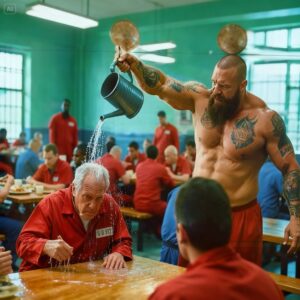
    Marik stood over the old man and, with a theatrical sneer, dumped the entire pitcher of ice water over Walter’s head.

    The liquid shocked the air. It streamed down Walter’s face, plastered his thin hair to his skull, and soaked his tan uniform, the number C74 blurring on his chest.

    A few nervous laughs sputtered out and died. Marik smiled, waiting for the reaction. The fear. The crying. The begging.

    “Welcome to hell, grandpa,” Marik’s voice boomed, scraping like gravel.

    “This is my house.”

    Walter Kin did not respond.

    He didn’t flinch. He didn’t gasp. He didn’t even look up.

    He just kept chewing his food, slowly, methodically, as if the insults and the ice water were just background noise.

    The silence that followed was heavier than any shout. It stretched for five seconds, then ten. Marik’s smile faltered. There was something wrong with this picture. Something unnatural in the old man’s calm.

    “This old man’s got a weird look, man,” one inmate whispered two tables over.

    “Shut up,” his neighbor hissed.

    “Or Grizzly breaks you next.”

    Annoyed by the lack of reaction, Marik slammed his massive hand on the table, shoving Walter’s tray. Food scattered. The old man still didn’t move.

    Finally, Walter Kin lifted his head.

    His eyes were pale blue, calm, and glacial. It was the look of someone who had seen things the rest of the world couldn’t bear. For one split second, Marik actually hesitated. That look tightened something in his stomach.

    He covered it with a bark of laughter.

    “This is gonna be fun, breaking you, old man.”

    Marik turned and swaggered away as the mess hall erupted in forced laughter.

    Walter slowly wiped his face with a napkin. He picked up his tray, walked to the sink, washed his hands, and headed back to his cell. He didn’t hurry. He didn’t tremble.

    He walked past dozens of inmates, their eyes following him, their pity mixing with a new, strange feeling.

    Fear. But this time, it wasn’t for Marik.

    That night, the cell block was quiet. On one side, Marik bragged about the incident. But in Walter’s cell, there was only silence. He wasn’t sleeping. He stared at the cracked ceiling, his hands trembling.

    Not from weakness. But from memory.

    “Hey, old man,” a young inmate in the next cell hissed through the bars.

    “What’d you do to get in here?”

    Walter turned his head slowly. His gaze seemed to cut through the steel and concrete.

    “Let’s just say,” his voice was a dry rasp, “it took them a long time to stop me.”

    No one spoke to him after that.

    The next day, the mess hall felt different. Without saying a word, Walter Kin had already changed the atmosphere of the prison.

    No one knew it yet, but the man who seemed so vulnerable, the one the bully had humiliated, was the kind of man who didn’t need to raise his voice to be the most dangerous person in the room.

    The days that followed were heavy, as if the prison itself was holding its breath.

    Walter remained invisible. Mornings in the laundry, afternoons in the yard, nights in silence. He seemed to care about nothing. And maybe that’s what finally started to break Dylan Marik.

    For men like Grizzly, fear was oxygen. Its absence was a suffocation.

    “That old man thinks he can ignore me,” Marik growled one evening, sharpening a piece of metal against the concrete floor of the yard. His crew laughed nervously. They knew that look. When the Grizzly picked a target, he didn’t stop until he saw blood.

    Walter, meanwhile, was observing.

    He watched the guards’ movements. The sound of their keys. The rotation schedules. The blind spots in the security cameras. He wasn’t just looking; he was recording.

    It wasn’t curiosity. It was habit. A habit you only learn after decades of living between secrets and death.

    One afternoon, during rec time, Marik approached, flanked by his two lieutenants. The sun beat down on the yard, and a hush fell as they surrounded Walter.

    “Listen close, old man,” Marik began, a cruel smirk on his face.

    “I gave you a few days to settle in. Now, you learn the rules.”

    Walter slowly looked up. No fear. No anger.

    “And what rules would those be?” he asked, his voice gravelly but firm.

    Marik laughed, getting in Walter’s face.

    “You talk when I say you can. You walk when I tell you to. And if you breathe louder than me, you wake up without teeth.”

    The entire yard was watching.

    Walter sighed, a long, tired breath. He straightened his back and murmured, “You talk too much.”

    A ripple went through the inmates. Marik’s eyes widened. He shoved the old man, hard.

    But Walter didn’t fall. He regained his balance with an agility that no one expected. For a split second, his body tensed with an almost tactical precision.

    An inmate whispered, “Hey… did you see that? The old man moved like a soldier.”

    Marik stepped forward, his rage building.

    “I want to see how far this goes, old man.”

    Walter slowly bowed his head.

    “You’re going to find out,” he said, his voice a low promise.

    That night, the whispers turned into a storm.

    Some claimed the old man had killed a man with his bare hands before his arrest. Others swore he was military, black ops. No one knew the truth, and the less they knew, the more the fear grew.

    Marik didn’t believe in rumors. He needed to see the fear in Walter’s eyes. He needed control.

    He waited for the perfect moment. Three days later, during the late-night guard change, he followed Walter Kin toward the maintenance workshop.

    The prison wasn’t just a building; it was a living thing, vibrating with the fear of a thousand trapped souls. Even the guards knew fear here.

    Walter Kin had become an enigma at the heart of this system.

    The guards knew the bare minimum: Sentenced for double homicide. Secret transfer from the federal system. Incomplete file.

    Something was wrong. The file didn’t mention a trial or the location of the crime. Entire pages were redacted with thick black ink, as if someone had tried to erase whole sections of his past.

    Director Harvé Dolan reviewed the transfer report again.

    “This file is incomplete,” he muttered.

    “Where is this man’s military history?”

    His deputy replied, “Sir, the file came from the Department of Defense. Most pages are classified.”

    Dolan frowned.

    “Classified? In a civilian prison?”

    “Federal order, sir. It said: ‘Apply. Do not question.’”

    Dolan closed the file. A shiver ran down his spine. Men like this don’t just end up here by accident.

    In the yard, Harold “The Whisper” Rens, a lifer with hollow eyes, watched from a distance. He knew more secrets about Blackridge than any warden.

    “That old man,” he murmured to a new inmate.

    “He’s not normal. I’ve seen men like that before. Special Forces. Look at his breathing. His eyes. He’s never not watching.”

    The rumors spread, but Walter continued his routine.

    But at night, when the prison sank into darkness, something in him changed. His eyes, usually tired, became alert. His body, so still during the day, moved with perfect silence. Lying on his concrete bunk, he would repeat small, precise, controlled gestures—finger taps, wrist rotations, muscle tensing—as if practicing an invisible discipline.

    His muscles still responded. Time had marked his body, but it hadn’t erased the training.

    Marik, meanwhile, was sharpening his hate. He needed to break the old man. But the more he watched, the more that quiet gaze unnerved him.

    “He’s not normal,” he growled to one of his men.

    “No man reacts like that.”

    “Maybe he’s already dead inside,” the man shrugged.

    Marik fell silent. He knew that wasn’t it. It was something else. Something he couldn’t name, but that was starting to eat at him like an infection.

    The dawn at Blackridge was always the same: cold, gray, and promising nothing. But this morning, the air carried something else. A crawling, invisible tension.

    Walter Kin woke before the siren. He sat on the edge of his cot, bare feet on the icy concrete. For a moment, he thought he heard echoes from another time—whispered orders, radio static, muffled gunfire.

    He took a deep breath. The war was coming back. Even here.

    At the other end of the prison, Dylan Marik also woke, but fed by a different energy: anger. He had dreamed of the old man, of that cold, untamable gaze. He shot up and punched the wall, as if to chase the feeling away.

    When the breakfast bell rang, the mess hall became a stage.

    Walter entered, tray in hand, eyes forward. Marik was waiting at the back, surrounded by his men.

    Walter sat in his usual spot. He wasn’t running from the danger, but he wasn’t seeking it out. He was simply facing it.

    Marik stood up. His heavy footsteps echoed. He stopped next to the old man.

    “You and me, we still have a score to settle, old man,” he said, tossing a piece of stale bread onto Walter’s tray.

    Walter barely looked up.

    “Then settle it.”

    The short, cold reply stung Marik. He put a hand on Walter’s shoulder, squeezing hard enough to make bone creak.

    But in Walter’s eyes, he saw no pain. No fear.

    Only an evaluation.

    A look that was measuring him. Calculating distance, strength, reaction time.

    Marik let go, unsettled. He forced a smile.

    “You got guts for a guy who can barely walk straight.”

    Walter calmly raised his head.

    “Courage is a word you use badly, son. I just don’t have anything left to lose.”

    The silence was absolute. Even the guards in their towers watched, not daring to intervene.

    Marik took a step back. He didn’t know why, but his body had reacted before his mind. He turned, faking indifference, but deep down, something had cracked. The ancient fear that all violent men know when they realize they might not be the most dangerous one in the room.

    The dynamic changed.

    Small incidents began to happen. One of Marik’s men was found unconscious in the laundry, no sign of a struggle, just… out. Another swore he saw the old man walking the halls at night when his cell was locked.

    The rumors caught fire. He works for the CIA. He killed men in the desert. He’s an ex-hitman.

    Sergeant McCready told Director Dolan, “This Kin is a weird bird. His file is half-empty.”

    “I know,” Dolan replied.

    “And the more we ask, the more trouble we risk.”

    Marik didn’t care about reports. He wanted control back. In prison, power is survival. And he felt that power slipping.

    During the evening count, he whispered to two accomplices, “Tonight. We end this.”

    The plan was simple: corner the old man in the maintenance hallway, out of the camera’s view.

    But simple plans always die first.

    Walter already knew. He had noticed the looks, the whispers, the rhythm of their steps. He knew the predator before it attacked.

    As dusk fell, he walked slowly toward the empty mess hall. He knew Marik was coming. And he knew this confrontation wouldn’t just be physical.

    The true power, he had learned long ago, isn’t in the strength of the storm.

    It’s in the calm before it.

    The dawn broke hard over Blackridge. From the watchtowers, guards watched the yard, never imagining this day would change the prison forever.

    Dylan “Grizzly” Marik was wound tighter than a spring. He tried to hide his unease behind forced laughter, but his eyes betrayed him. He kept dreaming of the old man.

    At the other end of the yard, Walter Kin was adjusting his pant leg. In reality, he was watching reflections in the guard post window. The shadows on the ground. The men who loitered too close.

    He knew Marik was coming. But he also sensed another presence. A new face among the guards. A look that didn’t belong. A look that knew.

    The old instinct woke up—the one that whispered when death was near.

    “Now,” Marik said in a low voice, nodding to his accomplices.

    The three men moved, surrounding the old man like wolves. Walter didn’t move, still kneeling by his shoe.

    Marik spoke first.

    “Time’s up, grandpa.”

    Walter stood up slowly, shoulders straight. His steel-blue eyes locked on Marik. “I knew you’d come,” he said calmly.

    Marik smiled. “Then this will be quick.”

    The other two men fanned out. One held a piece of metal from the laundry. The other, a chain wrapped around his fist.

    Rens, watching from the back, whispered to himself, “My God. He’s not scared. He’s calculating.”

    Marik attacked first. A roar. A massive fist cutting the air.

    He hit nothing.

    Walter pivoted in a short, sharp movement, dodging the tattooed arm. He then tapped Marik’s shoulder twice. Precise. Surgical.

    Marik stumbled back, stunned by the sudden, sharp pain.

    The entire yard froze.

    Walter didn’t smile. He just observed, like a technician checking his work. “I warned you,” he said softly.

    The second man rushed, brandishing the metal shank. Walter ducked, grabbed the man’s wrist, and used his own momentum to throw him to the ground. The crack of bone on concrete was sharp and final.

    In seconds, chaos erupted. Guards shouted. Alarms blared. But no one intervened, mesmerized by the scene.

    Marik, blind with rage, screamed, “I’ll kill you!”

    Walter deflected the first blow, blocked the second, and pushed the giant against the wall. For a moment, their hands locked—brute force against absolute control.

    And that’s when Marik saw it. In the old man’s eyes. Not fear. Not emotion.

    It was the look of someone who has taken lives and learned to feel nothing.

    Walter shoved him back. The giant stumbled. Before he could recover, the old man whispered, “You don’t know what hell is, son. I lived there.”

    The guards finally swarmed in, screaming orders. Marik, humiliated, was dragged to his cell, trembling with a fury he couldn’t understand. Walter, silent, was led to isolation.

    He didn’t resist. He didn’t speak.

    But the damage was done. The entire prison had seen. The man they thought was weak had just dismantled the monster.

    Hours later, Director Dolan re-watched the security footage. He played the scene again and again.

    “That’s not luck,” he whispered.

    “That’s a technique.”

    In the federal files, men with that kind of training weren’t called inmates.

    They were called assets.

    The prison was quiet. Marik woke in a cold sweat, his arm numb. For the first time in years, he felt real fear.

    Across the compound, Walter stared at the ceiling of his isolation cell. His instinct told him this was only the beginning.

    When a truth like this awakens, a prison stops being a punishment. It becomes a battlefield.

    The days in isolation were a heavy, threatening silence. The video of the fight circulated among the officers.

    Director Dolan tried again.

    “I want a full report on this man.”

    “Sir,” his assistant said, “we tried. The files are locked. Federal level.”

    “Someone has to know something.”

    “A correspondence is scheduled, sir. From the Department of Defense. They requested we stop asking questions.”

    Dolan leaned back. Defense. This wasn’t a disciplinary issue. It was a military one.

    In the blocks, the rumors exploded. Walter was a secret agent. He’d eliminated generals, politicians, cartel leaders. Every story was wilder than the last. And every story bred fear.

    In the yard, “The Whisper” Rens watched the new alliances form. The prison hierarchy was rewriting itself.

    The young officer, Perry, dared to ask Walter a question through the cell slot while delivering food.

    “Mr. Kin… who were you?”

    Walter’s gaze became distant.

    “I was the kind of man the government makes when it needs something to disappear.”

    “Disappear?” Perry repeated.

    “People,” Walter said calmly.

    “Missions. Evidence. Sometimes, consciences.”

    Perry went cold. He reported the exchange to Dolan. The director just said, “Don’t speak of this to anyone. Ever.”

    That night, a sealed envelope arrived on Dolan’s desk. No return address. Inside, a single sheet. Two lines.

    Do not interfere with Walter Kin. He remains useful.

    Dolan stared at the words. For the first time, he understood. The old man in Block C wasn’t a prisoner.

    He was a living secret. A secret the government had failed to bury.

    Walter was released from isolation. His return to the yard vibrated the air.

    When he walked past, even Marik looked away. The tattooed giant seemed smaller. The man who dictated the rules was now irrelevant.

    Walter picked up a broom and began to sweep. A simple, banal act. He was saying, “I have nothing to prove.” And that’s what made him terrifying.

    Harold Rens sat near him.

    “That was crazy, what you did.”

    Walter kept sweeping.

    “It’s not about confronting, Rens. It’s about surviving without becoming what they want you to be.”

    “And what do they want?”

    “For us to forget who we are.”

    On the other side of the yard, Marik watched. He saw the changed looks. His influence was eroding. It was a war he was losing, not with fists, but with his soul.

    That night, Walter refused his meal. Lying on his cot, he closed his eyes. The clang of metal doors mixed with older sounds: helicopter blades, the thwack of suppressed rifles, voices on a radio.

    Kin, terminate protocol.

    His own voice, younger: There are civilians.

    The cold reply: Civilians do not count.

    He finally understood. He felt no remorse. Only the quiet clarity of accepting what he had become. And that acceptance made him invincible.

    The next morning, the unbelievable happened.

    During breakfast, Marik walked up to the old man’s table. Everyone held their breath. They waited for the insult, the revenge, the blood.

    The giant stood there for three seconds, staring at Walter.

    Then he turned, and walked away.

    Without a word.

    The tyrant of Blackridge had just folded.

    From the tower, Perry watched.

    “He didn’t just change the prison, sir.”

    Dolan didn’t take his eyes off the yard.

    “No. He’s changing the very nature of fear.”

    Winter fell on Blackridge. The wind sliced through the yard.

    Walter continued his routine. But in his eyes, the old instinct was back. Something is coming.

    The rumors were right.

    Director Dolan was receiving three men in dark suits. Federal insignias.

    “Transfer approved,” one said, opening a briefcase.

    “Transfer?” Dolan frowned.

    “Kin is under observation.”

    The lead agent cut him off.

    “Not anymore. You were just a temporary guardian. As of now, he is federal property again.”

    Property. The word hung in the air.

    That night, Walter knew. He saw it in the modified patrols, the locks checked twice. Sitting on his cot, he watched the hallway’s reflection in his metal cup. Two men had passed three times in ten minutes. It wasn’t a patrol. It was surveillance.

    Marik felt the tension, too. His fear had become obsession.

    “He’s not leaving here before me,” he growled. He was no longer looking for power. He was looking for vengeance.

    Officer Perry, on his rounds, whispered to Walter.

    “They’re coming for you. I don’t know who, but they aren’t from corrections.”

    Walter just nodded.

    “I know.”

    “Then why aren’t you doing anything?”

    The old man looked up.

    “Because running gives them control. These people only understand me when I stay still.”

    “These people?”

    Walter’s gaze went through the wall.

    “The ones who build the monsters, and then forget the monsters remember.”

    In the north tower, the floodlights flickered. The cameras went offline, one by one.

    In the control room, one of the federal agents watched a monitor.

    “He hasn’t lost it. He still understands before he acts.”

    His colleague replied, “We just need a pretext to get him out.”

    The first agent smiled coldly.

    “Don’t worry. Marik is about to give us one.”

    The mess hall at Blackridge was dead quiet. The air itself felt like it had been sucked out.

    Walter Kin entered.

    In the watchtowers, spotlights followed his silhouette, adjusted by hands that weren’t just guards. The men in suits watched the monitors.

    At the far end of the room, Dylan “Grizzly” Marik was waiting. His body was tense, his hands shaking. This was his last stand.

    Marik stood up suddenly, flipping his table. The metal crash sounded like a gunshot.

    “Time’s up, old man!” Marik roared.

    “No one is saving you today!”

    Walter set down his tray.

    “I’ve never needed saving.”

    The tension snapped. Marik charged.

    Walter sidestepped. The fist hit air. The old man pivoted and drove an elbow into Marik’s ribs. A sharp crack echoed.

    Marik stumbled but came back, a wounded animal. Walter blocked the next blow, shifted his weight, and threw Marik against another table.

    Marik grabbed a metal tray and swung it like an axe.

    The blow connected. Walter staggered, rolling with the impact, but came right back up, wiping blood from his lip. He wasn’t angry. He was clinical.

    “You don’t understand,” he said, breathing hard.

    “I was trained to neutralize men like you.”

    Marik roared and charged again.

    Walter intercepted the move mid-stride. His hand clamped onto the giant’s wrist. His body pivoted with impossible fluidity.

    And with a single, devastating movement, the giant collapsed.

    Silence.

    Walter stood over him, chest heaving. He whispered, almost to himself, “The difference between us… is that I learned how to stop before the last blow.”

    But the last blow didn’t come from him.

    It came from above.

    A sharp CRACK. A non-lethal round from the north tower. The message was clear: It’s over.

    The federal agents swarmed in, shoving guards aside. Two of them grabbed Walter.

    “He’s leaving the premises,” one agent announced, holding up a transfer order.

    “Where are you taking him?” Dolan demanded, powerless.

    “Where the government keeps its ghosts.”

    Walter didn’t resist. He gave one last look at the yard. Officer Perry watched from the gallery, his heart sinking.

    “No,” Dolan whispered.

    “They’re just taking back what belongs to them.”

    The great gates of Blackridge slammed shut. Inside the armored vehicle, Walter stared straight ahead.

    An agent in the front seat looked in the rearview mirror.

    “You haven’t changed, Kin.”

    Walter didn’t turn.

    “And you haven’t learned a thing.”

    Back in the mess hall, Marik lay on the floor. His eyes, once full of fire, were empty. He was broken, defeated not by force, but by the calm of his enemy.

    Walter Kin was gone from Blackridge. But his shadow remained.

    The prison was never the same. The violence just… stopped. It was as if Walter’s silence had been left behind, imposing a new kind of order.

    In Cell Block C, Dylan Marik spent his days staring at the floor. He finally understood. Fear changes sides when it meets someone who has already conquered it internally. The giant who once ruled the prison now ate alone, in silence.

    Director Dolan received a call from Washington.

    “The Kin file is closed. He will be relocated. No further records will be kept.” The line went dead.

    Officer Perry found an envelope on his desk. Inside, a note: True power is knowing when not to use it.

    Months later, on a lost highway in Arizona, a military truck stopped at an abandoned gas station. A man with white hair got out. He was wearing an old coat and worn boots.

    He walked toward the horizon, where the desert stretched out like a silent, endless sea.

    In his pocket, a piece of paper: Some wars never end. They just change battlefields.

    Walter Kin kept walking, and didn’t look back.

  • On a night when the world had gone silent and left her behind, she met a man society taught her to fear. This is the story of a missed train, a Hells Angel, and the discovery that sometimes, saviors don’t have wings—they have patches.

    On a night when the world had gone silent and left her behind, she met a man society taught her to fear. This is the story of a missed train, a Hells Angel, and the discovery that sometimes, saviors don’t have wings—they have patches.

    You know that kind of quiet that settles in when the last train has pulled away? The whistle fades down the tracks and takes a little piece of the world with it, leaving behind nothing but the hum of a flickering light and the cold night air. That’s where we find Anna Brooks. Twenty-nine, sitting on a hard wooden bench, clutching a duffel bag that had seen better days and a ticket that was now just a worthless piece of paper.

    She wasn’t lost, not really. Just left behind again. The digital clock above the station’s dead vending machine blinked 11:47 PM. The train home was gone. The next one wasn’t until the sun came up. Her phone had died hours ago, and the payphone on the wall was a ghost, its cord cut clean. She pulled her coat tight, a shiver running through her that had nothing to do with the cold. Headlights from the highway sliced through the darkness now and then, but they were just ghosts passing by. “Just one night,” she whispered to herself. “You’ve handled worse.”

    And then she heard it. A low, steady growl coming from down the road. It wasn’t a car; this was deeper, heavier. Thunder on wheels. A single headlight cut through the gloom, moving with a slow, deliberate pace that said it wasn’t in a hurry for anyone. A motorcycle rolled into the empty lot, its chrome catching the dying light. The rider was a big man, his leather jacket dusted with the grit of a thousand miles. On his back, stitched in red and white, was a patch that made Anna’s heart kick into her throat: HELLS ANGELS.

    Every story she’d ever heard about men like him flooded her mind—danger, trouble, the kind of chaos you run from. He killed the engine, and the silence that rushed in to take its place felt louder than the roar. The man swung a leg over the bike, his boots crunching on the gravel. He pulled off his helmet, and Anna saw a face carved by wind and time. Maybe late thirties, early forties. His eyes were tired, like they’d seen too much of the road, but they weren’t empty.

    “You stranded?” he asked. His voice was rough, like gravel, but it wasn’t mean.

    Anna could only nod.

    “Missed the last train?” He glanced at the dark station, and a flicker of understanding crossed his face. “Figures. Station closes soon. You got somewhere to go?”

    She hesitated, the lie almost forming on her lips before she gave up. “No. Just… waiting till morning.”

    His gaze drifted to the dark highway, then back to her. “Not a good idea. Lot of things crawl out around here after midnight that don’t got your best interests at heart.” He pulled a small thermos from a saddlebag, poured steaming coffee into the lid, and held it out. “You look cold.” He saw her hesitation and added, “Don’t worry. It ain’t poisoned.”

    Her fingers brushed his leather glove as she took the cup, and the warmth was like a small miracle. “Thank you,” she whispered.

    “Name’s Jackson Maddox,” he said, leaning against his bike. “Ride with the Angels out of Bakersfield.”

    A faint smile touched her lips. “Anna. Nice to meet you, Anna who missed the last train.”

    His dry humor cut through the tension of the night. The coffee was strong, honest, and better than any she’d had in years. “So, what’s your story?” he asked, his posture relaxed but watchful.

    She shrugged, looking away. “Came to see someone who… doesn’t exist anymore.”

    He tilted his head. “Dead?”

    “Not exactly. Just… gone.” Her voice cracked on the last word, and a wave of embarrassment washed over her. But Jackson didn’t push. He just stood there, letting the silence be, not demanding anything from it. When she finally looked up, she wasn’t met with judgment, but with a quiet recognition.

    “I’ve been there,” he said softly. “Different road, same dead end.”

    The words hung between them, a shared truth between two strangers. Just then, a truck roared down the highway, then slowed, its headlights sweeping over them. It pulled to a stop a few yards away. Jackson’s whole demeanor shifted. His eyes narrowed, and he moved just slightly, putting himself between Anna and the truck.

    Two men climbed out, their laughter sharp and ugly in the night air. “Hey, sweetheart,” one of them called out. “You need a real ride?”

    Anna flinched, stepping back. Jackson didn’t move an inch. His voice dropped, calm and low, but with an edge like broken glass. “She’s already got one.”

    The man squinted. “Oh yeah? You some kind of tough guy?”

    A slow, cold smile touched Jackson’s lips. “No. Just a man trying to drink his coffee.”

    The second man muttered something and took a step forward. Jackson didn’t raise his voice or puff out his chest. He just reached up and zipped his jacket a little higher, making sure the full Hells Angels patch was impossible to miss.

    The men froze. You could see the calculation in their eyes, the sudden re-evaluation. Whatever they were planning, it wasn’t worth this. They mumbled something about “no trouble” and backed away, disappearing into their truck. Jackson didn’t relax until their taillights were gone.

    He turned back to Anna as if nothing had happened. “Told you. This ain’t a good place to wait alone.”

    Her hands were shaking. “You didn’t even touch them,” she said, her voice barely a whisper.

    Jackson shrugged. “Didn’t have to. People talk tough till they see the patch. Then they remember their manners.” He glanced at the emblem on his back—the winged skull, the bold red letters. “People think that patch means danger. Sometimes it does. But danger works both ways. We don’t go looking for trouble, Anna. We ride so folks like them think twice about bringing it.”

    She looked at his bike, scarred and beautiful, not just a machine but a piece of armor. An idea was forming in her mind, a seed of trust where only fear had been.

    “Come on,” he said. “I got a garage up the hill. It’s warm, dry, and safe. You can crash there till morning. I’ll take first watch.”

    Every warning bell she’d ever had went off. Don’t trust strangers. But then again, no stranger had ever stood between her and harm without asking for a thing. She met his steady gaze and gave a single nod. “Okay.”

    A faint smile returned to his face. He started the bike, and the roar shook the cold air awake. He held out a hand. “Then climb on. Let’s get you somewhere safe.”

    She hesitated for only a second before climbing on behind him, her hands gripping the sides of his jacket. The leather was cold, then solid, then strangely comforting. As they pulled onto the highway, the wind hit her face, but for the first time all night, she wasn’t afraid. The world blurred into a ribbon of dark hills and distant lights, the only sound the steady rhythm of the engine and the man in front of her. He rode like someone with nothing left to prove.

    After a few miles, he slowed, turning onto a side road that led to a row of worn-out garages. A neon sign flickered over one: MADDOX MOTORS. “Home sweet temporary home,” he muttered, swinging off the bike.

    The garage smelled of oil, steel, and coffee—the scent of a life spent fixing what the world broke. Tools lined the walls in perfect order. In a corner, a space heater hummed beside an old, comfortable-looking couch. On a corkboard, photos were pinned—men with their arms around each other, patches on their backs. It was a place with rough edges, but it was clean, lived-in. It was safe.

    Jackson poured her another cup of coffee. “Sit,” he said, nodding to the couch as he grabbed a blanket. When he handed it to her, she noticed his hands—scarred and calloused, but steady. The hands of a man who knew chaos but could still handle something fragile with care.

    “So,” she said quietly, “you really are one of them.”

    “Twenty years,” he replied. “Before that, I was just a kid who thought an engine could drown out the silence.”

    “And now?”

    He smiled faintly. “Now I fix bikes, keep my brothers safe, and sometimes make sure strangers don’t freeze waiting for a train that ain’t coming.”

    She felt a strange warmth spread through her, and it wasn’t just the coffee. “You make it sound… noble.”

    “Ain’t noble,” he said, lighting a cigarette. “Just honest. We look out for our own, and for people who need it. Folks see the patch and think ‘outlaw.’ But truth is, we’ve pulled more wrecked cars off highways than half the tow trucks in this state.”

    A small, real laugh escaped her. They sat side-by-side on a workbench, eating chili from mismatched bowls that he’d heated up. It was spicy enough to burn paint, just as he’d promised, but it was warm, and she couldn’t remember the last time she’d felt so human.

    “Why were you at that station?” he finally asked.

    She hesitated. “My dad’s funeral. I hadn’t seen him since I was twelve. I thought… I thought I’d feel something. But I didn’t.”

    Jackson nodded slowly. “Sometimes absence is heavier than grief.”

    “You’ve lost people?”

    His jaw tightened. “A few. A brother from the club. A girl I almost married.” His voice went quiet. “Life happened. The road split. I took the one that didn’t have her name on it.”

    Their eyes met, and in that moment, they weren’t strangers anymore. They were just two people carrying the weight of unfinished stories.

    Later, as she drifted off to sleep on the couch, wrapped in the blanket, she asked one last question. “Why are you helping me?”

    He paused by the door, his hand resting on the back of a chair. “Because once, when I was half-starved and fully lost on a desert road, someone stopped for me when nobody else would. An old Angel named Rex. He didn’t ask questions. Just said, ‘You’re safe now, kid.’ I told myself if I ever got the chance, I’d do the same.”

    As he turned out the main light, leaving only the soft glow of the heater, the first drops of rain began to tap against the metal roof. For the first time in a long time, the sound wasn’t lonely. It was safe. Outside, under the flickering neon, Jackson stood watch.

    When Anna woke, the garage was filled with golden morning light and the smell of fresh coffee. Jackson was standing by the open door, a mug in his hand, looking out at the highway. “Morning,” he said, a half-smile on his face. “You sleep like someone who finally found a roof that don’t leak.”

    He handed her a cup. “You can catch the 10:30 from Ridge Station. It’s about thirty minutes north. I’ll get you there.”

    “You don’t have to,” she started.

    “I know,” he said, his tone leaving no room for argument. “But I’m going to.”

    As she gathered her things, she saw a framed photo on the workbench. A group of bikers, arms slung over each other’s shoulders, looking not like outlaws, but like brothers. “These your guys?” she asked.

    He walked over, a mix of pride and sadness in his eyes. “That’s the crew. Those three there… Marcus, David, Ryan… they’re gone now. We buried them with their vests on.”

    Before she could respond, a deep, synchronized rumble filled the air. “Brothers are here,” Jackson said simply.

    Four Harleys rolled into the lot. The lead rider, a broad man with gray in his beard and kind eyes, dismounted. “Heard you picked up a stray,” he said, smiling at Jackson before extending a hand to Anna. “Name’s Bishop. Any friend of Jackson’s is family for the day.”

    Another biker handed her a paper bag. “Breakfast. Figured you’d need it.”

    They were nothing like the caricature she’d held in her mind. They were just men, fixing bikes, sharing jokes, moving with an unspoken trust. As they prepared to leave, the engines idled in unison, a steady heartbeat. Jackson handed her a helmet.

    The ride to the station was a full escort. Cars pulled over as the convoy of Angels thundered past, sunlight glinting off chrome. It was wild and freeing, and Anna felt a part of herself she thought was long dead spark back to life.

    At the station, Jackson helped her down. “I don’t know how to thank you,” she said, her voice thick.

    “You already did,” he replied. “You believed we weren’t what people said we were. That’s enough.” He stepped back. “You take care of yourself, Anna Brooks.”

    As the train whistle blew, the Angels revved their engines in a roaring farewell. Jackson gave a small nod, a two-finger salute to his temple. As the train pulled away, she pressed her hand to the window, watching them disappear down the highway. The world doesn’t always send angels with wings, she realized. Sometimes, it sends them on two wheels.

    Weeks later, back in the city, a headline in a discarded newspaper caught her eye: Hells Angels Save Family from Highway Fire. The photo showed Jackson, covered in soot, standing beside a burned-out car. He and his brothers had pulled a mother and her two kids from the flames. Tears stung her eyes. He hadn’t stopped helping people.

    That night, she wrote him a letter, pouring out her gratitude, and mailed it to Maddox Motors, hoping the road would do the rest.

    A month later, a rumble echoed outside her apartment building. Anna stepped onto her porch to see five Harleys lined up on the curb. Jackson stood in the center, helmet under his arm.

    “You wrote a letter,” he said. It wasn’t a question.

    “You got it.”

    “Every word,” he nodded. “Brought the guys. They wanted to meet the lady who made me look like a hero in the papers.”

    He stepped forward and handed her a small, heavy object. It was a silver keychain, a winged skull engraved with the words, “You’re safe now.”

    “It’s not a gift,” he said quietly as she looked at it, her eyes shimmering. “It’s a reminder.”

    Over the next year, Anna became part of their world. She learned to change oil, helped at charity rides, and saw the town’s fear turn to respect. One autumn morning, she found a new mural on the garage wall: a lone biker stopping for a stranded woman by the tracks, the words underneath reading, “Kindness Rides Farther Than Fear.”

    “Thought it was time to remember that night properly,” Jackson said, finding her staring at it.

    That evening, as the sun set, the Angels gathered for a memorial ride. Jackson held out a spare helmet. “You coming?”

    She smiled. “Wouldn’t miss it.”

    They rode out together, a chorus of steel and wind, as people stepped out of diners and homes to watch them pass. When they stopped on a ridge overlooking the valley, the sky burned gold.

    “You did good, Anna Brooks,” Jackson said, his eyes soft in the fading light.

    “So did you, Jackson Maddox,” she whispered back. “You made me believe again.”

    He gave a small, real smile. “That’s what angels do.”

    As the sun disappeared, the rumble of engines rose once more, a sound not of chaos, but of peace, their taillights glowing like embers of hope against the horizon. And somewhere between the asphalt and the sky, a woman who’d missed a train had found something better. She’d found a home.

  • They paraded me in handcuffs for impersonating a Navy SEAL. The cameras were rolling, the whole base was laughing. Their golden-boy Staff Sergeant tore me apart for stolen valor. They thought I was just some pathetic woman playing dress-up. They had no idea who I really was. And they definitely didn’t know that by arresting me, they had just triggered a countdown to uncovering the deadliest traitor in US history… and he wasn’t the man they thought he was.

    They paraded me in handcuffs for impersonating a Navy SEAL. The cameras were rolling, the whole base was laughing. Their golden-boy Staff Sergeant tore me apart for stolen valor. They thought I was just some pathetic woman playing dress-up. They had no idea who I really was. And they definitely didn’t know that by arresting me, they had just triggered a countdown to uncovering the deadliest traitor in US history… and he wasn’t the man they thought he was.

    Interrogation Room 3 was a concrete box. Ten by ten. Beige walls, scuffed with the ghosts of a thousand other interrogations. A metal table bolted to the floor, two metal chairs. A single, small window high on one wall showed nothing but a sliver of flat, blue sky. A digital recorder already sat on the table, its small red light blinking. Recording.

    The room smelled of stale coffee, industrial cleaner, and the faint, metallic tang of fear. It was a smell I knew well. I had sat in rooms like this before, on the other side of the table.

    Ramsay gestated to the chair with a flick of his chin. “Have a seat, sweetheart.”

    He settled into his own chair, the picture of dominant authority. He owned this room. He owned me. Tucker guided me into the seat, his touch still professional, impersonal. I wondered if he had any idea he was a pawn in a performance that had started 18 months ago. He was just a man doing his job, and for that, I respected him more than the peacock strutting in front of me.

    “Remove the restraints,” Ramsay ordered, leaning back and lacing his fingers behind his head. He was savoring this. “I want our guest to be comfortable for our little chat. Give her some water, too. We’re civilized here.”

    Civilized. That was the word he chose. This man, who had just subjected me to a medieval public shaming, was now playing the part of the reasonable officer. The hypocrisy was so thick I could almost taste it.

    The metallic click-clack of the handcuffs opening was deafening in the small room. The cuffs fell away. My wrists screamed in protest, red and raw from the nerves being pinched. I didn’t rub them. Not yet.

    First, I placed my hands flat on the metal table, palms down. The surface was cold. I flexed my fingers, one by one, feeling the blood rush back, cataloging the pinpricks of returning sensation, checking nerve function. It was a precise, medical self-assessment, not the grateful rubbing of a civilian.

    Through the one-way observation mirror, I knew Pierce and Cain were watching. I felt their scrutiny like a physical weight. I had to give them a show, too. Just a different one. This wasn’t for the crowd. This was for the professionals. I needed them to see the cracks in Ramsay’s story, not in me.

    Ramsay opened his manila folder, the one he’d waved in the courtyard. He spread several documents across the table with a theatrical flourish. Photographs. Schematics.

    “So,” he began, his voice dripping with condescending patience. “Let’s start with the basics. Your name. Your real name, this time.”

    I met his gaze. My heart was beating at a steady 60 beats per minute. I had already cataloged the room: one door, two guards (Tucker and another by the wall, a new face), one-way mirror to my left. Ramsay was my primary focus. His pupils were dilated, not with anger, but with excitement. He was high on the power. This was a drug for him.

    “Evelyn Cross,” I said. My voice was quiet, steady. No fear. No defiance. Just a statement of fact.

    “Age?”

    “Twenty-eight.”

    “Occupation?”

    “Currently unemployed.”

    Ramsay’s perfect eyebrows rose. “Unemployed. How convenient. And what did you do before your recent career change to federal criminal?”

    For the first time, I let a flicker of something—not amusement, but interest—touch my expression. “I worked in logistics.”

    “Logistics?” He made a show of writing it down on a yellow legal pad, his pen strokes exaggerated. “And I suppose your ‘logistics’ experience included detailed knowledge of classified military installations, did it? Accessing restricted data? Impersonating dead heroes?”

    He fanned the documents toward me. They were aerial photos of the base, technical diagrams, security protocols. The planted evidence.

    “Let’s talk about these,” he said, his tone shifting from mockery to a prosecutor’s sharp edge. “Detailed schematics of our defensive positions. Guard rotations accurate down to the minute. Classified protocols that would take months of surveillance to compile.”

    He leaned in, his voice dropping, the performance returning. “Unless, of course, someone gave them to you. Who’s your handler, Evelyn? Which foreign service are you working for? Russia? China? Don’t tell me, North Korea? You don’t look the type, but hey, I’m open to surprises.”

    This was the moment. The pivot.

    I looked at the documents, not with the fear of a civilian caught, but with the professional interest of an analyst. My eyes scanned the images, not randomly, but in trained patterns. Top-left to bottom-right, identifying key infrastructure, threat vectors, ingress/egress points. My finger traced the edge of one aerial photo, my nail just barely brushing the laminate.

    From behind the glass, I heard Master Chief Cain shift his weight. A heavy, creaking sound. He’d recognized the scanning technique. He knew what he was looking at. He was old-school intelligence, from a time before digital. He knew the tradecraft.

    “I’ve never seen these documents before,” I said finally, my voice flat.

    Ramsay laughed, a sharp, ugly sound. “Right. They just materialized in your backpack. Maybe your fairy godmother left them under your pillow. You expect me to believe that?”

    I held his gaze. “I said I’d never seen these documents. I didn’t say I was unfamiliar with the information.”

    The distinction, so subtle, landed in the room with the weight of a dropped grenade.

    Ramsay’s smile faltered, just for a second. The practiced confidence wavered.

    Behind the glass, Pierce straightened. I could almost hear him. What did she just say?

    “Explain that,” Ramsay demanded, his voice a little tighter.

    I leaned back slightly, keeping my posture open, non-confrontational. I was just a helpful “logistics manager.” “Norfolk Naval Base is a major East Coast installation. Its general layout, operational capacity, and primary defensive positions are matters of public record for anyone with basic research skills. Half of these photos,” I tapped one, “look like they were pulled from Google Earth. The resolution is civilian-grade.”

    I pointed to one of the “classified” diagrams. “And this schematic of the power grid? It’s outdated. That substation by the south gate was refitted 18 months ago after the hurricane. This diagram still shows the old transformer array. What makes information classified, Staff Sergeant, isn’t its existence. It’s its accuracy and specificity. Most of this… it’s just noise. Impressive-looking noise, but noise nonetheless.”

    I gave him a small, helpful smile. “If you paid for this information, I’d ask for a refund.”

    Ramsay’s jaw tightened. This wasn’t going according to his script. He was supposed to be breaking down a hysterical wannabe, not debating operational security with a logistics manager. He had planted evidence, but he had planted bad evidence. Sloppy. Arrogant. Just like him.

    “She’s right,” Commander Blackwood, the base CO, who had joined the others behind the glass, said quietly. I couldn’t hear him, but I knew he’d be there. I’d seen his car pull up. “Half of what he’s showing her could be pulled from Jane’s Defense Weekly.”

    Ramsay, flustered, swept the photos aside and replaced them with a new set of documents. Personnel files.

    “Fine,” he snapped. “Let’s talk about something more specific. Something you can’t find on Google.” He slammed the file down. “These are the active duty records for SEAL Team 6. Names, deployment histories, family information. The kind of data that gets people killed. We found this in your bag, too.”

    My focus sharpened. This was different. This wasn’t open-source. This wasn’t “noise.” This was real. This was the blood.

    My breathing pattern shifted. Still controlled, but deeper. Heightened alertness. I reached for one of the files. My movement was precise, confident. The gesture of someone who handled classified materials every day.

    I scanned the top page. It was a deployment roster. My stomach twisted. I knew two of the names on that list. I had served with their brothers. I had attended a funeral for one of them. The rage was a cold, hard stone in my gut.

    “This information is current as of last month,” I observed. My voice was cold now. All pretense of “logistics” was gone. “That suggests ongoing, active access to classified databases. Not a one-time theft. A leak.”

    The observation hit Ramsay like a slap. He’d been so focused on his performance that he’d forgotten basic operational security. By showing me current intelligence, he had revealed a critical piece of the puzzle: the leak was active, and it was inside. He had just confirmed my entire investigation.

    “That’s not your concern,” he snapped, but his composure was cracking. He was trying to regain control, but he was losing it.

    “Isn’t it?” I set the file down and looked directly at him. “You’re accusing me of espionage based on outdated, public-domain documents I’ve never seen, while simultaneously demonstrating that highly classified, life-threatening information is being leaked from sources I couldn’t possibly have access to. That seems like a logical contradiction, Staff Sergeant.”

    Behind the glass, Cain whistled softly, a sound I’d find out about later. “She’s not just running circles around him. She’s running the whole damn track.”

    Ramsay stood abruptly. The chair screeched against the concrete, a harsh, grating sound designed to startle, to intimidate.

    I didn’t flinch. Not an eyelid.

    My head tilted, tracking his movement. My body remained relaxed, but poised. Ready to move.

    “You know what I think?” he said, pacing behind me now, trying to use his height and position to intimidate. His voice was a low growl. “I think you’re a professional. Not some wannabe playing dress-up, but an actual intelligence operative. The question is, which service? CIA? DIA? Or maybe something… more exotic?”

    It was a classic fishing expedition. He was desperate for a reaction, for anything to regain his footing.

    I gave him nothing. “What would make you think that?”

    The counter-question, the deflection, made his frustration boil over.

    “Because civilians don’t sit there analyzing classified documents like they’re reading a restaurant menu!” he exploded, slamming his palm on the metal table. The sound was a gunshot in the small room. The water cup jumped.

    “Because normal people don’t discuss operational security like they wrote the manual! And because every instinct I’ve developed over 12 years of service is screaming at me that you are not who you pretend to be!”

    I waited. I let the echo of his shout fade. I let the silence stretch, filling it with my calm.

    When I finally spoke, my voice was quiet, but it cut through his rage like a scalpel.

    “If your instincts are that sharp, Staff Sergeant… perhaps you should trust them completely.”

    The challenge hung in the air. He stared at me, his perfect features flushed, his chest heaving. For the first time, he looked uncertain. He looked… afraid.

    He had started the day hunting a rabbit and was just now realizing he’d cornered a wolf.

    The door to the interrogation room burst open, breaking the tension. Private Luna Hayes, a young soldier I’d seen in the courtyard, stumbled in, her hands shaking as she held a steaming mug.

    “Staff Sergeant, you… you requested coffee,” she stammered, her eyes wide, terrified of interrupting, taking in the scene.

    “Just put it down and get out!” Ramsay snapped, turning his rage on her. He needed a target, and she was a soft one.

    Hayes flinched and hurried to the table. Her trembling hand sloshed hot coffee over the side of the mug, spilling it across the metal surface and onto her own fingers. She gasped, pulling her hand back, tears welling in her eyes.

    Instinct took over.

    Before anyone could react, before Ramsay could yell at her again, I reached into the pocket of my scuffed pants and pulled out a small, foil-wrapped packet. A sterile, antiseptic field wipe. The kind issued in every med kit.

    “Here,” I said, my voice gentle. I tore it open with one hand, a precise, practiced tear, and offered it to her. “Clean the burn. Coffee is acidic; it can scar if you don’t neutralize it quickly.”

    Hayes stared at me, then at the wipe, and gratefully took it. “Th-thank you, ma’am.”

    As she dabbed at her skin, she watched my hands. The way I’d opened the packet, the way I held it.

    “Field medicine basics,” I said quietly, answering her unspoken question. “Everyone should know how to treat minor injuries.”

    Ramsay watched the exchange, his eyes narrowing to slits. After Hayes scrambled out of the room, he leaned across the table.

    “Where exactly did you learn ‘field medicine,’ Miss Cross?”

    “First aid certification is required for most high-risk logistics positions,” I replied evenly. “Workplace safety regulations. OSHA.”

    It was a plausible lie. But it wasn’t an answer to his question.

    Behind the glass, Commander Blackwood had made a decision. “I’m making some calls,” he said, his voice grim. “Pierce, keep watching. Cain, run a complete background check on Evelyn Cross. I want to know everything. Employment, credit reports, traffic tickets, library cards. Everything.”

    “What classification level, sir?” Cain asked.

    “Start with civilian. If that comes up empty… escalate.”

    Blackwood left the observation room just as Ramsay’s phone buzzed on the table. He glanced at the text message.

    His face went pale. Not flushed with anger, but a sick, ashen gray.

    He stared at the screen for a long, silent moment. Then he slowly, very slowly, lifted his eyes to meet mine.

    “Interesting,” he said, his voice barely a whisper. “It seems our background check on you has hit… complications.”

    I kept my expression neutral. “What kind of complications?”

    “The kind,” he said, his voice shaking with a new emotion—not anger, but genuine shock—”where your fingerprints trigger classified access warnings in federal databases. Pentagon-level warnings.”

    I held his gaze. My heart rate hadn’t changed. “That’s unusual.”

    “‘Unusual’?” His voice cracked. “Lady, civilians don’t have fingerprints in classified databases unless they’ve done something to earn the personal attention of the Joint Chiefs. So, I’ll ask you one more time. Who are you really working for?”

    Before I could answer, the door opened again. This time, it was Master Chief Cain. His weathered face was grim. He didn’t look at me. He locked eyes with Ramsay.

    “Staff Sergeant. I need you in the hallway. Now.”

    Ramsay, looking like a man underwater, numbly followed him out.

    The door clicked shut.

    I was alone.

    For the first time since 0600 hours, I was completely alone.

    I closed my eyes. Just for a second. I let out a single, controlled breath. Phase One complete. The bait was taken. The trap was set. Phase Two, initiating.

    I opened my eyes. Through the one-way mirror, I knew Pierce was still there, watching. I stretched my neck, worked my shoulders, and performed a series of subtle muscle-tension exercises, the kind you do when you’ve been held in restraints or confined spaces. I rolled my wrists, testing the nerves Ramsay’s cuffs had aggravated.

    In the hallway, Cain was delivering the news. “The background check is a nightmare, Staff Sergeant. Her Social Security number is valid, but the employment history is a ghost. Credit reports show regular, substantial income from a holding company that was officially dissolved three years ago. The bank records… they’re routing through known intelligence community financial networks.”

    Ramsay leaned against the wall. “What are you saying, Master Chief?”

    “I’m saying,” Cain said, his voice low, “that this woman has all the hallmarks of someone operating under official, deep cover. And you just paraded her in front of the entire base.”

    The color drained from Ramsay’s face. “That’s impossible. If she were legitimate, she would have identified herself at the gate. She would have used her credentials.”

    “Would she?” Cain’s skepticism was sharp. “If she’s running a long-term infiltration op, do you think she’d blow her cover just to avoid a few hours of interrogation from a base-level security sergeant? You didn’t just arrest a civilian, Ramsay. You may have just compromised a national security asset.”

    Ramsay’s perfect world was crumbling. He’d built his career on being the best, the smartest, the most decorated. The idea that he’d been so profoundly wrong, so spectacularly fooled, was a blow to his entire identity.

    He stumbled back into the interrogation room, his arrogance gone, replaced by a raw, desperate confusion.

    I looked up at him mildly. “Problems with the background check?”

    “Nothing I can’t handle,” he lied, but his voice was hollow.

    I nodded thoughtfully. “Database anomalies can be challenging. Especially when you’re dealing with compartmented information systems.”

    The jargon hit him like a physical blow. Compartmented information systems. Not a term civilians knew. Not something you learned from TV. It was specific, high-level intelligence language.

    “How… how do you know about compartmented information?” he demanded.

    I gave him a small, cold smile. “I read a lot.”

    His phone buzzed again. A new text.

    He looked at it. His hand was shaking so badly he almost dropped it. He went from pale to ghostly white. He stared at the screen, then at me, his eyes wide with something that looked like pure terror.

    “Your… your fingerprint search,” he stammered. “It just triggered a Level One security alert at the Pentagon. A Red alert. They’re… God, they’re sending a classification review team. From D.C.”

    “That seems excessive,” I observed, “for a simple identity verification.”

    I leaned forward, dropping my voice, letting the mask of “Evelyn Cross” fall away, just a little. “Unless the identity being verified is supposed to be classified. Unless that identity… is supposed to be dead.”

    The sound of vehicles approaching, fast, cut through the silence. Not just a car. A convoy. Black SUVs, government plates, tinted windows. The kind that showed up when a routine security matter became a national security crisis.

    The door flew open. Commander Blackwood was back. His face was a mask of controlled urgency.

    “Staff Sergeant Ramsay,” he said, his voice a formal command. “I need you to step outside. Now.”

    “Sir, I’m in the middle of—”

    “Your interrogation is suspended, Sergeant. Indefinitely. Pending clarification of numerous security matters.” Blackwood’s eyes were like steel. “Wait in the hallway.”

    Ramsay, defeated, looking like a ghost himself, walked out of the room.

    Blackwood closed the door. He took Ramsay’s seat. The entire dynamic of the room had inverted. The hunter was gone, and the real authority was in the room.

    He studied me, his expression unreadable.

    “Miss Cross,” he began, his voice low. “I have spent the last 30 minutes on a secure line with some very, very senior people in Washington. Your presence here has created… significant interest.”

    I nodded. “I imagine it has.”

    “I’m going to ask you a direct question,” he said. “And I need a direct answer. Are you operating under official cover?”

    This was the moment. The decision point.

    “That depends, Commander,” I said, my voice just as quiet. “On whether you have the clearance to know the answer.”

    His eyes tightened. “I have Top Secret clearance. SCI. Special Access Programs authorization.”

    “That may not be sufficient.”

    The implication hung in the air, staggering. I was claiming a classification above his. A level reserved for the most sensitive operations, for the “ghost” programs that didn’t officially exist.

    “What,” Blackwood asked, his voice barely a whisper, “would be sufficient?”

    I looked at him, truly evaluating him for the first time. He was a good officer. Smart. Cautious. He’d seen through Ramsay’s circus. He’d earned this.

    “Contact the Pentagon Duty Officer. The 24-hour secure line,” I said. “Ask them to run a verification request for Operation Nightfall.”

    Blackwood’s blood ran cold. I saw the color drain from his face. He knew the name. Every senior officer did. The mission that never happened. The one that was a total disaster. The one that got an entire team wiped off the map.

    “When they ask for authentication codes,” I continued, my voice flat and cold, “tell them Ghost 7 requests extraction confirmation.”

    Blackwood physically recoiled, as if I had struck him.

    “That’s… that’s impossible,” he whispered. “Ghost 7 was killed in action. Eighteen months ago. She died with the rest of her team.”

    I met his gaze, and for the first time, I let the exhaustion, the cold, and the infinite weight of the last 18 months show in my eyes.

    “Reports of my death,” I said, “were greatly exaggerated.”

    The silence in the room was absolute. Blackwood stared at me, seeing not the “impostor” in the wrinkled t-shirt, but the specter of a mission gone wrong.

    Outside, the federal team—my team, my handlers—was storming the building. They were moving with purpose, securing the floor, their faces grim. They were here to contain the breach.

    Blackwood was frozen, processing the revelation. A ghost was sitting in his interrogation room.

    A knock. The door opened, and a woman in a sharp, conservative suit entered. She had cold eyes and the unmistakable air of a federal agent.

    “Commander Blackwood?” she said, flashing credentials. “Special Agent Sarah Carson, FBI. We’re taking custody of the suspect and securing this facility.”

    Blackwood, still stunned, just nodded.

    Carson turned to me. Her eyes were sharp, analytical. “Miss Cross. I’m here to conduct your operational debrief.” She then looked at the two guards. “We’ll take it from here.”

    Tucker and the other guard left. Blackwood, reluctantly, followed.

    The door shut. It was just me and Agent Carson. My handler. The person I was supposed to trust.

    “Ghost 7,” she began, her voice all business. “Please confirm your mission status.”

    I took a breath. The performance was over. It was time to be an operator again.

    “Active deep-cover infiltration of Norfolk Naval Base,” I recited, my voice crisp. “Purpose: identifying the source of unauthorized disclosure of classified SEAL team operational parameters to hostile foreign intelligence services. Duration: eight months active, 18 months total investigation.”

    “Suspected targets?” Carson asked, her pen poised over a notepad.

    This was it. The culmination of my entire mission. The reason for the arrest, the interrogation, the humiliation. It was all a test. A final provocation designed to confirm my target.

    “Primary suspect,” I said, my voice like ice. “Staff Sergeant Colt Ramsay, Base Security Division.”

    Carson nodded, not a flicker of surprise on her face. “Evidence basis?”

    “Psychological profile indicates narcissistic personality disorder with a severe authority complex and significant, unexplained financial stressors. He’s vulnerable to bribery. He has access to the classified deployment schedules. His behavior today, his need to publicly humiliate me and his reckless display of classified materials he shouldn’t have even possessed, confirms the profile. He’s sloppy. He’s arrogant. And he’s our traitor.”

    Agent Carson smiled. A thin, cold smile. “Excellent work, Ghost. Your assessment is correct. Ramsay is our man.”

    She stood up. “A federal team is detaining him now. If your assessment holds, he’ll be facing federal charges within 72 hours.”

    She opened the door. “Your mission is concluded. An escort will transport you to a secure facility for a full debriefing.”

    I nodded. It was done. 18 months of living in shadows, of watching, of waiting. 17 compromised operations. Three dead SEALs. And we finally had the man responsible.

    I felt a wave of relief so profound it almost made me dizzy.

    As I was escorted from the building, I saw Ramsay. He was in the hallway, flanked by two of Carson’s federal agents. He wasn’t in handcuffs, not yet, but he was a prisoner. His face was a mask of pure, unadulterated confusion and terror. He looked at me as I passed, his eyes pleading.

    I looked right through him. He was a traitor who had sold American lives. He deserved no pity.

    My handler, Agent Carson, put a hand on my shoulder. “You did good, Ghost. You got him. Let’s get you home.”

    The federal sedan had barely cleared the main gate of Norfolk when the world turned inside out.

    Agent Carson’s secure phone buzzed. Not a call. A text.

    She read it, and her expression, always so controlled, shifted. A flicker of… annoyance?

    “Change of plans,” she said to the driver. “We have to reroute.”

    My internal alarms, quiet for the first time in months, suddenly screamed to life.

    “What’s the situation?” I asked.

    “Just a complication,” she said, her voice a little too smooth. “Ramsay. He somehow slipped custody during transport. They think he’s still on base.”

    The driver executed a sharp U-turn, tires squealing, and raced back toward the base.

    My blood ran cold.

    Slipped custody? From two armed federal agents? Ramsay was good, but he wasn’t that good.

    “How?” I demanded, my voice sharp. “The transport vehicle?”

    “Found abandoned,” Carson said, not looking at me. “Guards are unconscious, but alive. Looks like a chemical sedation.”

    My mind raced. Sedation. Not a struggle. Not a fight. An extraction.

    “That’s not an escape,” I said, my voice flat. “That’s a rescue. He has help.”

    The implication hit me like a physical blow. If Ramsay had an extraction team inside a federal cordon… the conspiracy was bigger than we knew. It meant my 18-month investigation had been compromised from the beginning.

    We roared back onto the base, which was now in chaos. Alarms were blaring. Searchlights cut through the twilight. Marines were setting up checkpoints.

    Carson was on the phone, barking orders. “Activate tactical teams! I want a full perimeter. I want thermal imaging. Find him!”

    She turned to me, her face a mask of professional urgency. “Ghost 7, I’m reactivating your operational status. We need you. You know his psychology better than anyone. Where would he go?”

    I stepped out of the car into the heart of the command center, which was now a federal operations hub. Maps, screens, radio chatter.

    Commander Blackwood was there, his face grim. “We’ve locked down the base, but he knows our protocols inside and out. If he’s here, he’s in a place we won’t look.”

    “What’s his state of mind?” Carson asked me.

    “Desperate,” I said, my mind running tactical scenarios. “His world just ended. His career is gone. He’s facing life in prison. The profile I built… he’s narcissistic. When his ego is completely destroyed, he’ll become unpredictable. Violent.”

    “He’s a threat,” Carson said.

    “He’s a massive threat,” I agreed.

    A communications tech handed me a secure sat-phone. “Ma’am, an encrypted message just came through on a closed network. It’s… addressed to you. To Ghost 7.”

    I took the phone. My hands were steady.

    One line of text.

    Ghost 7. Amphitheater. One hour. Come alone or others die.

    I showed it to Carson.

    “It’s a trap,” she said instantly. “He’s trying to take a hostage. We’ll position snipers. Assault teams.”

    “No,” I said, the word a flat command.

    Carson stared at me. “You can’t be considering going alone.”

    “I’ve been hunting this man for 18 months,” I said, my voice like steel. “I built the profile. He’s not asking for a hostage. He’s asking for me. This was always going to end with a confrontation. If you send in teams, he’ll vanish, or he’ll start killing civilians to force your hand. Let me go. I’ll be your tracker.”

    Carson studied me, then nodded. “Fine. But you’ll be wired. Embedded comms. Real-time tactical support. The moment he becomes a threat, my teams intervene. Understood?”

    “Understood.”

    An hour later, I was no longer Evelyn Cross. I was in full tactical gear. The wrinkled t-shirt was gone, replaced by Kevlar and web-gear. I checked my weapon, my comms, my backup. The transformation was complete.

    I walked across the silent, locked-down base. The emergency lights cast long, terrifying shadows. The amphitheater was a B-shaped concrete bowl, built into a hillside. The central stage was lit by harsh floodlights, a perfect circle of light in a sea of darkness. A perfect kill zone.

    I walked into the center of the light, my hands visible.

    “I’m here, Ramsay!” I called out.

    “Ghost 7.” His voice echoed from hidden speakers. It wasn’t the voice of a panicked fugitive. It was cold. Calm. Just like mine. “I was beginning to think you wouldn’t show.”

    “Where are you, Colt?”

    “Close enough to talk. Far enough to make sure your federal friends don’t interrupt.”

    “What do you want?” I asked.

    “The truth,” his voice echoed. “Something that seems to be in short supply. You’ve spent 18 months investigating me for espionage. But you never asked the most obvious question.”

    My blood chilled.

    “If I’m the leak,” he continued, “if I’m the traitor… why would I risk exposing myself by interrogating you so aggressively this morning? Why would I create a public spectacle that guaranteed federal scrutiny?”

    It was a valid point. A very, very good point. A guilty man would have buried my arrest, not broadcasted it.

    “People make mistakes under pressure,” I said, my comms open, Carson listening to every word.

    “Or,” Ramsay’s voice shot back, “when they’re being set up by someone who needs a scapegoat.”

    The world stopped.

    Set up.

    “Who set you up, Colt?” I asked, my voice dangerously quiet.

    “Someone with access to your entire 18-month investigation. Someone who knew Ghost 7 had survived and was operating under deep cover. Someone who could feed you fabricated evidence, twist my financial records, and build a psychological profile that perfectly framed me.”

    My heart, which had been steady at 60 bpm, hammered once. Hard.

    “Someone,” Ramsay said, his voice laced with venom, “like your handler. Agent Sarah Carson.”

    It was impossible. It was… it was the only thing that made sense.

    “Prove it,” I whispered.

    “Check your left cargo pocket,” he said.

    My hand moved. I felt a small, cold object that had not been there when I geared up. A micro-data drive. He’d had someone plant it on me. He had allies inside the federal team.

    “Carson has been running intelligence to Chinese operatives for three years,” Ramsay’s voice explained. “She used her position to identify threats, then used operatives like you to eliminate them. You weren’t hunting a traitor, Ghost. You were cleaning house for one.”

    My comms earpiece crackled. It was Carson’s voice, sharp and urgent.

    “Ghost 7! We have confirmed hostile movement! Ramsay is not alone. Snipers are authorized to engage. Clear the target area immediately!”

    I looked around. I saw no snipers. No assault teams.

    “She’s lying,” I whispered, keying my mic off.

    “In about 10 seconds,” Ramsay said, “she’s going to give the order to terminate this operation with extreme prejudice. She’ll claim you were killed when Ramsay tried to take a hostage. She’s here to eliminate us both.”

    Ramsay emerged from the shadows of the sound booth. He was still in his uniform, his hands empty and raised.

    “She’s been monitoring you since you arrived at Norfolk,” he said, walking toward me. “Every report you filed, every piece of evidence you thought you found… she fabricated it. She handed me to you on a silver platter.”

    My earpiece: “Ghost 7, clear the area! That’s a direct order! We are engaging!”

    I looked at Ramsay. The man I had hunted for 18 months. The man I’d believed responsible for the deaths of my brothers-in-arms.

    And I saw the truth.

    I saw a patriot who had been framed. Just like me.

    “Colt,” I said, my voice low and urgent. “Do exactly as I say. Don’t hesitate.”

    He nodded, his military discipline taking over.

    I started walking, casually, toward the main exit. “Stay parallel. Maintain visual. Be ready to move on my mark.”

    We had taken three steps.

    CRACK.

    The first shot shattered the night. It wasn’t a warning. It wasn’t a suppression shot. It was a kill shot.

    The bullet struck the concrete where I had been standing a half-second before.

    CRACK-CRACK!

    Two more shots. Aimed at both of us.

    “Cover!” I screamed.

    We dove behind a concrete barrier as a hail of gunfire erupted from the shadows. These weren’t federal agents. These were assassins.

    “Federal snipers don’t shoot to kill without a warning!” Ramsay yelled from behind his barrier.

    “No,” I yelled back, my voice grim. “They don’t.”

    Carson was cleaning up her loose ends. And we were the loose ends.

    My training took over. Cold, tactical clarity. I activated my emergency beacon—a deep-channel, encrypted signal that bypassed the FBI and went straight to Pentagon Special Operations Command.

    “They’re jamming military frequencies!” Ramsay shouted.

    CRACK-THWIP!

    Bullets chewed at our cover. They were forcing us into a kill zone.

    “We have to move!” I shouted. “Maintenance building, to our nine! On my mark! Irregular sprint pattern! MARK!”

    We broke cover. We ran in opposite directions, zig-zagging, before converging on the dark doorway of the maintenance building. Bullets kicked up dust at our heels.

    We crashed through the door, a tangle of limbs and tactical gear.

    Ramsay, running full-speed, caught his boot on the threshold and stumbled, colliding hard with my back.

    We both went down.

    The impact was brutal. My right shoulder slammed into the concrete floor. Ramsay’s full weight drove me down.

    There was a loud RRRRIP.

    My tactical shirt, snagged on a metal conduit, tore open from my shoulder to my elbow.

    We lay there, stunned, breathing hard, as the gunfire continued outside.

    Ramsay pushed himself up on his elbows. “Eve… Ghost… I’m sor—”

    The words died in his throat. He just… stared.

    He wasn’t looking at my face. He was looking at my right arm, now exposed under the harsh fluorescent light of the maintenance bay.

    The skin from my shoulder to my elbow was not unblemished. It was covered in an intricate, precise tattoo. A masterwork of black ink.

    It was a compass rose. In its center, an arrow pierced straight and true.

    But it was the text, written in a stark, military script around the edge of the compass, that made Ramsay’s blood freeze.

    OPERATION NIGHTFALL. GHOST 7. 38°52′ N, 77°03′ W. MORTUUS SED NON OBLITUS.

    Dead but not forgotten.

    The coordinates weren’t for some foreign battlefield. They were for Washington, D.C.

    Ramsay’s eyes, wide with shock, traced the lines. He looked from the tattoo to my face. The realization, the full, crushing weight of who I was, hit him.

    “Holy cow,” he whispered, his voice trembling. “You’re her. You’re actually Ghost 7. The survivor.”

    I pushed myself to a sitting position, making no effort to cover the tattoo. The secret I had guarded for 18 months was out.

    “Operation Nightfall,” he said, his voice full of a new, terrible awe. “The mission that went sideways. Six operatives went in… one came out. Officially, Ghost 7 died with the rest of her team.”

    “The reports were exaggerated,” I said, my voice heavy with the memory of the five men who didn’t come back.

    “Those coordinates…” he said, “That’s the Pentagon.”

    “The mission location is classified,” I said. “What matters is that five good men died while I lived. This… this is to remind me why I do this. Why I hunt men like Carson.”

    The sound of new vehicles broke the tension. Not the sedans of Carson’s team. This was the heavy rumble of military transport. Tracked vehicles.

    My emergency beacon had worked.

    My earpiece, silent for so long, crackled to life. But it wasn’t Carson.

    “Ghost 7, this is Commander Blackwood. We’ve lost contact with Agent Carson and are assuming operational control. Marine Special Operations units are securing your position. We are friendly.”

    The cavalry had arrived. The real cavalry.

    Ramsay looked at me, his expression a complex mix of shame, awe, and remorse.

    “Ghost 7… Eve,” he said, his voice thick. “This morning. When I arrested you… the things I said… the humiliation… I thought I was protecting my base. If I had known… If I had known who you were, what you sacrificed…”

    “You were doing your job, Sergeant,” I interrupted, cutting him off. My voice was sharp, but not unkind. “Your instincts were right. There was a spy at Norfolk. You just had the wrong target.”

    “But the way I treated you…”

    “Colt,” I said, using his first name for the first time. “Warriors don’t apologize for doing their duty. They learn from it. And they do better next time.”

    I stood up and offered him my hand. The one without the tattoo.

    He took it and rose. He was a good soldier. He’d been framed, but his honor was intact.

    “What happens now?” he asked.

    I looked toward the door, where the shadows of Marine operators were now taking up positions.

    “Now,” I said, my hand instinctively going to the data drive in my pocket. “We finish what we started. Carson’s network is bigger than just her. And they just tried to kill two American operatives.”

    I pulled my torn shirt together as best I could, but the compass rose, my past, was still visible.

    “They’re not just traitors,” I said, my voice dropping to a whisper, cold with a promise of what was to come. “They’re a target list.”

    We walked out of the maintenance building and into the secure perimeter of the Marines.

    Colonel Mitchell, a man I recognized from Pentagon briefings, met us. His eyes immediately went to the tattoo on my arm, and his expression was one of profound respect.

    “Ghost 7,” he said, saluting. “Staff Sergeant Ramsay. Pentagon sends its compliments. Agent Carson and her assassination team are in custody.”

    He turned to Ramsay. “Sergeant, that data drive you secured contains evidence of the largest espionage ring in modern history. Your name is cleared.”

    Ramsay just nodded, still processing.

    “But the news isn’t all good,” Colonel Mitchell continued, his face grim. “We’ve lost contact with three other Ghost operatives in the last 72 hours. Two in Southeast Asia, one in Eastern Europe. Carson’s network has been hunting all of you.”

    The news hit me like a physical blow. Three more. Captured or killed.

    “The investigation is expanding,” Mitchell said. “This isn’t just espionage anymore. It’s a war.”

    He looked at me. He looked at Ramsay.

    “Ghost 7, your cover is blown, which means your mission profile just changed. Staff Sergeant Ramsay, your analytical skills have been… noted.”

    I knew what was coming.

    “We’re building a new task force,” Mitchell said. “Off the books. Its only mission: to hunt down every last member of Carson’s network and recover our missing assets. Dead or alive.”

    I looked at Ramsay. He’d started the day as my target. He’d ended it as the only person on earth who knew my full story.

    “Interested in some overseas travel, Master Sergeant?” I asked.

    A slow, grim smile spread across Ramsay’s face. “After today, hunting spies in a jungle sounds almost relaxing.”

    “Don’t be so sure,” I said, my eyes drifting to the coordinates on my arm. The coordinates that reminded me of the cost.

    “The war in the shadows is over,” I said. “Now, we bring the war into the light.”

  • My fiancé left me at the altar for his “sick” best friend. His billionaire father was so furious, he promised to drag his son back. But I had a better idea. In front of 500 guests, I turned to his father, the most powerful man in the city, and asked, “Since he won’t marry me, will you?”

    My fiancé left me at the altar for his “sick” best friend. His billionaire father was so furious, he promised to drag his son back. But I had a better idea. In front of 500 guests, I turned to his father, the most powerful man in the city, and asked, “Since he won’t marry me, will you?”

    {“aigc_info”:{“aigc_label_type”:0,”source_info”:”dreamina”},”data”:{“os”:”web”,”product”:”dreamina”,”exportType”:”generation”,”pictureId”:”0″},”trace_info”:{“originItemId”:”7568541868661689608″}}
    The scent of three thousand white roses was suffocating.

    It was all I could smell, thick and cloyingly sweet, as I stood at the altar, a perfect porcelain doll in a five-figure couture gown. The cathedral was packed. Five hundred of the city’s elite, all pretending to be moved by the union of the Monroe and Yates families.

    My groom, Daniel Yates, was beaming. I was, for the first time in our eight-year relationship, genuinely happy.

    The officiant smiled.

    “May I ask the groom, Mr. Daniel Yates, are you willing to marry Miss Clara Monroe as your wife, no matter rich or poor, in health or sickness, staying with her for the rest of your life?”

    I watched Daniel’s face, my heart pounding a hole in my ribs.

    He opened his mouth. He looked at me, his smile faltering.

    “I… Daniel…”

    He blinked. He looked past me, into the crowd. His eyes widened.

    “Lydia?”

    A name. Not mine.

    The crowd turned. A gasp rippled through the pews.

    My best friend, Lydia Lane—my maid of honor—was swaying, her hand pressed to her head. “Daniel,” she whispered, just loud enough for the microphone to catch it.

    “I… Lydia…”

    And then she collapsed.

    “Lydia!” Daniel screamed. He didn’t hesitate. He didn’t look at me. He shoved past the officiant and ran off the altar, jumping the steps to get to her.

    “Lydia! What’s wrong? Lydia!”

    He scooped her up into his arms, his white tuxedo jacket bunching. The crowd was on its feet, a chaotic murmur of shock and confusion.

    “Daniel,” Lydia whispered, her head falling weakly against his chest.

    “Don’t worry about me. Go back. Clara is waiting.”

    “How can I not worry about you?” he yelled, his voice cracking with a panic I had never, ever heard him use for me. He started running, carrying her down the aisle.

    “This wedding is off!” he shouted back over his shoulder.

    “It’s off! Let’s go to the hospital! Hurry!”

    The great cathedral doors slammed shut behind them, leaving an echo and a terrible, ringing silence.

    I was left standing at the altar. Alone. In front of five hundred people. The white roses suddenly smelled like a funeral.

    “Hold it.”

    My voice was dead. Flat. I turned to my “best friend,” who was suddenly looking much better, clinging to Daniel’s arm.

    “Lydia is your bestie. What if something happens to her? Aren’t you worried at all?”

    I looked at Daniel. The man I had loved since I was sixteen. The man who had just shattered my life, my reputation, and my family’s name in one, irreversible act.

    “Daniel Yates,” I said, my voice shaking, but not with tears. With a cold, clarifying rage.

    “I’ve given you so many chances over the years. Today is the last one.”

    He actually had the audacity to scoff at me.

    “Threatening me, huh?” He adjusted Lydia in his arms, settling her more comfortably.

    “We’re done, Clara. Can’t you see she’s sick?”

    We’re done.

    He turned his back on me and walked out.

    My mother was sobbing. My father looked like he was about to have an aneurysm. The press, gathered outside, was already exploding. I was the joke of the century. The runaway bride who was left at the altar.

    I felt a hand on my back. “Richard,” a low voice said.

    “Take Lydia. To the hospital. I’ll handle things here.”

    It was Victor Yates.

    The real power. Daniel’s father. A man known as the ruthless king of the business world. Cold, decisive, and the one person Daniel was truly terrified of. He was tall, impeccably dressed, and radiated an authority that made the air around him feel thin.

    He turned to my father.

    “My apologies. It’s my fault for not raising him properly.” Then his eyes, cold as steel, landed on me.

    “That bastard Daniel. I’ll drag him right to your feet. He is yours to deal with.”

    He was going to bring him back. To force this. To make me marry the man who had just publicly chosen another woman over me.

    And in that moment, in the wreckage of my life, a new, wild, terrifying idea sparked to life.

    I was done being the victim. I was done being the good, quiet, understanding fiancée.

    “Since Daniel doesn’t want to marry me,” I said, my voice echoing in the stunned silence, “why don’t I just pick someone else to marry?”

    My father’s head snapped up.

    “Clara, what are you talking about?”

    Victor Yates paused, his hand on the door. He turned, his expression unreadable. “What do you mean?”

    I gathered my white dress. I walked off the altar, down the steps, past the shocked faces of my family, until I was standing directly in front of the most powerful man in the city. I looked him right in the eye.

    “Mr. Yates,” I said, my voice clear and steady.

    “Will you marry me?”

    A collective, shattering gasp filled the room. Someone dropped a phone. My mother fainted.

    Victor just stared at me. He didn’t move. He just… watched me.

    “Oh my gosh,” someone whispered.

    “Is she insane? She’s swapping grooms!”

    “Victor Yates is ten times harder to handle than Daniel…”

    I ignored them. I kept my eyes on him.

    “Mr. Yates,” I continued, laying out my case like a business proposal.

    “Though I’m young, I know how to act properly. I know what’s good for us. This way, both our families save face. The ceremony can go on as planned. Your guests are not disappointed. Our joint ventures are not compromised. And your son… is taught a lesson.”

    A flicker of something—amusement? respect?—danced in his cold eyes.

    “You’re actually much bolder than I thought, Miss Monroe.”

    “Mr. Yates,” I said, not backing down.

    “Yes or no?”

    He looked at me for a long, agonizing second. Then, a slow, dangerous smile touched the corner of his mouth.

    “Yes,” he said.

    “I’ll marry you.”

    The room exploded.

    “Unbelievable!”

    “This is ridiculous!”

    “Are they both insane?”

    Victor walked past me, taking his son’s place on the altar. He gestured for me to join him. I did.

    The officiant, looking pale and terrified, stammered, “B-but… the ring…”

    Victor slipped a heavy gold signet ring from his own pinky finger. “Forget that. I’ll buy you a new one. Okay with that?”

    He was asking me. I nodded.

    “No problem.”

    “Great,” he said. He turned to the officiant.

    “Proceed.”

    The rest was a blur. The vows were a contract, spoken into a breathless void.

    “Now then,” the officiant finally managed, “the groom may… kiss the bride.”

    A new hush fell. Rumor said Victor Yates hadn’t been with a woman in a decade. That he was made of ice.

    He turned to me. He was tall, and I had to look up. He was not Daniel. He was not a boy. He was a man. He leaned in, and his lips brushed mine. It wasn’t passionate. It was a seal. A promise. A final, definitive click of a lock.

    “Ceremony complete,” he said, not to the crowd, but to me.

    I was no longer Clara Monroe. I was, in the most shocking twist of my life, Mrs. Victor Yates.

    The “wedding night” was sterile. We were driven to his sprawling, modern mansion—a fortress of glass and dark stone overlooking the city. Not the charming wedding house I had been planning to move into with Daniel.

    A housekeeper showed me to a guest suite that was larger than my old apartment. Victor didn’t follow.

    I found him an hour later in his study, a massive room lined with books. He was staring at a full-wall analysis of the stock market. He didn’t look like a man who had just gotten married. He looked like a general planning a war.

    “I’m good now,” I said quietly from the doorway.

    He turned. He’d removed his jacket. Broad shoulders, tapered waist. Even through his crisp white shirt, I could see the outlines of… abs. My God. I must have been staring.

    “Still staring?” he asked, his voice laced with a dry amusement.

    I blushed. “I… You can still change your mind,” I blurted out.

    “We can declare this wedding invalid. Annullment.”

    He walked toward me, slowly. He stopped just a foot away.

    “I won’t change my mind, Clara. We’re already married.” He tilted his head.

    “Wait. Don’t tell me you’re not up for it.”

    Was he… flirting?

    “How about,” I said, finding a sudden, strange burst of confidence, “you do a ‘test drive’ then?”

    His eyes darkened. The amusement was gone, replaced by something hotter, more intense. He took a step, closing the space.

    Then his phone buzzed.

    He stopped. The moment shattered. He looked at the screen, and the mask of the CEO slammed back into place.

    “I’m heading to the study,” he said, his voice all business again. He walked past me. “You go rest.”

    As I stood in the hallway, I heard his voice, cold and precise.

    “Andrew. I want the full analysis on Mr. Daniel… Yes. He had three chances. Skipping the wedding was strike one. He has two left.”

    I went to bed alone, my mind reeling. I had married a stranger. A cold, calculating, and terrifyingly attractive stranger. But as I lay in the massive bed, I felt something I hadn’t felt in years.

    Safe.

    I woke up to the smell of coffee. Victor was already gone. A man named Andrew—the voice from the phone—was waiting for me in the dining room.

    “Sir, breakfast is ready,” he said, as if it were any other Tuesday.

    I sat. “Mr. Yates… Victor… he left?”

    “Yes, ma’am. He had a 6 AM meeting. He asked me to brief you.” Andrew placed a tablet on the table.

    “He wanted to check on the assets under Mr. Daniel’s name. The financials are here.”

    “Okay…” I had no idea what to do with this.

    “And about the wedding house,” Andrew continued, “what should we do with it?”

    “The house I was… supposed to…”

    “Yes. Since Mr. Daniel walked away from the wedding, Mr. Yates says he doesn’t deserve to keep it. He wants to transfer it under your name, as a gift.”

    I was stunned.

    “No… no need for that.”

    “You don’t want it?” Andrew looked, for the first time, confused.

    “Oh, no… no. I mean… yes. Thank you. Thanks for your gift,” I stammered. The rumors were right. He was bossy as hell. But this… this was a new level.

    I had to see it.

    I drove to the wedding house. My house. The one I had spent six months decorating. The one where I’d imagined raising my children with Daniel.

    My stomach churned. Maybe this was a mistake.

    I used my old key. It worked. I stepped inside. And there they were. Daniel and Lydia. On my sofa. Kissing. They sprang apart.

    “Clara!” Daniel yelled, wiping his mouth.

    “You… you came in time! I was looking for you.”

    “Where were you last night?” I asked, my voice dangerously calm.

    “I called. You ignored my calls. Nowhere to be found.”

    “Where I went is none of your business,” he snapped.

    “Let’s not forget, you ended the marriage yesterday.”

    I laughed. A real, bitter laugh.

    “I… I ended it? You’re delusional.”

    “Clara, look,” he said, trying that old, placating tone that always worked on me.

    “I know you’re still mad about the… runaway thing. But think about it. We’re still engaged…”

    “No, Daniel. We’re not.”

    “…and you’ve got your family backing you. Lydia’s completely alone. She has no one else but me!”

    “So what?” I crossed my arms.

    “So,” he said, as if it were the most reasonable thing in the world, “you should act mature and give up the wedding house for her to live in.”

    I just stared at him. The audacity. The sheer, galaxy-sized entitlement.

    “Daniel Yates,” I said slowly, “you seriously need a brain check. What kind of sane person starts daydreaming in broad daylight like you do?”

    “Daniel, don’t be upset,” Lydia whimpered, stepping out from behind him. She was, of course, crying.

    “It’s all my fault. She has every right to be mad. I’ll leave now. I don’t want to be the reason people fall out…”

    She made a show of walking to the door.

    “Hey, don’t go!” Daniel grabbed her, pulling her back. He glared at me.

    “Clara, are you done making a scene? There’s a limit to how jealous you can act! All this will do is make me love you less! Now, pack your stuff and move out.”

    “Move out?” I asked.

    “Daniel, who do you think you are to yell at me and try to kick me out?”

    “I’m the owner of this place!”

    “Not anymore,” I said, smiling.

    “This house belongs to your mom now.”

    He froze. His brow furrowed.

    “My… mom? What are you talking about? Are you kidding?”

    “No.” I walked past him, running my hand along my marble countertop. “She’s right in front of you. The house is mine.”

    “What nonsense are you spouting? We’re not married yet, and you’re already after the house? Don’t buy it.”

    “Why don’t you call and check?”

    “Of course I’ll check!” he snarled, pulling out his phone.

    “Hey, Andrew! Let me ask you something. Is the wedding house still under my name?”

    I watched his face. It was a beautiful, slow-motion cascade of confusion, shock, and pure, unadulterated panic.

    “Mr. Daniel, that house was transferred this morning… to Mrs. Yates’s name.”

    He lowered the phone.

    “Mrs. Yates? Wait… you mean… Clara?”

    I leaned against the counter.

    “Now, do you believe me? My dear… son, Daniel.”

    His jaw dropped. “S-son?”

    “It must be a gift from Uncle Victor to his future daughter-in-law,” Lydia whispered, her eyes wide.

    “Daughter-in-law?” I laughed.

    “Oh, honey, you’re not keeping up.”

    “I… I really underestimated you,” Lydia spat, her mask of tears vanishing. The snake was finally showing her face.

    “Just one day, and my… and his dad already gave you the wedding house. Clara, you’ve always had the best of everything! Don’t think that marrying rich means you’ll be better than me! I’m not letting that happen!”

    “Daniel,” she wailed, turning the tears back on.

    “What am I supposed to do now? I really don’t have anywhere else to go…”

    “Don’t worry, Lydia. You’ve got me,” he said, puffing out his chest.

    “So what if this house is yours? I’m the Yates heir! I’m moving in here with Lydia for sure!”

    “Oh, yeah?” I said.

    “Go ahead and try.”

    “With pleasure.” He grabbed Lydia’s hand and started walking toward the master bedroom.

    I stepped in his way.

    “Clara,” Lydia suddenly pleaded, “right now I really have nowhere else to go. For the sake of all those years we were best friends… can you please just let me stay? Just a few nights?”

    I looked at her. The woman who had planned her collapse at my wedding. The woman who was sleeping with my fiancé.

    “Lydia,” I said, “you stole my man, tried to move into my wedding house, and now you’re talking about sisterhood? You’re just… disgusting.”

    “Clara, I…”

    WHACK.

    Her hand cracked across my face. No, wait. That wasn’t right. My cheek didn’t even sting. Daniel, however, lunged.

    “Clara, you’ve gone too far! Lydia begged you like that, and you still hit her! Hurry, apologize to her!”

    I touched my face.

    “She… she slapped herself. What are you talking about? Why should I apologize?”

    “Still making excuses? You think I’m blind?” he roared.

    I stared at them. The two of them. The gaslighting. The shared delusion. The sheer, toxic insanity of it all.

    “You see?” I said, my voice dangerously quiet.

    “This time… it’s me hitting her.”

    WHACK.

    My palm connected with Lydia’s cheek with a sound that echoed through the entire house. It was glorious.

    “You… you dare to hit her!” Daniel yelled.

    “Yeah, I hit her,” I said, rubbing my hand.

    “What? Need my permission? Clara, you’re completely unreasonable! You really think I wouldn’t hit you?”

    He raised his hand. He actually raised his hand to hit me.

    “Fine, then,” I said, not flinching.

    “Today, let’s just see who’s tougher.”

    “Daniel! What are you doing!”

    We all froze.

    Victor was standing in the doorway. He hadn’t raised his voice. He didn’t need to. His presence sucked all the oxygen out of the room.

    “Dad,” Daniel stammered, his hand still in the air.

    “Come on,” I said, grabbing my purse. I walked straight to Victor.

    “I’m done here. Hope you two live happily ever after.”

    I walked out, brushing past my new husband. As I left, I heard Daniel’s panicked voice.

    “Dad, it’s not what it looks like! She…”

    I didn’t stay for the rest. I didn’t need to.

    That evening, Victor found me in the mansion’s library.

    “You’re in a good mood, aren’t you?” he asked.

    “So, you already know,” I said, not looking up from my book.

    “Andrew gave me a full report. Will you be mad at me?”

    He chuckled. A low, surprising sound.

    “He was the one who forgot his decency. Giving him a lesson is totally justified. All right.”

    He held out a small, velvet box.

    “What’s this?”

    “This is an heirloom,” he said, opening it. A stunning, intricate bracelet of jade and diamonds rested inside.

    “Carried by every lady of the Yates family.”

    “I… I can’t take this.”

    His eyes narrowed.

    “What? Changing your mind?”

    “I’m just…”

    “Take it,” he said. It wasn’t a request.

    I let him fasten it on my wrist. It was heavy. Real.

    “Thank you.”

    “Andrew,” he called out, though Andrew was nowhere in sight. The man just… appeared.

    “Make a public announcement. The Yates family will hold a banquet next week. I’ll officially introduce my wife to the public.”

    “Yes, Mr. Yates.”

    “Also,” Victor added, his eyes on my new bracelet, “freeze all of Daniel’s assets. Make sure he learns his lesson so he knows how to honor his elders.”

    “Yes, sir.”

    Andrew vanished.

    “Wait,” I said.

    “When did he disrespect his elders?”

    Victor’s lips twitched.

    “He raised his hand to my wife, in my house. That’s disrespect.”

    Oh.

    “Wait,” Daniel’s voice screeched from my phone, which I’d apparently left on speaker. He must have been calling Andrew.

    “What? My dad got married? Hey! You haven’t answered me yet!”

    I picked up the phone.

    “Mr. Daniel, the wedding house was transferred to Mrs. Yates’s name. Now you believe it, my dear son.”

    “Mrs. Yates? Clara? Wait… Clara is the woman my dad just married? No! That’s impossible! Dad’s decisive! He plays by the book! No way he’d be into his own daughter-in-law! Clara must have said that to piss me off! She’s talking nonsense!”

    I hung up.

    The banquet was a sea of champagne and fake smiles. Daniel and Lydia were there, looking disheveled and frantic. They were clearly on the hunt.

    “Daniel, this place is fancy,” Lydia cooed, loud enough for everyone to hear.

    “I wish one day we could have an event here.”

    “Don’t rush, Lydia,” Daniel said, “All of the Yates money will be mine. All that matters now is to bond with my dad’s wife. Kill her with kindness. We just need to suck up to her, real good.”

    I almost choked on my champagne.

    “But Daniel,” Lydia fretted, “we don’t even know what she looks like. What if she’s tough to deal with?”

    “Yeah,” another voice said.

    “I still don’t know what kind of person the new Mrs. Yates is. My dad’s been super tight-lipped.”

    “Mrs. Yates is here!” Andrew announced.

    I stepped out from the side parlor, where Victor and I had been greeting my parents.

    Daniel and Lydia rushed over, their faces set in greedy, welcoming smiles.

    “Come on,” Daniel said.

    “Let’s go see my mom.”

    He stopped. He stared. His smile melted.

    “Clara? Why is it you?”

    “Of course it’s me,” I said, smiling sweetly.

    The crowd erupted in whispers.

    “Isn’t that Daniel’s fiancée? He ran away from the wedding… is she here to make a scene?”

    “Clara, I have to admit, you’re pulling out all the stops,” Lydia spat, her composure cracking.

    “You, Mrs. Yates? We’re not married yet!”

    “Lydia,” I said, “I know you’re still mad about me and Daniel…”

    “Don’t start,” she snapped.

    “This is a Yates family event. If you upset Mrs. Yates, it won’t end well. Let’s talk in private. Don’t make a scene.”

    “Sounds like Miss Lane knows quite a lot about Mrs. Yates,” I mused.

    “Obviously,” she preened, “I haven’t met her, but if Mr. Yates picked her, she must be a real lady. From a distinguished family. Graceful in every way.”

    “Nicely said,” I replied. “I’m loving this. Tell me more.”

    “Come on, Daniel, look at her!” Lydia shrieked, finally getting it.

    “Enough, Clara,” Daniel said.

    “Quit the sarcasm. Don’t mess with her. You just want to get a chance to suck up to my mom so you can marry me, right? Dream on!”

    I laughed. “Daniel, you think too highly of yourself. To marry you? What a joke. You’re not worth the effort.”

    “First you impersonate my mom, now you taunt me! If you don’t want to marry me, then leave!”

    “But if I leave, this whole party falls apart.”

    “You don’t buy what I say?” he sneered.

    “Well, then,” I said, holding up my wrist.

    “Take a look at this. Only the lady of the Yates family can wear this bracelet.”

    His face went white. “Why are you wearing it? My dad… he really married you?”

    “Finally using your brain,” I said.

    “No way! You scammed this bracelet! You still refuse to give up on me, you daydreamer!”

    “Daniel,” Lydia whispered, her eyes glued to the jade.

    “I used to dream all the time about a bracelet like this… it’s so fancy. Someone like me shouldn’t even be touching it.”

    “It’s just a bracelet,” Daniel said, his eyes softening.

    “Of course you deserve it. She’s not good enough for it. This bracelet… it doesn’t belong to you! Give it to Lydia! Hand it over, now! Don’t make me use force!”

    “In your dreams,” I said, pulling my arm back.

    “Give it to me!” he lunged.

    “Let go!”

    “Give it to me!”

    “Hands off!”

    He grabbed my wrist. Lydia grabbed his arm. I twisted away.

    CRASH.

    The bracelet, the ancient family heirloom, hit the marble floor and shattered into a dozen green fragments.

    A collective gasp. Lydia pounced.

    “Everyone, come look! Miss Clara Monroe is too arrogant! She smashed the Yates family heirloom!”

    My parents rushed over, their faces pale with horror.

    “Clara!” my father hissed.

    “How could you destroy the Yates family’s heirloom? If you offend them, the whole Monroe family is going to suffer! Apologize to Mr. Daniel! Hurry!”

    “You guys are just a bunch of traitors,” I whispered, my heart breaking.

    “Me? Say sorry to him? He’s not worth it.”

    “Still talking back!” my father roared.

    “You ungrateful woman! You’ll kneel and plead for mercy or my name isn’t what it is! Down!”

    He pushed me, hard, trying to force me to my knees.

    “Down!”

    “Let go of me! No way!”

    “Bow till you drop!”

    “Clara,” Lydia sneered, towering over me.

    “From this moment on, Daniel and everything tied to the Yates family… belongs to me.”

    “Fine,” I spat, yanking my arm from my father’s grip.

    “Since he’s your favorite, focus on him. Keep him from causing havoc.”

    “You’ve broken the bracelet and pissed off Mr. Yates,” Lydia continued, her voice triumphant.

    “Before long, no place in this city will tolerate you. Let’s just wait for him and see.”

    “He’s really screwed,” Daniel muttered to Lydia.

    “Using my dad to threaten me… you evil, heartless witch. Are you going to report this? Is my destruction your goal?”

    He suddenly grinned, a truly terrifying, unstable look in his eyes.

    “You’re claustrophobic, right? Just wait till I lock you in a dark room. Let’s see how tough you act then.”

    He grabbed me.

    “What are you doing!”

    “Lock this woman in the storage room!” he yelled to a pair of confused waiters.

    “Don’t let her dirty my parents’ eyes!”

    They dragged me, kicking and screaming, toward the dark service hallway.

    “Dad! You’re here!” Daniel’s voice, suddenly cheerful, echoed from the ballroom.

    “Uncle Victor!”

    I heard Victor’s deep voice.

    “What are you guys up to?”

    “Nah, nothing! Just thinking how to make a good impression on my mom! Where’s my wife?”

    “Your wife? Oh, my mom? I haven’t seen her either. I circled the area. No strangers. Wait… could she have gotten lost? Maybe she’s in the lounge? It’s her first official appearance, she has to look stunning!”

    I pounded on the storage room door.

    “VICTOR! IN HERE!”

    “I’m asking,” Victor’s voice was closer now, cold, “where is Clara?”

    “I’m in here!” I screamed, my panic rising. The walls were closing in.

    “Daniel locked me in here!”

    “Dad,” Daniel said, his voice high with false sincerity.

    “Why are you asking about her? She’s not here either. None of us have seen her. She hasn’t been here at all.”

    “That can’t be right,” my mother’s voice.

    “She got here way earlier. She called us an hour ago, said she was here and had a surprise for us…”

    “Mr. Yates,” Andrew said, “I checked the place. No sign of Madam anywhere.”

    “Got it,” Daniel laughed.

    “Clara’s got some tricks up her sleeve. She actually bribed Andrew! Calling her ‘Madam,’ huh? Told you, Dad. Clara never even showed up.”

    “Hello.” Victor’s voice was pure ice.

    “This bracelet was my gift for Clara. And you’re still saying she never came?”

    A pause.

    “What’s that noise?” Victor demanded.

    “So many people, Dad,” Daniel stammered.

    “Some noise is inevitable…”

    “Uncle Victor,” Lydia cut in.

    “The banquet’s about to start. Don’t let something so trivial spoil your mood. Everyone’s waiting…”

    BOOM.

    The storage room door flew open, the lock splintered.

    Victor stood there, his face a mask of thunder. He saw me, gasping, on the floor. He saw the terror in my eyes.

    He gently helped me up, his hands surprisingly warm.

    “Victor,” I whispered, “I’m sorry…”

    “Clara,” he said, his voice low.

    “Who did this to you?”

    “I… I’m fine.”

    “Dad! You got me wrong!” Daniel yelled, running over.

    “It was Clara! She…”

    Victor’s hand shot out, grabbing his son by the throat.

    “Daniel,” Victor said, his voice terrifyingly calm.

    “I gave you everything. I held hope that beneath your recklessness, you’d someday grasp true responsibility. But you let me down. Over and over again.”

    He released him, and Daniel crumpled to the floor, gasping.

    “I said I’d give you three last chances. The first was the wedding. You ran off. I didn’t punish you. The second time, you humiliated Clara in her own house. I still let you off easy.”

    Victor looked at the splinters of the door.

    “But today, you crossed the line. You laid hands on my wife. From this day forward, I officially strip you of your status as the Yates heir.”

    “Dad! I was wrong! I know I messed up!” Daniel scrambled forward, grabbing Victor’s legs.

    “Please! Give me one more chance! I swear I’ll turn my life around!”

    “One more chance?” Victor looked down at him with utter disdain.

    “You chose cruelty over family. My trust and the Yates name are no longer yours to claim.”

    “Dad, don’t do this! Please! It was Clara! She cheated on me first!”

    My head snapped up.

    “What?”

    “Don’t talk nonsense, Daniel!” I snapped.

    “When did I cheat on you?”

    “Still acting innocent?” he sneered, getting to his feet.

    “Then answer me this! Who were you with on Wednesday night? And what were you doing?”

    “Wednesday night?” I tried to remember.

    “I… I don’t remember. But I’m sure it wasn’t with a jerk like you.”

    “I didn’t plan on airing your dirty laundry,” he spat, “but you’re forcing my hand. Let me jog your memory. Wednesday night, 8:00 PM. You were spotted latching onto an old man at the Regal Hotel’s entrance. Is this enough to prove you cheated?”

    I remembered. Oh, God.

    “All right,” I said.

    “Now I remember. That night… I was with another man.”

    The room gasped. My father looked horrified.

    “Clara! How could you!” my mother shrieked.

    “See?” Daniel yelled, triumphant.

    “Everyone heard that! She admitted it!”

    “Yeah, I did,” I said.

    “But I didn’t cheat. The moment you ran away from the wedding, our engagement was void. Whatever I do has nothing to do with you.”

    “You… you… you’re that desperate? Turning down a young man to throw yourself at some old dude? What could he give you? Wealth? Power?”

    “You were wrong,” I said, a slow smile spreading across my face.

    “He’s not ‘some old man.’ Okay, maybe a tiny bit older than you. But in terms of grace, maturity, and dignity, he’s miles ahead. He’s responsible. He treats people with respect. And above all… he’s someone I can truly trust with my life. I have chosen him for life.”

    “Bravo, Clara Monroe!” Daniel clapped.

    “So you’re proudly admitting your affair! You’d better pray that old man can protect you, because one day I’ll make you beg!”

    “Dad, you heard her!” he yelled at Victor.

    “A shameless woman like her has no decency! She’s not worthy of being my wife, and she doesn’t deserve to cross our threshold!”

    “You don’t get to judge her right to cross our threshold,” Victor said, his voice flat.

    “Clara acts properly. But you… you disgrace our family for some woman with a shady background.”

    “Dad, she admitted it! What spell did she cast on you?”

    “Daniel,” I said, stepping forward.

    “You accuse me of cheating, but you don’t even know who I supposedly cheated with. You’re so quick to slap a label on me.”

    “I don’t know who he is, but I’ve got proof! I’ll show everyone what kind of old man could make you give up being the Yates daughter-in-law just to become a mistress! I’ll show everyone how this shameless pair ended up together!”

    He pulled out his phone and pointed it at the ballroom’s large projection screen.

    “You all saw that, right!” he screamed, as a video played. It was me, at the Regal Hotel. Holding hands with a man. “This shameless woman! They’ve ruined the Yates family name!”

    “Oh my god… Mr. Yates…”

    “Dad? How… how could it be you?”

    The man in the video, the “old man” I was with, was Victor.

    Victor stepped forward, pulling me to his side. He wrapped an arm around my waist.

    “That’s right,” he announced to the entire, shell-shocked room.

    “The man with Clara is me. Clara is my lawfully wedded wife. The rightful lady of the Yates family.”

    “No… no way!” Daniel stammered.

    “This is a trick! You teamed up to mess with me!”

    “Clara is now my wife,” Victor stated, his voice final.

    “You should call her ‘Mom.’”

    “Mr. Yates married his son’s fiancée!”

    “Now this is interesting!”

    “Dad! Have you lost your mind?” Daniel shrieked.

    “She’s my fiancée! You can’t just… if you want to marry someone, pick anyone! Why did it have to be her?”

    “Do I need your permission to marry her?” Victor asked.

    “I get it now!” Daniel pointed at me.

    “She must have seduced you! She married you just to get back at me! Clara, using this cheap trick is plain stupid! He’s my DAD!”

    “Seriously,” I said, “Your dad and I were both single. Why couldn’t we be together? You think I did this to get back at you? Who do you think you are?”

    “Clara,” Daniel suddenly pleaded, his tone changing.

    “I know you’re still mad… but Lydia and I are just friends. I was cold to you… I thought you cheated… Clara, you still mean something to me. Please stop making a scene. Let’s talk at home…”

    He reached for me.

    Victor’s arm shot out, blocking him.

    “You’re not even worthy of touching her. Let me say it again. Clara is my wife. You should be calling her ‘Mom.’”

    “Dad, you can’t do this!”

    “I’ve made myself clear. As of today, you are no longer the Yates heir. To Clara, you’re just her son. We’re leaving.”

    “No!” Daniel lunged at me. “This isn’t real!”

    Victor moved. He didn’t just push Daniel. He threw him. Daniel crashed into a dessert table, sending champagne glasses flying.

    “Does it hurt?” Victor asked me quietly, rubbing his hand where Daniel had grabbed me.

    “No… I…”

    “When I got hurt as a child,” he said, his voice surprisingly soft, “my mom would do this for me. She said it would help it heal faster.”

    I stared at him.

    “I’m sorry,” he said, his eyes intense.

    “I made you suffer today. I promise… stuff like this won’t happen again.”

    “Aren’t you afraid?” I whispered.

    “That I’m only marrying you to get back at Daniel?”

    “Not at all,” he said, a small smile playing on his lips.

    “Whether impulsive or not, becoming a Yates means you’re my chosen wife. You’ll always have my full backing. From now on, Clara, you’re not just the lady of the Yates family… but also the one I want to protect. If anyone even dares to lay a finger on you, they’ll have to get through me first.”

    And in that moment, I knew. This wasn’t a marriage of convenience anymore.

    The next few weeks were a whirlwind. Victor was true to his word. He cut off ties with a long-term business associate, Vanessa Shaw, after she publicly humiliated me at a cocktail party, dumping a glass of wine on my dress and calling me a “novelty.” Victor didn’t just defend me; he terminated a ten-year partnership on the spot, telling her, “You are just my business associate. You have no right to my wife.”

    Our marriage, born from revenge and shock, was becoming… real. He gave me access cards, shared his daily schedule, and started coming home for dinner.

    Then, Daniel’s grandmother showed up. Victor’s mother, Elara. She was a terror. She despised me, called me a “little seductress,” and, in a shocking power play, forced Victor to let Daniel and Lydia move into the mansion.

    “He’s still your son!” she’d shrieked.

    “Everything in the Yates family will be passed on to him! If he’s no longer the heir, who will inherit instead?”

    It was a nightmare. Lydia, now living under the same roof, took every opportunity to taunt me. Daniel acted as if he were still the prince.

    I was planning Victor’s 35th birthday, a surprise. I was designing custom rings, a vine pattern. Daniel saw the design and, in his typical, narcissistic way, assumed it was for him.

    “You want to wrap around me like a vine,” he’d smirked.

    The night of the dinner, he showed up, expecting a “reconciliation.” When Victor walked in, and I presented him with the rings, Daniel’s face was a picture of pure, pathetic humiliation.

    “You were lying!” he’d screamed.

    Victor’s response was cold.

    “She is my wife. And your rightful elder. Do not forget it again.”

    But the real drama started a week later.

    I’d been feeling off. Drained. Nauseous. My friend joked, “What, are you pregnant?”

    It was impossible. Victor… he’d had an accident years ago. He couldn’t have children. That’s why his mother was so obsessed with Daniel, the adopted heir.

    I took a test anyway. And I saw two lines.

    I was pregnant.

    How could I tell him? What if he thought… what if he thought I’d cheated?

    Before I could find the words, we were summoned to a family dinner at the grandmother’s manor. Lydia was there, engaged to Daniel, and smugger than ever.

    The moment Victor was out of the room, she struck.

    “Clara, how could you break Grandma’s favorite vase?” she screamed. I turned, and the priceless celadon vase, a keepsake from Victor’s late father, was in pieces on the floor.

    “What? I didn’t touch it!”

    “Lydia, you are lying!” I yelled.

    “You shoved me!”

    “You were the only one standing near it!” she cried to Elara.

    “She said it was ‘old junk’ and smashed it!”

    “I believe Clara,” Victor said, walking back in.

    “I know what kind of person she is.”

    “Well, let’s see,” he said, pulling out his phone.

    “Mrs. Wong, go get me the hallway security footage. Right now.”

    The footage was clear. Lydia, walking behind me, deliberately shoving me into the pedestal.

    “So, it really was you, Lydia Lane,” Elara whispered, her face pale.

    “You tried to frame Clara.”

    “I… I didn’t mean to!” Lydia stammered. “I lost my footing! It was an accident!”

    “Whether it was an accident or not,” Victor said, “the footage makes things clear. You’re manipulative and full of lies. You don’t deserve to marry into this family.”

    “I now declare,” Elara said, her voice shaking with rage, “the engagement between Daniel and you is cancelled.”

    “No!” Lydia shrieked, cornered and desperate.

    “You can’t! You can’t throw me aside! I… I’m pregnant!”

    The room went silent.

    “Lydia… are you serious?” Daniel asked.

    “Grandma, I’m pregnant!” Lydia cried.

    “I’m carrying a Yates child!”

    Elara’s eyes lit up.

    “A Yates child… a blessing! After Victor’s accident… Daniel, he may not be blood, but this baby… this baby is the new heir! The Yates Group will be his one day!”

    Lydia’s smirk was back, triumphant.

    The stress, the shock… it was too much. Lydia, now the queen of the manor, began to order me around. “Get me water, Mom,” she’d sneer.

    “I’m carrying the heir. You’d better do what I say.”

    I refused. We argued. She lunged at me, and I stumbled, falling hard against a table. A sharp, terrible pain shot through my abdomen.

    “Clara!” Victor yelled.

    “Grandma,” Lydia whimpered, “she just fell down, all of a sudden!”

    But I could feel it. Something was wrong. Terribly wrong.

    At the hospital, the news was a double-edged sword.

    “Mrs. Yates is pregnant,” the doctor announced.

    “She had some spotting from the fall, but the baby is fine. 6 weeks.”

    “Pregnant?” Victor was white as a sheet.

    “My… my wife is pregnant? Doctor, are you sure?”

    “Clara… why didn’t you tell me?” he whispered to me, his eyes filled with a dazed, unreadable emotion.

    “I… I was afraid,” I admitted.

    “Pregnant?” Lydia scoffed from the doorway.

    “That’s impossible. Everyone knows Victor can’t have kids! This baby… it can’t be Uncle Victor’s! She cheated! It’s a bastard!”

    “Enough!” Victor roared.

    “I trust Clara. This child is mine.”

    “Victor, don’t be so naive!” his mother snapped.

    “We won’t tolerate this! Divorce her now!”

    “I am not getting a divorce.”

    “It’s easy to prove,” Lydia said, a vicious smile on her face.

    “A DNA test will tell us the truth.”

    “Fine,” I said.

    “Let’s do the test.”

    An hour later, the doctor returned with the results.

    “So,” Lydia said, “that baby isn’t one of us, right?”

    “The test results show,” the doctor said, looking at his clipboard, “the child Mrs. Yates is carrying belongs to Mr. Yates.”

    “What! Impossible!” Lydia shrieked.

    “You mixed up the reports!”

    “Miss,” the doctor said, annoyed, “our testing is rigorous. Oh, and we also did further tests on Mr. Yates. It seems his previous diagnosis was a misdiagnosis. He has perfectly normal sperm motility.”

    Victor grabbed my hand, his eyes shining.

    “Clara… we can have a child.”

    “Mom,” he said to Elara, “this is a blessing.”

    “This is wonderful!” Elara cried, hugging me.

    “A true hero to the Yates family! Oh, this is a double blessing! Both you and Lydia are pregnant!”

    “Madam,” the doctor interrupted, “from what I know, Mrs. Yates is the only one pregnant.”

    “What? But my granddaughter-in-law…”

    “Ah, yes,” the doctor said, looking at Lydia.

    “We examined this lady as well. She is not pregnant.”

    “Nonsense!” Lydia yelled. “My period is late! I’m nauseous!”

    “Our results are accurate,” the doctor said flatly.

    “Those symptoms are caused by irregular eating and an upset stomach. To put it simply… you just ate too much junk food.”

    The fallout was final.

    Lydia, exposed as a liar and a schemer, was thrown out. Daniel, however, didn’t follow.

    “Lydia, you messed up,” he’d told her, “and now you’re dragging me down.”

    “Daniel, how can you do this!” she’d screamed.

    “I sold everything! I borrowed from loan sharks! All to help you!”

    “Shut up!” he’d yelled.

    “You did this to yourself!”

    But her words… borrowed money… sold everything…

    Victor had been listening.

    “You’re sure?” he asked Andrew, his voice low.

    “Yes, sir,” Andrew replied.

    “While you were… occupied… Mr. Daniel was selling core technology to our rivals. Taking bribes. Tampering with bidding data. We have all the evidence.”

    Victor’s face was carved from stone. He walked into the living room, where Daniel was pleading with his grandmother.

    “Even now,” Victor said, “you refuse to see the truth. Daniel, starting today, you are no longer part of the Yates family. And you have nothing to do with me.”

    “Victor, you can’t!” Elara protested.

    “All thanks to you, Victor Yates!” Daniel finally snapped, his true self emerging.

    “Quit acting so noble! I’ve done so much for this family! Have you ever really treated me as your own? Now that you have your biological son, if I don’t think for myself, I’ll be kicked out with nothing!”

    As if on cue, the doorbell rang.

    “Mr. Daniel Yates?” two police officers said.

    “We received a report. You leaked trade secrets and embezzled funds. Please come with us.”

    I watched as they took him away, the man I once thought I’d spend my life with. He was just a pathetic, greedy boy.

    Victor put his arm around me, his other hand resting gently on my stomach.

    “Mom,” he said to Elara.

    “It’s over now.”

    A year later, I stood in that same cathedral. The white roses smelled sweet this time, not cloying. I was in a new dress, a simple, elegant ivory one. Victor stood across from me, holding our six-month-old son.

    “Clara,” he said, his voice thick with an emotion I now knew so well.

    “I’ve imagined this… our wedding… more times than I can count. Now, it’s finally coming true.”

    He slipped the vine-patterned ring on my finger.

    “Before I met you, I never thought about staying with anyone forever. But after I met you… Clara, you’re the only one I want to call my wife.”

    I looked at my husband, and my son, and the life I had built from the ashes of my humiliation.

    I hadn’t just gotten revenge. I had won.

  • There are fires that burn you and fires that forge you. For one pilot, the ghost of a falling sky was a memory she couldn’t outrun, until she heard a whisper from the flames, telling her to turn back and face the silence.

    There are fires that burn you and fires that forge you. For one pilot, the ghost of a falling sky was a memory she couldn’t outrun, until she heard a whisper from the flames, telling her to turn back and face the silence.

    You learn to live with ghosts. Mine smells like jet fuel and burned plastic. Ten years ago, I walked out of a helicopter wreck over Syria with my hands cooked to the bone and my lungs full of smoke. The man next to me, my co-pilot Jackson, he didn’t walk out at all.

    They called me a hero. Put my face in the papers, pinned a medal on my chest I never wanted. But every time someone said my name with praise, all I could hear was the voice I didn’t get to hear in those last seconds—his. That day, the sky just broke open and showed its teeth. It was supposed to be a simple evac, get some civilians out before things went sideways. But the missile that found us, well, it didn’t much care for our plans.

    I kept the bird level just long enough for three souls to make it out. Jackson… he saved me. I left the service not long after. I told people I needed time. The truth was, I couldn’t sit in another briefing room, couldn’t stand the thought of someone thanking me for surviving what he didn’t. The dog tag they pulled from his body, scorched and half-melted, has never left my pocket.

    For ten years, I ran from anything that sounded like rotor blades. Then came the call. An email, actually, from the Federal Aviation Authority. Polite. Formal. A request to come back as a safety adviser for a new program, Iron Point. I almost hit delete. But then I saw the aircraft model. Same machine, same skin, just a different coat of paint. I knew if I didn’t go, someone else might fly straight into that same fire. And this time, there might not be a Serena Hayes to pull anyone out.

    So I came back. I shaved off a decade of running and stepped onto the Iron Point training base just as the sun was coming up. The air had that same sharp, metallic taste I remembered. Only this time, I wasn’t flying. I walked into the classroom at 0730 sharp. Twelve young pilots, their uniforms still stiff and their eyes a little too sure of themselves, all turned to look at me. I knew that look. I used to wear it myself, back before I learned what war really smells like.

    One of them, a blonde kid, cocky, no older than twenty-five, leaned back in his chair. “Real soldiers only,” he muttered, just loud enough. Then louder, “Instructor’s lounge is next door, ma’am.”

    I didn’t say a word. Just placed my tablet on the lectern and sat down, slow and deliberate. Silence has a weight to it, you see, if you know how to carry it. And I’d been carrying it for a long, long time.

    The door behind me opened, and General Langston stepped in. He stopped, scanned the room, and his eyes landed on me. He snapped a crisp salute. “Good to have you back, Titan 1.”

    The smirks just… evaporated. That name landed on the table like a hammer. They had no idea what it cost to earn that call sign. I gave him a single nod and returned the salute. My hands didn’t shake, but they remembered. “Titan 1” wasn’t a badge of honor. It was a scar, earned in a burning cockpit when I chose to stay, gripping a flight stick so hard I felt the bone in my wrist crack. It came from the man who didn’t make it out. They thought I was there to teach them theory. I was there to make sure none of them ever had to carry what I did.

    That mission started like any other. Hot air, bad intel, and a clock that wouldn’t stop ticking. Jackson was in the co-pilot seat, chewing gum like he always did when things got tight. The evac zone was a mess, but we dropped into a hover, watching civilians scramble toward the ramp as smoke curled up from the hills. The first missile was a warning shot, hitting just east of us.

    The second one didn’t miss. It hit our tail with a force that rips the world apart. The whole bird groaned, twisting in midair. Panels blew, and fire just leaped into the cabin. The cockpit filled with that thick, bitter smoke, and I couldn’t see a thing. But I heard him. Jackson’s voice cut right through the chaos.

    “Get them out, Serena.”

    That was it. Four words. No fear, no doubt. Just trust. My hands were already blistering on the controls, skin melting to plastic, but I held her steady. We got just enough lift for the ramp to drop. Three people jumped. I didn’t look back. Then came an internal blast, the floor bucking beneath me, and the panel next to Jackson just blew outward. I remember screaming his name. After that… nothing.

    I woke up face down in black gravel outside the wreck, my ears ringing like a church bell. My hands were charred. My lungs felt like ash. And Jackson wasn’t there. He was still inside. They pulled me clear, called me a miracle. But they never saw the look on his face before the smoke took him. They never heard his voice. I lived, but I left a part of myself burning in that cockpit. Some days, I can still smell the smoke.

    It happened again during a routine simulation. One of the training modules was flagged for an overheat. I was in the observation booth, watching the numbers climb, when the temperature spiked right past the safety line. But the fire alert… it stayed dark.

    I froze. Not from fear, but from a cold, chilling recognition. That same blank screen. That same silence. The system should have screamed. Instead, it whispered nothing, just like it had ten years ago. I demanded the diagnostic logs. The tech on duty gave me a funny look, said they weren’t available. I told him to pull them anyway. He stalled.

    Later that night, a soft knock came at my office door. It was Maya Chen, the youngest systems engineer on the base. Her eyes were darting around, like she was afraid of being seen. She told me the warning protocol had been disabled a month ago. A “temporary cost-saving measure,” signed off by her supervisor. I asked her why she was telling me this. She just looked down and said she’d heard the stories about Syria… about me. And that something about the silence on that dashboard felt wrong.

    I pressed her for the change log. She said it was buried deep, mislabeled under routine maintenance, like someone wanted it lost forever. That’s when I felt it—that old, familiar weight on my chest. This wasn’t just carelessness. This was intentional. Someone had silenced the system on purpose. And I looked at Maya, and I told her what I was just then realizing myself. The fire never really goes out. It just waits for the silence.

    I found his name in a system audit from eight years ago. Cal Monroe. Back then, he was the lead who’d signed off on the very same faulty update that failed us in Syria. The one that cost Jackson his life. And now? Now he was here at Iron Point, wearing a suit, sitting behind a big, polished desk, calling the shots like the past never even happened.

    I stood in his office, the file in my hand. My pulse was steady. “You approved it,” I said. “You signed the revision that suppressed fire alerts.”

    He didn’t even blink. Just leaned back, all casual. “Old files from a combat zone don’t prove much, Hayes.”

    I dropped the report on his desk. “It’s your signature. Jackson fought that update. You shut him down. He died because of you.”

    He looked at the paper, then back up at me, a cold little spark in his eye. “You really want to do this? You sure you want people digging that far back?” His voice dropped, got real soft. “There’s a memo from that night. Suggests you left the cockpit before impact. That you ran.”

    The room tilted. I kept my face a mask. “That’s not true. I stayed. You know I stayed.”

    He just shrugged. “Perception matters more than fact, Serena. And perception can be adjusted. If this goes public, I’ll make sure that memo sees the light of day. You’ll lose every ounce of credibility you’ve clawed back.”

    For a second, I couldn’t breathe. Not from fear. From pure, white-hot fury. He thought he could bury me with whispers and shame. But I’d already been buried once. And I knew exactly how to claw my way back out.

    The message came on an encrypted app I didn’t recognize. I found something in the old Syria witness reports. Thought you should know. Then came the twelve words that stopped my world. He screamed your name before the fire took him.

    I read it three times. The sound of engines, the heat, the moment I lost him—it all came rushing back. I’d buried that memory so deep, but those words cracked it wide open. I sat there in the dark of my room, my hand clutching that warped dog tag in my pocket. This wasn’t just a ghost. This was a push. Someone was digging for me, and they wanted me to keep digging, too.

    So I did. I went back into the archived maintenance logs from the month before the crash. And there, buried in a folder labeled “Non-Critical Patches,” I found it. A software fix submitted by Jackson Lee, timestamped ten days before he died. It was a patch to restore the fire alert. His notes were crystal clear: Request urgent approval. Existing config risks suppression of warning during tail-fire events.

    It was flagged for immediate review. And then denied. The signature on the rejection: C. Monroe. No reason given. Just a check mark next to “Insufficient Risk.”

    He knew. Jackson had seen it coming. He’d tried to fix it. And all this time, I’d carried the shame of surviving, of choosing to get those civilians out instead of him. But he hadn’t been waiting for me to save him. He’d been trying to save us all. That message wasn’t a ghost. It was a challenge. And it lit something in me I thought had burned out for good. I closed the file and whispered to the dark, “He screamed my name.” I wouldn’t let that be the last thing he ever did.

    In the sim room, the lights were low, casting everything in that cold, blue training glow. I had them run an emergency drill. I watched Scott Alden—the same cocky kid from the briefing room—at the controls. An engine alert blared. Simulated flames flickered. And he froze. He toggled the wrong switch, and the virtual aircraft started to spin.

    My voice cut through the comms. “Kill the throttle, Alden! Dump it now!”

    He just stared. I ripped off my headset, slammed the master override, and the screens went black. Silence fell like a stone. I stood up slowly. “You just killed three people in a simulation,” I said, my eyes locked on his. “Don’t make it four for real.”

    Before anyone could answer, Monroe stepped in from the hall. “You had no authority to override that sim, Hayes.”

    “Authority doesn’t matter when gravity does,” I shot back, and walked out before the fire in my own voice could catch.

    Later that night, Maya knocked on my door. Her hands were trembling. She handed me a small flash drive. “He signed a data reset order twenty minutes after the sim,” she said, her voice a whisper. “I copied the backup before it got wiped.”

    I plugged it in. There it was, clear as day. System Warning Override. Manual Bypass. User: C. Monroe. The timestamp matched the exact minute the simulator had started to overheat. He’d disabled the alert. He wanted the sim to fail—to pin it on me. This wasn’t just a man protecting his reputation. This was a man who used silence as a weapon, again and again.

    “Speaking up costs,” I told her, my own hands steady now. “But silence costs more.”

    While Maya was restoring old server partitions, she found something else. A corrupted entry from the day after the crash. A log of Jackson’s personal effects. Everything had been sent to his family, except one item: “damaged electronics.” It had been routed to a locker in a long-term storage hangar.

    We found it behind a stack of old parts—a rusted locker, and inside, a cracked plastic bag holding a single, black USB drive.

    Back in my office, I plugged it in. It wasn’t a data log. It was an audio file. I hit play. A burst of static, and then… Jackson’s voice. Rough, tired, but clear. “The system’s failing,” he was saying to someone. “The alerts are delayed again. If we stay silent, we’re complicit.”

    My breath caught in my throat. Ten years. I hadn’t heard his voice—not his real voice—in ten years. He had warned them. He had fought. And they let the fire take him. The guilt I’d carried for so long wasn’t just mine. It was theirs. I looked at Maya. “This changes everything.”

    She just nodded. “What do we do now?”

    I stood up, my heart finally beating with a steady rhythm. “Now,” I said, “we speak loud enough for everyone to hear.”

    The briefing room in D.C. was cold and clean. Monroe sat across the table, flanked by his lawyers, looking like the truth was just another negotiation. The chairman asked if I had new evidence.

    I stood, plugged in the drive, and played the recording. Jackson’s voice filled the room. If we stay silent, we’re complicit. The quiet that followed was deafening. I showed them the logs, Monroe’s signature on the override. Maya stood beside me, her voice firm as she confirmed the data’s authenticity.

    Monroe tried to dismiss it all, calling it manipulated. Then, from the back of the room, Scott Alden stood up, his arm in a sling from a training injury. “That system failed,” he said, his voice shaking a little. “She didn’t. Ma’am saved my life.”

    Every eye in that room turned to him. Monroe had nothing left to say. His confidence just bled out of him, one fact at a time. The chairman stood, looked me dead in the eye, and said, “Welcome back, Titan 1.”

    They offered me a corner office in Washington. A big title, a polished desk. I said no. I went back to the training grounds in Colorado, where the wind blows through the open hangars. I built a new program there. The Titan Protocol. No jargon, no filters. Just one promise at the top of every manual: Integrity Before Image.

    One evening, an email from Alden popped up. Just a few words. I stopped trying to be perfect. I try to be good. Thank you. That line meant more to me than any medal.

    I stepped outside into the cool dusk. The mountains stretched out under a quiet, clean sky. I looked up, and I knew Jackson was still flying with me. Not as a ghost, not as guilt, but as the compass I carry. A reminder that fire doesn’t just destroy. It reveals. And sometimes, if you’re lucky, it points you home. I stood there for a long time, hands in my pockets, just listening to the stillness. Letting it finally say, You stayed. And that was enough.

  • My Father Threw Me Out Pregnant at 19. His Voice Was Ice: “You Made Your Bed—Now Lie in It.” For Twenty Years, I Fought Alone, Raised My Daughter in Poverty, and Built a Life From Absolute Ash. When My Family Finally Came Looking For Me, Expecting a Broken Woman They Could Pity, They Were Stopped Cold at the Gate. My Aide Looked at Them and Asked the One Question That Froze Their Blood: “Are you here to see General Morgan?”

    My Father Threw Me Out Pregnant at 19. His Voice Was Ice: “You Made Your Bed—Now Lie in It.” For Twenty Years, I Fought Alone, Raised My Daughter in Poverty, and Built a Life From Absolute Ash. When My Family Finally Came Looking For Me, Expecting a Broken Woman They Could Pity, They Were Stopped Cold at the Gate. My Aide Looked at Them and Asked the One Question That Froze Their Blood: “Are you here to see General Morgan?”

    My name is Morgan, and twenty years ago my father looked me in the eye and said, “You made your bed. Now lie in it.”

    Those words burned through me and never fully left. They were the last thing he spoke before he slammed the door and left me standing on the porch in November air so cold my breath came out like scraps of white paper.

    I had a duffel, a coat that wouldn’t zip entirely, and a life inside me that my family had decided was inconvenient.

    I was nineteen, pregnant, and suddenly stripped of every assumption I had about safety.

    In our small Midwestern town appearances were everything. My father was the kind of man people called a pillar: deacon at the church, the one whose handshake landed with the weight of a sermon. He wore his Sunday suit like armor and quoted scripture as if it were a lawbook. He had taught both my brother and me the difference between public virtue and private discipline, although he seemed to forget which side he stood on when the fault touched his own family.

    My mother sat in the kitchen, muffled sobs peppering the quiet through the window, but she didn’t come out. Maybe she couldn’t; maybe she was afraid of his fury. My older brother, arms folded, smirked like he’d won a cruel contest.

    I stepped off the porch into a night that smelled of wet leaves and furnace smoke. I did not go back. I didn’t want to give him the satisfaction of me crawling. The first thing I learned outside of my father’s house was how hollow a church-sentence can be when it is used as a weapon.

    At first survival meant work. I cleaned offices at night and bussed tables during the day. My eight-hour diner shifts fused into twelve; my feet swelled, my knuckles cracked from dishwater and bleach. I rented a studio with peeling paint and a sink that leaked into a pan. The heat was temperamental; so at night I curled under two thrift-store quilts and let my body keep the small person inside me warm. Every kick, every flutter became a promise. This was no longer only my life. It was ours.

    The town could be its own kind of desert. When I walked the strip with my coat half-buttoned around my belly, people kept their gazes glossy and polite.

    There was one low evening, weeks before Christmas, when I had to walk home from the diner because the old car I’d borrowed finally died. I sat on a bus-stop bench and let the tears come—big, hot, ridiculous tears—until a woman in her sixties with kind eyes and gloves the color of worn leather sat beside me, handed me a thermos of tea, and said, “Honey, God never wastes pain.”

    That sentence cracked something open. I carried the thermos and her words with me like talismans. If pain could be repurposed, then perhaps shame could become fuel.

    I found a community college catalog and circled classes like a map of possible exits. I applied for grants and loans. I signed up for ROC—the Reserve Officer Candidate program—because structure and accountability suited the shape I needed. At twenty, watching catalogs with the single-mindedness of someone building a ladder, I made the first real plan of my life.

    Routines saved me. Mornings smelled like burnt coffee and baby powder. I would lace thrift-store boots, strap Emily—my daughter, born into a studio with a hospital bracelet still scabbed at my wrist—into a cheap stroller, and trudge to the neighbor who watched her while I worked the breakfast shift.

    Community college classes were fluorescent-lit and jumped from the boredom of bureaucratic forms into public speaking, which terrified me. ROC met at dawn. The world I had been shoved into was demanding, precise, and unforgiving. It was exactly what I needed.

    There were small people who shaped that path. Walt, a retired gunnery sergeant who took pity on me one morning at the diner, would slide folded post-it notes across the counter: push-up progressions, how to lace boots, how to tape a blister. He called every woman “Ma’am” as if this small courtesy could be folded into the rest of her life. Ruth Silverhair brought casseroles without drama, without asking why I lacked the safety net everyone assumed existed. She taught me how to hold my head in a way that didn’t beg for pity.

    Money was always in the margins. When the February gas bill arrived with that red stamp of doom, I sold plasma twice to keep the lights on. I learned how to stretch a rotisserie chicken across three dinners and sew on buttons with dental floss.

    When the nights were long, I read essays about resilience and scribbled notes in a spiral notebook. When the days were longer again, I put my name on an application for an officer accession program and wrote my essay at the library where the copy machine took nickels and the internet took pity.

    The acceptance letter arrived in late spring. I pressed it to my chest and cried, not because anything dramatic happened, but because it made real a line I had drawn when I first left that porch—this is the direction, this is the work, this is the kind of story I want to become.

    Training chewed me up and remade me.

    I learned map language—azimuths and contours—and I learned how to count heartbeats and call them steady. I learned to make my bunk with corners sharp enough to slice the night. The cadre yelled; I took their hits, fixed errors, and kept walking.

    There were losses and trade-offs. I missed Emily’s first steps because I was at land navigation practice. I lost a week of daycare spots over a tardy signature and recovered by tapering my pride into apologies and small bribes of warmed soup. Nights, sometimes, I lay awake and the porch light from my youth would come back, a phantom I couldn’t quite turn off. Other nights I slept like a tide had finally pulled out the murky water and let the coast be visible.

    By the time I commissioned, the girl who had sat at a bus-stop bench and wondered whether dignity fit in a duffel bag had become someone else entirely. The uniform pressed across my shoulders, the bar of rank felt like the balance of a life ledger. Emily—tiny in a thrift-store blue dress—stood by me and clapped like a girl whose whole world had come true. I mailed a copy of that commission photo to my mother with a short note: We’re safe. We’re okay. I didn’t send one to my father. Pride was a fragile, costly thing; I was not ready to gift it.

    The military became my life-plank. I learned to move logistics and people with the methodical patience of someone whose mistakes could ripple beyond a kitchen to a field of other people. I learned to brief colonels without my voice quaking, and in that competence I found a strange peace. It did not erase the scar of that night; it repurposed its meaning. Instead of a verdict, I turned it into a kind of engine: each early morning, each list checked, was a brick laid in an edifice of survival and service.

    Emily grew into a kid with a shoebox full of library cards and a habit of taping them into a collage like trophies for small joys. The first time I walked into her school cafeteria in uniform on “Bring a Parent to Lunch” day, I felt the strange gravity of normalcy. She took my hand like it was the most ordinary thing in the world and introduced me with a level of pride that had nothing to do with my rank and everything to do with her confidence in me. That moment sealed something: I was building a life we could live in, one measured not by the church’s judgments but by the quiet tally of being there.

    Years turned; I moved up in rank, learned how to steward people and materiel, and became the woman capable of carrying a command. What I never expected was an invitation back into the arena I thought I had walked away from.

    A call came one December—my mother, voice thin and rattled, said, “Your father is not well.”

    That sentence carved open an old place. Two decades of distance and discipline could not guard against the small human truth of a man who, in his later years, was trembling with the same vulnerability he’d once forced on me.

    She told me he listened to the doctor better than he had listened to anything else in life. She said, as if collecting a dangerous favor, “If you ever wanted to see us, we’re coming. We won’t stay long. Your brother will drive.”

    I sat in a kitchen that had learned to be steady, a house that ate lists for breakfast, and let twenty years of anger and mercy circle in my chest. I made tea. I wrote “family” on a guest list and crossed it out and rewrote it in capital letters. I called Emily. “Do you want them here?” she asked, the kind of sensible question only a daughter married to a mother could ask.

    “I want a beginning,” I said, surprising myself. “We can always choose an ending later.”

    But they didn’t come to my home. They must have asked someone in town, gotten my name, my location. They came to my office.

    The morning they arrived, the sky was the pallid blue of cold weather. I watched from my office window, four floors up, a cold cup of coffee in my hand, as the old SUV pulled up to the main gate of the installation.

    They looked small. My father, stooped and smaller in ways he had never allowed himself to be in public. My brother Mark, looking irritated and out of place. My mother, clutching her purse to her chest like a shield.

    They stepped out and approached the young guard at the gate. I couldn’t hear, but I knew the conversation. I had seen it a hundred times.

    “We’re here to see Morgan,” my father must have said.

    I watched the young Private at the gate. He was professional, sharp. He checked his list. He looked confused. “Morgan, sir? I don’t have anyone by that name on the visitor list.”

    “She’s my daughter!” my father insisted. I could see his hands gesturing, his voice rising to that old pulpit-thump he used when he was being challenged. “Morgan! Just tell her we’re here!”

    The Private, trained for this, spoke calmly into his radio. A moment later, my aide, Captain Evans, walked out from the visitor center. Evans is all crisp edges and zero nonsense. He carries the weight of my command like it’s his own.

    “May I help you?” his voice was polite, but firm.

    “We are here,” my father said, impatient, “to see our daughter, Morgan.”

    Captain Evans looked at his clipboard. He looked at them. The silence was louder than the morning traffic. “I’m afraid there’s no one by that name scheduled, sir.”

    “I… I don’t understand,” my mother whispered, looking terrified.

    “She works here!” Mark snapped, his voice cracking with frustration. “Just… Morgan! We haven’t spoken in a while. She’s our family.”

    Captain Evans looked at them, and I saw a flicker of understanding—or maybe pity—in his eyes. He lowered his voice. “I see. Sir, ma’am… what is your daughter’s full name?”

    A blank. A terrible, hollow silence. They looked at each other. My full name. My rank? They had no idea who I was. They had come looking for the 19-year-old girl they threw away.

    “She… she’s just Morgan,” my father said, his voice finally breaking, defeated.

    Captain Evans sighed, then stood straighter, his duty clear. “I apologize. There are five thousand people on this installation. But I think I know who you’re looking for.”

    He paused. He looked them dead in the eye, one by one.

    “Are you here to see General Morgan?”

    The world stopped. I watched my father’s face collapse. I watched my brother’s smirk finally, after twenty years, wipe clean. I watched my mother’s hand fly to her mouth.

    The man who told me I had made my bed, the man who slammed a door on a pregnant girl in the cold, was now standing at my gate, under my command, having to ask permission from my aide to see the woman he never thought I could become.

    I didn’t go down. Not then. I let them wait. I let them reckon with the name.

    The bed he told me to lie in? I rebuilt it. I made it into a fortress. And from where I stand, the view is perfectly clear.

  • “SOMEONE GET THIS A CHAIR,” he sneered, mocking my prosthetic legs in front of his entire class. “The last thing we need is her breaking a hip.”  He thought I was a broken-down contractor, a “liability.” He didn’t know he was talking to ‘Nyx’. He didn’t know I was about to set a new facility record. His. The hum was the first thing I noticed. It wasn’t a sound. It was a vibration, a low, steady thrum of power that traveled up from the polished concrete floor and into the sensitive receptors of my prosthetics. I wasn’t just standing on the observation deck; I was interfaced with it. I could feel the thrum of the “Crucible” below us, the massive combat simulation facility, sleeping and waiting for its next meal. The air smelled of industrial disinfectant, ozone from the holographic displays, and something else… a faint, coppery tang of nervous sweat. It was coming from the cadets, a nervous assembly of the academy’s best, all standing in a rigid, uncomfortable semi-circle. They were the future. And they were terrified. Not of the test. Of him. “Someone get this a chair.” The words landed like a wet slap in the quiet room. “The last thing we need is her breaking a hip trying to teach real soldiers how to fight.” That was Sergeant First Class Evans. Barrel-chested, booming-voiced, and smelling faintly of cheap aftershave and an over-inflated ego. He was the gatekeeper, the very picture of institutional arrogance, a man who believed the volume of his voice directly correlated to the value of his opinion. The cadets rippled with that awful, nervous laughter. The kind that seeks permission. The kind that begs to be included in the circle of power, even when the circle is drawn with casual cruelty. He was talking about me. I didn’t turn. I didn’t flinch. My fingers kept moving across the holographic interface, a liquid economy of motion. I was calibrating the opposing force (OpFor) protocols. To him, I was a broken contractor, a “liability.” My legs—the matte black carbon fiber that started just below my knees—were, in his eyes, a mark of failure. Proof that I “couldn’t hack it.” He saw a broken woman. He saw a data analyst. He saw a diversity hire. He didn’t see the weapon. I kept my gaze fixed on the diagnostic screen. He was just noise. A predictable variable in a complex system. But the noise was persistent. “I mean, look at her,” he continued, pacing behind me, a predator marking his territory for his cubs.  “With all due respect… ma’am…” He spat the word “ma’am” like it was an insult, a thing he was forced to say. “This is the sharp end. We are training war fighters here. They need to learn from men who’ve been there, done that. Not from someone who… well…” He let the silence hang, and it was thick with his meaning. Not from someone who got broken and sent home. The cadets shifted. They were young. They believed in muscle and shouting. Evans was their god. I was an anomaly. A ghost in the machine. In the shadowed corner of the room, another man stood. Colonel Davies. He was the real power, but he was silent. He wasn’t watching Evans. He was watching me. I felt his gaze. It wasn’t the judging, dismissive look of the sergeant. It was analytical. He wasn’t looking at my legs; he was looking at my stance. He saw the perfect, unconscious distribution of weight. He saw the stillness in my hands. Davies saw what Evans couldn’t. He saw a weapon that hadn’t been broken, but had been reforged. He had read my file. Or at least, the parts they hadn’t blacked out. He knew. A soft chime from the console. The system was calibrated. I tapped a final sequence, my movements precise, economical. This absolute lack of engagement—my refusal to even look at him—was, I knew, infuriating. It was a statement of confidence so profound it needed no words. It told him, and his cadets, that his opinion was an irrelevant variable. He took it as a challenge. “You see, cadets,” he announced, his voice bouncing off the thick observation glass.  “Combat is a physical reality. It’s about muscle memory! Endurance! The ability to push your body past its limits! It’s about carrying your brother on your back when he’s hit!” With every sentence, he glanced at me. At my legs. He was painting a picture of a warrior and deliberately, meticulously, drawing me out of it. The cadets nodded. This, they understood. “The OpFor… the simulated enemy…” Evans continued, “is usually run by a junior instructor. A simple task.” He waved a dismissive hand at my console.  “We’ll let our guest contractor run the targets from here. Should be simple enough for you to handle, ma’am.” He smirked at the cadets.  “Just try not to trip over any cables.” The snickering returned. I simply slid a cooling sleeve over the primary actuator on my left prosthetic…. Read full in below 👇

    “SOMEONE GET THIS A CHAIR,” he sneered, mocking my prosthetic legs in front of his entire class. “The last thing we need is her breaking a hip.” He thought I was a broken-down contractor, a “liability.” He didn’t know he was talking to ‘Nyx’. He didn’t know I was about to set a new facility record. His. The hum was the first thing I noticed. It wasn’t a sound. It was a vibration, a low, steady thrum of power that traveled up from the polished concrete floor and into the sensitive receptors of my prosthetics. I wasn’t just standing on the observation deck; I was interfaced with it. I could feel the thrum of the “Crucible” below us, the massive combat simulation facility, sleeping and waiting for its next meal. The air smelled of industrial disinfectant, ozone from the holographic displays, and something else… a faint, coppery tang of nervous sweat. It was coming from the cadets, a nervous assembly of the academy’s best, all standing in a rigid, uncomfortable semi-circle. They were the future. And they were terrified. Not of the test. Of him. “Someone get this a chair.” The words landed like a wet slap in the quiet room. “The last thing we need is her breaking a hip trying to teach real soldiers how to fight.” That was Sergeant First Class Evans. Barrel-chested, booming-voiced, and smelling faintly of cheap aftershave and an over-inflated ego. He was the gatekeeper, the very picture of institutional arrogance, a man who believed the volume of his voice directly correlated to the value of his opinion. The cadets rippled with that awful, nervous laughter. The kind that seeks permission. The kind that begs to be included in the circle of power, even when the circle is drawn with casual cruelty. He was talking about me. I didn’t turn. I didn’t flinch. My fingers kept moving across the holographic interface, a liquid economy of motion. I was calibrating the opposing force (OpFor) protocols. To him, I was a broken contractor, a “liability.” My legs—the matte black carbon fiber that started just below my knees—were, in his eyes, a mark of failure. Proof that I “couldn’t hack it.” He saw a broken woman. He saw a data analyst. He saw a diversity hire. He didn’t see the weapon. I kept my gaze fixed on the diagnostic screen. He was just noise. A predictable variable in a complex system. But the noise was persistent. “I mean, look at her,” he continued, pacing behind me, a predator marking his territory for his cubs. “With all due respect… ma’am…” He spat the word “ma’am” like it was an insult, a thing he was forced to say. “This is the sharp end. We are training war fighters here. They need to learn from men who’ve been there, done that. Not from someone who… well…” He let the silence hang, and it was thick with his meaning. Not from someone who got broken and sent home. The cadets shifted. They were young. They believed in muscle and shouting. Evans was their god. I was an anomaly. A ghost in the machine. In the shadowed corner of the room, another man stood. Colonel Davies. He was the real power, but he was silent. He wasn’t watching Evans. He was watching me. I felt his gaze. It wasn’t the judging, dismissive look of the sergeant. It was analytical. He wasn’t looking at my legs; he was looking at my stance. He saw the perfect, unconscious distribution of weight. He saw the stillness in my hands. Davies saw what Evans couldn’t. He saw a weapon that hadn’t been broken, but had been reforged. He had read my file. Or at least, the parts they hadn’t blacked out. He knew. A soft chime from the console. The system was calibrated. I tapped a final sequence, my movements precise, economical. This absolute lack of engagement—my refusal to even look at him—was, I knew, infuriating. It was a statement of confidence so profound it needed no words. It told him, and his cadets, that his opinion was an irrelevant variable. He took it as a challenge. “You see, cadets,” he announced, his voice bouncing off the thick observation glass. “Combat is a physical reality. It’s about muscle memory! Endurance! The ability to push your body past its limits! It’s about carrying your brother on your back when he’s hit!” With every sentence, he glanced at me. At my legs. He was painting a picture of a warrior and deliberately, meticulously, drawing me out of it. The cadets nodded. This, they understood. “The OpFor… the simulated enemy…” Evans continued, “is usually run by a junior instructor. A simple task.” He waved a dismissive hand at my console. “We’ll let our guest contractor run the targets from here. Should be simple enough for you to handle, ma’am.” He smirked at the cadets. “Just try not to trip over any cables.” The snickering returned. I simply slid a cooling sleeve over the primary actuator on my left prosthetic…. Read full in below 👇

    {“aigc_info”:{“aigc_label_type”:0,”source_info”:”dreamina”},”data”:{“os”:”web”,”product”:”dreamina”,”exportType”:”generation”,”pictureId”:”0″},”trace_info”:{“originItemId”:”7568515780455697672″}}
    The hum was the first thing I noticed.

    It wasn’t a sound. It was a vibration, a low, steady thrum of power that traveled up from the polished concrete floor and into the sensitive receptors of my prosthetics. I wasn’t just standing on the observation deck; I was interfaced with it. I could feel the thrum of the “Crucible” below us, the massive combat simulation facility, sleeping and waiting for its next meal.

    The air smelled of industrial disinfectant, ozone from the holographic displays, and something else… a faint, coppery tang of nervous sweat. It was coming from the cadets, a nervous assembly of the academy’s best, all standing in a rigid, uncomfortable semi-circle. They were the future. And they were terrified.

    Not of the test. Of him.

    “Someone get this a chair.”

    The words landed like a wet slap in the quiet room.

    “The last thing we need is her breaking a hip trying to teach real soldiers how to fight.”

    That was Sergeant First Class Evans. Barrel-chested, booming-voiced, and smelling faintly of cheap aftershave and an over-inflated ego. He was the gatekeeper, the very picture of institutional arrogance, a man who believed the volume of his voice directly correlated to the value of his opinion.

    The cadets rippled with that awful, nervous laughter. The kind that seeks permission. The kind that begs to be included in the circle of power, even when the circle is drawn with casual cruelty.

    He was talking about me.

    I didn’t turn. I didn’t flinch. My fingers kept moving across the holographic interface, a liquid economy of motion. I was calibrating the opposing force (OpFor) protocols. To him, I was a broken contractor, a “liability.” My legs—the matte black carbon fiber that started just below my knees—were, in his eyes, a mark of failure. Proof that I “couldn’t hack it.”

    He saw a broken woman. He saw a data analyst. He saw a diversity hire.

    He didn’t see the weapon.

    I kept my gaze fixed on the diagnostic screen. He was just noise. A predictable variable in a complex system. But the noise was persistent.

    “I mean, look at her,” he continued, pacing behind me, a predator marking his territory for his cubs.

    “With all due respect… ma’am…” He spat the word “ma’am” like it was an insult, a thing he was forced to say.

    “This is the sharp end. We are training war fighters here. They need to learn from men who’ve been there, done that. Not from someone who… well…”

    He let the silence hang, and it was thick with his meaning. Not from someone who got broken and sent home.

    The cadets shifted. They were young. They believed in muscle and shouting. Evans was their god. I was an anomaly. A ghost in the machine.

    In the shadowed corner of the room, another man stood. Colonel Davies. He was the real power, but he was silent. He wasn’t watching Evans. He was watching me.

    I felt his gaze. It wasn’t the judging, dismissive look of the sergeant. It was analytical. He wasn’t looking at my legs; he was looking at my stance. He saw the perfect, unconscious distribution of weight. He saw the stillness in my hands.

    Davies saw what Evans couldn’t. He saw a weapon that hadn’t been broken, but had been reforged. He had read my file. Or at least, the parts they hadn’t blacked out. He knew.

    A soft chime from the console. The system was calibrated. I tapped a final sequence, my movements precise, economical.

    This absolute lack of engagement—my refusal to even look at him—was, I knew, infuriating. It was a statement of confidence so profound it needed no words. It told him, and his cadets, that his opinion was an irrelevant variable.

    He took it as a challenge.

    “You see, cadets,” he announced, his voice bouncing off the thick observation glass.

    “Combat is a physical reality. It’s about muscle memory! Endurance! The ability to push your body past its limits! It’s about carrying your brother on your back when he’s hit!”

    With every sentence, he glanced at me. At my legs. He was painting a picture of a warrior and deliberately, meticulously, drawing me out of it.

    The cadets nodded. This, they understood.

    “The OpFor… the simulated enemy…” Evans continued, “is usually run by a junior instructor. A simple task.” He waved a dismissive hand at my console.

    “We’ll let our guest contractor run the targets from here. Should be simple enough for you to handle, ma’am.”

    He smirked at the cadets.

    “Just try not to trip over any cables.”

    The snickering returned.

    I simply slid a cooling sleeve over the primary actuator on my left prosthetic. It was a routine gesture, like a runner stretching their hamstring. High-output cybernetics generate heat under a cognitive load. To them, it looked like a strange, medical procedure. It cemented their perception of me as fragile.

    Good. Let them think that. Let them be arrogant. Arrogance is a fatal flaw. It creates blind spots. And I intended to drive a truck through them.

    Colonel Davies remained in his corner. He knew what was coming. He was a silent arbiter, letting this play out. He knew some lessons can’t be taught. They have to be witnessed. They have to be felt.

    The lead cadet, Miller, gave a confident thumbs-up to Evans through the glass.

    “All right, people!” Evans boomed, clapping his hands.

    “Alpha Squad is going in! Mission: Hostage rescue, high-value target, third floor, east wing. I expect a new facility record today! Let’s show our guest contractor how the professionals do it!”

    He gave me one last, condescending smirk.

    My eyes flickered. On my screen, a single icon blinked.

    OPFOR CONTROL: ENGAGED.

    I placed my hands on the controls. The holographic interface pulsed, waiting.

    I wasn’t just running “targets.”

    was the OpFor. I was the ghost in the machine. I was the Crucible.

    And the game began.

    The breach was textbook. Loud, fast, and aggressive.

    Alpha Squad blew the door to the apartment complex and flowed inside like water. Six men, moving as one. Evans had trained them well. In a very specific, very predictable way.

    In the observation room, Evans narrated with paternal pride.

    “See that? A perfect dynamic entry! Overwhelming force, maximum aggression! They’ve established a foothold in seconds. The AI won’t know what hit it!”

    He glanced at me. I was supposed to be fumbling, flustered, trying to react to his “professionals.”

    But I wasn’t reacting. I was waiting.

    My hands moved over the interface with a surgeon’s precision.

    They were 30 seconds in.

    Click.

    The first anomaly.

    The squad’s comms—a secure, military-grade encrypted channel—filled with a burst of white noise, and then went dead.

    On the tactical display, I saw Cadet Miller tap his headset.

    “Comms are down!” he yelled, his voice now only audible via the room’s ambient mics.

    “Switch to hand signals!”

    Evans frowned.

    “Minor glitch. They can handle it.”

    It wasn’t a glitch.

    I hadn’t just jammed them. I had hijacked them.

    While they were switching to hand signals, I was already feeding a new signal directly into their headsets. Not static. Something worse.

    A ghost.

    A faint sound, just at the edge of hearing. A woman crying. Coming from a room to their left.

    Their mission was the third floor. The hostage. This new sound was on the first floor.

    I watched them. They were trained to react to auditory cues. But they were also trained to prioritize the objective. This created a conflict. A moment of hesitation.

    I was testing their discipline.

    They failed.

    Miller, the leader, pointed two men to the door on the left.

    “Check it. Fast.”

    Mistake. They split their team. They violated their own force integrity. All for a sound I’d pulled from a Hollywood horror movie sound library.

    As the two men breached the empty room, I made my next move.

    Click.

    The lights in the entire corridor flickered and died. Absolute, total darkness.

    The squad’s night-vision goggles flared to life. The world turned an eerie, grainy green. They felt safe again. They owned the dark.

    Evans nodded.

    “Good. Good. Adapt and overcome.”

    He still didn’t get it.

    I waited until all six were in the green.

    Click.

    I activated the IR strobes.

    I had concealed them in the simulation’s fire detectors. They were calibrated to the exact refresh frequency of their NVGs.

    To the cadets, the world became a blinding, pulsating, disorienting hell of white light. It was a visual scream. They were effectively, completely blind.

    Panic began to set in. Their perfect choreography dissolved. They were bumping into each other, yelling, ripping the useless goggles from their faces, only to be plunged back into the total darkness they’d tried to avoid.

    In the observation room, the smug look on Evans’s face had evaporated. It was replaced by a slack-jawed confusion.

    “What the hell is this?” he muttered, staring at the tactical display. The six green icons of Alpha Squad were frozen, chaotic.

    “What’s she doing?”

    A bead of sweat trickled down his temple. The silence in the room was heavy now. Accusatory. The other cadets were no longer watching their squad. They were watching me.

    Their nervous laughter was a distant memory. Now, there was only a growing, terrible awe.

    They weren’t watching a training exercise. They were watching a predator dismantle its prey.

    And I hadn’t deployed a single virtual enemy.

    I had used darkness. I had used sound. I had used their own expectations against them. They were defeated, and they hadn’t even fired a shot.

    But I wasn’t done.

    Now, for the masterclass. Psychological warfare.

    They were blind, scattered, and terrified. Their comms were useless. Their eyes were useless. What did they have left? Their ears.

    So, I took those, too.

    Click.

    I activated the building’s simulated fire suppression system on the floor above them.

    To a panicked, disoriented mind, the sound of pressurized water roaring through pipes doesn’t sound like water. It sounds like footsteps. Heavy, running, pounding footsteps. Dozens of them. All converging on their position.

    Then, I used the directional speakers in the walls. I projected the sound of enemy combatants. Shouting. Not in English. Not in any language they knew. It was a chaotic, guttural sound designed to isolate them, to confirm their worst fear: they were surrounded by an overwhelming force they couldn’t see, hear, or understand.

    On the main screen, the biometric readouts of the six cadets were displayed.

    HEART RATE: 180… 185… 190. RESPIRATION: Ragged. STRESS LEVEL: Critical.

    They were experiencing the full physiological effects of genuine terror.

    Sergeant Evans could only watch. His fists were clenched, his knuckles white. His entire doctrine of “overwhelming force” was being systematically dissected by an opponent who was invisible, intangible, and seemingly omniscient.

    He had taught his men how to fight soldiers. He had never taught them how to fight a ghost.

    Cadet Miller, to his credit, tried to regain control. He yelled, “Fall back! Back to the breach point! Now! Move!”

    It was a logical decision. Retreat to a known, secure position.

    He was doing exactly what I wanted him to do.

    I waited. I let them stumble over each other in the dark, their boots slipping on the concrete, their blind panic making them clumsy.

    They were halfway down the hall.

    Click.

    I sealed the door they had originally breached.

    A simulated steel fire door slammed shut with a deafening, final CLANG that echoed through the facility.

    They were trapped.

    And only now, after they were blind, deaf, panicked, and caged, did I introduce the OpFor.

    They didn’t come through the doors. They didn’t come up the stairs.

    On the tactical display, six red icons materialized. They were rappelling down the outside of the building.

    CRASH. CRASH. CRASH.

    Six windows shattered in perfect, synchronized harmony.

    The blinded, panicked cadets spun around, caught completely in the open, in a fatal funnel of their own making.

    The end was swift. It was merciless. It was professional.

    A series of soft thwips from their simulation vests as the “rounds” hit.

    THWIP-THWIP. THWIP.

    One by one, the green icons representing Alpha Squad turned red.

    Miller. Red. Sanchez. Red. Chen. Red. Jackson. Red. Greer. Red.

    Miller was the last to fall. He managed to raise his rifle, firing a blind, desperate burst at a window he couldn’t see.

    THWIP.

    Miller. Red.

    Total time from initial breach to full squad neutralization: Four minutes, seventeen seconds.

    It was a new facility record. The fastest, most comprehensive, most humiliating failure in the history of the Crucible.

    A profound, deafening silence fell on the observation room.

    The screens displayed the final, brutal calculus: ALPHA SQUAD: 0 KILLS, 6 CASUALTIES. OPFOR: 6 KILLS, 0 CASUALTIES.

    Sergeant Evans stared at the screen. His face was pale, his mouth slightly open. He whispered a single word, a mantra of pure, pathetic disbelief.

    “No… No way. That’s… that’s a system glitch. It has to be.”

    He turned to me, his eyes wide with a mixture of rage and confusion.

    “What did you do?”

    For the first time since he had entered the room, I turned my head.

    I looked directly at him.

    I said nothing.

    My silence was the final blow. It was more damning than any insult, more powerful than any boast. It was the silence of absolute, undeniable, and catastrophic competence.

    The cadets weren’t looking at their instructor anymore. They were looking at me. And for the first time, they saw me. Not the prosthetics. Not the “contractor.” They saw the mind that had just dismantled their best and brightest.

    The myth of the grizzled sergeant was cracking. The legend of the quiet contractor was being born.

    Into this suffocating silence, Colonel Davies finally moved.

    He stepped out from the shadows. His polished boots made a sharp, rhythmic clack… clack… clack… on the floor. Each step was a hammer blow.

    He walked past the disgraced sergeant as if he was a piece of furniture. He stopped directly behind me. I was already running the post-simulation diagnostic.

    “Instructor Sharma,” he said. His voice was calm, but it held the unmistakable weight of command.

    I swiveled in my chair, the movement fluid and silent.

    “Colonel.”

    He gave a slight, almost imperceptible nod. Then he turned to the main console.

    “Computer,” he commanded.

    “Bring up Instructor Personnel File. Authorization code: Davies-Delta-One-Niner.”

    The screen flickered, replacing the grim tally with a secure personnel file interface.

    ANA SHARMA.

    Most of the fields were a frustrating wall of black ink: [REDACTED].

    “Override security classification,” Davies ordered.

    “Tier One Authorization. O-6 Command Prerogative.”

    The screen blinked. The black ink dissolved.

    And the room stopped breathing.

    The cadets leaned in, their eyes wide. Sergeant Evans’s face, already pale, turned ashen.

    The first line to clear was “FORMER UNIT DESIGNATION.”

    It wasn’t a regular unit. It was a string of letters. Joint Special Operations Command (JSOC) – Task Force 11.

    The room felt suddenly cold. Task Force 11. A ghost unit. A legend. The unit they sent to solve problems no one could ever know about.

    The screen continued to populate.

    “CODENAME: NYX.”

    A cadet in the back made a small, choked sound. Nyx. The phantom operator from the early days of the war, credited with dozens of impossible missions, whose very identity was a myth.

    “SPECIAL QUALIFICATIONS:”

    MASTER CQC INSTRUCTOR
    TIER ONE OPERATOR
    DIRECTOR, ASYMMETRIC WARFARE SIMULATION

    That last one hit Evans like a physical blow. I wasn’t just using the system. I had been on the team that designed it. I hadn’t just beaten them in the Crucible. I had built the Crucible.

    “AWARDS:”

    DISTINGUISHED SERVICE CROSS
    SILVER STAR (w/ 3 Oak Leaf Clusters)
    BRONZE STAR (w/ Valor)
    PURPLE HEART (w/ 4 Oak Leaf Clusters)

    The last one explained my legs. But it did so in a language of such profound sacrifice that it reframed everything. My legs weren’t a failure. They were a testament.

    And then, the final line. A mission summary, heavily redacted, but with a few key phrases left.

    “OPERATION: SPARTAN HAMMER. …sustained catastrophic injuries while single-handedly holding a defensive position against overwhelming enemy forces… actions directly responsible for the successful extraction of… [SEAL TEAM 3].”

    Sergeant Evans made a small, strangled sound.

    I didn’t need to look at him. I knew. SEAL Team 3. His old unit.

    He had built his entire career, his entire identity, on his time with them. And the revelation that this woman—this “liability” he had mocked—had saved men from his own tribe… perhaps men he knew… it was a blow from which his ego would never recover.

    Colonel Davies let the information hang in the air for a full minute, letting its weight crush the ignorance that had filled the room.

    He then turned his back to the screen. He faced me.

    He did not offer a handshake. He did not offer a word of thanks.

    He did what a soldier does in the presence of undeniable greatness.

    He snapped his body to the most rigid, formal posture of attention. He raised his hand in a salute. It wasn’t the casual gesture of an officer. It was the sharp, crisp, deeply respectful salute a warrior gives to a legend.

    “Instructor Sharma,” he said, his voice ringing with ironclad respect.

    “My sincere apologies for my sergeant’s lack of professional courtesy. It will not happen again.”

    The message was clear. Assumptions kill. Respect is earned. And the most dangerous person in the room… is the one you see the least.

    The story of that day became a fable.

    Sergeant Evans was formally reprimanded, but his real punishment was the truth. He found me a week later. Not in the control room. In the library.

    He stood before me, his bluster gone, his arrogance stripped away. He was humbled.

    “Ma’am,” he said, his voice low.

    “I checked the logs for Spartan Hammer. I… I knew two of the men on that team. They told me they owed their lives to a ‘guardian angel’ on overwatch. They never knew who it was.”

    He finally met my eyes.

    “It was you.”

    I just nodded.

    He took a deep breath.

    “Permission to attend your next debrief, ma’am. I need… I need to learn what you did to my squad. I need to understand.”

    He was asking to be my student.

    I closed my book.

    “Permission granted, Sergeant.”

    The simulation was renamed. The cadets called it “Sharma’s Gauntlet.” To fail was expected. To survive for five minutes was a mark of distinction.

    Evans became my most fervent advocate. He translated my “ghost” tactics into his physical drills. He learned. He adapted. He became a better instructor.

    My legacy wasn’t the file. It wasn’t the medals. It was the change. It was the hundreds of new officers who graduated, who learned to think before they acted. Who learned that the loudest voice in the room is always the weakest.

    And that true strength… the kind that wins wars… is quiet, precise, and devastating.