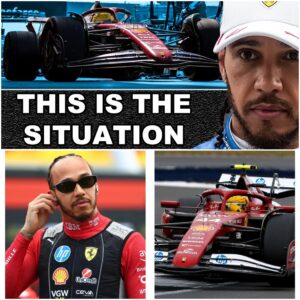
The mood of the two Ferrari drivers at the Hungarian Grand Prix could not have been any different after qualifying on Saturday.
Charles Leclerc secured his 27th Formula 1 pole position at the Hungarian Grand Prix.
He was a mixture of delighted and stunned by the time he got out of his Ferrari, somehow finding a way to topple the previously unbeatable McLarens.
Karun Chandhok couldn’t believe Leclerc beat both McLaren drivers, especially considering Oscar Piastri and Lando Norris had led every session up to that point.
On the other side of the Ferrari garage, Lewis Hamilton was devastated.
The margins were excruciatingly thin, with Hamilton missing out on a place in Q3 by a few milliseconds.
If fans wanted an idea of just how competitive this season is, then the fact that Q3 was the closest qualifying session in F1 history tells you everything you need to know.
Hamilton was disconsolate in the media pen afterwards, making the incredible claim that Ferrari should replace him based on his performance.
Team principal Fred Vasseur has disagreed with Hamilton on the cause of his early exit from qualifying
The seven-time world champion found it difficult to come to terms with the result of the session, but did make time to say something about Leclerc that the Monegasque driver will love.
Photo by Mark Thompson/Getty Images
Lewis Hamilton praises Charles Leclerc after ‘amazing’ Hungarian Grand Prix pole position
Speaking to the written press, via The Race, Hamilton said about Leclerc’s pole lap: “It’s amazing for the team.
“Clearly, the car is capable of being on pole. So big congrats to Charles and to the team.”
Vasseur then explained to the media: “It’s better to start from pole in Budapest than P11 [P12], and it will be difficult, but you cannot compare P1 and P11, you need to compare one tenth in Q2.
“This is more of an issue because Charles was not far away to be out in Q2, and you need to keep this in mind in your analysis of the day.
“But it is what it is. We have to do a better job to not be exposed in Q1 and Q2, and the fact that we had to use extra sets in Q1 was not a good start to the session, and then you have one set for Q2.”
Charles Leclerc ‘surprised’ by Lewis Hamilton at Ferrari this season
Leclerc has the upper hand on Hamilton both in qualifying and race results this season.
Hamilton is still waiting for his first podium finish in a Grand Prix, while his Monegasque teammate has four top-three finishes in the last six races.
Leclerc has been surprised by Hamilton since his arrival from Mercedes, and the pair do appear to be pushing each other very hard.
After the seven-time world champion’s strong performance last month at Silverstone, Leclerc declared that Hamilton was Ferrari’s only positive.
Not only does this show that Hamilton is nowhere near needing to consider whether he should be replaced, but that his teammate does still have his back when things get tough.
Ferrari appear to have taken a step forward with their update package, but Hamilton hasn’t been able to capitalise on those upgrades yet.
Leclerc definitely has, and that could lead to Ferrari’s first victory of the season if things go his way on Sunday.
Rivalry Ignites in Budapest: Norris vs Piastri and McLaren’s Defining Moment at the 2025 Hungarian Grand Prix
The sun-scorched tarmac of the Hungaroring is no stranger to drama. But in 2025, the Hungarian Grand Prix is less about a championship chase and more about a civil war brewing within McLaren. Two drivers. One team. And a single weekend that could alter the trajectory of the entire season.
Lando Norris and Oscar Piastri enter Budapest with the same car beneath them but vastly different motivations. Norris, now a seasoned campaigner, is McLaren’s cornerstone. His maturity and precision have made him the team’s most reliable asset in recent seasons. Yet standing across from him in the garage is the rising force of Piastri—brash, bold, and no longer content with being cast as the junior partner.
A Battle Years in the Making
Norris’s 2025 campaign has exemplified what makes him a formidable F1 talent. His performances this season have been consistent and quietly brilliant—always in contention, always extracting maximum points. His understanding of car dynamics and race craft has made him the de facto leader within the team.
But Piastri is no longer the soft-spoken rookie. His relentless development, raw speed, and fearless overtakes have placed him firmly in the spotlight. His hunger to challenge Norris isn’t just ambition—it’s a declaration.
Budapest is the perfect venue for this battle. The Hungaroring, a tight and twisting circuit often compared to Monaco without the walls, is a test of finesse and mental resilience. Overtaking opportunities are scarce, mistakes are punished, and every corner demands respect. It’s here that differences in style and philosophy are most brutally exposed.
Norris: The Strategist
For Norris, the Hungaroring is a playground of precision. His driving style thrives in environments where rhythm and car placement outweigh sheer power. He builds his pace methodically over practice sessions, studying every bump and curb. Engineers trust his feedback, and his calm demeanor under pressure often translates into race-defining decisions from the pit wall.
But while his calm is his strength, it can also be a vulnerability. Against a charging teammate who is willing to risk it all, control must be balanced with aggression. Norris knows this, and Hungary will force him to find that balance.
Piastri: The Disruptor
Oscar Piastri enters Hungary with the mentality of a disruptor. He’s not here to support McLaren’s existing hierarchy—he’s here to rewrite it. Piastri’s approach is fundamentally different: he pushes earlier, brakes later, and seizes opportunities others hesitate over. In a sport of calculated risks, he’s rewriting the formula.
What sets Piastri apart is his fearlessness. Every race weekend, he chips away at the aura surrounding Norris, daring to challenge his authority within the team. His feedback is aggressive, his setup preferences more extreme, but his results are beginning to justify that boldness. He doesn’t want to just race Norris. He wants to beat him.
Inside the Garage: Tension Rising
McLaren faces a unique challenge—managing two highly competitive drivers without sacrificing team harmony. Team principal Andrea Stella has made it clear: there will be no favoritism. Positions must be earned, not gifted. This has fueled a fierce, but controlled rivalry within the team, forcing both drivers to reach deeper.
Strategically, McLaren often splits their cars to suit their drivers. Norris prefers a stable setup with predictable rear grip, allowing him to manage races with precision. Piastri, on the other hand, demands a sharper front end—better for aggressive entries and sudden direction changes. These preferences push McLaren’s engineering team to be flexible and inventive. The tension, while unspoken, is thick in the garage.
Budapest is where this technical divergence could come to a head. If one setup delivers a decisive advantage, it might tilt not only the weekend but the balance of power moving forward.
Qualifying: The First Blow
At the Hungaroring, qualifying is often more consequential than the race itself. With overtaking notoriously difficult, starting grid position becomes a decisive factor. This is where Norris’s meticulous preparation could shine. He knows how to coax performance from tires over a single lap and thrives in high-pressure moments.
But Piastri has a knack for the unexpected. His aggressive style, while riskier, can unlock pole-worthy performances. If the track conditions suit his driving, he could spring a surprise—throwing down the gauntlet before the race even begins.
Qualifying will be their first real head-to-head of the weekend, and every millisecond will matter. In this battle, psychological advantage is just as important as grid position.
Race Day: No Margin for Error
When the lights go out on Sunday, the duel intensifies. The Hungaroring is narrow, unforgiving, and demands unwavering concentration. Norris will likely aim for a clean getaway and measured race management. If he qualifies ahead, his plan will be to control the pace and avoid drama.
Piastri, however, lives for the chaos. His race craft, especially in changing conditions or under safety car restarts, is razor-sharp. If strategy opens a window, expect him to pounce. Whether it’s an early pit stop, an undercut attempt, or a bold lunge into Turn 1, Piastri is prepared to gamble.
McLaren’s pit wall faces its own moment of truth. One poorly timed call could cost a position—or trigger internal controversy. Managing both drivers’ ambitions without letting the rivalry boil over will be as crucial as tire selection.
Strategy and the Mental Game
Racing isn’t just about lap times. It’s about nerves. And here, the contrast is stark.
Norris is cool-headed. His strategic thinking and calm under pressure are key assets. He plays the long game. But that steadiness can be disrupted if the narrative begins to shift in Piastri’s favor.
Piastri is building confidence with every session. He’s challenging the status quo, and his underdog status fuels him. If he beats Norris in Hungary, it could spark a deeper transformation—not just in the paddock’s perception, but within McLaren’s structure itself.
In a sport where team dynamics can define the outcome of a season, this mental edge is vital. Who controls the garage atmosphere? Who earns the first strategy call? These are not minor details—they’re the markers of leadership.
A Defining Weekend
As the checkered flag waves in Budapest, one narrative will take shape. Either Norris solidifies his authority, proving once again that he is McLaren’s best hope for glory. Or Piastri announces that the future has arrived—and it’s dressed in his racing overalls.
The implications stretch far beyond the podium. Hungary could determine which driver becomes the team’s focal point in the title fight. In a year where margins are razor-thin and development wars are constant, internal clarity matters.
And for McLaren, the Norris vs. Piastri duel isn’t a distraction—it’s a catalyst. Two drivers pushing each other to the limit is exactly what the team needs to return to the front of the grid.
But make no mistake. This rivalry isn’t ending in Budapest.
Ferrari at a Crossroads: Lewis Hamilton, Internal Tensions, and the Data War That Could Shape F1’s Future
In the grand theatre of Formula 1, where millisecond gains and internal politics are often indistinguishable, few stories are as compelling — or as volatile — as what’s unfolding inside Ferrari’s Maranello base. The Scuderia isn’t just grappling with a car setup or engine concept; it’s navigating a growing schism between legacy and change, tradition and disruption. And at the center of this maelstrom? Lewis Hamilton.
As Ferrari prepares for the seismic shift that is the 2026 power unit regulation overhaul, all eyes might be on the racetrack, but the real race is happening behind closed doors — in meetings, telemetry logs, and strategic debriefs. Hamilton’s arrival at Ferrari was always going to shake things up. But now, it’s looking less like integration and more like confrontation — a quiet but mounting power struggle with Charles Leclerc and the entrenched Ferrari ecosystem.
The Spa Spark: A Feeling of Being “Filtered”
It began with a whisper — not over team radio, but buried in the data from the Belgian Grand Prix at Spa. Starting from the pit lane, Hamilton felt something was off. Not in the obvious performance metrics, but in the subtle torque delivery. A seasoned simulator user and forensic data analyst in his own right, Hamilton described the issue as a “drift and throw” response — a filtered feel. That word filtered never aired publicly, but insiders confirm it was anything but casual. It hinted at something more than technical — a suspicion that he wasn’t getting the full measure of what was on offer.
That comment was never meant for the media. It was for the engineers.
It triggered what would become a multi-hour review session back in Maranello, where Hamilton compared his car’s data directly against Leclerc’s — examining torque maps, deployment profiles, even minute shifts in corner exit behavior. And the findings led him to make a bold move: a direct meeting with Enrico Gualtieri, Ferrari’s Power Unit Technical Director.
This wasn’t about curiosity. It was calculated. Hamilton wasn’t just trying to adapt to a new car — he was staking a claim on Ferrari’s future.
Beyond Collaboration: A Clash of Philosophies
Leclerc’s reaction? Telling. When asked about Hamilton’s deep dive into engine discussions, his only reply was a clipped, amused “It’s normal” — but his body language suggested otherwise. For Leclerc, Ferrari isn’t just an employer; it’s his racing identity. Groomed through the academy, given the golden seat early, and calibrated into every part of the system, Leclerc represents the continuity Ferrari clings to.
Hamilton, meanwhile, represents disruption.
The garage now buzzes with quiet tension. No outright hostility, but a notable absence of synergy. Separate debriefs. No shared track walks. Reduced communication in engineering huddles. The chemistry that builds title-winning pairings just isn’t there — not yet, and maybe not ever.
Hamilton’s intentions go far deeper than a typical driver-engineer relationship. He’s demanding influence over the architecture of the next power unit. And in Ferrari’s insular culture, where hierarchy and tradition reign, that’s a red flag.
A Silent Engineer and the Battle for Influence
This brings us to Matteo Fiorentini — a name that won’t appear in press briefings but reportedly carries immense weight inside Ferrari’s technical team. Officially, he’s a Power Unit Performance Analyst. Unofficially, he’s the man who translates raw telemetry into engineering directives. In a power structure shaped by layers of tradition, Fiorentini’s silence is strategic — but when he speaks, even Gualtieri listens.
Hamilton knows this. He’s done this before.
At Mercedes, just ahead of the 2022 regulations, he initiated similar deep dives with hybrid specialists — sessions that ultimately contributed to Mercedes’ mid-season resurgence. At Ferrari, he’s taken the same route, asking not just for raw data, but for Fiorentini to be in the room during his upcoming factory visit. That’s not an ask; that’s a move.
Because if Fiorentini starts using Hamilton’s feedback to shape engine development, the center of gravity inside Ferrari could shift. Quietly. Without fanfare. But decisively.
The Missing Data Line That Spoke Volumes
Ferrari’s internal processes are starting to show signs of strain. After Spa, both Leclerc and Hamilton ran identical power unit simulation programs for the Hungarian GP. All standard procedure. But when summary logs were distributed, Hamilton’s file was missing a line: “Load sync at throttle blip entry unconfirmed.”
That detail matters. It affects how the car handles torque on mid-corner downshifts — a sensitivity Hamilton is famously tuned into. Without that validation, the engine mapping couldn’t be adjusted for his needs without formal overrides. Leclerc’s file? That line was present, green-lit, and already implemented into his setup.
Hamilton didn’t explode. He didn’t accuse. He simply asked: “Was Matteo in that session?” No names. No drama. But everyone understood.
An Institutional Bias? Or Just System Lag?
Is Ferrari intentionally sidelining Hamilton? Or is this just the inertia of a system built around Leclerc?
Probably the latter — but that may be just as dangerous. Ferrari’s race engineers and systems are reportedly optimized to interpret Leclerc’s feedback — his language, his cadence, his timing. That’s years of institutional memory that doesn’t translate overnight, no matter how many titles Hamilton brings.
That’s the friction point.
Because the 2026 regulations represent a reset — not just technically, but politically. Ferrari can’t afford another missed window. And Hamilton, a veteran of exactly this kind of reset, knows it. He’s pushing not just to be heard, but to lead. To shape.
But the question is: will Ferrari let him?
A Power Struggle Written in Telemetry
This isn’t a traditional driver rivalry. It’s not Prost vs. Senna or Rosberg vs. Hamilton. It’s deeper — a data war. A contest over who controls the informational bloodstream of the team. Who gets heard first. Whose input defines direction.
Ferrari now faces a choice: remain loyal to its lineage and continue evolving around Leclerc, or allow Hamilton to inject the radical change that brought Mercedes so much success in the hybrid era.
If the system continues to stall Hamilton’s influence — if key validation lines remain “unconfirmed,” if feedback is routed slower, if Fiorentini’s algorithms stay locked to old voice patterns — then this isn’t just internal friction. It’s a failure of adaptation.
And Hamilton won’t sit quietly for long.
The Calm Before the Storm
As Hungary approaches, the Ferrari garage looks composed. But beneath that surface calm, tensions are tight as piano wires. Engineers brief separately. Simulator data reportedly arrives staggered. Hamilton wants raw access, unfiltered logs, direct insight into the black box. Meanwhile, Leclerc walks the paddock with polished ease, secure in a system built around his voice.
But the cost of maintaining the status quo may be greater than Ferrari realizes.
Hamilton hasn’t threatened to walk. Not yet. But the message is clear: influence or indifference — choose. The 2026 power unit is more than an engine. It’s a referendum on Ferrari’s future identity.
So, Will Ferrari Bend — or Break?
This is more than a story of two drivers. It’s the story of a team trying to evolve, grappling with the gravitational pull of its own legacy. And in Formula 1, cultural rigidity is just as dangerous as aerodynamic drag.
The implications of this slow-burning internal war stretch beyond Ferrari. If Hamilton succeeds, he won’t just have shaped an engine — he’ll have changed the very architecture of one of motorsport’s most mythologized institutions.
And if he fails?
Well, the data might not show it immediately. But the silence will. And in F1, the silences always speak the loudest.
Hungarian Grand Prix Qualifying: A Tale of Two Ferraris, One Despondent Hamilton, and a Puzzled Red Bull
The 2025 Hungarian Grand Prix qualifying session delivered one of the most dramatic and unpredictable Saturdays of the season. Charles Leclerc stunned the paddock by taking pole position for Ferrari, while his teammate, seven-time world champion Lewis Hamilton, languished down in 12th. As much as Leclerc’s performance was a triumph of precision and execution, Hamilton’s result—and his raw, emotional reaction—became the story of the day.
This wasn’t just a bad day at the office for Hamilton. It was a culmination of recent struggles that pushed the Briton to suggest, perhaps tongue-in-cheek but nonetheless painfully, that Ferrari might need to change its driver lineup. That’s a remarkable statement from someone so often measured, but it reveals how deep the frustration runs.
Lewis Hamilton: Raw Emotion and Inner Doubt
Immediately after qualifying, Hamilton described himself as “absolutely useless,” declaring that he had driven “terribly” and that not once during the weekend did he feel competitive. But his most startling quote came when he said: “It’s me every time. You’ve seen there’s no problem with the car. You’ve seen the car’s on pole. So we probably need to change driver.”
While no one believes Hamilton is seriously calling for his own dismissal, it’s clear this was a low emotional ebb. In fact, it might rank as one of his most self-critical moments, reminiscent of his despair at last year’s Qatar Grand Prix when he declared, “I’m not fast anymore.”
Hamilton’s brutal honesty is well-known. He rarely blames the car or the team, often absorbing the blame himself. But this moment of vulnerability is also a reflection of the immediate media environment in which drivers now operate. Unlike in past seasons, where there was a brief buffer before press interviews, today’s post-session debriefs happen almost instantaneously—often while emotions are still boiling.
Despite the disappointment, Hamilton did muster a congratulations to Leclerc and the team, acknowledging the pole position as a bright moment for Ferrari. It’s a testament to his character even in frustration.
Was It Really That Bad for Hamilton?
In the cold light of day, the picture isn’t quite as bleak as Hamilton painted. While he trailed Leclerc through practice sessions by a few tenths, the actual Q2 margin that cost him a spot in Q3 was just 0.015 seconds. Yes, he missed out by fifteen thousandths of a second.
Team principal Fred Vasseur was quick to downplay the drama. “You can’t judge this based on one car in P1 and the other in P12,” he said, pointing out that the performance gap wasn’t massive. Rather, the team failed to execute Q2 properly, and Hamilton was on the wrong side of a very fine line.
The key takeaway? Hamilton wasn’t miles off the pace. The Ferrari SF-25 had shifted to a lower-downforce setup, and with dropping track grip and cooling temperatures, the tire window became critical. A miscalculated out-lap or slight timing error in Q2 could easily have been the difference between P12 and a shot at pole.
Leclerc’s Pole: More Than Just Pace
Leclerc’s pole wasn’t just a case of “fast driver goes fast.” It was a result of learning from Q2’s near-miss and executing a subtle but vital strategy in Q3. After noting that cars lingering too long at the end of the pit lane were losing as much as 6–7°C in tire temperature, Leclerc made a decisive call: go out early and preserve the rubber’s optimal condition.
His radio message was clear: “Focus on one thing: go out as soon as possible. I want the least cars possible at the end of the pit lane.” That decision, combined with his improved feel from Ferrari’s recent suspension tweaks, gave him the tire grip and confidence needed to string together a lap good enough for pole—despite the track actually being slower than it had been in Q2.
Ferrari, often criticized for strategic errors in years past, executed this one to perfection.
McLaren’s Vanishing Dominance
Before Q3, the session looked like it belonged to McLaren. Both Lando Norris and Oscar Piastri had dominated through the practice sessions and early qualifying rounds. The Hungaroring, with its medium-speed corners and technical layout, seemed tailor-made for the McLaren MCL60B.
But then, something changed: the wind.
A 90-degree shift in wind direction disrupted McLaren’s finely tuned aero balance. Team principal Andrea Stella noted that this wind change alone cost the team up to four-tenths of a second. Combine that with reduced driver confidence and tire temperature management issues, and McLaren’s grip on the front row suddenly vanished.
As George Russell pointed out, “No one did their personal best in Q3.” And for once, that included the McLaren duo. Neither driver could replicate their Q2 times, leaving the door open for Ferrari to sneak through.
Red Bull’s Mysterious Slide
Curiously absent from the pole fight? Red Bull.
Max Verstappen qualified eighth—his worst starting position of the season. But it’s not just the position that alarmed the paddock; it’s how the Red Bull RB20 felt across the board. There was no major balance issue, no single corner where they were hemorrhaging time. It was a simple, mysterious lack of grip.
Both Verstappen and technical director Pierre Wach described the same puzzling scenario: the car felt numb, unresponsive, and resistant to setup changes. Verstappen summed it up best: “Somehow this weekend, nothing seems to work.”
This is unusual territory for Red Bull. In past difficult weekends, they’ve struggled with balance—oversteer, understeer, corner entry. But this time, it was something more fundamental. Despite different front wing configurations and setup experiments, the car just didn’t bite into the track.
And this wasn’t just a Max problem. Yuki Tsunoda, running a similar package at RB, was only a tenth and a half behind Verstappen but still got eliminated in Q1. The field spread was razor-thin, but Red Bull simply lacked the performance to contend.
Looking Ahead: Reset or Warning Sign?
For Ferrari, Leclerc’s pole is a morale-boosting reminder that with the right conditions and decisions, they can compete at the front. For Hamilton, this weekend may be remembered as a turning point—not because of the result, but because of the emotional honesty he displayed.
And for Red Bull and McLaren, it’s a wake-up call. The competitive gap at the front is shrinking. Environmental factors—wind, temperature, grip—now make the difference between front row and midfield.
The 2025 Hungarian Grand Prix qualifying was not just about who was fastest. It was a showcase of how precision, emotion, and execution all intersect in modern Formula 1.
And it proved, yet again, that in this sport, milliseconds can redefine a narrative.
Fernando Alonso’s Health Revelation: A Defining Moment for Aston Martin and Formula 1
In a sport defined by fractions of a second and unrelenting pressure, Aston Martin’s recent confirmation of Fernando Alonso’s unexpected health concern has sent ripples through the Formula 1 world. For a driver renowned not just for his skill, but for his near-mythic resilience and mental toughness, such news is as rare as it is unsettling. In a season already packed with intensity, this development marks more than a mere plot twist—it may well be a defining moment for both driver and team.
A Sudden Turn in a Critical Phase
The timing of the announcement is significant. Formula 1 is currently in a critical phase of the championship, where every race, every pit strategy, and every point holds immense weight. Aston Martin, relying heavily on Alonso’s tactical genius and racecraft, is in a dogfight with the likes of McLaren, Ferrari, and Mercedes. Any question surrounding Alonso’s availability or performance introduces a degree of uncertainty that the team can ill afford.
Although Aston Martin has not released specific details, the public confirmation of a health issue suggests seriousness. And yet, Alonso is no stranger to adversity. From his early rise as the youngest world champion to his triumphant return after a sabbatical from F1, he has consistently shown the ability to overcome daunting obstacles. This new challenge may prove no different—but it places enormous pressure on the team to adapt quickly and support their star driver through uncharted waters.
The Man, the Machine, and the Mind
Fernando Alonso has always been more than just a racing driver. He is a symbol of fierce determination, strategic brilliance, and endurance. His comeback in recent years has silenced critics and reignited fan admiration, especially given his age—43, a rarity in a sport increasingly dominated by younger talent.
What makes this health concern especially complex is the dual nature of the challenge: physical and psychological. Formula 1 demands peak physical condition, but it also tests the mental limits of even the most seasoned drivers. For Alonso, who has thrived on mental fortitude throughout his career, this situation presents a different kind of trial. It’s not about taming the car—it’s about confronting vulnerability in a sport that rarely tolerates it.
A Team’s True Test
Aston Martin now faces one of its biggest tests since its resurgence in the sport. How the team responds to this situation will not only affect the current season’s trajectory but also define its reputation within the paddock. So far, their approach has been notably transparent—acknowledging Alonso’s condition rather than allowing speculation to spiral. In a sport known for secrecy, this move has set a tone of honesty and responsibility.
Internally, the engineering and performance departments must adapt. They are tasked with the near-impossible: maintaining the team’s competitive edge while potentially compensating for a driver operating at less than 100%. This involves optimizing car setup, managing race strategies with surgical precision, and supporting Alonso’s recovery without sacrificing results. The success or failure of this balancing act could be the story of the season.
Rivals Smell Opportunity
Formula 1 is, by nature, a sport of margins—and rival teams have already begun recalibrating. Mercedes, Ferrari, and McLaren are all eyeing the situation for potential opportunities to gain points. With Alonso’s health in question, competitors may sense weakness in Aston Martin’s armor, especially as the Constructors’ Championship battle tightens.
Still, anyone who has watched Alonso over the years knows that doubting him is a dangerous game. If anything, adversity tends to bring out his most tenacious performances. The paddock may be preparing to strike, but there’s a universal understanding that an under-pressure Alonso is still a formidable force.
The Role of Lance Stroll and Technical Innovation
Much will also depend on Lance Stroll. While capable, Stroll has played a supporting role to Alonso this season. If Alonso is forced to miss races or cannot drive at full capacity, Stroll will need to step into a leadership role on track. This is both a challenge and a rare opportunity for him to prove his mettle.
Aston Martin’s technical department, on the other hand, holds another key to navigating this crisis. The car’s recent upgrades have positioned it as one of the most stable and innovative on the grid. Maintaining that edge is crucial. More than just performance, the engineering team must now focus on driver-centric development—enhancing comfort, reducing physical strain, and ensuring Alonso feels secure behind the wheel.
A Moment That Transcends Racing
What makes this development even more significant is how it reframes the broader conversation about the human demands of Formula 1. Alonso’s health revelation is a powerful reminder that even the most elite athletes are susceptible to wear, stress, and vulnerability. As the sport pushes toward longer calendars and tighter schedules, this incident may act as a catalyst for more robust driver wellness protocols across teams.
For Aston Martin, it’s also a moment of reflection—a chance to evaluate and strengthen the systems in place to protect their most valuable assets. Their response, both immediate and long-term, will serve as a case study in crisis management within elite motorsport.
Alonso’s Defining Test
For Fernando Alonso, this may be one of the most personal challenges of his career. It’s not a technical failure, not a bad pit stop, not a team politics issue—it’s a confrontation with his own limits. But if history has taught us anything, it’s that Alonso doesn’t just return—he evolves. From underpowered cars to misfiring strategies, he has endured more than most in the sport.
Now, he faces a battle that is deeply human. And if he can overcome it, it won’t just reaffirm his place among F1’s legends—it will elevate it. A successful comeback under these circumstances would be a testament to grit that goes beyond racing.
The Road Ahead
As the season continues, the question isn’t just whether Alonso will return to full strength. It’s about how Aston Martin positions itself during his recovery. Will they crumble under the weight of uncertainty, or will they use this moment as a crucible to forge greater unity and determination?
All eyes are now on the green garage. Fans wait, rivals strategize, and the sport watches a drama that transcends grid positions. This is the story of a team and a driver at a crossroads.
In the high-stakes world of Formula 1, there are moments that reveal character more than any trophy or podium. This is one of those moments. And if history holds true, we may once again witness Fernando Alonso rise—not just as a racer, but as a symbol of unyielding strength.
Ferrari’s Bold Gamble: Is Fred Vasseur the Right Man to Lead the Prancing Horse Back to Glory?
In a move that could reshape the trajectory of Scuderia Ferrari for years to come, the Italian team has confirmed the contract extension of Team Principal Frédéric Vasseur. While this decision brings continuity to a team often plagued by instability, it also raises pressing questions about direction, ambition, and whether Ferrari has missed a once-in-a-generation opportunity to take a different path. As the world’s most iconic Formula 1 team stares down a critical crossroads, the spotlight has never burned brighter on Maranello.
A Tumultuous Past, A Promising Start
To fully understand the implications of Ferrari’s renewed faith in Vasseur, one must revisit the context of his arrival. Taking over from Mattia Binotto in early 2023, Vasseur inherited a team rich in heritage but burdened by chaos. Ferrari was spiraling—a giant lost in a sea of tactical blunders, internal politics, and wasted potential.
Vasseur’s mission was nothing short of monumental: restore order, inspire belief, and chart a course back to title contention. In his first full season, signs of recovery began to emerge. Ferrari finished second in the Constructors’ Championship in 2024 and bagged six wins under his leadership. The team had stopped the bleeding, and hope flickered once more in the hearts of the Tifosi.
But Formula 1 is a sport where progress is measured in tenths of a second and seasons are judged in championships. In 2025, Ferrari finds itself stalled.
A Difficult 2025: From Hope to Hesitation
This season has exposed the fragility of Ferrari’s resurgence. McLaren is the undisputed powerhouse, while Ferrari has struggled to keep pace. No wins. Just five podiums—all courtesy of Charles Leclerc. Lewis Hamilton, the marquee signing for 2025, remains acclimatizing to a new team environment, and the promise of a super-team pairing is yet to materialize.
It feels as if Ferrari took two steps forward in 2024 but has been treading water ever since. The buzz around Maranello has turned to whispers of concern. Speculation reached a fever pitch as Italian media reported Ferrari’s interest in poaching Christian Horner—Red Bull’s tactical mastermind and one of Vasseur’s fiercest rivals.
It would have been a seismic move—recruiting the architect of Red Bull’s dominance—but it also risked disrupting Ferrari’s delicate progress. Instead, Ferrari chose familiarity over fireworks.
The Case for Stability
The decision to extend Vasseur’s contract speaks volumes about the direction Ferrari wishes to pursue. It suggests that Ferrari’s upper management, including CEO Benedetto Vigna, believes the current struggles are temporary. That Vasseur has planted the seeds of long-term growth. That what Ferrari needs now isn’t revolution, but evolution.
This vote of confidence is rare in Maranello. Historically, the team has cycled through leadership with the frequency of pit stops. Since Jean Todt left in 2007, a revolving door of team principals has kept the Scuderia in a perpetual state of transition. Perhaps Vasseur represents a break from that cycle—a leader being given time to implement a vision.
Vasseur himself framed the extension as an “incentive to continue evolving,” noting that while a solid foundation has been laid, the real challenge begins now. His goal? Build something enduring. But in the results-driven world of Formula 1, good intentions only go so far.
The 2026 Reset: Golden Opportunity or Looming Trap?
The stakes couldn’t be higher. The 2026 season brings with it a sweeping overhaul of F1’s regulations—engine architecture, aerodynamic guidelines, and sustainability mandates are set to redefine the competitive landscape. It’s the biggest shake-up since the hybrid era began in 2014.
This reset represents both a threat and a golden opportunity for Ferrari. Vasseur will have a clean slate, a chance to outmaneuver the competition in an environment where past dominance counts for little. With Hamilton likely more settled and Leclerc arguably at the peak of his powers, the driver lineup is among the strongest on the grid. Ferrari’s technical department, too, has seen meaningful restructuring.
But history has shown that regulation changes can make or break a team. Get it wrong, and years can be lost. For Vasseur, 2026 could define his legacy—not just at Ferrari, but in Formula 1 history.
Is Patience the New Ferrari Strategy?
Perhaps the most intriguing element of this decision is what it suggests about Ferrari’s mindset. Has the team finally embraced patience after decades of knee-jerk decisions? Or is this merely a temporary reprieve, with Vasseur’s job security hanging by a thread should 2026 falter?
There’s reason to be cautiously optimistic. Despite the disappointing 2025 season, Ferrari has managed to avoid the kind of internal turmoil that previously plagued the team during poor performance stretches. No high-profile firings. No media outbursts. This newfound calm could signal a cultural shift—a realization that lasting success demands stability.
At the same time, expectations remain sky-high. Ferrari is more than just a racing team. It is an Italian institution. Its fans, the Tifosi, are among the most passionate and demanding in motorsport. The last Constructors’ Championship came in 2008. Every year without silverware feels like an eternity.
A Message to the Drivers
The Vasseur extension also brings clarity to Ferrari’s drivers. For Leclerc, it ensures continuity with a leader he’s worked well with. For Hamilton, it provides a stable environment in which to unlock the best of his remaining years in F1. The message from Ferrari is clear: the structure is in place, and now it’s time to deliver.
But what happens if the results don’t come? What if 2026 is another season of missed opportunities and underperformance? Will Ferrari hold its nerve or revert to old habits?
The Weight of Expectation
There’s no denying that Vasseur has already made an impact. He’s brought order, steadiness, and respect back to the garage. His experience—spanning ART Grand Prix, Sauber, and Renault—has equipped him with a broad perspective on team management and driver development.
But Ferrari is no ordinary team. The pressure is greater. The scrutiny, relentless. Every strategy call, every car upgrade, every media statement is dissected under a microscope. Vasseur’s challenge isn’t just technical; it’s psychological and cultural.
In that sense, his job is as much about building belief as it is about building a fast car. He needs to inspire Hamilton and Leclerc, energize the factory, and galvanize a fanbase starved for glory. It’s a massive burden, but one that comes with the chance to become a legend.
Final Verdict: Sensible or Short-Sighted?
So, is Fred Vasseur the right man for the job?
That depends on what you believe Ferrari needs right now. If the goal is to build patiently, develop sustainable excellence, and avoid the chaos of past eras, then this decision makes perfect sense. Vasseur offers measured leadership and an engineer’s mindset with a racer’s heart.
But if you believe Ferrari needs to shake up the status quo—to make a bold statement like poaching Christian Horner or another game-changing figure—then this extension might feel like a missed opportunity.
Ultimately, only the 2026 season and beyond will reveal the wisdom of Ferrari’s choice. What is clear, however, is that the margin for error is shrinking. The competition is fiercer than ever, the regulations are changing, and the clock is ticking.
Ferrari has made its bet. Now, all eyes turn to Vasseur. Will he rise to the occasion—or become yet another name in the long list of leaders who couldn’t crack the Maranello code?
The Prancing Horse is poised on the edge of history. Time will tell if Vasseur is the man to ride it into a new era of dominance—or if the search must begin once more.
Fracture in Red: Hamilton, Leclerc, and Ferrari’s Quiet Crisis
Charles Leclerc’s pole lap in Budapest didn’t just surprise McLaren—it stunned Ferrari. At a circuit he once called cursed, Leclerc pulled out a 1:15.372 masterstroke that displaced both Piastri and Norris. But while the cameras zoomed in on celebration, the other side of the garage stood still. Lewis Hamilton had already packed up, eliminated in Q2, his tone quiet, resigned. No technical complaint, no radio fury—just a slow fade.
It wasn’t just a bad qualifying. It was the final beat in a weekend that had been out of rhythm from the start. In FP1, after just one exploratory lap, Hamilton told engineer Riccardo Adami the car didn’t feel right. Not a request. Not a balance note. Just discomfort. And Adami’s response? A flat “okay.” No probing, no recalibration. Just silence. For a driver like Hamilton, that silence is deafening. It doesn’t just reflect a setup issue—it reflects emotional misalignment.
In contrast, Leclerc’s connection with the car was electric. As the track cooled and grip peaked, he stitched together a lap that showed not raw aggression, but rhythm. The SF25 came alive for him—turn-in, throttle pickup, corner balance—all singing in harmony. It was a car speaking Leclerc’s language.
Hamilton’s SF25, meanwhile, felt like it had forgotten his dialect entirely. His style—smooth, incremental, intuitive—clashed with the chassis designed to reward early rotation and aggressive braking. It’s not a matter of preference. It’s architecture. And when architecture doesn’t fit the driver, confidence erodes. In Budapest, Hamilton wasn’t just out of sync. He was out of trust.
That trust breakdown showed up in the data too. Ferrari’s new rear suspension package, designed to stabilize the car under high-speed load, matched Leclerc’s driving profile to near perfection. But for Hamilton, it broke the feedback loop. His corrections came late—not because of overdriving, but because of hesitation. The car responded before he committed. And that’s a trust issue, not a telemetry glitch.
Inside Ferrari, that disconnect is becoming systemic. Setup requests tell the story. Leclerc asked for a revised anti-roll bar setting—it was implemented immediately. Hamilton requested a softer diff map to help with exit traction in sector 3. It was trialed, then shelved. One driver’s feedback leads to change. The other’s becomes a data footnote.
Worse still, engineers are reportedly beginning to default to Leclerc’s telemetry for baseline setup design. Not out of favoritism, but convenience. His style produces replicable results. Hamilton’s nuanced feedback—phrases like “the rear feels anxious”—requires interpretation. And in a high-pressure environment like Ferrari, interpretation can feel like guesswork. So they lean on what’s clear.
That clarity has a cost. Slowly but steadily, Hamilton is becoming Ferrari’s variable—respected, but not trusted as the performance anchor. His lap times aren’t the issue. His integration is. And that’s where the real damage lies. Because in Formula 1, when one driver starts defining the car’s evolution, the other isn’t just adapting. He’s chasing.
Even Hamilton’s most trusted tools are being marginalized. Brake Map 7, a setup he once used to stabilize rear instability in Baku, quietly returned in Budapest. Ferrari didn’t acknowledge it in the post-session debrief. But it was there in the overlays, a signal that Hamilton was searching for confidence his engineer wasn’t offering.
This emotional drift has precedent. At Mercedes, Hamilton’s bond with Peter Bonnington was legendary—built on years of mutual understanding. At Ferrari, his voice is now filtered through Adami, a veteran but not a translator. Their radio exchanges have grown shorter. The empathy is missing. And when feedback doesn’t get a response, drivers stop offering it fully.
Internally, Ferrari’s engineering team is fracturing into two quiet camps—those designing around Leclerc’s sharp, aggressive profile, and those struggling to adapt Hamilton’s layered, feel-based style into numbers. It’s not open conflict. It’s erosion. And erosion, left unchecked, becomes identity.
From the outside, Ferrari still claims dual-driver development. But the signals are clearer than ever: Leclerc defines the car. Hamilton interprets it. That imbalance isn’t malicious—it’s inertia. But it carries strategic consequences. Especially in a title fight this tight.
McLaren, unified in rhythm, continues to develop both drivers in lockstep. Red Bull, struggling in patches, knows they need only outlast Ferrari’s instability. And Mercedes—watching quietly—may be preparing for Hamilton’s early return if this spiral continues. There are whispers of exit clauses. Nothing public, but enough to change tone in the paddock.
Budapest revealed more than lap times. It exposed fault lines. A pole lap for Leclerc. A 12th place for Hamilton. One driver syncing with his car. Another circling, searching for language it no longer speaks. And in a team that promised balance, that’s more than a setup issue. It’s a philosophical crisis.
Because this was never just about speed. Hamilton was brought in to realign Ferrari’s culture. To prepare for the 2026 regulations not with horsepower, but with leadership. His value lies in cohesion—in knowing how to harmonize departments, how to bridge feel and function. But if Ferrari won’t build around that strength, they reduce him to a symbolic presence.
The real danger? That this becomes another chapter in F1’s long book of dual-leader projects gone quiet. Like Vettel in 2020, when Ferrari shifted chassis evolution around Leclerc. Like Ricciardo at Red Bull, when Verstappen’s data took over development. Like Bottas at Mercedes, frozen out by a car increasingly shaped by Hamilton’s needs. In each case, the second voice got quieter, until it wasn’t part of the conversation.
Now, in 2025, Ferrari risks doing the same—this time with the wrong driver. Because Hamilton, for all his history and titles, isn’t demanding dominance. He’s asking to be heard. To lead, not just follow.
Leclerc is fast, integrated, and rightfully celebrated. But if Ferrari lets the car evolve exclusively toward him, they risk limiting its future. Not just for this year, but for 2026, where adaptability will define success. And Hamilton, uniquely, offers that adaptability—if they build with him, not just around him.
As Monza looms, the stakes are rising. The Tifosi will see the lap times, but they’ll feel the chemistry. And if Budapest was a quiet fracture, Monza could be a reckoning. Because trust, once broken, doesn’t return through data. It returns through belief.
Ferrari has to decide: Will they recalibrate and harness both philosophies, or keep drifting toward a singular identity? The answer won’t just shape their title hopes. It will define who they are as a team—and who they’re building for.
The 2026 Power Shift: Is Aston Martin Engineering a Formula 1 Coup with Christian Horner?
In the high-octane world of Formula 1, where politics, performance, and billion-dollar moves dictate the future of racing dynasties, a seismic shift might just be underway. In recent weeks, a sequence of financial, strategic, and personnel decisions has sent shockwaves across the paddock. At the center of it all: Aston Martin, a strategic $146 million stake sale, Christian Horner’s unexpected availability, and the looming specter of a 2026 revolution. Is this a coincidence of timing—or the opening gambit of a master plan?
Aston Martin Sells Stake Amid Financial Struggles
Let’s start with the facts. Aston Martin Lagonda, the luxury carmaker that has long danced between brilliance and bankruptcy, recently signed a binding letter of intent to sell its 4.6% stake in the Aston Martin Aramco Formula 1 team for $146 million. It may sound small, but for a company reeling from a profit warning, slumping sales in China, and growing pressure from U.S. tariffs, this cash injection is anything but minor.
Aston Martin debuted on the London Stock Exchange in 2018 with lofty aspirations—valued at £4.33 billion. Now, its share price has plummeted from £19 to a mere 71 pence, bringing its total value to around £826 million. As analysts note, a move toward privatization is now under serious consideration. That could simplify ownership, reduce overhead from public listing, and attract fresh capital for future growth—particularly in its Formula 1 ambitions.
But here’s where things take a curious turn.
The F1 Team’s Valuation Skyrockets
While the parent company struggles, the F1 team tells a very different story. The recent stake sale valued Aston Martin’s racing outfit at $3.2 billion—a 23% increase over last year’s valuation of $2.6 billion. That’s a remarkable jump, reflecting not only Formula 1’s surging global popularity but also the team’s significant investments.
Back in 2018, Canadian billionaire Lawrence Stroll rescued the then-Force India team and began transforming it into a legitimate front-runner. New facilities, wind tunnels, and—most importantly—talent have followed. The biggest name among them? Adrian Newey, perhaps the most decorated technical mastermind in F1 history.
All of this makes the timing of Christian Horner’s sudden availability deeply suspicious—or deeply strategic.
Christian Horner: From Ouster to Opportunity
Horner, Red Bull Racing’s once-unshakable team principal, was unceremoniously removed from his role in July. After years of leading Red Bull to multiple constructors’ and drivers’ championships, the abruptness of his exit raised eyebrows across the sport. Yet his silence afterward was even more curious.
Now, oddsmakers are listing Aston Martin as the 7/4 favorite to become Horner’s next destination. Ferrari extended Fred Vasseur. Mercedes remains closed off. McLaren and Alpine are long shots. Williams and Cadillac are in contention but don’t offer the immediate potential that Aston Martin does.
This leaves Horner with one clear path back to relevance—and possibly glory.
Reunion With Newey? The 2026 Wildcard
Adding fuel to the fire is the very real possibility of a reunion between Horner and Newey, this time at Aston Martin. It wouldn’t just be nostalgic; it could be lethal for the competition. According to an Aston Martin insider, Newey is reportedly not involved in the current AMR25 car. His focus is completely on the 2026 regulations, which will usher in a new engine formula and technical landscape. That’s not an oversight; it’s a reset.
And if Horner joins now, he gets to lead that reset—a new team structure, a blank slate, and the chance to build a championship contender from the ground up. Fernando Alonso himself has confirmed that Aston Martin’s attention is already zeroed in on 2026, with little left to develop this year beyond pit stops. They’re waiting. Planning. Engineering a breakthrough.
Could Horner Be Involved in Ownership?
But what if Horner’s role goes beyond team principal?
The buyer of the $146 million stake has not been publicly disclosed. Given the close timing of Horner’s availability, the team’s valuation spike, and the focus on structural realignment, speculation is swirling that Horner—or an ally—could be directly involved in the investment. It would be a shrewd way to join the team with more influence and upside than ever before.
If Aston Martin does indeed go private, it opens the door for new types of strategic partnerships, free from the scrutiny of public markets. That’s an attractive prospect for someone like Horner, especially if he sees this as a long-term power play rather than a simple return to the pit wall.
What About Red Bull?
All of this sets up a delicious rivalry. Red Bull, the team Horner helped build into a dominant force, could soon find itself staring down a resurgent Aston Martin—led by their former boss, designed by their former guru, and powered by Honda in 2026.
It’s the kind of rivalry that could reignite the sport’s most compelling narratives. Red Bull has been untouchable in recent seasons, but dynasties fade—and challengers rise.
The real drama? Red Bull may have unknowingly created its most dangerous enemy.
Lawrence Stroll’s Endgame
At the center of all this remains Lawrence Stroll. He didn’t pour $117 million into Force India just to hover around eighth place in the constructors’ standings. He wants wins. Championships. Legacy.
With a team now worth over $3 billion, a new Honda engine partnership beginning in 2026, and possibly Horner and Newey working together again, Stroll may have finally assembled the ultimate chessboard.
And he’s not playing checkers.
A F1 Super Team in the Making?
Let’s connect the dots:
Aston Martin sells a stake at a high valuation → $146M raised.
The parent company explores privatization → increased control, reduced scrutiny.
Christian Horner becomes available just weeks later → no official job yet.
Adrian Newey focuses solely on 2026 regulations → zero input on current car.
The team publicly signals it’s in “wait mode” → all eyes on next year.
The buyer of the stake? Still a mystery.
The question isn’t just whether Horner will return. It’s whether he’s already been building his comeback all along—quietly, strategically, and with the perfect partner.
Conclusion: The Road to 2026 Just Got a Lot More Dangerous
This is no longer business as usual in Formula 1. We may be witnessing the birth of a new F1 super team—privately owned, expertly led, technically advanced, and obsessively focused on the future. If Horner joins, this won’t be a comeback.
It’ll be a revolution.
Red Bull may have slammed the door on Horner. Ferrari already has its general. Mercedes shows no signs of change. But Aston Martin? They just cleared the board, raised new funds, and might be offering Horner the keys to a $3 billion war machine with Newey at his side.
In Formula 1, timing is everything. And right now, 2026 is the target—for Aston Martin, for Christian Horner, and perhaps for the future balance of power in the sport.
The real war hasn’t even started yet. But when it does, remember this moment.
Because it might just be when the next champion was born.
McLaren’s 2025 Resurgence: A Championship War Within the Same Garage
In the annals of Formula 1 history, there are seasons defined by dominant cars, and others remembered for fierce driver rivalries. But rarely do both threads intertwine so tightly as in the 2025 F1 season, where McLaren—after years of false dawns—has risen from the shadows to redefine modern F1 dominance. Yet, the true spectacle isn’t found in their gap to the rest of the grid. It lies inside the garage, between two of the sport’s brightest young stars: Lando Norris and Oscar Piastri.
This is not your typical team versus team season. It’s a civil war—graceful on the surface, ruthless beneath. McLaren’s car is a masterpiece of engineering, taking the Woking-based team from perennial midfield contenders to title favourites. But their path to both championships has been anything but straightforward. Because when your two drivers are so evenly matched, and your car so consistent, the battle becomes psychological, strategic, and personal.
A Rivalry Without Malice, Yet Full of Fire
Oscar Piastri’s clinical victory at Spa-Francorchamps marked McLaren’s 10th win in 13 races this season—a season that has seen six 1-2 finishes, three of them consecutive from Austria onwards. The constructors’ championship? All but over. McLaren leads with a points advantage so commanding that even a major upset wouldn’t dethrone them. But while the team trophy feels inevitable, the Drivers’ Championship is hanging by a thread.
Piastri’s win at Spa gave him a 16-point lead over Norris, a margin that would normally be called “comfortable” in any other scenario. But not here. In a season this closely fought, where mechanical gremlins or a single lap-one error can swing 25 points in either direction, that lead feels almost negligible. Lando Norris knows it. Oscar Piastri knows it. The next corner, the next tire call, the next pit stop—any of it could be decisive.
At Spa, a minor misjudgment by Norris gave Piastri the opening he needed on the very first lap. Lando launched too aggressively into Turn 1, compromising his exit up the hill. Piastri, displaying the opportunistic instinct of a seasoned racer, pounced on the Kemmel Straight and never looked back. Norris had the raw pace and determination to challenge, but a slightly slower pit stop and a couple of cornering mistakes sealed his fate.
In many ways, the result at Spa mirrored Silverstone a few weeks prior—fine margins and missed opportunities.
A Title Fight Measured in Millimeters
What makes this championship duel so riveting is that every race changes the narrative. At Austria, Norris prevailed. At Silverstone, a time penalty cost Piastri dearly. In Spa, Oscar capitalized early and managed the race with calm composure. It’s not raw pace that separates them anymore; it’s execution under pressure.
For many fans, this is reminiscent of Mercedes in the mid-2010s—Hamilton vs. Rosberg. Yet unlike that emotionally volatile partnership, Norris and Piastri have so far kept things civil. There are no public jabs, no toxic radio messages, no inflammatory headlines. Even after their tangle in Canada, when Norris admitted fault, both drivers handled it like professionals. It’s a rivalry founded on mutual respect, not animosity. But make no mistake: it’s intense.
The psychological games are quieter but just as significant. One mistake, one misjudged tire stint, and the balance of power shifts. That pressure is relentless, and it’s visible in how both drivers are beginning to feel the strain.
Could Verstappen Do Better? The Online Debate
Naturally, some have questioned whether Max Verstappen, the gold standard of modern F1, could be even more dominant in this McLaren. And while it’s tempting to believe that Verstappen would have a 100-point lead by now, that line of thinking misses the bigger picture.
Max thrived in an ecosystem built for him at Red Bull—every element of that team, from strategy to chassis development, centered on him. McLaren doesn’t operate that way. Under CEO Zak Brown and Team Principal Andrea Stella, McLaren has been deliberately structured to support two top-tier drivers equally. It’s a strategy designed to maximize constructor points and longevity, but it creates a razor-thin, pressure-packed environment internally.
Verstappen may be a once-in-a-generation talent, but even he would face challenges adjusting to McLaren’s setup and internal dynamics. We’ve seen champions like Hamilton and Sainz struggle after switching teams. Fit matters. And in McLaren’s case, the team chemistry—however tense—has been carefully cultivated.
The McLaren Machine: Fast, Fragile, and Fearsome
Another underappreciated element is the car itself. The 2025 McLaren is a technical marvel. It breaks lap records—just look at Spa—and maintains high downforce even through turbulent air. But therein lies the irony: the car’s strength is also a curse.
With so much aerodynamic grip, it becomes harder to follow closely. Dirty air has returned in a big way, and in almost every race this season, the driver who leads lap one ends up winning. That’s not team orders—it’s physics. Equal machinery, reduced overtaking opportunities, and ultra-sensitive tire wear mean that track position is king. Which only heightens the pressure on drivers to get it right at lights out.
This season, mistakes have consequences that ripple across an entire race. That’s what makes Norris vs. Piastri so captivating. Every session matters. Every decision is magnified.
Treading the Line Between Harmony and Hostility
There’s no denying that McLaren’s internal balance is a tightrope walk. Social media is ablaze after every race, dissecting body language between team bosses, analyzing pit radio tones, and projecting potential favoritism. Fans are quick to declare the team biased one way or another. But from the outside looking in, McLaren seems to be managing the rivalry masterfully—at least for now.
Zak Brown is playing the long game. He doesn’t want a repeat of the toxic Hamilton–Rosberg dynamic that fractured Mercedes. McLaren wants a culture of respect and resilience. And so far, they’re getting it. But as the final stretch of the season looms, with only a few races remaining and a title on the line, maintaining that harmony will become harder. The stakes are simply too high.
The Bigger Picture: A Sport Reinvigorated
This isn’t just McLaren’s redemption story—it’s a sign that Formula 1 is entering a new era of intra-team rivalries. After seasons dominated by one man and one team, 2025 is offering something different: a chess match at 200 mph, a rivalry without the drama but full of stakes.
Whether it’s Norris or Piastri who emerges as champion in Abu Dhabi, one thing is certain: the title will be earned, not given. Every overtake, every pit call, every ounce of mental fortitude will matter. And for McLaren, whose last title came over a decade ago, this is more than just success—it’s resurrection.
They aren’t just winning races. They’re rebuilding a legacy.
Final Thoughts
It’s easy to say McLaren could be more dominant if they picked a number one driver. It’s tempting to imagine how Max Verstappen or Lewis Hamilton might fare in this car. But the beauty of the 2025 season is that it’s not about total domination—it’s about tension.
McLaren is showing that there’s more than one way to win in Formula 1. Sometimes, the most compelling championship fight doesn’t come from a rivalry between teams. Sometimes, it’s about two elite drivers, sharing a garage, battling quietly but fiercely for supremacy.
And that, perhaps more than anything, is what makes this season unforgettable.
Gabriel Bortoleto is in his rookie season in F1 this year and has already shared a track with some of the sport’s biggest names – but he has no doubt about who is the best driver
Max Verstappen and Lewis Hamilton are among the best F1 drivers ever(Image: Formula 1 via Getty Images)
A Formula 1 rookie has made a bold claim about who he considers the greatest driver in the sport’s history. And it is not seven-time champion Lewis Hamilton who gets the vote of Gabriel Bortoleto, who is in his first season with midfield outfit Sauber.
Instead, the 20-year-old Brazilian racer places Max Verstappen on the same pedestal as his compatriot, the legendary Ayrton Senna. Speaking to Motorsport.com, Bortoleto said: “For me, along with Ayrton Senna, he [Verstappen] is the best driver of all time.
“I really admire his way of approaching races, his way of understanding the sport, of understanding the car and the calmness with which he faces everything.”
Interestingly, Verstappen played a significant role in shaping Bortoleto’s career even before he joined Sauber, which will become the Audi works team from next year. The Dutch ace, who bonded with Bortoleto over video games, ensured that key figures in other teams were aware of the young Brazilian’s talent.
Bortoleto added: “We started playing video games and simulators together more and more. Since then, we’ve been in touch a lot and he helps me a lot. For example, he helped me a lot on my way to F1 by giving me a lot of advice and recommendations, and talking about me with people in the paddock.”
He also spoke of how Jonathan Wheatley, the Sauber team principal, had some encouraging words for a rising star in F1. “Jonathan told me that even before I joined Sauber-Audi, Max was very positive about me.
“I know Max doesn’t usually talk about this himself, especially in front of the media, but it’s something he helped me with – talking about me to people in F1. I was getting good results and he wanted to help me.”
Despite only notching up six points so far this season and being dubbed a “B-standard” driver by Red Bull adviser and young driver chief Helmut Marko, Bortoleto took that particular comment on the chin. He confidently stated: “I’ve seen that [quote] and I love challenges.
“I think, hearing that from Helmut, he is a guy that has put a lot of talents in Formula 1, and has put a lot of wrong talents already in F1, so you can see he got it right and wrong and, hopefully, I will prove him wrong with time.
“But nothing I can say now in the media would change his mind, just my results on track, and I’m sure I’m going to prove him wrong at some point and, hopefully, he will admit this when I prove him wrong.”