Blog

  • Inside The Mystery Of Lieserl Einstein, The Secret Daughter Of Albert Einstein

    Inside The Mystery Of Lieserl Einstein, The Secret Daughter Of Albert Einstein

    Just a year after she was born in 1902, Albert Einstein’s daughter Lieserl Einstein suddenly vanished from the historical record — and until 1986, no one even knew she existed.
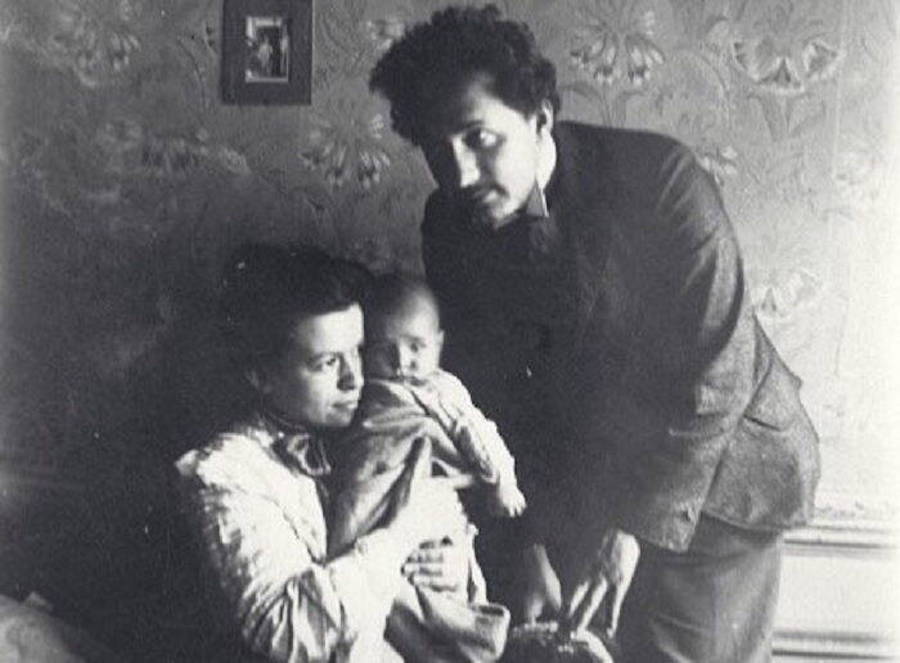
    Lieserl Einstein

    Public DomainAlbert Einstein and Mileva Marić with their first son, Hans, in 1904, two years after Lieserl Einstein was born.

    Albert Einstein was one of the greatest physicists in history. But for years, parts of his private life remained hidden — including the fact that he had a daughter, Lieserl Einstein.

    Why was Lieserl a secret? Because she was born out of wedlock. In 1901, Mileva Marić, a physics and mathematics student with Einstein at the Zurich Polytechnic, left the school and returned home to Serbia, giving birth to a daughter the following year. In 1903, Einstein and Marić married.

    But then, Lieserl Einstein disappeared. And she remained hidden until well after both Marić’s and Einstein’s deaths in 1948 and 1955. It wasn’t until discovering decades-old personal letters between the two in 1986 that Einstein’s biographers even learned that she existed at all.

    So, what happened to Lieserl Einstein, Albert Einstein’s only daughter?

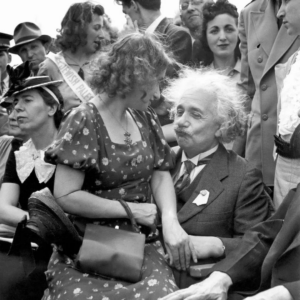
    Có thể là hình ảnh đen trắng về 5 người và đám đông

    Albert Einstein with his step-daughter Margot at the opening of the Jewish Pavillion at the World’s Fair in Flushing Meadows in Queens.

    The Mystery Of Albert Einstein’s Forgotten Child

    Lieserl Einstein was born on Jan. 27, 1902, in the city of Újvidék in what was then the Kingdom of Hungary in Austria-Hungary and is today part of Serbia. And that is just about all researchers know for sure about the life of Albert Einstein’s daughter.

    Her disappearance was so complete that historians never learned about Einstein’s daughter until 1986. That year, early letters between Albert and Mileva surfaced. Suddenly, scholars discovered references to a daughter called Lieserl.
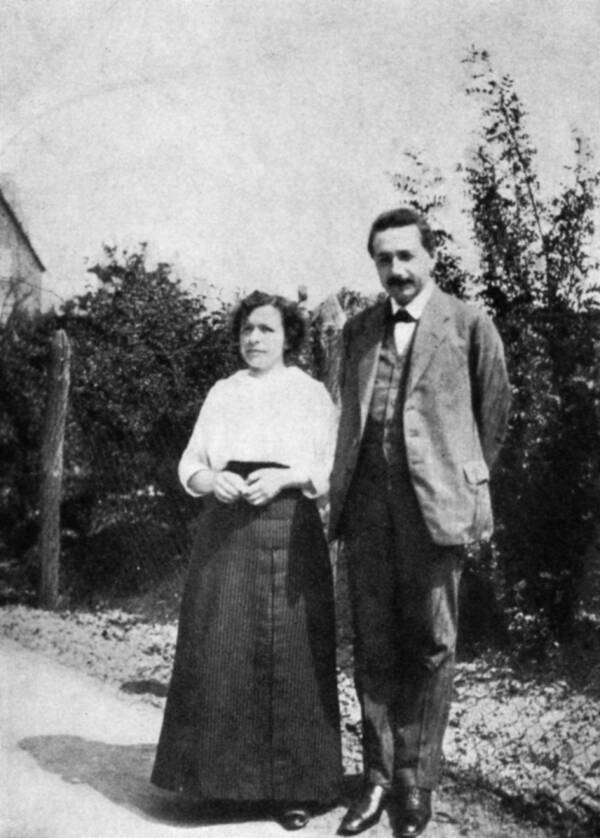
    Albert Einstein And Mileva Marić

    Ann Ronan Pictures/Print Collector/Getty ImagesAlbert Einstein with his first wife Mileva Marić, c. 1905.

    On Feb. 4, 1902, Albert Einstein wrote to Mileva Marić, “I was scared out of my wits when I got your father’s letter because I had already suspected some trouble.”

    Mileva had just given birth to Einstein’s first child, a daughter they referred to as Lieserl. At the time, Einstein lived in Switzerland, and Marić had returned to her hometown in Serbia.

    “Is she healthy and does she already cry properly?” Einstein wanted to know. “What kind of little eyes does she have? Whom of us two does she resemble more?”

    The physicist’s questions went on and on. Finally, he said, “I love her so much and I don’t even know her yet!”

    Albert asked Mileva, “Couldn’t she be photographed once you are totally healthy again?” He begged his lover to make a drawing of his daughter and send it to him.

    “She certainly can cry already, but to laugh she’ll learn much later,” Einstein mused. “Therein lies a profound truth.”

    But when Mileva joined Albert in Bern, Switzerland, to be married in January 1903, she did not bring Lieserl. The child seemingly vanished from all historical records. Lieserl Einstein became a ghost. In fact, not a single letter dated after 1903 contained the name Lieserl.

    Searching For Lieserl Einstein

    When scholars learned that Albert Einstein had a daughter named Lieserl Einstein, the search for information about her began. But historians could not find a birth certificate for Lieserl Einstein. Not a single medical record remained. They could not even find a death certificate referencing the child.

    Even the name “Lieserl” was likely not her real name. Albert and Mileva referred variously in their letters to a “Lieserl” and a “Hanserl,” generic gendered German diminutive names, when referring to their desires of having a girl or a boy — somewhat similar for hoping for a “Sally” or a “Billy.”

    Left with a mystery, historians tried to piece together clues about what happened to her.

    Hans Einstein

    ETH LibraryMileva and Albert with their first son, Hans.

    Albert Einstein and Mileva Marić were unmarried when they had Lieserl. The pregnancy disrupted Mileva’s plans. She had been the only woman in Einstein’s class at Zurich Polytechnic. But after learning of her pregnancy, Mileva withdrew from the program.

    Albert’s family never approved of Mileva. “By the time you’re 30, she’ll already be an old hag,” Einstein’s mother warned of the woman who was just three years older than him.

    Despite his family’s misgivings, Albert married Mileva. But only after leaving Lieserl behind in Serbia, where Mileva’s family cared for her.

    Einstein had a motive to hide his illegitimate daughter. Working in a Swiss patent office, an out-of-wedlock child could halt his career before it began.
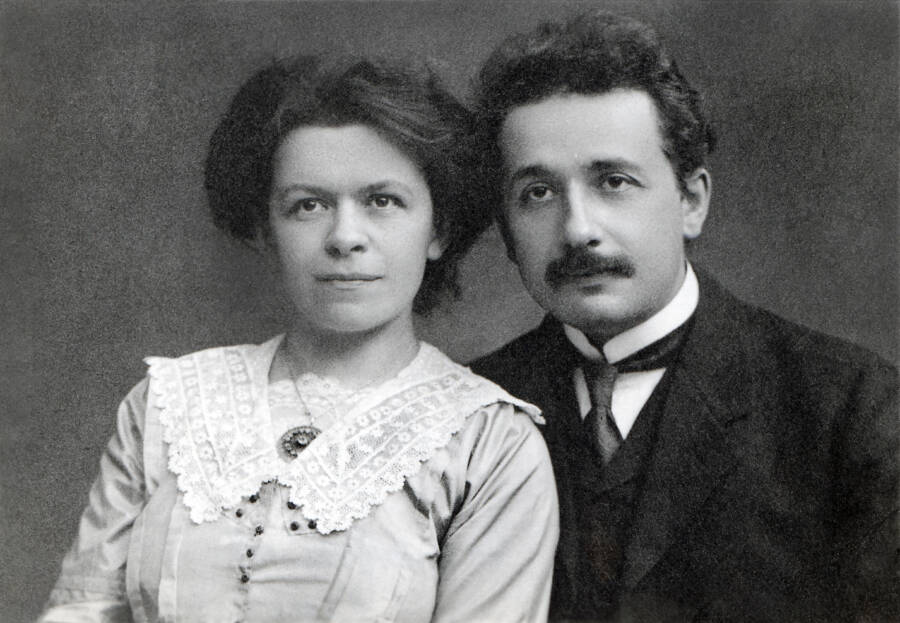
    Parents Of Lieserl Einstein

    Universal History Archive/Universal Images Group via Getty ImagesMileva Marić and Albert Einstein in 1912, two years before they separated.

    The last reference to Lieserl in Einstein’s letters comes in September 1903. “I’m very sorry about what has befallen Lieserl,” Albert wrote to Mileva. “It’s so easy to have lasting effects from scarlet fever.”

    Lieserl had apparently come down with scarlet fever around 21 months old. But Einstein’s letter implies she survived. “If only this will pass,” he wrote. “As what is the child registered? We must take precautions that problems don’t arise for her later.”

    The scant clues left scholars with two theories: either Lieserl died as a child or the Einsteins gave her up for adoption.

    What Happened To Lieserl Einstein?

    In 1999, author Michele Zackheim published Einstein’s Daughter: The Search for Lieserl. After years spent searching for clues and interviewing Serbians about family trees, Zackheim developed a theory.

    According to Zackheim, Lieserl had been born with unknown developmental disabilities. Mileva Marić left Lieserl behind with her family when she traveled to Bern to marry Albert. Then, some months before her second birthday, Lieserl died.

    Mileva Marić And Sons

    Hebrew University of JerusalemMileva Marić and her two sons, Hans Albert and Eduard.

    It’s possible that Albert, so eager for a photograph of his daughter, never met Lieserl Einstein. He certainly never mentioned her in writing after 1903.

    It’s also possible that Albert hid Lieserl from his family. However, a few weeks after Lieserl’s birth, Einstein’s mother wrote, “This Miss Marić is causing me the bitterest hours of my life. If it were in my power, I would make every possible effort to banish her from our horizon, I really dislike her.”

    “There’s a real attempt to keep Einstein as the icon of humanitarianism and goodness, and he wasn’t good,” Zackheim argues. “He was an enormously talented creative genius and he was a dreadful father and a dreadful person and not kind to his children at all.”

    Albert Einstein Lecture

    Ferdinand Schmutzer/Austrian National LibraryAlbert Einstein left Mileva Marić and his sons in 1914.

    In 1904, Mileva realized she was pregnant again. She waited to tell Albert, afraid of his reaction. “I’m not the least bit angry that poor Dollie is hatching a new chick,” the physicist told his wife. “In fact, I’m happy about it and had already given some thought to whether I shouldn’t see to it that you get a new Lieserl.”

    By then, mere months after Lieserl Einstein disappeared from historical records, Albert already had his mind on a “new Lieserl.”

    What happened to Lieserl Einstein? Whether she died as a child or her parents gave her up for adoption, Lieserl vanished from history.

    Albert Einstein had at least two children after Liesel. Learn more about his son Hans Albert Einstein, a renowned mechanical engineer who taught at Berkeley. Then read the depressing story of Eduard Einstein, Albert Einstein’s forgotten son.
  • The Sherman Tank – Beast or Bust?

    The Sherman Tank – Beast or Bust?

    The Sherman Tank – Beast or Bust?

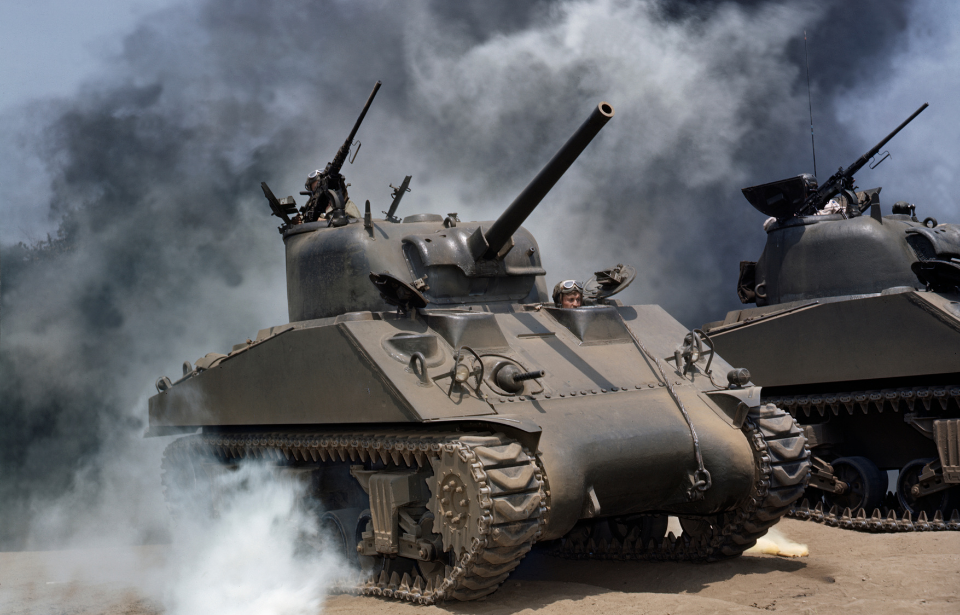
    Photo Credit: Camerique/Getty Images

    The Sherman tank is one of the most well-known tanks involved in WWII, alongside the German Tiger and Soviet T-34. In the decades after the war, the reputation of the Sherman decreased to the point where many regarded it as the worst tank of the war. We will take an in-depth look into whether or not the Sherman is deserving of this reputation, and some of the reasons why it could easily be argued as being the best tank design of WWII.

    The Sherman and its terrible reputation

    A US Medium Tank M4 Sherman at the Murmansk Commercial Seaport. Recovered from the Barents sea

    If you ask people about the Sherman, you might think they look like this new. (Photo Credit: Lev Fedoseyev\TASS via Getty Images)
    The basic running gear, drivetrain, and lower hull of the Sherman dated back to the 1930s and were designed with a huge emphasis on reliability and commonality of parts to make maintenance easier.

    Many complaints about the tank come from its gas engines, the fuel for which would easily ignite when the tank was hit. The vehicle was originally designed for the 400 horsepower air-cooled Continental R975 radial engine. It had a good power-to-weight ratio but was very tall, resulting in the Sherman being almost as tall as the Tiger, even though it weighed 25 tons less. This height made the Sherman an easy target, especially from the side.

    The armor is another area of debate, as it was only 50 mm on the front of the hull, and 38 mm on the sides and rear. The turret faired a little better with 76 mm over the front and 50 mm over the sides and rear.

    With the right ammunition, the Tiger, Panther, and King Tiger could all penetrate the Sherman from well over 3,000 meters away, a simply unfair advantage.

    A penetrating hit to the earlier models would almost certainly set the tank ablaze too, due to the storage of the ammunition. In fact, studies conducted during the war found 55–80 percent of Shermans burned after being hit.

    The ammunition it did store was relatively useless against later German tanks. The 75 mm M3 gun firing the M61 APCBC round could penetrate 88 mm of armor at 100 meters. The Tiger 1 had 100 mm of armor over the front.

    For these reasons, it’s clear to see in a direct one-on-one engagement the Sherman had almost no chance of success against the heavier German tanks. A German tank could sit 3,000 meters away, fire a round, penetrate the Sherman, and set it ablaze, right? Absolutely. Does this make the Sherman an inferior tank? Not quite.

    Why was the Sherman like this?

    Rusty Sherman tanks recovered from the sea

    Photo Credit: Lev Fedoseyev\TASS via Getty Images
    Many of the arguments highlighting the Sherman’s shortcomings rely on heavier and newer German tanks. However, to fully understand the Sherman, one needs to understand the challenges facing Allied militaries at the time.

    Any tank produced in the U.S. that was destined for Europe had to be shipped over the Atlantic. To increase the number of vehicles per shipment, engineers had to strike a perfect balance between weight and performance.

    Germany did not face such weight limits, as they transported their vehicles across the continent by rail. From the get-go, the Sherman was limited in many ways.

    Despite this, it still managed to be packed full of great qualities.

    The Sherman’s excellent qualities: Firepower

    US Fifth Army M4 Sherman mounted tank, on the Gothic Line during World War Two, Lucca, Italy, September 16th 1944.

    Photo Credit: European/FPG/Getty Images
    At the time of its design, the heaviest German tank was the Panzer IV. The Panzer IV was a superb tank in its own right, which many argue should have been prioritized over the nation’s bigger tanks.

    Until 1942, the maximum amount of armor found on a Panzer IV was 50 mm, which was mounted flat on the front of the hull. The turret front was even worse, with just 30 mm of armor. A Sherman with the smaller 75 mm gun could punch through this armor from over 2,500 meters away, while the Panzer IV’s short-barrelled 75 mm gun would simply tickle the Sherman’s frontal armor, even at point-blank range.

    Empty 75mm HE shell cases being collected from Sherman tanks firing in the indirect fire support role in the Anzio bridgehead, Italy, 5 May 1944.

    Empty 75mm HE shell cases being collected from Sherman tanks firing in the indirect fire support role in the Anzio bridgehead, Italy, 5 May 1944. (Photo Credit: No 2 Army Film & Photographic Unit)
    For dealing with thicker armor, the British adapted Sherman to carry a 17-pdr gun with the Sherman Firefly, which was extremely powerful. The U.S. later followed suit with the 76 mm M1 gun

    Armor

    View of a pair of M4 Sherman tanks as they manouver through smoke during a training exercise, July 1942.

    View of a pair of M4 Sherman tanks as they manouver through smoke during a training exercise, July 1942. (Photo Credit: Camerique/Getty Images)
    On paper, the Sherman’s armor seems unimpressive, with exactly half the frontal armor as the Tiger I, but in reality, the Sherman was one of the most well-protected medium tanks of the war. Its 50 mm of frontal hull armor was angled at 56 degrees, which gave it an effective thickness of 90 mm, an amount almost equal to the front of the Tiger I. A German study concluded that even the Tiger I’s infamous 88 mm gun would not be able to penetrate the front of a Sherman if it was angled away by 30 degrees.

    The Sherman’s side armor was only 38 mm and not angled at all. In comparison, the Panther’s side armor was only 2 mm thicker, albeit set at a 30-degree angle. However, even with this angle, it could be penetrated by the Sherman’s 75 mm M3 from well over 2,000 meters away.

    This level of armor protection on a 35-ton tank was virtually unheard of at the time.

    The later, longer-barrelled 88 mm KwK 43 L/71 used on vehicles like the Tiger II and Jagdpanther would have made mincemeat of the Sherman at any combat range, but even the heaviest Soviet vehicles fielded during the war were not immune to this devastating gun.

    Fire risks

    A blazing Sherman tank abandoned during the Battle of the Bulge

    A blazing Sherman tank abandoned during the Battle of the Bulge. (Photo Credit: Allan Jackson/Keystone/Getty Images)
    The main complaint about the Sherman was its notorious habit of burning when hit; however, this is unfair. The main reason for the Sherman’s volatility was because of its ammunition storage. Ammunition was stored in the turret, hull sides, and hull floor, which meant a hit in the side (where hits were most likely to come from), would almost certainly hit ammunition. Likewise, the petrol would easily ignite when exposed to flames.

    The problem with this argument is almost all comparable tanks; the T-34, Panzer IV, Tiger, and Panther, stored their ammunition in these locations too, and all of those except the T-34 also used petrol engines. This means the Sherman was not alone in its combustibility. According to an Allied study, the Panzer IV actually caught fire more often than the Sherman.

    Burning was not a localized issue to the Sherman, but was observed with most tanks from the era.

    An Axis armoured division is under heavy fire from British artillery.

    circa 1940: An Axis armored division is under heavy fire from British artillery. (Photo Credit: Keystone/Getty Images)
    But the U.S. actually tried to correct this, by first adding applique armor over vulnerable areas, and later adding wet ammunition racks. Wet ammunition racks surrounded the shells with liquid which would immediately extinguish any fires. This made an enormous difference to the burn rates of Shermans, with only 10–15 percent burning after a hit, ironically making it one of the least flammable tanks of the war.

    Large spring-loaded hatches and a floor hatch made for a quick escape out of the vehicle should it catch fire.

    Tanks with wet ammunition storage can be identified by a “W” by its designation, for example, M4A1(76)W.

    In addition to this, the belief that the Sherman was nicknamed the “Ronson,” because of their “Lights first time, every time” slogan is likely a myth. This exact slogan only appeared on Ronson adverts in the 1950s. There is a Ronson advert from 1927 that contains the slogan “Lights every time,” but servicemembers linking the Sherman to a slogan used 15 years prior to the tanks adoption seems unlikely.

    Adaptability

    A Sherman Firefly crew of 1st Northamptonshire Yeomanry load ammunition for the 17-pounder gun into their vehicle before the start of Operation 'Totalise'.

    Sherman Firefly. (Photo Credit: No 5 Army Film & Photographic Unit)
    The Sherman’s design lent itself well for future upgrades.

    The tank had a very large turret ring for its size (larger than the Panther’s), which allowed it to easily accept future gun upgrades and improved crew comfort. The tank’s tall height translated to more room for the crew inside too, who could operate much more effectively than in foreign designs. It also allowed for a wide range of engines, which eliminated the problem of engine shortages holding up production.

    Later upgrades increased the tank’s combat capabilities, with the up-armored M4A3E2 “Jumbo” Sherman, and the up-gunned British Firefly.

    Logistics

    U.S. Army M4 "Sherman" tanks of Company A, 741st Tank Battalion and other equipment loaded in an LCT, ready for the invasion of France, circa late May or early June 1944.

    Photo Credit: U.S. Army Signal Corps
    The main arguments addressed so far have been the most commonly mentioned attributes of the Sherman that many regard as severe drawbacks on the battlefield, but the Sherman is even more impressive when you consider its logistical advantages.

    The Sherman was designed from the beginning to be easy to build, repair and maintain. They used interchangeable parts, so a suspension bogie could simply be unbolted from one tank and bolted onto another. Similarly, the front-mounted transmission and its housing could be completely unbolted and removed. This placement also gave the crew more protection.

    The Sherman was so easy to produce, that the U.S. made 50,000 of them during the war. The Soviets produced many more T-34s, but the quality of these vehicles was often so poor that rainwater would seep through the welds, and they would be built to wildly different specifications by different factories, limiting the interchangeability of parts.

    The Germans simply could not keep up with the production of Allied vehicles, with just under 1,400 Tigers and 490 Tigers IIs being produced during the war. As a result, tank-on-tank engagements with these vehicles were exceptionally rare. Because of this, many crews actually preferred the 75 mm gun over the more powerful 76 mm gun as it fired a much better high explosive round that was used against the more numerous soft-skinned vehicles and troops.

    M4 Sherman tanks of the 2nd Armoured Division, United States Ninth Army cross over the Weser River on a pontoon bridge

    M4 Shermans crossing a pontoon bridge. (Photo Credit: Fred Ramage/Keystone/Hulton Archive/Getty Images)
    Its weight of around 35 tons allowed it to cross smaller European bridges than heavy German tanks, and it made recovering a knocked-out tank much easier.

    Conclusion

    U.S. M4 Sherman tank of an Armored Division or the 744th Tank Battalion, Netherlands, October 1944.

    Photo Credit: Galerie Bilderwelt/Getty Images
    So, was the Sherman the best tank of the war? It depends on the metric you are using.

    If you are basing the best tank on the most powerful gun, for example, then the Jagdtiger would be the winner. But the Jagdtiger is a design that is considered today as a failure. This highlights why choosing one attribute is a poor method of identifying the best tank of the war.

    From an unbiased perspective, the Sherman is an exceptional all-rounder that was still able to compete with much newer and more advanced vehicles later in the war, thanks to its adaptability. Its simple maintenance kept them running, and its ease of production kept new ones arriving. Its gun was perfectly adequate against most of the targets it faced, and up-gunned versions were able to deal with almost anything else. Crews operated in relative comfort, and in the event that it was hit, later models were some of the safest vehicles to be in and escape from.

    For these reasons, the Sherman deserves a better reputation at the very least, and a solid case can be made for it as the best tank of WWII.

  • James Stewart Paused His Hollywood Career to Bomb German Strongholds In Europe

    James Stewart Paused His Hollywood Career to Bomb German Strongholds In Europe

    James Stewart Paused His Hollywood Career to Bomb German Strongholds In Europe

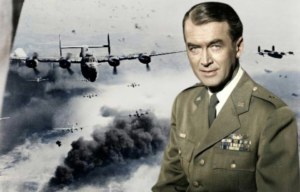
    Photo Credit: 1. Mondadori Portfolio / Getty Images (Colorized by Palette.fm) 2. U.S. Air Force / National Museum of the United States Air Force (Colorized by Palette.fm)Photo Credit: 1. Mondadori Portfolio / Getty Images (Colorized by Palette.fm) 2. U.S. Air Force / National Museum of the United States Air Force (Colorized by Palette.fm)

    James “Jimmy” Stewart is among the most recognizable stars from the era of Vintage Hollywood. Starring in the likes of Vertigo (1958), It’s a Wonderful Life (1946) and The Philadelphia Story (1940), he was involved a number of classic films. Despite being in the midst of growing his acting career, Stewart opted to serve with the US military during World War II, and participated in a number of bombing missions over Germany.

    James Stewart wanted to be an aviator

    Portrait of the Stewart family

    James Stewart and his family, 1918. (Photo Credit: Unknown Author / Jimmy Stewart: A Biography / Eliot Marc / Wikimedia Commons / Public Domain)
    Born on May 20, 1908, James Stewart was a shy child who took an interest in all things aviation. Rather than spend time playing with other kids in his neighborhood, he spent hours in the basement of his family’s home, building model aircraft, learning about chemistry and creating mechanical drawings. Given this interest, it was a dream come true when the young Stewart was able to take to the skies with a barnstormer immediately following the First World War.

    While the future actor hoped to attend the US Naval Academy and become a naval aviator, his father had other plans. He wanted Stewart to attend his alma mater, Princeton, and thus enrolled him in Mercersburg Academy to improve his grades. It was at the school that he first became involved in acting, appearing on-stage in a 1928 production of The Wolves.

    Stewart enrolled in Princeton in 1928 to study architecture. While there, he joined a number music and drama clubs, which led him to turn down graduate school to perform with the University Players in West Falmouth, Massachusetts, alongside Henry Fonda, who fast became a close friend and confident.

    Entry into Hollywood

    James Stewart and Katharine Hepburn as Macaulay "Mike" Connor and Tracy Lord in 'The Philadelphia Story'

    The Philadelphia Story, 1940. (Photo Credit: Carlito / Metro-Goldwyn-Mayer / MovieStillsDB)
    Before landing in Hollywood, James Stewart appeared in a handful of Broadway productions. After being given an uncredited role in the 1934 film, Art Trouble, he signed a multi-year contract with Metro-Goldwyn-Mayer (MGM). This afforded him both minor and co-starring roles, the most popular of which were Next Time We Love (1936), alongside Margaret Sullivan, and Navy Blue and Gold (1937).

    Despite his growing success and popularity, MGM was nervous to give Stewart any leading roles, and often refused to lend him out to other studios. He was eventually given permission to star in the 1938 Columbia Pictures feature, You Can’t Take It With You, which thrust him into the spotlight. The following year, he starred in Mr. Smith Goes to Washington, for which he earned a nomination for the Academy Award for Best Actor.

    Stewart’s success only continued, as, in 1940, he appeared in two popular films: The Mortal Storm, alongside Sullivan, and The Philadelphia Story, in which Katharine Hepburn was his co-star.

    James Stewart enlists in the US Army Air Corps

    James Stewart standing with another airman in front of an aircraft

    James Stewart with a Consolidated B-24 Liberator crew member. (Photo Credit: U.S. Air Force / National Museum of the United States Air Force)
    While making a name for himself in Hollywood, James Stewart continued to pursue his interest in aviation. He’d obtained his commercial pilot’s license and private pilot’s certificate, and had amassed over 400 flight hours by the time he enlisted with the US Army Air Corps. He also owned his own aircraft – a Stinson Voyager – and was an investor in Thunderbird Field, which had been contracted to train military pilots.

    Military service was in Stewart’s blood, as both his grandfathers had fought in the American Civil War. His father had also served during the Spanish-American War and World War I. He first tried to enlist in November 1940, but was rejected after not meeting the necessary weight requirements. He tried again the following February and was accepted, becoming the first major American movie star to join the US Army during WWII.

    When later asked why he opted to put his acting career on hold to serve, he said, “This country’s conscience is bigger than all the studios in Hollywood put together, and the time will come when we’ll have to fight.”

    As he was 33 years old at the time, Stewart applied for a commission on the basis of his private piloting experience and the fact he was a university graduate. He was subsequently made a second lieutenant and underwent basic training at Moffett Field, in Santa Clara County, California. Before long, he was teaching aspiring pilots how to fly the Beechcraft AT-6 Wolverine, the Model 18 and the Boeing B-17 Flying Fortress.

    During this time, Stewart, still under contract with MGM, made no new commercial films. Instead, he did public appearances for the US Army Air Forces, which, by then, had replaced the Air Corps.

    Combat in the European Theater

    Consolidated B-24 Liberators in flight

    Consolidated B-24 Liberators with the 445th Bombardment Group in-flight over enemy territory, 1944. (Photo Credit: USAAF / National Archives / United States Air Force Historical Research Agency, Maxwell AFB Alabama / Wikimedia Commons / Public Domain)
    The US Army was hesitant to allow someone as well-known as James Stewart to engage in combat, despite the actor wanting to see action in the European Theater. After stints at airfields across the United States, he was given the opportunity with the 703rd Bomb Squadron, 445th Bombardment Group, of whom he was the commander. Upon arriving in England, they were based at RAF Tibenham and assigned to the 2nd Combat Wing, before being transferred to RAF Old Buckenham.

    The 445th flew their first combat mission on December 13, 1943, attacking a U-boat pen in Kiel, Germany. Stewart was in charge of the high squadron, and flew as the lead pilot on a mission to Bremen just three days later. On Christmas Eve, he, again, led the group, this time on a mission against German rocket-launch sites in Pas-de-Calais, France. This wound up being the largest raid by the US Eighth Air Force up to that date, with 2,000 aircraft involved.

    On January 7, 1944, Stewart was promoted for his actions during a raid over the German city of Ludwigshafen. Upon departing the target area, the bombardment group accompanying the the 445th flew 40 degrees off course. When Stewart informed the group lead of this, he was told he was the who was mistaken. Despite knowing the truth and the danger the other group would face, he followed them and helped many survive an attack by 60 Luftwaffe aircraft.

    Changing roles

    French military official pinning the Croix de Guerre with palm to James Stewart's uniform

    James Stewart receiving the Croix de Guerre with palm, 1944. (Photo Credit: US Air Force / Wikimedia Commons / Public Domain)
    During the early months of his time in Europe, James Stewart developed a favorable reputation among his men and superiors. He was named the operations officer of the 453rd Bombardment Group on March 31, 1944, after which he became the chief of staff of the 2nd Combat Wing, 2nd Air Division, Eighth Air Force.

    In early 1945, Stewart was, again, promoted, this time to colonel, putting him one of a small list of American service members to rise to the rank in only four years. He was also the recipient of a number of decorations, including the Air Medal with three oak clusters, the Distinguished Flying Cross and the Croix de Guerre with palm.

    When the war in Europe began to wind down, Stewart was tasked with overseeing the demobilization of the 2nd Combat Wing, so its members could be transferred to the Pacific Theater.

    James Stewart retired from the US Air Force after decades of service

    Military portrait of James Stewart

    James Stewart. (Photo Credit: U.S. Air Force / National Museum of the United States Air Force)
    James Stewart returned to the US in mid-1945 and continued to serve for another two decades. He was placed in a reserve role with the US Army Air Forces and, later, the Air Force. When reinstated into active-duty, he served as the deputy director of operations with the Strategic Air Command, learning to fly the Boeing B-47 Stratojet and B-52 Stratofortress. After this, he was named the Air Force’s officer of information at the Pentagon.

    In 1957, Stewart was nominated for a promotion to brigadier general. While this was initially opposed, he was given the rank two years later, becoming the highest-ranking actor in the history of the US military.

    Given his age and position in the Air Force, Stewart saw limited service during the Vietnam War. In February 1966, he flew as a non-duty observer on a B-52 as part of Operation Arc Light. Three years later, his son, US Marine Corps Lt. Ronald Stewart, was killed in action (KIA) while serving overseas.

    On May 31, 1968, Stewart officially retired from the Air Force after 27 years of service. The reason: he’d reached the mandatory retirement age of 60. Both during and after, the actor rarely spoke about his service, with the only exception being an episode of the 1974 documentary series, The World At War. He also refused to star in any war-related movies, saying that film was “not the same” as real-life combat.

    A turbulent return to Hollywood

    Still from 'It's a Wonderful Life'

    It’s a Wonderful Life, 1946. (Photo Credit: MoviePics1001 / RKO Radio Pictures / MovieStillsDB)
    Following the Second World War, James Stewart made his return to Hollywood, despite his continued military service. However, he initially didn’t believe it would happen, as he’d begun to question his acting abilities. His self-doubt was so great, in fact, that he considered returning home to run his family’s store.

    In 1946, It’s a Wonderful Life hit theaters as Stewart’s first post-war film. While viewed as a classic nowadays, the film received mixed reviews upon its release and was only moderately successful at the box office. Following this, he performed on radio and made a brief return to Broadway.

    It wasn’t until 1949 that Stewart, again, found film success, starring as baseball star Monty Stratton in The Stratton Story. He followed this up with numerous collaborations with Alfred Hitchcock – VertigoThe Man Who Knew Too Much (1956), Rope (1948) and Rear Window (1954) – and Anthony Mann. He also starred in a number of Western films, with the roles affording him appearances alongside such actors as John Wayne and his old friend, Henry Fonda.

    Stewart’s final live-action film came in the form of 1980’s The Green Horizon, which was panned by critics. He semi-retired after its release, with his official final role being An American Tail: Fievel Goes West (1991), in which he voiced the character of Sheriff Wylie Burp.

    James Stewart’s final years and death

    James Stewart holding up his Honorary Academy Award

    James Stewart with his Honorary Oscar at the 57th Annual Academy Awards, 1985. (Photo Credit: ROB BOREN / AFP / Getty Images)
    Despite largely retiring from acting in the later years of his life, James Stewart remained in the public eye. That being said, he was guarded about his personal life and rarely revealed details to the media. In February 1994, his wife, Gloria, passed away from lung cancer. He subsequently fell into a deep depression and became even more reclusive, only leaving his bedroom to see his children and eat.

    In December 1996, the battery in Stewart’s pacemaker was scheduled to be changed, but he refused to keep the appointment. This would have fatal consequences, with him being hospitalized the following February for an irregular heartbeat. He then developed thrombosis, and a week later suffered a pulmonary embolism, which led to a heart attack. He passed on July 2, 1997 surrounded by his children.

    Several high-profile stars were present at his funeral, including Carol Burnett, June Allyson and Robert Stack. In recognition of Stewart’s decades-long service with the Air Force, he was given full military honors, complete with three volleys of musketry.

  • USS Missouri (BB-63): American Battleship and Site of the Japanese Surrender

    USS Missouri (BB-63): American Battleship and Site of the Japanese Surrender

    Photo Credit: PH2 MICHAEL D.P. FLYNN / Wikimedia Commons / Public Domain

    The USS Missouri (BB-63) was a bit late to the party. Completed in January 1944, she was the last US battleship to enter the action during the Second World War. Despite this, the vessel played an important role in American history, as she was the site of the Japanese surrender in September 1945, officially putting an end to the conflict that had taken over the world for six years.

    The United States wanted to counter Japan

    Government officials standing around a large table

    The 1922 Washington Naval Treaty limited the size of battleships. (Photo Credit: Unknown Author / Wikimedia Commons / Public Domain)
    While the United States was in peacetime in the 1930s, military officials felt a war with Japan was possible. In response, the Navy was tasked with creating a new battleship design. Specifically, the Americans wanted a ship that could counter Japan’s Kongō-class battlecruisers.

    Following the First World War, the world’s powers signed the Washington Naval Treaty, which placed limitations on how large newly-constructed ships could be. This was followed by the Second London Naval Treaty, which Japan refused to sign. This led to further negotiations, which allowed the US to build battleships up to 45,000 tons, as opposed to the previous limit of 36,000.

    Construction of the USS Missouri

    Deck guns on the USS Missouri (BB-63)

    The USS Missouri (BB-63) was 887 feet long and boasted .50-caliber Mk VII deck guns (Photo via Getty Images)
    After plans were approved, the USS Missouri was ordered in June 1940, with construction beginning the following January. Work on the Iowa-class battleship was completed in 1944, with a crowd of 30,000 gathering to see the vessel off.

    Missouri‘s turbines allowed her to reach a top speed of 32.5 knots, and she boasted nine 16-inch .50-caliber Mark VII deck guns as her main battery. The battleship’s second battery featured 20 five-inch .38-caliber dual-purpose guns, along with 20 quadruple mounts for 1.6-inch Bofors guns for anti-aircraft defense. On top of all that firepower, Missouri also featured forty-nine 0.8-inch Oerlikon light AA auto-cannons placed along the length of the ship.

    The battleship had a shakedown cruise south of the Chesapeake Bay, before traveling to Hunters Point Naval Shipyard in San Francisco, California. There, Missouri was fitted for service as a fleet flagship.

    The USS Missouri was the site of the Japanese surrender

    Sailors gathered around the USS Missouri's (BB-63) deck armaments as a kamikaze aircraft flies toward the battleship

    The USS Missouri (BB-63) was the victim of kamikaze attacks in April 1945. (Photo Credit: Harold “Buster” Campbell / Len Schmidt / USS Missouri Memorial Association / Naval History and Heritage Command / Wikimedia Commons / Public Domain)
    After entering service, the USS Missouri was sent overseas as part of Task Force 58, arriving near Tokyo in January 1945. The battleship immediately took part in an attack on the Japanese city, with her armaments providing anti-aircraft support. Following this, she continued to perform strikes against Japan, including during the Battle of Iwo Jima.

    Not long before the Battle of Okinawa, Missouri and two other US vessels were transferred to Task Force 59, tasked with bombarding the southern part of Okinawa. This was to distract the Japanese forces from the planned invasion of the island’s west side. In April 1945, Missouri was the victim of an attack by kamikaze aircraft, but only suffered cosmetic damages. Days later, another kamikaze pilot struck the vessel, injuring two crewmen.

    On September 2, 1945, Missouri became the site of the Japanese surrender. The formal ceremony was attended by Gen. Douglas McArthur and Adm. Chester Nimitz. On the Japanese side, Minister of Foreign Affairs Mamoru Shigemitsu was present.

    Service during later US-involved conflicts

    USS Missouri (BB-63) firing her deck guns while at sea

    A few years after the Second World War came to an end, the USS Missouri (BB-63) was pressed into service in Korea. (Photo Credit: U.S. Navy / Wikimedia Commons / Public Domain)
    The USS Missouri was, again, pressed into service in 1950, upon the outbreak of the Korean War. Initially part of the Pacific Fleet, the vessel was the first US battleship to arrive in Korean waters, and throughout the conflict bombarded shorelines and acted as a carrier escort.

    In 1955, she was sent to Puget Sound for decommissioning, and over the next few decades was moored in Seattle, where she served as a popular tourist attraction. Approximately 250,000 guests visited Missouri each year.

    In 1984, Ronald Reagan‘s administration looked to rebuild the Navy’s fleet, as a not-so-subtle threat to the USSR. Missouri was reactivated the same year and upgraded with the latest weapons and technology. This included the addition of four Mk 141 quad cell launchers for RGM-84 Harpoon anti-ship missiles, a quartet of Phalanx 0.8-inch .76-caliber Close In Weapon System rotary cannons and eight Mk 143 Armored Box Launcher mounts for Tomahawk missiles.

    Three years later, Missouri was sent to Kuwait as part of Operation Earnest Will, having been outfitted with 25 mm chain guns and 40 mm grenade launchers. In January 1991, she arrived in the waters off the Persian Gulf in support of America’s efforts during Operation Desert Storm, tasked with destroying sea mines and providing fire support.

    The USS Missouri‘s retirement and legacy

    View of the USS Arizona Memorial

    Today, the USS Missouri (BB-63) operates as a museum and faces the USS Arizona Memorial. (Photo Credit: Julia Thurston Photography / Getty Images)
    Ronald Reagan brought the USS Missouri out of retirement as a check against the Soviet Union. However, by the mid-1990s, the USSR had dissolved and Russia was no longer a threat. As such, the US military was looking to cut costs, forcing the battleship back into retirement.

    At first, Missouri returned to Puget Sound, before being sent to Ford Island in 1998. That’s where she remains to this day, docked some 500 feet from the USS Arizona Memorial. Missouri faces the memorial, in a position symbolizing a permanent watch over those who lost their lives during the Japanese attack on Pearl Harbor in December 1941.

  • Taylor Swift gets seal of approval from Travis Kelce’s four-year-old niece

    Taylor Swift gets seal of approval from Travis Kelce’s four-year-old niece

    Taylor Swift gets seal of approval from Travis Kelce’s four-year-old niece
    Travis Kelce’s niece is a Swiftie, and appears to ship Traylor wholeheartedly.

    Travis Kelce’s niece is a Swiftie, and appears to ship Traylor wholeheartedly. In a wholesome TikTok posted by Jason Kelce’s wife, Kylie, on Monday, their four-year-old daughter, Wyatt, familiarized herself with her dad’s team, the Philadelphia Eagles, play against the Los Angeles Rams. “Just another swiftie tryna [sic] learn football, or a kid tryna avoid a nap. Who Knows?” the NFL wife jokingly captioned the pictures, shouting out her husband’s team with a “#GoBirds”. As the sharp-witted repeatedly asked “who’s that,” pointing to the screen when a player would pop up, Kylie obligingly answered, further explaining their roles. The caption referred to the phenomenon following pop sensation Taylor Swift and NFL star Travis Kelce’s budding romance, whereby Taylor’s devoted fanbase, who call themselves "Swifties", started studying up on the NFL. Moreover, as Swift took a breather from her ongoing record-breaking Eras Tour and attended multiple of her new admirer’s football games over the past few weeks, the league’s viewership drew in a huge female viewership, per Page Six. Now, if her dad being in the NFL wasn’t already enough to pique her interest in football, the blossoming romance between her uncle and her favourite musician seemed to have done the job.

    In a wholesome TikTok posted by Jason Kelce’s wife, Kylie, on Monday, their four-year-old daughter, Wyatt, familiarized herself with her dad’s team, the Philadelphia Eagles, play against the Los Angeles Rams.

    “Just another swiftie tryna [sic] learn football, or a kid tryna avoid a nap. Who Knows?” the NFL wife jokingly captioned the pictures, shouting out her husband’s team with a “#GoBirds”.

    As the sharp-witted repeatedly asked “who’s that,” pointing to the screen when a player would pop up, Kylie obligingly answered, further explaining their roles.

    The caption referred to the phenomenon following pop sensation Taylor Swift and NFL star Travis Kelce’s budding romance, whereby Taylor’s devoted fanbase, who call themselves “Swifties”, started studying up on the NFL.

    Moreover, as Swift took a breather from her ongoing record-breaking Eras Tour and attended multiple of her new admirer’s football games over the past few weeks, the league’s viewership drew in a huge female viewership, per Page Six.

    Now, if her dad being in the NFL wasn’t already enough to pique her interest in football, the blossoming romance between her uncle and her favourite musician seemed to have done the job.

  • Is Taylor swift really Pregnant for Travis Kelce? The real Truth Unveiled

    Is Taylor swift really Pregnant for Travis Kelce? The real Truth Unveiled

    Is Taylor swift about to be a mom to a little boy or girl?

    Speculation is rampant that Taylor Swift is expecting a baby with new partner Travis after she was spotted with a prominent stomach bulge on Sunday evening (October 7, 2023), during romantic dinner date nearby her place.

    Another source revealed that “she TWICE made toasts … by drinking water instead of wine,” adding that it is “highly unusual” to “toast with anything but a full glass of wine.” (In case you weren’t aware, pregnant ladies aren’t supposed to drink alcohol.)

    Twitter reacts to Taylor Swift pregnancy rumor

    Travis Kelce “I do not comment on her personal life,”… and therefore has neither confirmed nor denied. This has caused multiple stories about the alleged pregnancy to make their way through bulletin boards and other social media sites during the past 24 hours, just following engagement rumors earlier this week.

    Now we’ll have to wait and see if that ‘baby bump’ and that ‘high-profile wine-voidance’ are the key clues that ultimately lead to the Best Famous Baby News of the year.

  • EXCLUSIVE: Taylor Swift is seen Jogging In Travis Kelce’s $6m Kansas City mansion with her friends

    EXCLUSIVE: Taylor Swift is seen Jogging In Travis Kelce’s $6m Kansas City mansion with her friends

    Taylor Swift and Travis Kelce will move in together for good if their ‘practice run’ at his $6 million Kansas City mansion goes well, according to insiders, who claim the loved up ‘soulmates’ have discussed a family.

    A moving truck was spotted outside the NFL star’s new pad on Tuesday – just one day after Taylor, 33, wrapped the South American leg of her Eras tour with a sold out concert in Brazil – with furniture and other items pictured being carried inside.

    The couple, who started dating in September, are said to be ‘obsessed’ with each other, with the pair flying to and from his games and her concerts to spend time together.

    ‘While Taylor is not officially moving in with Travis, her friends and family believe she isn’t exactly moving out either,’ a source close to the Blank Space singer told DailyMail.com exclusively.

    Taylor Swift's friends and family believe Travis Kelce, 34 (pictured in September after a Kansas City Chiefs game) is her 'soulmate'

    Taylor Swift’s friends and family believe Travis Kelce, 34 (pictured in September after a Kansas City Chiefs game) is her ‘soulmate’

    Taylor, 33, is staying at Travis's $6 million home (pictured here) as 'a practice run,' for the future, according to a source

    Taylor, 33, is staying at Travis’s $6 million home (pictured here) as ‘a practice run,’ for the future, according to a source

    On Tuesday, a moving van was seen unloading furniture and other personal belongings into Travis's mega-mansion, where Taylor flew to after wrapping her South American tour dates

    On Tuesday, a moving van was seen unloading furniture and other personal belongings into Travis’s mega-mansion, where Taylor flew to after wrapping her South American tour dates

    Taylor Swift runs to Travis Kelce and kisses him after her show

    ‘Everyone truly believes that Taylor and Travis are soulmates. Taylor also believes this, as does Travis.

    ‘They are both absolutely obsessed with each other and yes, very much in love. They want the same things in life – a future and possibly a family. If things continue going the way they are going they will continue to cohabitate because that is what couples in love do. This is kind of like a practice run in a sense.’

    The legendary musician and the Kansas City Chiefs tight-end, 34, are reportedly looking to spend the holidays together and have no plans to put any distance between them – except when their careers require it.

    ‘If things continue going the way they are going they will continue to cohabitate because that is what couples in love do. Couples live together,’ the source continued.

    ‘For Taylor, it is about where her heart is – and right now her heart is in his home in Kansas City with the man that she loves.’

    Taylor’s property portfolio, which includes houses in New York, Rhode Island, Tennessee and Los Angeles is believed to be worth around $80 million.

    But despite an apparent desire to shack up with her new man, the Love Story singer isn’t planning to sell any off.

    ‘These houses are not being sold and she is not getting rid of any of her stuff, nor is she putting it all into boxes and loading it in to Travis’s attic,’ the source added.

    As a van unloaded furniture at Travis’s luxury 17,000 sq. ft. property, him and Taylor were seen arriving separately to the newly-built $8 million mansion owned by Travis’ teammate Patrick Mahomes, 28, and his wife Brittany, 28.

    Taylor and Travis enjoyed a double date with his teammate Patrick Mahomes and his wife Brittany, 28 - pictured with Taylor at a Chiefs game earlier this year

    Taylor and Travis enjoyed a double date with his teammate Patrick Mahomes and his wife Brittany, 28 – pictured with Taylor at a Chiefs game earlier this year

    Taylor stepped out with Brittany and Selena Gomez, 31, earlier this month

    Taylor stepped out with Brittany and Selena Gomez, 31, earlier this month

    Taylor and Travis spent several hours at Patrick's brand new $8 million home the same day that a moving van was seen at Travis's crib

    Taylor and Travis spent several hours at Patrick’s brand new $8 million home the same day that a moving van was seen at Travis’s crib

    Travis Kelce arrives to Patrick Mahomes house in Rolls Royce alone

    The two couples spent several hours together at the Mahomes’ mega-mansion – which features a full-length football field with his name in the end zone and his logo on the 20 yard line.

    They were then spotted arriving back at Travis’s newly built six-bedroom, six-bathroom home, which was said to have been built with Taylor in mind.

    Taylor doesn’t return to the stage until February 7, when she takes her tour to Japan.

    In the meantime, the loved up duo have plenty of time to spend playing house.

    ‘Up until now it has been time snatched as they both have had such busy schedules,’ a source previously revealed exclusively to DailyMail.com.

    Taylor has watched him play in the NFL four times, he flew 5,400 miles to Buenos Aires, Argentina, to see her in concert, and they appeared on Saturday Night Live together.

    ‘Obviously those aren’t the things that a regular new couple would do in their first months together,’ the source continued.

    ‘But now Taylor and Travis can try to be as normal as their lives allow them to be.

    ‘They finally have the time and opportunity to spend some for real quality time together.’

    Back in July, Travis talked about attending one of her concerts on his New Heights podcast and reflected on his failed attempt to give Taylor his number.

    However, it appears their romance was meant to be, with the sports star stating: ‘There were definitely people she knew that knew who I was, in her corner [who said]: “Yo! Did you know he was coming?” I had somebody playing Cupid.’

    Taylor soon reached out to Travis, and the Chiefs star expressed: ‘She told me exactly what was going on and how I got lucky enough to get her to reach out.’

    The pair’s budding romance first came to light when Taylor was seen attending the Chiefs game against the Chicago Bears in late September.

    Pro football player Travis recently opened up about his whirlwind romance with Taylor during an interview with the Wall Street Journal

    Pro football player Travis recently opened up about his whirlwind romance with Taylor during an interview with the Wall Street Journal

    'I've never been a man of words,' he told the outlet, adding: 'Being around her, seeing how smart Taylor is, has been f***ing mind-blowing. I'm learning every day'

    ‘I’ve never been a man of words,’ he told the outlet, adding: ‘Being around her, seeing how smart Taylor is, has been f***ing mind-blowing. I’m learning every day’

    Moment Travis Kelce blushes as Taylor Swift changes lyrics for him

    Travis recently opened up about their highly publicized union, telling the Wall Street Journal: ‘Everybody around me telling me “Don’t f**k this up!”… Obviously I’ve never dated anyone with that kind of aura about them.

    ‘I’ve never dealt with it. But at the same time, I’m not running away from any of it.’

    He continued: ‘The scrutiny she gets, how much she has a magnifying glass on her, every single day, paparazzi outside her house, outside every restaurant she goes to, after every flight she gets off, and she’s just living, enjoying life.

    ‘When she acts like that, I better not be the one acting all strange.’

    The two have met each other’s entire families and were set to spend Thanksgiving together before the unthinkable tragedy struck Taylor on tour on November 17 when fan Ana Clara Benevides, 23, collapsed and died in the oppressive heat at her show in Rio de Janeiros.

    Ana’s death shattered Taylor. ‘I can’t even tell you how devastated I am by this,’ she posted on her Instagram Story. ‘She was so incredibly beautiful and far too young.’

    Taylor invited five members of the young fan’s family to her final show last Sunday where they watched her perform from a VIP tent.

  • Exciting news just dropped: Travis Kelce and Taylor Swift have something amazing to share, leaving fans on the edge of their seats!

    Exciting news just dropped: Travis Kelce and Taylor Swift have something amazing to share, leaving fans on the edge of their seats!

    it’s been engaged in for years on overdrive. Kelce expands his celebrity further outside of football, which is something plenty of NFL players could use — football doesn’t guarantee you’re rich forever, and careers are often short. And Swift further expands her empire, sells some more concert and movie tickets, and gathers fodder for her next album.

    Taylor Swift is great at translating attention and loyalty into money. The NFL is great at turning attention and loyalty into money. Their combined forces equal … well, you get the point.

    IT’S A CULTURAL PHENOMENON. IT’S A CAPITALISTIC SPECTACLE. IT’S FUN. IT’S ALSO FRAUGHT.

    “It’s like a business bonanza that just appeared for two brands that have some of the biggest brands in the world,” said it’s been engaged in for years on overdrive. Kelce expands his celebrity further outside of football, which is something plenty of NFL players could use — football doesn’t guarantee you’re rich forever, and careers are often short. And Swift further expands her empire, sells some more concert and movie tickets, and gathers fodder for her next album.

    Taylor Swift is great at translating attention and loyalty into money. The NFL is great at turning attention and loyalty into money. Their combined forces equal … well, you get the point.

    IT’S A CULTURAL PHENOMENON. IT’S A CAPITALISTIC SPECTACLE. IT’S FUN. IT’S ALSO FRAUGHT.

    “It’s like a business bonanza that just appeared for two brands that have some of the biggest brands in the world,” said

  • Taylor Swift flees Australia via her private jet after her father was accused of assaulting a local photographer at a Sydney wharf following her last Eras concert

    Taylor Swift flees Australia via her private jet after her father was accused of assaulting a local photographer at a Sydney wharf following her last Eras concert

    Taylor Swift flees Australia via her private jet after her father was accused of assaulting a local photographer at a Sydney wharf following her last Eras concert

    Taylor travelled Down Under for seven sell-out concerts across Melbourne and Sydney, which came to an end on Monday night, and she has a few days off before she will return to the stage in Singapore on March 2.

    Her departure comes just hours after her father Scott Swift, 71, was accused of striking Ben McDonald, 51, at a ferry wharf in the suburb of Neutral Bay at about 2.30am on Tuesday, after the Australian leg of her Eras tour wrapped up.

    Taylor’s team said the photographer ‘threatened to throw a female staff member into the water’.Taylor and Scott had travelled from Homebush on a luxury superyacht called Quantum before the alleged assault.

    Footage from the moments before the alleged altercation showed Scott walking up wharf while giving photographers the middle finger.

    A spokeswoman for Taylor Swift told Daily Mail Australia the photographers were being ‘aggressive’.

    Two individuals were aggressively pushing their way towards Taylor, grabbing at her security personnel and threatening to throw a female staff member into the water,’ she said.

    However, Mr McDonald – the chief executive of Matrix Media Group – slammed the statement as ‘utter rubbish’ and said the only female at the scene was Taylor.

    ‘This is the sort of bulls**t I might expect,’ he said. ‘Which female was that? The only one there was Taylor.’

    Mr McDonald said the altercation was caught on camera and did not show the photographers acting aggressively.

  • “I hate it!” Jason Kelce’s wife Kylie Kelce reveals why being called a WAG ‘deeply bothers’ her on New Heights

    “I hate it!” Jason Kelce’s wife Kylie Kelce reveals why being called a WAG ‘deeply bothers’ her on New Heights

    “I hate it!” Jason Kelce’s wife Kylie Kelce reveals why being called a WAG ‘deeply bothers’ her on New Heights

    WAG” is an acronym for wives and girlfriends of sportsmen and women. But it’s also a term that one NFL player’s bride does not like at all. In fact, Philadelphia Eagles center Jason Kelce’s wife, Kylie Kelce, thinks being called a WAG is “terrible.”

    .

    Here’s what Kylie said about that when she was a guest on her husband and brother-in-law Travis Kelce‘s podcast.

    The pair first connected on the dating app Tinder. In 2015, Jason and then-Kylie McDevitt made their Instagram debut as a couple.

    Jason recently spoke on his podcast about their first date and admitted: “Got a little too inebriated. But I was sober enough to know it was the most beautiful woman I had ever seen in my life. It was love at first sight … I didn’t [believe in it] until I met [Kylie] and it was like fireworks exploded at the door the moment she walked into Buffalo Billiards.”

    .

    .

    ..

    .