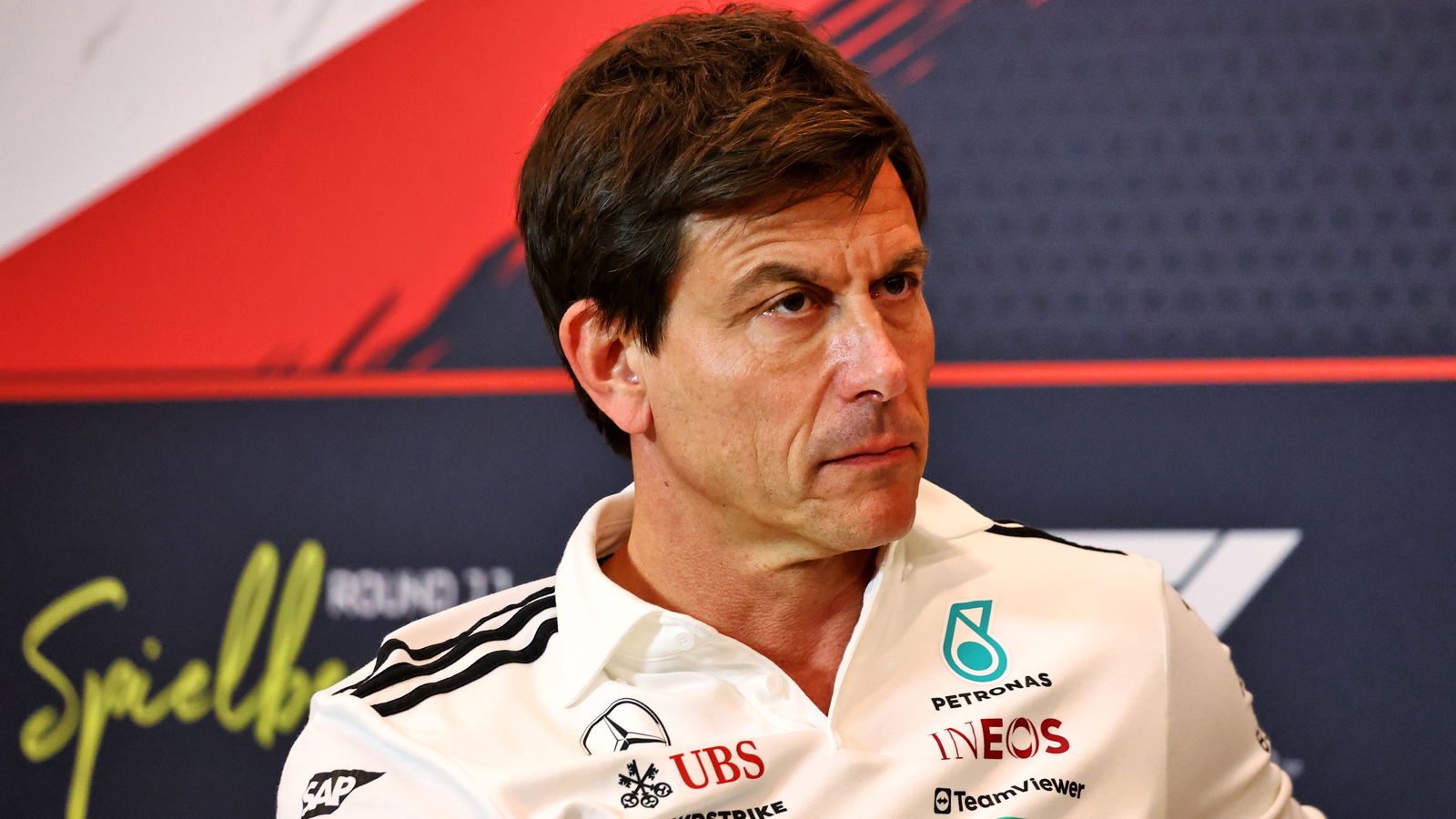
The Formula 1 paddock has erupted into early-season chaos, not due to an on-track collision, but because of a blistering verbal offensive launched by Mercedes Team Principal Toto Wolff.
In a stunning reversal of fortunes and narratives, Wolff has accused his competitors of already crafting “excuses” for losing the upcoming championship, advising them to focus on their own machinery rather than politicking against Mercedes’ engineering breakthroughs. The controversy centers on a heated dispute regarding engine compression ratios, secret meetings, and a Mercedes team that appears terrifyingly confident ahead of the new season.

The “Scorched Earth” Strategy
Following a successful shakedown of the new Mercedes AMG F1 W17E Performance in Barcelona, the mood within the Silver Arrows camp has shifted from cautious optimism to an aggressive, almost predatory confidence. Toto Wolff, usually a master of diplomatic deflection, has chosen a different path this winter: total offense.
Addressing the media and the swirling rumors of rival discontent, Wolff went “scorched earth” on the other engine manufacturers—believed to include Ferrari, Audi, and potentially Red Bull. His message was clear: stop complaining and start building better cars.
“I just don’t understand that some teams concentrate more on others and keep arguing a case that is very clear,” Wolff stated, referencing the ongoing drama surrounding the 2026 engine regulations. “It is clear in the regulations. Get your act together.”
This outburst comes in response to reports that rival teams have been holding “secret meetings” and sending letters to the FIA, attempting to lobby for rule changes or stricter monitoring of Mercedes’ power unit. Wolff’s dismissal of these tactics as “excuses” signals a psychological blow to the grid, suggesting that Mercedes knows they have found a significant advantage—and they know their rivals are afraid of it.
The Compression Ratio Controversy
At the heart of the dispute is a technical regulation concerning the engine’s compression ratio. For the upcoming season, the rules stipulate a compression ratio of 16:1 in the cylinders, a change from the previous 18:1. This reduction was intended to standardize performance, but Mercedes—and possibly Red Bull—appear to have outsmarted the intent of the rule through superior engineering.
Rumors suggest that Mercedes engineers have utilized “thermal deformation” or a similar advanced concept to optimize performance within the 16:1 constraint in a way that other manufacturers have failed to master. This innovation has allegedly unlocked more horsepower and efficiency, sending shockwaves through the paddock.
“They’ve just got to get their act together and stop making excuses for losing this upcoming season,” Wolff remarked, seemingly amused by the panic.
Rivals are reportedly pushing the FIA to introduce mandatory sensors to monitor the compression ratio in real-time or to outlaw the specific methods Mercedes is using. However, Wolff insists that his team has maintained “clear and transparent communication with the FIA all along.”
According to the Mercedes boss, the team approached the governing body proactively to ensure their designs were legal. “We said, ‘Okay, hey, we’re looking to do this, is it legal?’ And they were like, ‘Yeah, well, sure, as long as you guys don’t break the limits when it’s tested.'”
The implication is devastating for teams like Ferrari and Audi: Mercedes did their homework, got approval, and may now be “years ahead” in development. The frantic attempts by rivals to change the rules now, via secret letters and lobbying, are being painted by Wolff as the desperate flailing of teams that know they have been beaten before the first light goes out.
The “Fix Your F***ing Car” Reversal
Long-time Formula 1 fans will appreciate the rich irony of the current situation. It wasn’t long ago, during the height of Mercedes’ “porpoising” struggles with the W13, that Red Bull’s Christian Horner famously told Toto Wolff to “change your f***ing car” during a heated team principal meeting.
Now, the tables have turned completely. With reports that the Mercedes power unit is sophisticated, efficient, and fully legal, Wolff is effectively delivering Horner’s own advice back to the grid. The sentiment is no longer one of a team seeking help for safety reasons, but of a dominant force telling the rest of the field to step up their game.
“It’s kind of come full circle,” noted F1 analysts. “Toto is effectively saying, ‘Look, the engine is legal, the FIA has confirmed it. Stop crying to the FIA and fix your own engine.'”
This shift in dynamic suggests a Mercedes team that has shed the insecurities of the past regulation cycle. They are no longer the team pleading for intervention; they are the benchmark that others are trying to tear down.
Unprecedented Transparency and Confidence
Further evidencing this new era of confidence is Mercedes’ unusual openness regarding their car’s specifications. In a sport defined by secrecy, where teams hide floor edges and blur photos of diffusers, Mercedes has boldly released high-quality images and even the specific weight of their new challenger.
The Mercedes W17E Performance is listed at 772 kg. While this is technically 4 kg over the “placeholder” minimum weight of 768 kg, it is effectively right on the money once the adjusted tire weights (which came in heavier than expected) are accounted for. The real effective minimum is likely around 770 kg, meaning Mercedes is within a mere 2 kg of the limit—a negligible amount that can be easily shed before the first race in Melbourne.
“They are being far more aggressive with what they’re talking about than other teams,” observers noted. “As soon as their car was on track, we had high-quality pictures… and now they’re telling us the official weight.”
This transparency acts as a flex. It tells the world: Here is our car. We are not hiding because we don’t need to. We are fast, and we know it.
Drivers on “Winning Mentality”
The confidence isn’t limited to the management. Seven-time world champion Lewis Hamilton and his teammate George Russell have both expressed a renewed sense of purpose. Hamilton, despite the distraction of tabloid rumors linking him to high-profile celebrities, remains laser-focused on the track.
“I really feel the winning mentality in every single person in the team more than ever,” Hamilton said. “We are under no illusions, we have a lot of work to do, but it’s a positive.”
George Russell went a step further, describing the new car as “intuitive” and a proper “race car.” His comments about the driving style required for the new energy harvesting systems—where drivers might push less in corners to deploy more on straights—suggest a cerebral battle ahead, one that Mercedes feels well-equipped to win.
Russell explicitly name-dropped Max Verstappen and Lando Norris as the rivals he intends to fight, signaling that he views the Mercedes package as a championship contender.
The Broader Grid: Confusion and Speed
While Mercedes projects strength, the rest of the grid remains a mix of question marks. Aston Martin, reuniting Fernando Alonso with newly appointed ambassador Jenson Button, admits they might start the season “significantly overweight” due to an extreme concept shift. Button himself tempered expectations, suggesting their fight is a multi-year project rather than an immediate title bid.
Meanwhile, Pirelli has thrown another variable into the mix. The tire manufacturer admitted that the new cars are “much faster than we expected” during initial testing. This surprise pace forces Pirelli to bring the hardest compounds to upcoming races to cope with the loads, potentially altering strategy and favoring cars with better tire management—an area where Mercedes has historically excelled when their car is balanced.
Conclusion: The Silver Arrows Return?
As the F1 circus prepares for the season opener, the narrative has firmly shifted. The question is no longer “Can Mercedes catch up?” but rather “Can anyone stop them?”
Toto Wolff’s “scorched earth” comments are not just bluster; they are the calculated words of a man who believes he is holding a royal flush. By calling out his rivals’ “excuses” preemptively, he has framed the narrative for the entire season. If Mercedes wins, it’s because they engineered a better car. If rivals complain, it’s because they are sore losers who didn’t work hard enough.
For the first time in years, the swagger is back at Brackley. And if the rumors of their engine advantage are true, the rest of the grid might be fighting for second place before the lights even go out.
News

Inside Shane Richie’s love life: Drug – fuelled orgy with six blondes; real reason he split from Coleen Nolan; six-year ‘affair with fan’
Inside Shane Richie’s love life: Orgy with six blondes; real reason he split from Coleen Nolan; six-year ‘affair with fan’ He’s popular with the ladies… Shane Richie…

SH0CKING REVELATI0N:A sh0cking behind-the-scenes secret revealed about Lizzie Rizzini, the woman replacing Carol Kirkwood on the 6pm weather bulletin
BBC viewers still reeling from the departure of Carol Kirkwood got another surprise last night when presenter Lizzie Rizzini appeared to flash her black lace stockings on…

HEARTBREAKING: Peter Andre’s Tearful Message to Son Junior After SHOCKING Revelation About How He Truly Feels Toward Mum Katie Price — Katie Price’s reaction scares fans.
Peter Andre’s emotional message to son Junior after it’s revealed how he really feels about mum Katie Pri… PETER Andre has shared an emotional message to his…

Ben Shephard opens up about the devastating health battle his wife is facing: “She wakes up crying every single morning…”
Inside This Morning Ben Shephard’s Life Including Rarely Seen Wife and Health Battle Ben Shephard is a name synonymous with British television, renowned for his engaging presentation…

🚨 LIVE TV HEARTBREAK: Good Morning Britain Host Announces ‘Devastating’ Dɘath of Guest Minutes Into Show
Viewers of Good Morning Britain were met with heartbreaking news just minutes into Friday’s (January 30) episode, as co-hosts Kate Garraway and Ranvir Singh reported the tragic…

Emmerdale legend Cain Dingle will never be the same again after a shock cancer diagnosis turns his world upside down
FROure Desk. Full Terms and conditions are available on the website http://www.itv.com/presscentre/itvpictures/terms Emmerdale wouldn’t be Emmerdale without the glowering, grunting embodiment of manliness that is Cain Dingle (Jeff Hordley) But…
End of content
No more pages to load






