The waiting game is finally over. After months of secretive render drops, “livery-only” launches, and digital smoke and mirrors, the Formula 1 2026 season has officially roared to life. The Circuit de Barcelona-Catalunya is currently hosting the crucial “shakedown” sessions—a private test where teams are supposed to simply check systems, but in reality, it is the first time the world gets to see the actual machines that will battle for the championship.
And oh, what a morning it has been. If you thought the official launch season gave you the full picture, think again. From Red Bull’s masterful deception to Mercedes resorting to “craft store” technology, Day 1 in Barcelona has already turned the paddock upside down.
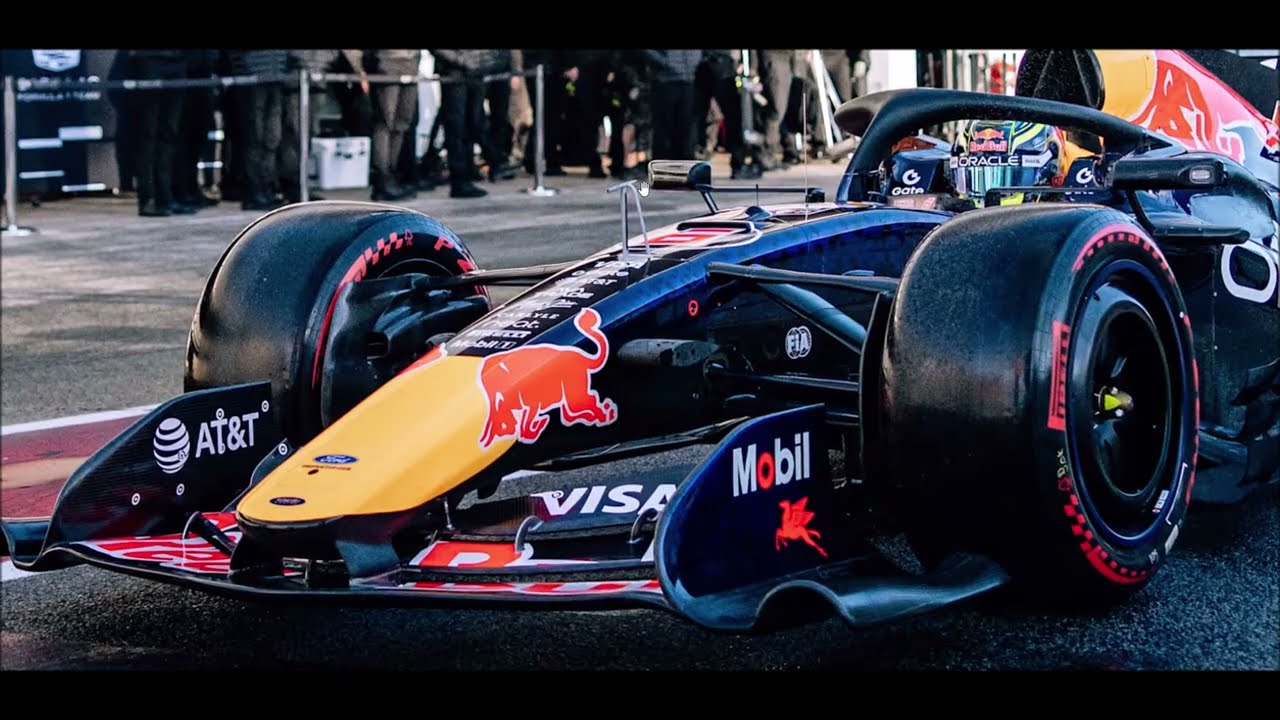
The Great Red Bull Deception
Let’s start with the talk of the town: Red Bull Racing. If you tuned into their glitzy official presentation recently, you can go ahead and forget everything you saw. In a move that is becoming a signature of the Milton Keynes outfit, the car presented to the media was nothing more than a show pony—a 3D artist’s fantasy designed to fool rivals and fans alike.
The real car that rolled out of the garage this morning is a completely different beast, and it’s a technical marvel that has left onlookers scratching their heads.
The most striking feature is the nose. Gone is the slender elegance of the show car; the real nose is much wider, housing the front wing actuator inside the structure. This is a clever aerodynamic play to reduce the “wake” (turbulent air) that usually spills off external mechanisms. But the real shocker is the sidepods.
Remember 2022? When Mercedes failed spectacularly with their “zero-pod” concept while everyone else, including Red Bull, went for wider, downwash-style bodywork? Well, in a twist of irony, Red Bull has now gone incredibly narrow. The sidepods are razor-thin, with side impact structures sticking out in an arrow shape that eerily resembles the Mercedes W13 of 2022.
Why do this now? It suggests extreme confidence. Narrow sidepods are risky—they make it harder to push the turbulent air from the front tires away from the car. But if Red Bull’s aerodynamicists have found a way to seal that airflow without the physical bulk of wide bodywork, they’ve unlocked a massive advantage in drag reduction. It is the tightest packaging on the grid, a bold statement for a team running its own engine for the very first time.
Mercedes: High-Tech Meets… Sewing Kits?
Over at the Mercedes garage, the W17 (or the 2026 equivalent) broke cover with a feature that had tech nerds zooming in on their screens. Taped to the high-tech carbon fiber front wing were… cotton threads.
Yes, you read that right. In a sport governed by Computational Fluid Dynamics (CFD) and wind tunnels that cost more than small islands, Mercedes is using tufts of yarn to visualize airflow. It’s a “back to basics” approach that is actually quite brilliant.
These “tufts” allow engineers to see real-time flow separation on the track. If the thread lays flat, the air is sticking to the wing (good). If it flutters wildly, the air is detaching (bad). It seems Mercedes is leaving nothing to chance, validating their simulations with old-school physics.
Structurally, the Mercedes contrasts sharply with the Red Bull. They have stuck with wider sidepods and a huge “undercut” (the empty space beneath the air intake) to channel air to the rear. It’s a philosophy of “better safe than sorry” regarding airflow management, ensuring the front tire wake doesn’t destroy the performance of the rear wing.
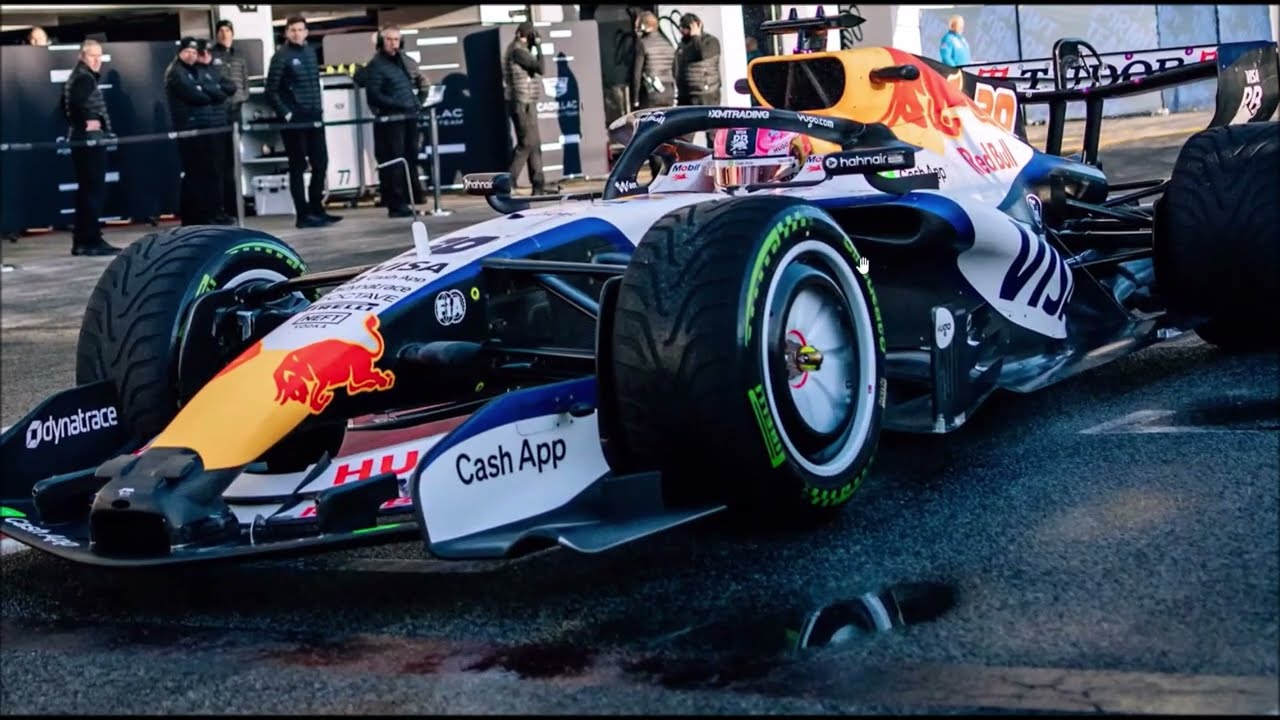
The American Surprise: Cadillac Turns Heads
Perhaps the biggest surprise of the morning came from the newcomers. General Motors’ entry, Cadillac, has arrived with a car that looks shockingly… finished.
Expectations for new teams are usually low. We expect bulky cooling, simple aerodynamics, and a “just happy to be here” vibe. But the Cadillac looks refined. It features an elegant nose and front wing concept that mirrors the top teams. More impressively, the cooling inlets are tiny.
This is a massive vote of confidence in their engine partner, Ferrari. Small inlets mean less drag, but they require an engine that doesn’t overheat. If Cadillac can run this tight packaging immediately, they might be hitting the ground running faster than anyone anticipated. They, too, were spotted using the “cotton thread” technique, proving they are here to learn fast and validate their data instantly.
Audi: The Heavyweight Challenger
In stark contrast to Cadillac’s elegance stands the new Audi. The German manufacturer’s first real F1 car looks, for lack of a better word, sturdy.
The nose is a thick, wide structure, likely housing bulky mechanics. The air inlets are significantly larger than those on the Red Bull or Cadillac. This is logical—Audi is building its own engine from scratch and doesn’t have the decade of hybrid experience that Mercedes or Ferrari has. They are playing it safe, prioritizing cooling over aerodynamic efficiency.
The car features a “water slide” design on the sidepods—deep channels meant to direct air to the diffuser—but overall, it lacks the refinement of the established players. It sits lower than the chassis shoulder, creating a bulky step. It’s not an ugly car, but in F1, “bulky” usually means “slow.” Audi clearly has a mountain to climb.
VCarb’s Risky Business
The team formerly known as AlphaTauri, now fully embraced as VCarb, has brought a design that is raising eyebrows for all the wrong reasons.
Their front wing features two separate actuators mounted openly in the airstream. The expert analysis from the track suggests a terrifying potential failure mode: synchronization. With two powerful motors controlling the active flaps, they must move in perfect unison. If one lags even by a millisecond at 200 mph, the wing could twist and snap.
Furthermore, putting these actuators right in the airflow creates dirty wake that travels down the car, potentially robbing the floor of downforce. It’s a high-risk, high-reward strategy that hints at a team desperate to find a loophole, but it might result in a lot of carbon fiber confetti during testing.
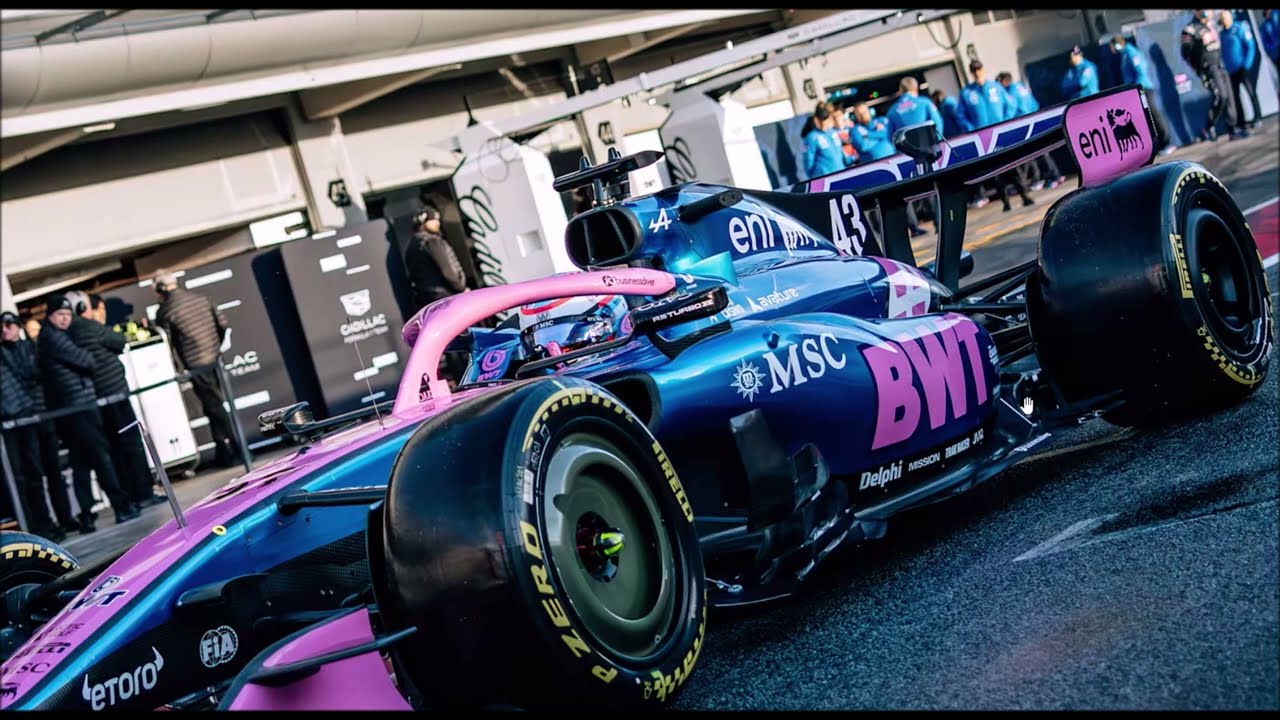
Alpine’s Shark Fin and “Water Slides”
Alpine has unveiled a car that looks like it’s trying to do everything at once. Now powered by a Mercedes customer engine, they have adopted a “water slide” sidepod design similar to the Audi but with much more aggression.
The standout feature is a massive “shark fin” on the engine cover, paired with a huge DRs pod and extra winglets to manage airflow. They are terrified of the front tire wake hitting their rear wing, so they’ve built physical walls of carbon fiber to block it. It’s not the prettiest solution, but it might be effective. However, the actuator placed underneath the nose is a controversial choice that creates messy airflow right at the start of the car’s aerodynamic chain.
The Verdict from Day 1
As the sun sets on the first day of shakedowns, the psychological war is already won by Red Bull. By hiding their real car until the wheels actually touched the tarmac, they’ve kept their secrets safe for as long as possible.
The 2026 regulations were supposed to reset the field, but the diversity in designs—from Red Bull’s skinny bodywork to Audi’s bulky reliability and Cadillac’s surprising elegance—shows that the engineers have found a million different ways to go fast.
The renderings are gone. The cotton threads are out. The real Formula 1 season has begun, and if these first images are anything to go by, we are in for a wild ride of technical innovation and potential mechanical heartbreak.
Stay tuned as we wait for the final pieces of the puzzle: the real Aston Martin and McLaren, which are still hiding in the shadows.
News

Inside Shane Richie’s love life: Drug – fuelled orgy with six blondes; real reason he split from Coleen Nolan; six-year ‘affair with fan’
Inside Shane Richie’s love life: Orgy with six blondes; real reason he split from Coleen Nolan; six-year ‘affair with fan’ He’s popular with the ladies… Shane Richie…

SH0CKING REVELATI0N:A sh0cking behind-the-scenes secret revealed about Lizzie Rizzini, the woman replacing Carol Kirkwood on the 6pm weather bulletin
BBC viewers still reeling from the departure of Carol Kirkwood got another surprise last night when presenter Lizzie Rizzini appeared to flash her black lace stockings on…

HEARTBREAKING: Peter Andre’s Tearful Message to Son Junior After SHOCKING Revelation About How He Truly Feels Toward Mum Katie Price — Katie Price’s reaction scares fans.
Peter Andre’s emotional message to son Junior after it’s revealed how he really feels about mum Katie Pri… PETER Andre has shared an emotional message to his…

Ben Shephard opens up about the devastating health battle his wife is facing: “She wakes up crying every single morning…”
Inside This Morning Ben Shephard’s Life Including Rarely Seen Wife and Health Battle Ben Shephard is a name synonymous with British television, renowned for his engaging presentation…

🚨 LIVE TV HEARTBREAK: Good Morning Britain Host Announces ‘Devastating’ Dɘath of Guest Minutes Into Show
Viewers of Good Morning Britain were met with heartbreaking news just minutes into Friday’s (January 30) episode, as co-hosts Kate Garraway and Ranvir Singh reported the tragic…

Emmerdale legend Cain Dingle will never be the same again after a shock cancer diagnosis turns his world upside down
FROure Desk. Full Terms and conditions are available on the website http://www.itv.com/presscentre/itvpictures/terms Emmerdale wouldn’t be Emmerdale without the glowering, grunting embodiment of manliness that is Cain Dingle (Jeff Hordley) But…
End of content
No more pages to load






