The silence has finally been broken. For weeks, the Formula 1 paddock has been buzzing with whispers, rumors, and nervous anticipation regarding the reigning 2025 World Champions. While Ferrari, Mercedes, Audi, and even newcomers Cadillac were busy showcasing their liveries and conducting private shakedowns, McLaren remained ominously dark. There were no leaks. No teaser videos. No “accidental” glimpses of the chassis. Just a confident, perhaps even arrogant, silence.
That changed dramatically on Day 2 of pre-season testing in Barcelona.
The Woking-based squad finally rolled the MCL40 out of the garage, and the waiting world was greeted not with a cautious evolution, but with arguably the most aggressive and visually distinct machine of the 2026 pre-season so far. In a year marked by sweeping regulation changes—focusing heavily on electrical power, active aerodynamics, and reduced downforce—McLaren has chosen not to play it safe. They have arrived with a car that looks experimental, confident, and fundamentally different from its rivals.
The “Dark” Horses Arrive
To understand the impact of the MCL40’s debut, one must appreciate the context. Pre-season testing is notoriously deceptive; fuel loads are unknown, engine modes are turned down, and “sandbagging” (hiding true performance) is an art form. However, visual philosophy cannot be entirely hidden. When a car hits the track, the aerodynamic surfaces tell a story of intent.
McLaren’s “dark mode” winter was a statement in itself. By holding back their true aerodynamic philosophy until the very last moment, they denied rivals the chance to analyze or copy their homework. Now that the covers are off, it is clear why they were so secretive. The MCL40 is packed with design choices that challenge the early consensus of the 2026 regulations.
The Sidepod Paradox: Shrinking in a Cooling-Critical Era
The most shocking visual divergence sits squarely on the flanks of the car. The 2026 engine regulations place a massive emphasis on the electrical side of the power unit. With higher energy recovery rates and increased thermal loads from the hybrid system, the general expectation was that cars would need “brute force” cooling solutions—larger intakes and voluminous bodywork to keep temperatures in check.
McLaren, it seems, disagrees.
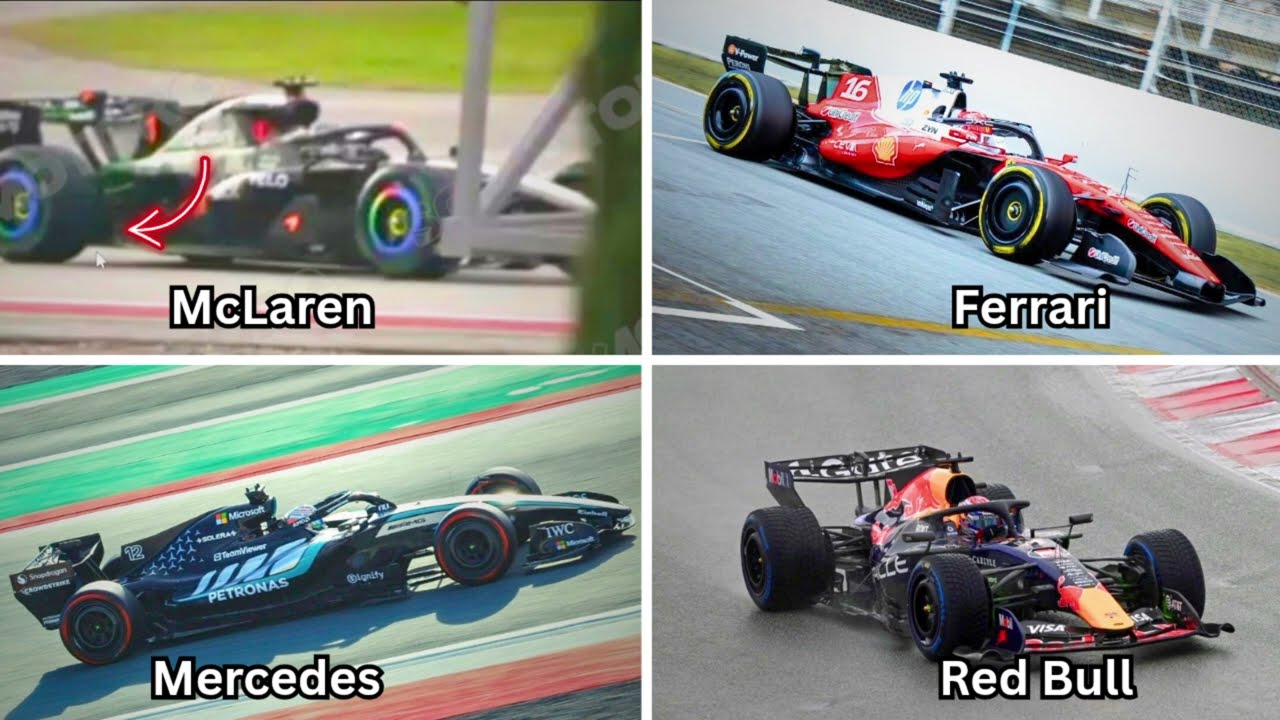
Comparing the new MCL40 to last year’s championship-winning MCL39 reveals a stunning contradiction. The 2025 car, built for the ground-effect era, featured massive, canopy-style sidepods that extended horizontally like wings. It was a broad, obtuse design. The 2026 car, despite the higher cooling demands, features smaller sidepods.
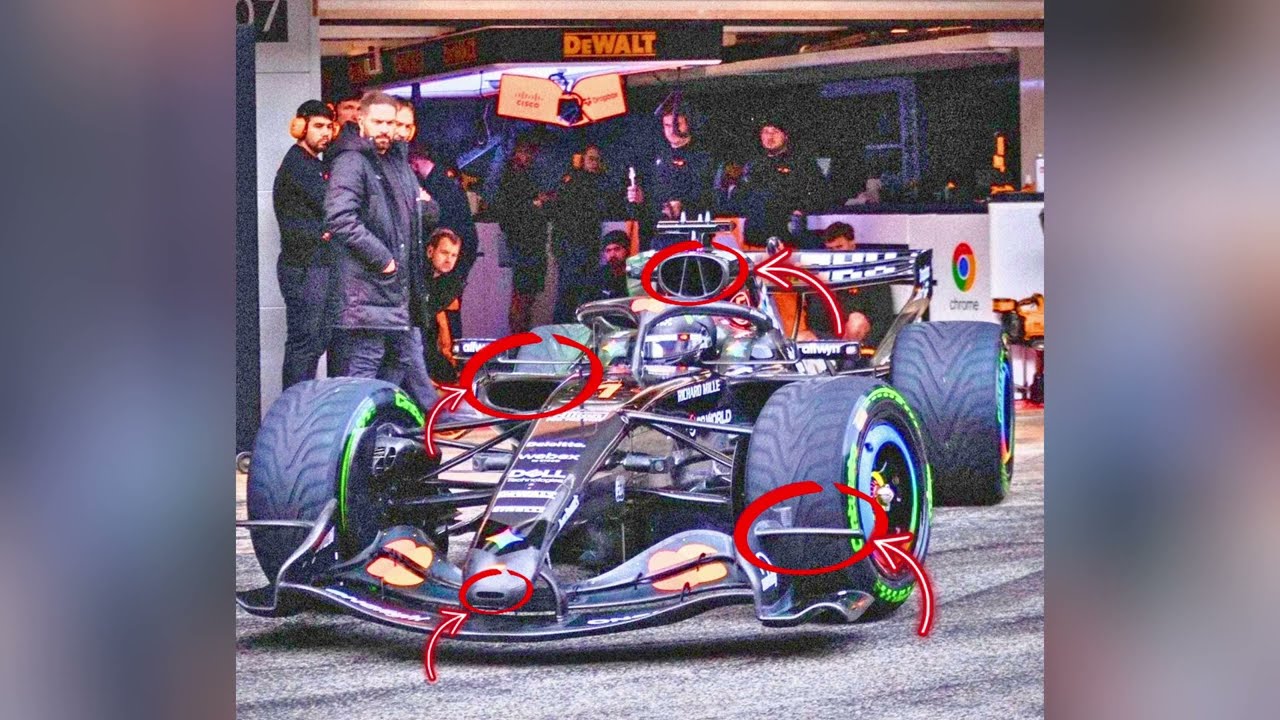
The new design swoops inward aggressively, forming a tight “C-shaped” contour that drastically reduces the visible bulk of the car. It features a pronounced “overbite” or overcut—a sharp, binary distinction between surfaces that contrasts heavily with the smoother, blended bodywork seen on the Ferrari SF26 or the Mercedes challenger.
This size reduction is ironic. Why would the car that needs more cooling look more compact than its predecessor? The implication is technically fascinating: McLaren has likely redistributed the cooling responsibilities to other, less visible areas of the car’s internal packaging. They are not relying on sidepod volume alone. It is a gamble on efficiency over volume, suggesting a confidence in their thermal management that other teams have not yet displayed.
The Airbox: Finding the Sweet Spot
While the sidepods scream aggression, the airbox—the intake above the driver’s head—whispers calculation. In terms of sheer size, it avoids the extremes seen elsewhere on the grid. It is not the gaping maw seen on the Racing Bulls entry, nor is it the ultra-compact, drag-chasing design of the Ferrari.
Instead, McLaren has opted for a “middle ground,” similar in scale to last year’s architecture. In previous eras, the airbox was often an aerodynamic afterthought. In 2026, it is critical. It feeds the hungry new power units and their complex cooling requirements. By choosing a neutral size, McLaren signals a balanced approach: they are not overcommitting to drag-inducing cooling, nor are they risking reliability by starving the engine of air. It is a sensible anchor point in an otherwise radical design.
The Nose Tip: A Masterclass in Flow Conditioning
One of the most intricate details of the MCL40 requires a zoom lens to appreciate, yet it might be the key to their front-end consistency. Sitting right on the tip of the nose is a prominent “pressure bleed slot.”
This is not a driver cooling duct. It is purely aerodynamic. At high speeds, air pressure builds up massively at the “stagnation point” of the nose. This high-pressure air can spill unpredictably, disturbing the flow over the front wing and under the floor—areas that are critical for generating downforce.
McLaren ran a smaller, track-specific version of this on the MCL39. On the MCL40, it is a permanent, larger fixture. This suggests that under the 2026 rules—where cars will undergo frequent “mode changes” due to active aerodynamics—stabilizing airflow is more valuable than raw peak load.
A larger bleed slot allows McLaren to vent that high-pressure air controllably, ensuring that the flow remains clean and predictable regardless of whether the car is braking, turning, or accelerating. While other teams struggle to regain lost downforce, McLaren is focusing on quality of airflow. If the air hitting your floor is cleaner, the floor works better. It is a philosophy of precision over power.
The Wing and The Rake: Deviating from the Pack
The front wing offers another glimpse into McLaren’s unique mindset. Most top teams, including Red Bull and Ferrari, have debuted with subtle, almost invisible upper elements near the endplates. McLaren, conversely, has installed an aggressive, protruding upper element.
This structure is designed to generate “outwash”—pushing turbulent air away from the car—and create local downforce. In a year where front wings are heavily restricted, finding loop-holes to manufacture outwash is gold dust. The fact that the reigning champions are the only front-runners committing to this aggressive geometry lends it immediate credibility. They aren’t following the trend; they are trying to set it.
Finally, there is the stance of the car itself. As the MCL40 sat in the pit lane, observers noted a distinct “high rake” attitude—the rear of the car sitting significantly higher than the front. This philosophy, famously used by Red Bull in 2021, helps energize airflow toward the diffuser. In the context of 2026, where ground effect is reduced, a higher rake could be the secret to reclaiming rear-end performance. It gives the MCL40 a predatory, nose-down look that screams speed even when standing still.
Conclusion: No Fear for the Future
It is important to remember the golden rule of pre-season testing: Times mean nothing, and parts change. The sidepods we see today could be gone by Round One. The wing angles will evolve.
However, the MCL40 represents something more than just a collection of carbon fiber parts. It represents a mindset. After winning the 2025 Championship, it would have been easy for McLaren to become conservative—to defend their position with a safe, middle-of-the-road challenger.
They have done the opposite.
From the shrunk-down sidepods to the high-rake stance and the complex nose-bleed trickery, the MCL40 is a car that takes risks. It is a machine built by a team that isn’t afraid to be an outlier. While Ferrari and Mercedes have seemingly converged on similar smooth aesthetics, McLaren has carved out a jagged, aggressive path of its own.
The “dark” winter is over. McLaren has stepped into the light, and if the MCL40 is as fast as it looks, the rest of the grid should be very, very worried.
News

Inside Shane Richie’s love life: Drug – fuelled orgy with six blondes; real reason he split from Coleen Nolan; six-year ‘affair with fan’
Inside Shane Richie’s love life: Orgy with six blondes; real reason he split from Coleen Nolan; six-year ‘affair with fan’ He’s popular with the ladies… Shane Richie…

SH0CKING REVELATI0N:A sh0cking behind-the-scenes secret revealed about Lizzie Rizzini, the woman replacing Carol Kirkwood on the 6pm weather bulletin
BBC viewers still reeling from the departure of Carol Kirkwood got another surprise last night when presenter Lizzie Rizzini appeared to flash her black lace stockings on…

HEARTBREAKING: Peter Andre’s Tearful Message to Son Junior After SHOCKING Revelation About How He Truly Feels Toward Mum Katie Price — Katie Price’s reaction scares fans.
Peter Andre’s emotional message to son Junior after it’s revealed how he really feels about mum Katie Pri… PETER Andre has shared an emotional message to his…

Ben Shephard opens up about the devastating health battle his wife is facing: “She wakes up crying every single morning…”
Inside This Morning Ben Shephard’s Life Including Rarely Seen Wife and Health Battle Ben Shephard is a name synonymous with British television, renowned for his engaging presentation…

🚨 LIVE TV HEARTBREAK: Good Morning Britain Host Announces ‘Devastating’ Dɘath of Guest Minutes Into Show
Viewers of Good Morning Britain were met with heartbreaking news just minutes into Friday’s (January 30) episode, as co-hosts Kate Garraway and Ranvir Singh reported the tragic…

Emmerdale legend Cain Dingle will never be the same again after a shock cancer diagnosis turns his world upside down
FROure Desk. Full Terms and conditions are available on the website http://www.itv.com/presscentre/itvpictures/terms Emmerdale wouldn’t be Emmerdale without the glowering, grunting embodiment of manliness that is Cain Dingle (Jeff Hordley) But…
End of content
No more pages to load






