The anticipation was palpable in Barcelona. For days, the Formula 1 paddock had been buzzing with whispers and speculation, waiting for the defending champions to finally show their hand. While other teams were busy racking up installation laps and shaking down their 2026 challengers, McLaren remained behind closed garage doors, opting for a strategic late start to maximize every second of development time. When the MCL40 finally rolled out onto the Circuit de Barcelona-Catalunya on Wednesday, it was immediately clear that this was no simple evolution—it was a technical statement.
However, the glitz of the reveal was quickly tarnished by the gritty reality of preseason testing. What began as a confident strut onto the world stage quickly turned into a race against time, as mechanical gremlins reared their heads and a resurgent rival fired a warning shot that echoed across the grid.
The Late Arrival and the Immediate Stumble
McLaren’s strategy was bold: skip the early filming days, bypass the Tuesday start, and use the extra time to refine the car in the factory. The logic was sound—why run a “primitive” car when you can debut a more polished weapon? But this approach left them with zero margin for error. When you join a five-day test on day three, every single lap becomes worth its weight in gold.
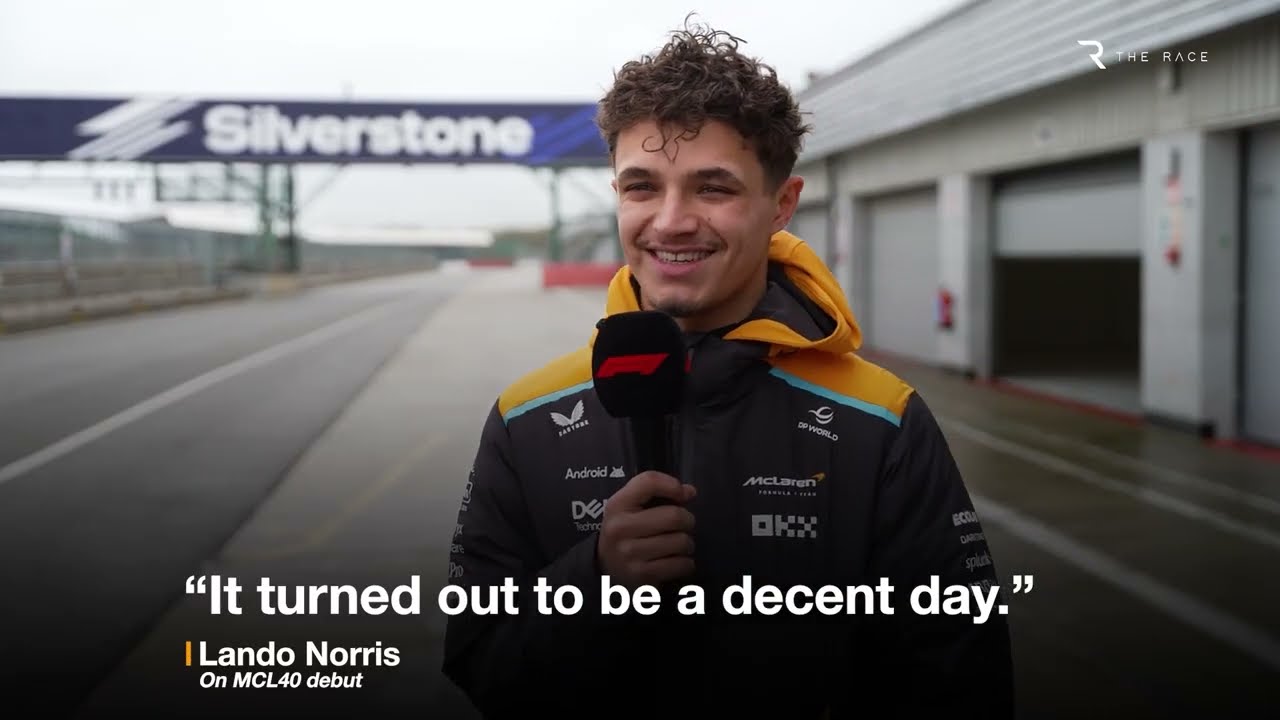
Lando Norris took the helm on Wednesday, and initially, the gamble seemed to pay off. The Briton clocked a solid 76 laps, and the mood in the garage was cautiously optimistic. Chief Designer Rob Marshall reported “no nasties” and no scary surprises—a crucial box ticked for a car operating under a completely new set of regulations. The car looked poised, the drivers seemed comfortable, and the paddock nodded in approval.
Then came Thursday.
The momentum came to a screeching halt when Oscar Piastri’s run was cut significantly short. A fuel system issue—a dreaded gremlin in the complex world of F1 hydraulics and plumbing—forced the team to strip the MCL40 down to its chassis. In a sport where mileage equals data, and data equals speed, seeing the car in pieces while rivals circled the track was a painful sight. Piastri managed only 48 laps, a paltry figure compared to the marathon stints being pulled by their competitors.
While Performance Technical Director Mark Temple downplayed the drama, noting it wasn’t a “day-ending shunt” like Red Bull suffered, the implication was clear: McLaren is already playing catch-up.
The Mercedes Juggernaut Returns
The context of McLaren’s stumble is made infinitely worse by the performance of their engine supplier and rival, Mercedes. The German manufacturer has arrived in Barcelona looking like the dominant force of old. While McLaren was diagnosing fuel leaks, the Mercedes works team was smashing in a whopping 183 laps in a single day.
It wasn’t just the volume; it was the quality of the running. George Russell and rookie sensation Kimi Antonelli were trading fastest laps and completing full race simulations while other teams were still figuring out their ride heights. Mercedes has re-established itself as the “early benchmark,” setting a bar for reliability and operational smoothness that McLaren is currently failing to clear. For a team defending a title, seeing the “Silver Arrows” running like a Swiss watch while your own car sits on jacks is the stuff of preseason nightmares.
Technical Marvels: The “Secrets” of the MCL40
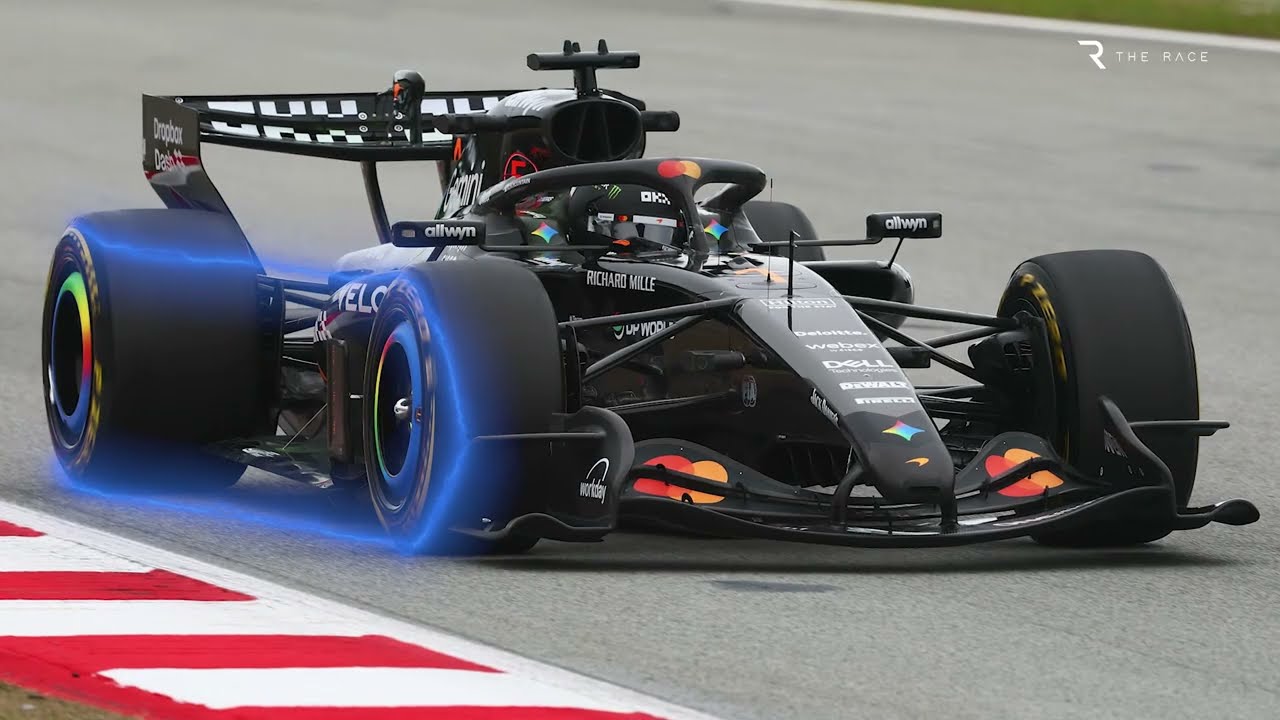
Despite the reliability headaches, the MCL40 itself is a fascinating beast. Now that the real car has hit the track, we can see that the launch renders were effectively a smokescreen. The physical machine features aggressive innovations that suggest McLaren has pushed the 2026 rulebook to its absolute limit.
1. The “Snowplow” and the Slim Nose The most striking feature is the nose cone. Unlike the bulky designs of their rivals, McLaren has opted for a slender, sharp tip. This isn’t just aesthetic; it frees up massive amounts of space underneath the car for airflow. Beneath this slender nose sits a complex arrangement of vanes that experts are calling “snowplow veins.” These structures vigorously channel air to the underfloor, feeding the ground-effect tunnels that generate the bulk of the car’s downforce. It is an intricate piece of aerodynamic sculpture that implies McLaren is chasing peak performance over safe, conservative airflow.
2. The Controversial Wing Fin Perhaps the most contentious addition is a large horizontal fin mounted on the front wing endplate. In an era where the FIA is desperately trying to reduce “outwash” (air pushed wide to stop cars from following each other closely), this fin seems to do exactly that. It directs air aggressively around the front tires, sealing the aerodynamic structures further back. It’s a cheeky, aggressive interpretation of the rules that will likely draw the ire of rivals—and the scrutiny of the scrutineers.
3. The Suspension Flip Mechanically, the team has made a massive pivot. Gone is the pull-rod front suspension of 2025; in its place is a push-rod system. This aligns McLaren with the rest of the grid but fundamentally changes the car’s anti-dive characteristics. This setup helps stabilize the aerodynamic platform under braking, preventing the nose from dipping and disrupting airflow. However, it changes the “feel” for the drivers. Norris, who struggled with car consistency early last year, will need to adapt quickly to this new mechanical geometry.
The Return of “High Rake”
One of the most surprising visual takeaways from Barcelona is the car’s stance. In the previous “ground effect” era, cars ran flat against the tarmac, sparking everywhere. The 2026 regulations, however, have seemingly revived the “high rake” concept—where the rear of the car is significantly higher than the front.
The MCL40 was spotted running with a noticeable nose-down angle. This creates a larger expansion area for the diffuser at the rear, theoretically increasing downforce. However, it’s a double-edged sword. Finding the “sweet spot” with a high-rake car is notoriously difficult. If you get it wrong, the airflow detaches, and you lose grip instantly. McLaren is currently exploring these windows, but with their limited track time, finding the perfect ride height is becoming a frantic experiment.

The Verdict: Panic or Process?
Is it time for McLaren fans to panic? Not yet, but the clock is ticking louder than ever.
Preseason testing is a liar’s game, and lap times mean little until qualifying in Bahrain. However, reliability is the one truth that cannot be hidden. Mercedes has proven they are bulletproof. McLaren has proven they are fragile.
The MCL40 is clearly a sophisticated, aggressive design. It is not a safe car; it is a swing for the fences. The “snowplow” details, the brake duct complexity, and the floor edge louvers all speak to a team chasing maximum theoretical performance. But a fast car that cannot finish a race simulation is useless.
As the Barcelona test wraps up, McLaren faces a grueling few days of data analysis. They have to solve the fuel system quirks, understand their new suspension, and optimize their high-rake ride height—all while looking over their shoulder at a Mercedes team that looks ready to reclaim its throne. The 2026 season hasn’t even started, but the race for survival is already underway.
News

Inside Shane Richie’s love life: Drug – fuelled orgy with six blondes; real reason he split from Coleen Nolan; six-year ‘affair with fan’
Inside Shane Richie’s love life: Orgy with six blondes; real reason he split from Coleen Nolan; six-year ‘affair with fan’ He’s popular with the ladies… Shane Richie…

SH0CKING REVELATI0N:A sh0cking behind-the-scenes secret revealed about Lizzie Rizzini, the woman replacing Carol Kirkwood on the 6pm weather bulletin
BBC viewers still reeling from the departure of Carol Kirkwood got another surprise last night when presenter Lizzie Rizzini appeared to flash her black lace stockings on…

HEARTBREAKING: Peter Andre’s Tearful Message to Son Junior After SHOCKING Revelation About How He Truly Feels Toward Mum Katie Price — Katie Price’s reaction scares fans.
Peter Andre’s emotional message to son Junior after it’s revealed how he really feels about mum Katie Pri… PETER Andre has shared an emotional message to his…

Ben Shephard opens up about the devastating health battle his wife is facing: “She wakes up crying every single morning…”
Inside This Morning Ben Shephard’s Life Including Rarely Seen Wife and Health Battle Ben Shephard is a name synonymous with British television, renowned for his engaging presentation…

🚨 LIVE TV HEARTBREAK: Good Morning Britain Host Announces ‘Devastating’ Dɘath of Guest Minutes Into Show
Viewers of Good Morning Britain were met with heartbreaking news just minutes into Friday’s (January 30) episode, as co-hosts Kate Garraway and Ranvir Singh reported the tragic…

Emmerdale legend Cain Dingle will never be the same again after a shock cancer diagnosis turns his world upside down
FROure Desk. Full Terms and conditions are available on the website http://www.itv.com/presscentre/itvpictures/terms Emmerdale wouldn’t be Emmerdale without the glowering, grunting embodiment of manliness that is Cain Dingle (Jeff Hordley) But…
End of content
No more pages to load






