The moment the Formula 1 world has been holding its breath for has finally arrived, and in true Adrian Newey fashion, it did not arrive quietly—or even on time.
As the 2026 Formula 1 pre-season testing reached its penultimate day in Barcelona, the paddock was buzzing with a singular question: Where is Aston Martin? While nine other teams had already been pounding the asphalt, gathering crucial data for the new regulation era, the garage doors at Aston Martin remained stubbornly shut. It wasn’t until the final hours of the fourth day that the AMR26 finally broke cover. But when it did, the collective gasp from the pit lane was audible.
This is not just another car launch. This is the first pure-blooded creation of Adrian Newey since his blockbuster move to Aston Martin. And if the initial visuals are anything to go by, the legendary designer has not just interpreted the 2026 rules; he has taken them hostage.
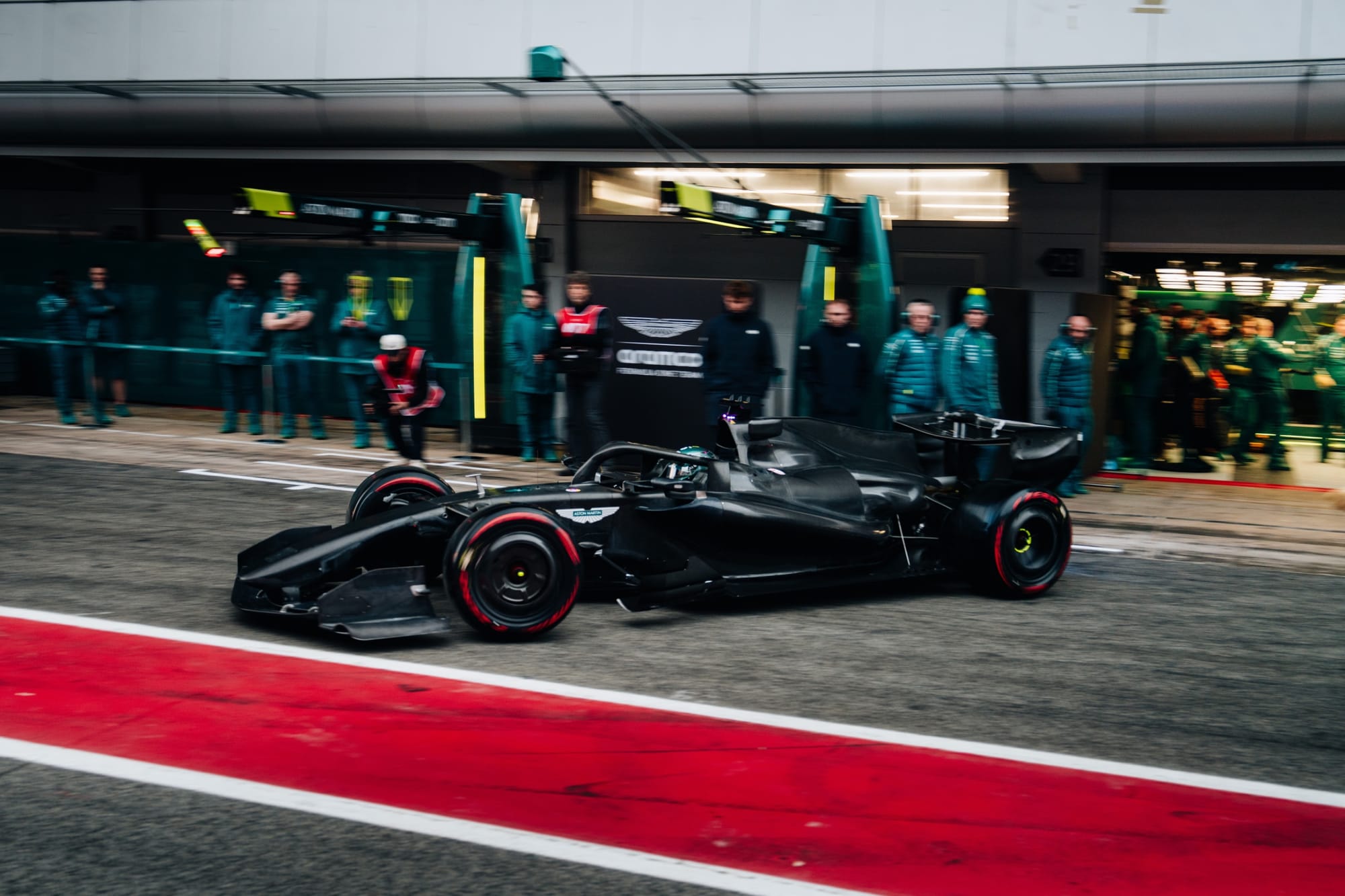
The “Extreme” Philosophy: Pushing the Limits
“Extreme.” That is the word being whispered by every technical analyst and rival engineer staring at the black carbon-fiber machine. The delay that cost Aston Martin the majority of the available running time in the shakedown test is now being viewed through a different lens: it is indicative of Newey’s characteristic, almost obsessive desire to push every single component to the absolute limit.
The AMR26 is a car that screams ambition. Designed and developed in the team’s new state-of-the-art factory opposite the Silverstone Circuit, it represents a massive leap forward. However, the lateness is concerning. Sources suggest the car is currently overweight—a common enemy in new regulatory eras—and reliability was immediately called into question when the car ground to a halt after only four laps on Thursday.
Yet, despite the teething troubles, the car made a colossal impression. With team owner Lawrence Stroll and star driver Fernando Alonso watching like hawks, Lance Stroll piloted a machine that looks unlike anything else on the grid.
Aerodynamic Sorcery: Viking Horns and “Zero Sidepods”
To understand why the AMR26 is so radical, you have to look at the details. Newey’s aggressive design approach starts at the very front. The nose is surprisingly wide, with bulbous sides designed to entice airflow to spill off and travel into the void beneath. This sets up a complex aerodynamic chain reaction, joining airflow passing between curved front wing pillars to create a high-pressure area behind the front wheels.
But the real shocker is the sidepods. Newey has effectively brought back his own version of the “zero sidepod” concept—albeit executed completely differently from the infamous Mercedes disaster of 2022. The AMR26 features high, shallow sidepods with an extreme undercut. Packaging the radiators in such a tight space must have been a logistical nightmare for the engineering team, but the aerodynamic payoff could be huge. These sidepods act as an extreme “double floor,” reducing drag and managing airflow displacement—a critical advantage in 2026 where cars are expected to be starved of electrical energy on long straights.
And then, there are the “Viking horns.”
Mounted behind the driver’s head on the airbox, these aerodynamic fins are a throwback to the McLaren MP4-20 of 2005—another Newey classic. Their job is to tidy up the chaotic airflow coming off the driver’s helmet and realign it towards the rear wing. It’s a touch of retro genius applied to futuristic problems.
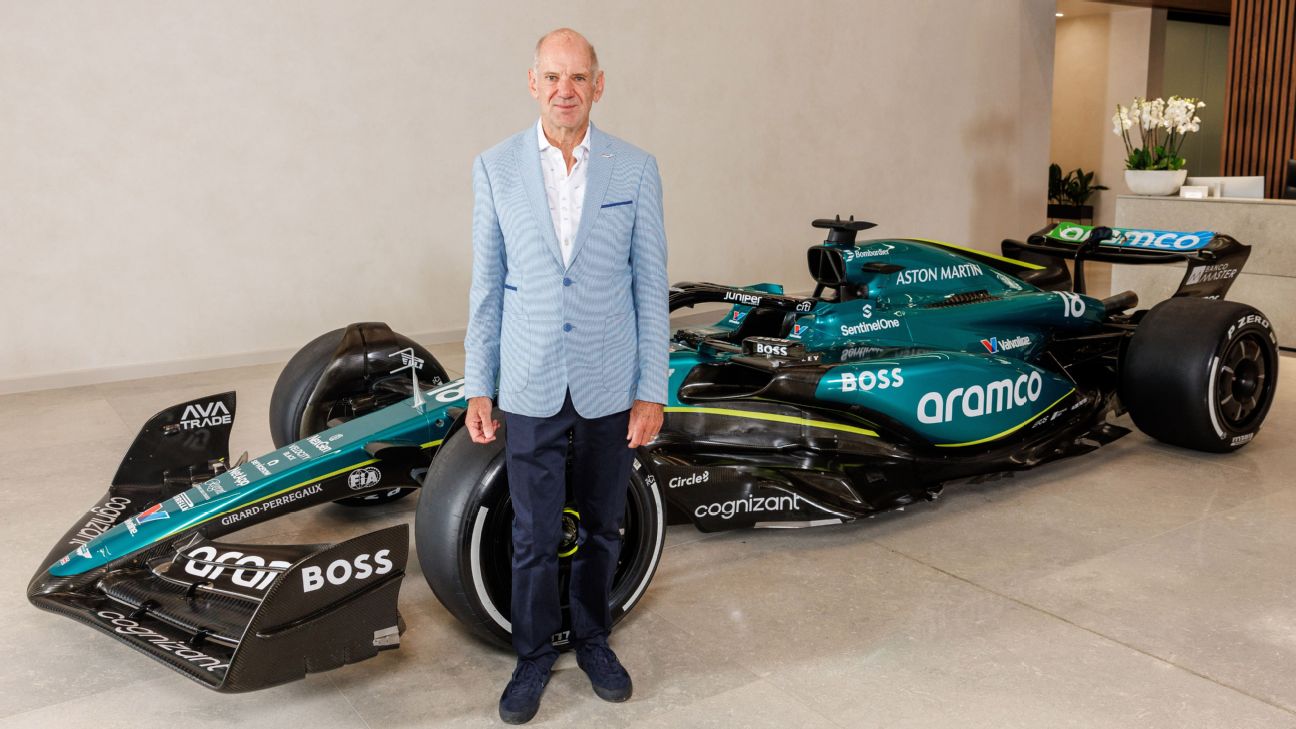
Suspension Secrets: The Anti-Dive Gambit
If the bodywork is art, the suspension is pure mathematics. The front suspension geometry is arguably the most extreme on the grid. The inboard mounting points are pushed right to the top of the chassis, while the rear leg of the top wishbone is mounted much lower and further back.
This specific geometry indicates a massive level of “anti-dive.” In simple terms, this means the car’s ride height won’t dip significantly under heavy braking. For a ground-effect car, maintaining a consistent aerodynamic platform is the holy grail of performance. Furthermore, this layout increases “caster” with speed, improving straight-line stability, while reducing steering load in slow corners to give drivers better feedback. It is a complex mechanical solution to an aerodynamic problem, a hallmark of Newey’s holistic design philosophy.
The Honda Headache: A Crisis in the Making?
However, a Formula 1 car is more than just a chassis, and this is where the dark clouds begin to gather over Silverstone. The AMR26 is the first car built in partnership with Honda under the new engine regulations, and all is not well in the engine bay.
While the chassis is spectacular, the power unit is a giant question mark. Honda’s journey to 2026 has been rocky. After initially withdrawing from F1, they dissolved much of their F1 division, redeploying staff to electrification projects. When they decided to return and partner with Aston Martin in May 2023, they were already on the back foot.
Honda Racing Corporation President Koji Watanabe has admitted they are working on a “very short timeline.” The loss of momentum, combined with the strict power unit cost cap ($95 million rising to $130 million), has made catching up nearly impossible. While competitors like Mercedes and Red Bull Powertrains have been refining their designs for years, Honda has had to restructure and recruit rapidly.

Battery Struggles and Missed Tricks
The technical rumors are even more worrying. Late last year, indications surfaced that Honda was struggling with the new battery technology—a component that is absolutely crucial for the 2026 rules, which place a massive emphasis on electrical power duty cycles. While Honda claims to be confident now, the doubt remains.
Furthermore, technical analysis suggests Honda may have missed out on key combustion tricks. With the MGH (Motor Generator Unit-Heat) now banned, the efficiency of the internal combustion engine is paramount. Honda’s technical lead, Tetsushi Kakuda, has admitted that changes in compression ratio limits have rendered some of their previous high-speed combustion advantages unusable. Meanwhile, rivals like Mercedes and Red Bull are rumored to have found ways to run compression ratios higher than the intended 16:1, giving them a significant power advantage.
If Honda is indeed down on power or efficiency, even Adrian Newey’s genius aerodynamics might not be enough to save them.
High Risks, Sky-High Expectations
As Fernando Alonso returned the car to the track on the final morning to finally begin racking up laps, the mood was a mix of apprehension and adrenaline. The AMR26 is a swing for the fences. It forces the team to manufacture its own gearbox for the first time since 2008, it integrates a new engine partner that is playing catch-up, and it utilizes a chassis concept that defies convention.
It is too early to say if the car is a championship contender. But one thing is certain: if the Aston Martin project fails, it won’t be because they played it safe. This is a car built in the finest tradition of Adrian Newey—uncompromising, innovative, and dangerously on the edge.
The 2026 season hasn’t even started, and Aston Martin has already won the battle for our attention. Now, they just need to win the race against time—and their own engine.
News

Inside Shane Richie’s love life: Drug – fuelled orgy with six blondes; real reason he split from Coleen Nolan; six-year ‘affair with fan’
Inside Shane Richie’s love life: Orgy with six blondes; real reason he split from Coleen Nolan; six-year ‘affair with fan’ He’s popular with the ladies… Shane Richie…

SH0CKING REVELATI0N:A sh0cking behind-the-scenes secret revealed about Lizzie Rizzini, the woman replacing Carol Kirkwood on the 6pm weather bulletin
BBC viewers still reeling from the departure of Carol Kirkwood got another surprise last night when presenter Lizzie Rizzini appeared to flash her black lace stockings on…

HEARTBREAKING: Peter Andre’s Tearful Message to Son Junior After SHOCKING Revelation About How He Truly Feels Toward Mum Katie Price — Katie Price’s reaction scares fans.
Peter Andre’s emotional message to son Junior after it’s revealed how he really feels about mum Katie Pri… PETER Andre has shared an emotional message to his…

Ben Shephard opens up about the devastating health battle his wife is facing: “She wakes up crying every single morning…”
Inside This Morning Ben Shephard’s Life Including Rarely Seen Wife and Health Battle Ben Shephard is a name synonymous with British television, renowned for his engaging presentation…

🚨 LIVE TV HEARTBREAK: Good Morning Britain Host Announces ‘Devastating’ Dɘath of Guest Minutes Into Show
Viewers of Good Morning Britain were met with heartbreaking news just minutes into Friday’s (January 30) episode, as co-hosts Kate Garraway and Ranvir Singh reported the tragic…

Emmerdale legend Cain Dingle will never be the same again after a shock cancer diagnosis turns his world upside down
FROure Desk. Full Terms and conditions are available on the website http://www.itv.com/presscentre/itvpictures/terms Emmerdale wouldn’t be Emmerdale without the glowering, grunting embodiment of manliness that is Cain Dingle (Jeff Hordley) But…
End of content
No more pages to load






